


New Football Practice Policies
March 25, 2014
Drive for Detroit: Playoff Week 1 Preview
October 31, 2019
By Geoff Kimmerly
Second Half editor
Whether your team's preferred final destination is Ford Field in Detroit or the Superior Dome in Marquette, the first steps will be taken this weekend during 144 MHSAA Playoff games across both peninsulas.
 Someone's season is on the line in every game from here on out, and below we take a glance at a matchup in each division that is especially notable during these first rounds of the 11 and 8-player tournaments.
Don't let a little cool weather keep you out of the stands and supporting your favorite team at this most exciting time of year. But if you choose to stay in, take in one or more of the 30 games being broadcast on FOX Sports Detroit Prep Zone or MHSAA.tv. Click for listings and check back with MHSAA.com all weekend for scores and updated brackets.
"Drive for Detroit" is sponsored by MI Student Aid.
11-Player
Division 1
Saline (8-1) at Belleville (9-0), Saturday
This is the most power-packed opener in any division, with both teams making Division 1 Semifinals a year ago. Both have faced four playoff teams this fall, and the only loss between them was Saline’s Week 1 defeat against reigning champion Clinton Township Chippewa Valley. The Hornets are familiar with this time of year with six District titles over the last seven seasons and a Division 1 runner-up finish in 2014. But Belleville has seemed on the verge of a Ford Field run with now three straight perfect regular seasons and, like Saline, all but one of its wins this fall by double digits.
Keep an eye on these FRIDAY Brighton (7-2) at Holt (7-2), Davison (7-2) at Romeo (7-2), Rochester Adams (7-2) at Utica Eisenhower (7-2), Detroit Cass Tech (5-4) at Grosse Pointe South (7-2).
Division 2
Muskegon Mona Shores (7-2) at Midland (8-1)
This is a rematch of a 2018 Division 2 Semifinal won by the Sailors 49-28. Both of these teams were stung late this fall but should be dangerous again with fresh starts that come with the playoffs. Mona Shores, which went on last season to finish D2 runner-up, has losses to two league champions including big to rival Muskegon High two weeks ago in a matchup that determined the Ottawa-Kent Conference Black title. Midland was defeated by a similar score last week by rival Midland Dow as the two shared the Saginaw Valley League Red title. The winner of this District opener could see Dow next week – the Chargers take on Big North Conference champion Traverse City Central on the other side of the District bracket.
Keep an eye on these FRIDAY South Lyon (8-1) at Fenton (8-1), Farmington (7-1) at Oak Park (8-1), Port Huron (6-3) at Port Huron Northern (8-1). SATURDAY Detroit U-D Jesuit (6-3) at North Farmington (9-0).
Division 3
DeWitt (7-2) at East Lansing (7-2)
This is one of the most highly-anticipated rematches of the first week, with these two and Holt having shared the Capital Area Activities Conference Blue title, and with the Panthers and Trojans finishing with the same playoff point average – East Lansing got the home game because of its 21-2 win over DeWitt in Week 5. Minus that performance, the Panthers averaged 39.6 points per game this fall – so expecting another all-out shutdown by the Trojans’ defense might be an unfair ask. But DeWitt’s defense also will have to deliver, as East Lansing’s offense (32.7 ppg) is scoring at its highest pace in decades.
Keep an eye on these FRIDAY Lowell (5-4) at East Grand Rapids (6-3), Zeeland East (5-4) at Zeeland West (8-1), St. Joseph (6-3) at Edwardsburg (9-0), Bloomfield Hills Brother Rice (6-3) at Flint Kearsley (7-2).
Division 4
Sparta (8-1) at Muskegon Orchard View (9-0)
Both of these teams have enjoyed banner seasons. Orchard View posted its first winning record since 2014, earned its first playoff berth since 2008, won the Lakes 8 Conference title and finished the regular season perfect for the first time since 2005. Sparta made the playoffs for the first time since 2013, tying its most wins since 2011 with its best regular-season record since 2006. The Spartans finished second in the O-K Blue to Grand Rapids Catholic Central, which faces Allendale on the other side of this District bracket. Orchard View did beat five playoff teams on the way to the playoffs. But comparing their lone shared opponent, Sparta downed playoff qualifier Spring Lake 38-3 in Week 3 after Orchard View defeated the Lakers 22-17 on opening night.
Keep an eye on these FRIDAY Fowlerville (6-3) at Goodrich (7-2), North Branch (7-2) at Pontiac Notre Dame Prep (8-1), Ortonville Brandon (7-2) at St. Clair (8-1).
Division 5
Almont (9-0) at Richmond (8-1)
This is a rare occurrence; Almont defeated Richmond in Week 7 28-10 and went on to win the Blue Water Area Conference title outright while closing out its second-straight perfect regular season. However, the Blue Devils’ nonleague opponents both made the playoffs, and the bonus for playing those teams was enough to push Richmond past Almont into a home game this week. The Raiders, however, also won the first Richmond game this fall on the road, and their annually-awesome defense continues to play anywhere. Almont has given up 69 points this fall – 39 over five home games and 30 over four away. But take away the first Almont matchup, and Richmond is averaging a robust 33.5 points per game.
Keep an eye on these FRIDAY Central Montcalm (7-2) at Portland (7-2), Olivet (8-1) at Lansing Catholic (8-1), Reed City (6-3) at Kingsley (9-0), Kalamazoo United (5-4) at Berrien Springs (8-0).
Division 6
Menominee (6-3) at Ishpeming Westwood (7-2), Saturday
Menominee is the smallest of Great Northern Conference schools and will play in Division 6 this playoffs after years in Division 4 and then Division 5. That has the Maroons matching up with many of the best from the Western Peninsula Athletic Conference, including Westwood for the first time. The Patriots finished third in the Iron, the strongest of the two West PAC divisions this fall – and they also beat Copper champion Ishpeming 38-0 in Week 4. But Menominee presents an all-new challenge, and the Maroons are on a roll after putting up 48 points last week in handing Division 5 contender Hopkins its only loss this fall.
Keep an eye on these FRIDAY Lake City (6-3) at Maple City Glen Lake (8-1), Ravenna (7-2) at Muskegon Catholic Central (6-2), Jonesville (6-3) at Hillsdale (9-0), Constantine (7-2) at Niles Brandywine (9-0).
Division 7
Detroit Loyola (4-4) at Detroit Central (8-1)
While Cass Tech and Martin Luther King always get the bulk of attention out of the Detroit Public School League, Central has earned recognition too winning the PSL Division 3 title and 3/4 championship game. There are seven unbeaten teams in the Division 7 bracket, and they’re getting the most attention. But the Trail Blazers have won eight straight games (including a forfeit) since falling to Dearborn Heights Crestwood in Week 1. Loyola is a deceptive 4-4, considering the high level of competition it faces. A Central win in this one would further announce the Blazers will be tough to beat.
Keep an eye on these FRIDAY Harbor Springs (6-3) at Charlevoix (6-3), Byron (6-3) at Beaverton (9-0), Centreville (6-3) at Lawton (9-0). SATURDAY Houghton Lake (6-3) at Traverse City St. Francis (6-3).
Division 8
Addison (7-2) at Sand Creek (7-2)
Both of these teams have faced and will be ready for top competition. Cascades Conference champion Addison is hitting the road to start the playoffs, seeking its first postseason win since 2007 and after closing the regular season against reigning Division 8 champion Reading. Sand Creek tied for second in the Tri-County Conference, but behind undefeated Division 7 contender Clinton and with the same TCC record as annual Division 8 challenger Ottawa Lake Whiteford. The Aggies also finished just ahead of Britton Deerfield thanks to a 50-22 Week 5 win – four weeks after B-D defeated Addison 28-16 to open the season.
Keep an eye on these FRIDAY Flint Beecher (5-3) at Clarkston Everest Collegiate (8-0), Mendon (7-2) at Reading (8-1), White Pigeon (7-2) at Cassopolis (9-0). SATURDAY Ottawa Lake Whiteford (5-4) at Royal Oak Shrine Catholic (7-2).
8-Player
Division 1
Gaylord St. Mary (4-5) at Pellston (8-1)
Pellston is one of three teams statewide making its playoff debut this weekend, boasting its first winning regular-season record since 1995. The Hornets’ only loss was the eventual Midwest Central Michigan Conference East champion Hillman, and they are riding an offense scoring just more than 46 points per game. St. Mary’s story has been well-publicized; the Snowbirds had to forfeit four wins earlier this fall but won their final two games to still make the playoffs. On the field they’ve averaged nearly 58 points per game, making this a likely offensive showdown regardless of the possible wintery weather.
Keep an eye on these FRIDAY Mesick (7-2) at Kingston (7-2), Bellevue (6-3) at Martin (9-0), New Haven Merritt (8-1) at Morrice (8-1).
Division 2
Crystal Falls Forest Park (7-2) at Powers North Central (9-0)
One of the best Upper Peninsula rivalries of the last half-decade will play out again after the teams previously met in Week 6 – a 34-8 Jets win that helped lock up the Great Lakes Conference West title. These two have met in the playoffs as well the last three years – and combined for three straight MHSAA Finals championship from 2015-17 – and last year the Trojans avenged a 24-point regular-season loss with a 12-point win over the Jets in Pre-Regional play. The first meeting this fall, North Central contained an offense that otherwise has averaged 51.8 points per game. Not counting a forfeit win last week, the Jets had three shutouts and gave up only six points per game during this regular season.
Keep an eye on these FRIDAY Engadine (8-1) at Pickford (8-1), Brethren (5-4) at Climax-Scotts (7-2), Kinde North Huron (6-3) at Peck (5-4).
Second Half’s weekly “Drive for Detroit” previews are powered by MI Student Aid, a part of the Office of Postsecondary Financial Planning located within the Michigan Department of Treasury. MI Student Aid encourages students to pursue postsecondary education by providing access to student financial resources and information. MI Student Aid administers the state’s 529 college savings programs (MET/MESP), as well as scholarship and grant programs that help make college Accessible, Affordable and Attainable for you. Connect with MI Student Aid at www.michigan.gov/mistudentaid and find more information on Facebook and Twitter @mistudentaid.
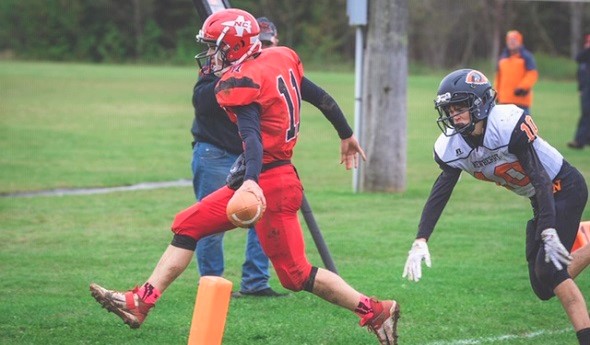
PHOTO: North Central clears a pylon for a score during a 54-0 win over Newberry on Oct. 11. (Photo by Jeff Rochefort.)