

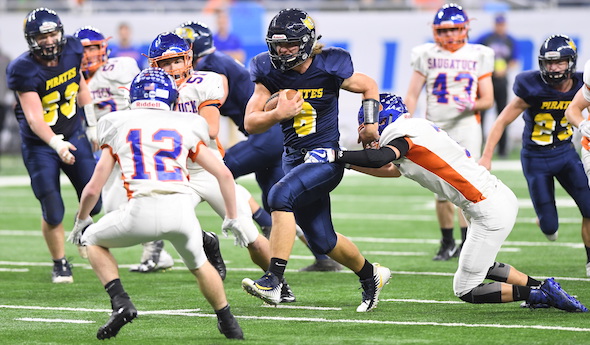
'Next Up' Help P-W to Next Championship
November 25, 2017
By Geoff Kimmerly
Second Half editor
DETROIT – The Pewamo-Westphalia football program finished a second straight season hoisting a championship trophy at Ford Field on Saturday, thanks to the “next man up” … and the next man … and the next man after that.
 It was easy to credit the Pirates’ first MHSAA football title ever, won last year, on the state’s all-time second leading rusher Jared Smith. But he graduated in the spring.
They got back to Ford Field in large part on the running and passing skills of senior quarterback Jimmy Lehman. And then Lehman potentially broke his left hand in the second quarter and didn’t play the final two.
In both instances, and a few more this fall, someone stepped right in. This time, the Pirates weathered the loss of Lehman and stood strong as Saugatuck’s offense caught stride to close with a 21-0 win that proved once more P-W’s teams of the last two seasons were even better than the sum of some truly elite parts.
“We had a lot of people that just really felt like they had to step up,” Lehman said. “We lost our first game (28-21 to Monroe St. Mary Catholic Central) and that was some of the adversity we had to go through all year – how were we going to respond from that? We just made sure we took every day and made it the best we could, and just improve from there.”
That loss to the Falcons was P-W’s only defeat of the last two seasons, and they improved to 40-3 over the last three years after also finishing Division 7 runner-up in 2015.
The “next man up” success sort of began in last season’s championship game, when Smith served as a tremendous decoy running for 48 of his 8,182 career yards while Lehman and others starred in a 28-14 win over Detroit Loyola.
Lehman took the reins fulltime this fall and threw for 1,627 yards and 20 touchdowns, running for 728 yards and 16 scores – and while starting as a forceful 6-foot-4, 215-pound defensive end as well.
His late first quarter touchdown run from 12 yards out said it all as Lehman broke two tackles and dragged three more defenders into the end zone. He stayed in the game at first after injuring the hand on P-W’s final possession of the first half, throwing a 12-yard touchdown pass to senior Peyton Heckman to finish his day.
The Pirates threw only one pass during a scoreless second half. Junior Noah Spitzley stepped in and helped that effort on the defensive side, tying for third on the team with six tackles.
“It says a lot about the other guys on the team, the other guys in the program that are just continually working and waiting for an opportunity,” P-W coach Jeremy Miller said. “Cameron Wirth started for us all year at fullback and linebacker, and we lost him on the opening kickoff of the Semifinal. Justin Pohl, who hadn’t played a whole lot, stepped in and did a great job at fullback for us today. So we always have the ‘next man up’ mentality, and these guys are constantly ready. And I think it says a lot about them.”
Saugatuck’s run this fall said plenty as well. The Indians this spring graduated Blake Dunn, the eighth-leading rusher in MHSAA career history. But they made it to Ford Field for the first time since finishing Division 8 runner-up in 2010, ironically after seeing perfect seasons end against P-W in District Finals the last two years in losses of 10 and six points.
“It’s been our dream forever to get here, and the first thing yesterday when we first walked in here, it was amazing – it just opened up,” Saugatuck senior linebacker Reece Schreckengust said. “It’s a great stadium, a great atmosphere. Losing hurts, but to get all the way here, it was a great season. I’m proud of every one of my teammates, my coaches, and myself and everyone else in our community for getting here. … To go out at Ford Field is probably the second best, besides winning it.”
 After struggling during the first half, Saugatuck (10-4) took its shots at making it close during the second.
The Indians drove to P-W’s 18-yard line on their second possession of the third quarter, but sophomore linebacker Jacob Pung ended that rally with an interception at the 11.
Saugatuck then drove to the Pirates’ 3-yard line early in the fourth quarter, before having first and second-down runs stopped for a one-yard loss and no gain, respectively, seeing a third-down pass fall incomplete and getting sacked on fourth down for a 16-yard loss by Spitzley and senior Damon Schneider.
Total, P-W (13-1) held Saugatuck to 147 yards of offense. The shutout was the Pirates’ second of the playoffs and sixth this season, not including a 2-0 forfeit win in Week 7.
“They’re just a big, physical, fast team,” Saugatuck senior quarterback Jackson Shriver said. “That’s what makes a great defense. They follow their system and play hard. They have a great team, and it was hard to play against them.”
Saugatuck’s defense deserved praise as well. The Pirates’ 21 points were their fewest since that opening-night loss.
“We had our moments when we could’ve come back, and unfortunately it didn’t happen,” Indians coach Bill Dunn said. “To hold a team like that to 21 is a good credit. A couple of those came off miscues either offensively, or a turnover. Our defense was exceptional considering the opponent. They were just a little bit better today.”
Senior Bryce Thelen added 92 yards rushing on 14 carries and scored P-W’s first touchdown midway through the first quarter. Schneider paced the defense with eight tackles including two sacks.
Schreckengust, who will graduate as Saugatuck’s career tackles record holder, had nine more, as did senior Connor Carper.
“They always play hard, and so respectful,” Thelen said of what’s become an annual meeting between the programs. “It’s always a hard-nosed game, always close, always super physical. They’re just fun games to play in that come down to a couple plays throughout the game that tilt the game one way or the other.”
The MHSAA Playoffs are sponsored by the Michigan Army National Guard.
PHOTOS: (Top) P-W quarterback Jimmy Lehman charges upfield during the Division 7 championship game. (Middle) Bryce Thelen eludes the grasp of a Saugatuck defender.
1st & Goal: 2025 Week 3 Preview
By
Geoff Kimmerly
MHSAA.com senior editor
September 11, 2025
The Michigan High School Football Coaches Association and Michigan Sports Writers both released their first state rankings of the season this week, providing their opinions on the top teams in every division.
 There are always a few programs that dominate from start to finish. But this season already seems like it could provide an audible.
Consider, of 602 teams playing 11 or 8-player football this fall, only 179 (just under 30 percent) after just two games. And that total is guaranteed to decrease by 28 teams over the next two days as we have that many matchups of unbeatens – several of which are noted below.
Some related food for thought: Although we finished the 2024 regular season with 27 undefeated teams statewide, only Millington and Deckerville hoisted MHSAA Finals championship trophies without taking a loss. We had only two undefeated champions in 2023 as well, but five in 2022.
You'll again have the opportunity to tune into several games this weekend on the NFHS Network. Scores for every game across the state will posted on the MHSAA Scores page as they conclude.
Bay & Thumb
Ithaca (2-0) at Saginaw Michigan Lutheran Seminary (2-0)
This matchup determined league championships in both 2022 and 2023, and Ithaca has won 20 straight league games including all five in the Tri-Valley Conference Blue a year ago. MLS gave the Yellowjackets their closest league game (35-14) last fall and is off to a solid start outscoring its first two opponents by a combined 82-8. Ithaca’s is coming off one of the state’s more notable victories of Week 2, 36-7 over Lawton.
Keep an eye on these FRIDAY Bay City John Glenn (2-0) at Essexville Garber (2-0) WATCH, Durand (2-0) at Montrose (2-0) WATCH, Saginaw Nouvel Catholic Central (2-0) at Saginaw Valley Lutheran (2-0) WATCH, Harbor Beach (2-0) at Ubly (1-1) WATCH.
Greater Detroit
Rochester Adams (2-0) at West Bloomfield (2-0) WATCH
Arguably the most competitive league in the state – the Oakland Activities Association Red – begins play with what should be a challenging matchup for both of these opponents. Adams claimed year’s meeting 21-17 on the way to eventually reaching the Division 1 Semifinals, and has a couple of big wins so far this fall over Romeo and Rochester. West Bloomfield has won both of its first two games by 37-0 scores, shutting out Dearborn Fordson and Southfield Arts & Technology.
Keep an eye on these FRIDAY Birmingham Groves (1-1) at Harper Woods (2-0), Clarkston (1-1) at Oxford (2-0) WATCH, Gibraltar Carlson (2-0) at Pontiac Notre Dame Prep (1-1) WATCH, Orchard Lake St. Mary’s (2-0) at Warren De La Salle Collegiate (1-1).
Mid-Michigan
Williamston (2-0) at Mason (1-1)
Williamston can finish reversing last season’s 0-3 start with a win over Mason, which won last year’s meeting 34-20. This matchup again kicks off the Capital Area Activities Conference Red schedule, and Mason has won 18 straight league games and the last three Red titles. The Bulldogs fell just short in their comeback attempt last week against DeWitt, but have won six in a row over the Hornets – who have been impressive in revenge wins over Lansing Catholic and Hastings.
Keep an eye on these FRIDAY St. Johns (2-0) at Fowlerville (2-0), Midland Dow (2-0) at Mount Pleasant (2-0), Portland (2-0) at Olivet (2-0) WATCH, Northville (2-0) at Howell (2-0) WATCH.
Northern Lower Peninsula
Davison (2-0) at Traverse City Central (2-0)
Davison has dominated these meetings the last three seasons, with three victories all by at least 35 points. But Central also is 2-0 heading into this game for the first time during that run and has scored a combined 96 points in big wins over returning playoff qualifiers Novi and Parma Western. Davison edged Warren De La Salle Collegiate last week 23-21 to avenge a 2024 defeat after opening with a 17-point win over Roseville.
Keep an eye on these FRIDAY Boyne City (2-0) at Cheboygan (1-1) WATCH, Kalkaska (2-0) at East Jordan (2-0) WATCH, Escanaba (2-0) at Petoskey (1-1) WATCH. SATURDAY Marquette (1-1) at Gaylord (2-0) WATCH.
Southeast & Border
Grand Rapids Catholic Central (2-0) at Jackson Lumen Christi (1-1) WATCH
We featured Lumen Christi in this space last week as well, but it’s hard not to again when the Titans have arguably the toughest nonleague schedule in the state. They’re coming off wins over two 2024 champions – Lombard Montini from Illinois and Pontiac Notre Dame Prep from Division 5 – and now get an opponent that fell just a win shy of also playing for the Division 5 title last season. Grand Rapids Catholic Central is facing its first in-state opponent after earning wins over teams from Illinois and Ontario.
Keep an eye on these FRIDAY Adrian (2-0) at Chelsea (2-0) WATCH, Blissfield (1-1) at Clinton (1-1) WATCH, Tecumseh (2-0) at Ypsilanti Lincoln (2-0) WATCH, Ann Arbor Huron (1-1) at Dexter (2-0).
Southwest Corridor
Schoolcraft (1-1) at Constantine (2-0)
This is a matchup we circle every season, and it’s easy to explain why. Constantine’s 31-29 win over Schoolcraft a year ago, while its third straight, was the second in a row decided by one score or less, as have been five of their last 12 matchups. Both teams went on to great success last season, Constantine winning a District title and Schoolcraft claiming its Regional. And while the Eagles do have an early loss, it came last week to Division 4 power Hudsonville Unity Christian.
Keep an eye on these FRIDAY Battle Creek Harper Creek (1-1) at Coldwater (2-0) WATCH, Kalamazoo United (1-1) at Lawton (1-1) WATCH, Three Rivers (2-0) at Otsego (1-1) WATCH, Niles (2-0) at Paw Paw (0-2) WATCH.
Upper Peninsula
Calumet (2-0) at Negaunee (2-0) WATCH
The Western Peninsula Athletic Conference Copper division is among the deepest leagues in northern Michigan, sending four teams to the playoffs last year with two more finishing 4-5. Calumet and Negaunee have been two of the frequent contenders, Negaunee last sharing the league title in 2023 and Calumet most recently in 2021. The Miners won last year’s matchup 29-0 and the last five in the series.
Keep an eye on these FRIDAY Hancock (0-2) at Houghton (0-2) WATCH, Iron Mountain (1-1) at Manistique (1-1) WATCH, Gladstone (0-2) at Kingsford (1-1) WATCH, Ishpeming Westwood (0-2) at Menominee (2-0) WATCH.
West Michigan
Caledonia (2-0) at Hudsonville (2-0) WATCH
These two are among four Ottawa-Kent Conference Red teams that have started 2-0, with three more at 1-1 as league play begins. Grandville and Rockford have especially notable wins among that 1-1 group, and this league race truly could be wide open – which will make every game including this one especially important. Hudsonville last season broke a three-year losing streak against Caledonia, and despite substantial graduations has opened with impressive victories over Byron Center and East Lansing. The Fighting Scots’ 56 points last week against Muskegon Reeths-Puffer were their most since 2023.
Keep an eye on these FRIDAY Hudsonville Unity Christian (2-0) at Ada Forest Hills Eastern (2-0) WATCH, Grand Rapids West Catholic (1-1) at Grand Rapids South Christian (1-1), East Kentwood (2-0) at Jenison (2-0), Grand Rapids Northview (2-0) at Sparta (2-0).
8-Player
Pickford (2-0) at Newberry (2-0)
Pickford has won the last two Great Lakes Eight Conference East titles, and last year’s run to finishing Division 1 runner-up included a 44-14 win over Newberry. But Newberry already has one victory this season over a team that reached Superior Dome a year ago – 22-20 over reigning Division 2 champion Crystal Falls Forest Park in Week 1 – and last week’s 34-14 victory over Ontonagon also avenged a 2024 loss.
Keep an eye on these FRIDAY Deckerville (2-0) at Bad Axe (2-0) WATCH, Adrian Lenawee Christian (2-0) at Climax-Scotts (1-1), Britton Deerfield (1-1) at Colon (2-0), Concord (2-0) at Mendon (2-0) WATCH.
MHSAA.com's weekly “1st & Goal” previews and reviews are powered by MI Student Aid, a division within the Department of Lifelong Education, Advancement, and Potential (MiLEAP). MI Student Aid encourages students to pursue postsecondary education by providing access to student financial resources and information. MI Student Aid administers the state’s scholarship and grant programs that help make college Accessible, Affordable and Attainable for you. Click to connect with MI Student Aid and find more information on Facebook and Twitter @mistudentaid.
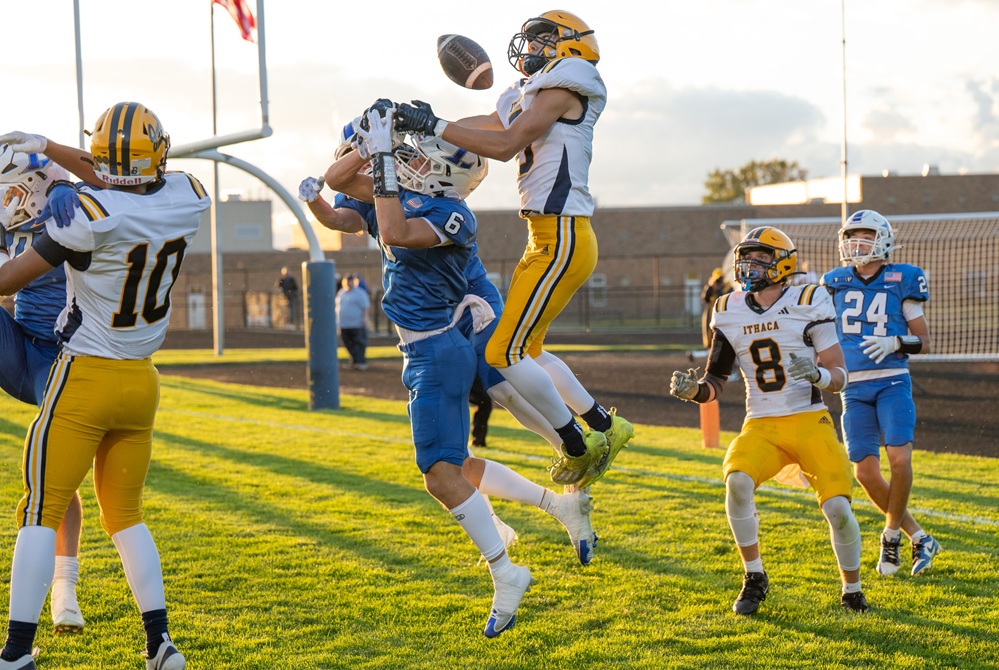
PHOTO Ithaca and Lawton players attempt to reel in a pass during the Yellowjackets' Week 2 win. (Photo by High School Sports Scene.)