

Next Players Up Keep Whiteford Surging
October 5, 2017
By Doug Donnelly
Special for Second Half
OTTAWA LAKE – For many smaller Class C football teams, losing four starters to injuries during the first six weeks of the season would be devastating.
 In Ottawa Lake, however, probably only those close to the Whiteford football program have noticed.
Despite the injury bug, the Bobcats are rolling like never before in school history. They are 6-0, averaging 53 points per game and sit alone atop the Tri-County Conference. The key is an unusual amount of depth – and a 28-player roster with 14 seniors and 14 juniors.
“Some of it has to do with a couple of innate classes, with more than the usual amount of kids,” sixth-year Bobcats coach Jason Mensing said. “There’s always an ebb and flow from one grade to the next. But, what we are experiencing is different. In Hunter Lake, not only did we lose a running back, but he was also a cornerback, kick returner and punt returner. And, Alex (Kohler) is a second-year starting guard, but is also our punter and he kicked off.”
Typically, only two or three players start on both sides of the ball for the Bobcats – a rare occurrence for a team has played in the Division 8 playoffs each of the past four seasons (they were in Division 7 in 2012).
“We try and coach every kid the same,” Mensing said. “That’s a very important piece. We really try and develop every player into a starting player. The ultimate goal is to make sure every kid gets on the field.”
Part of the reason the Bobcats have developed such depth is their deep playoff runs the past couple of seasons. The 2015 team advanced to the Division 8 Semifinals, and last year the Bobcats played in the championship game at Ford Field against Muskegon Catholic Central. Since Mensing arrived at Whiteford, he has invited every junior varsity player to practice with the varsity for all of the playoff weeks.
 “Those playoff runs have allowed our JV players a ton of extra practice over the past couple of seasons,” Mensing said. “If you think about that, it’s another season and then some. That makes a really big difference, especially the first two weeks or so of the next season. The players come in and already know what to expect, and they know the routine and the pace. They are playing at a higher level at an earlier time.”
Mensing and his staff of 10 varsity coaches work with grades 9-12 in practice on a daily basis.
“That’s a critical piece of coaching – every kid is receiving the same instruction,” he said.
A Tecumseh graduate and former Adrian College football player, Mensing is 53-13 since becoming head coach of the Bobcats, giving him the highest winning percentage of any coach in school history. The program has never been stronger – six straight playoff appearances, a 9-0 regular season last year and two consecutive 9-0 seasons by the JV team. He said he developed his coaching style from playing small college football.
“My background is small college football,” he said. “It always seemed to me to be the best way to operate that I know.”
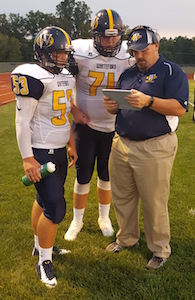
Whiteford’s offense has rushed for more than 2,200 yards heading into Friday’s game against Sand Creek – an average of about 10 yards a carry. Many of those yards are gained behind 6-foot-5, 280-pound all-state tackle Lucas Tesznar. Jacob Lewis, Jordan Book and Jaret Atherton all are starting for a second year on the offensive line. There are five solid backups in the mix, too, who have received plenty of playing time even though Whiteford has had a running clock at some point in each of its six games.
“At the line of scrimmage we have guys who can come in and play that would start in just about any other year,” Mensing said.
Whiteford lost two 1,000-yard running backs to graduation after last season, but have found several capable replacements in six juniors: Logan Murphy (823 yards on just 61 carries), Zach Bertz (266 yards and 10 touchdowns), Nathan Bauman (258 yards), Ty Eitniear (188 yards) and Lake (148 yards in three games). Bradyn Clark-Gilmore started the season at running back and had a 100-yard game but shifted to tight end and is now the leading receiver on the team (280 yards on 11 receptions).
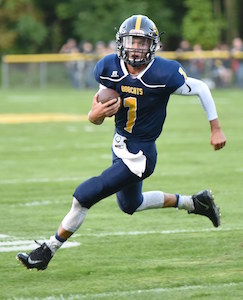
 Thomas Eitniear is the Bobcats’ quarterback. As the starting signal-caller, Eitniear is 29-4, already setting a record for most starts and wins by a Whiteford QB. He holds the school record for career passing touchdowns and is nearing the school record for career passing yards. This season he has 567 yards passing and 409 yards rushing. He’s committed to play baseball at the University of Toledo next year.
“We’ve got a Division I athlete playing quarterback,” Mensing said. “He is a difference-maker. I can’t tell you how many drives or even games have changed over the last three years because of him making a big play.”
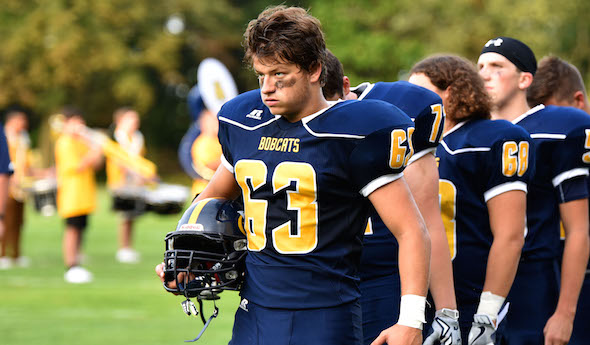
Inside linebacker Eli Shelton, safety Abba Risley, cornerback Ty Eitniear (three interceptions) and end Ethan Inman have been standouts on defense. Jack Garrison stepped up when Lake was injured and had several big games. One of the few two-way starters, Matthew Taylor, has been solid all season.
Mensing said players like Thomas Eitniear and Murphy won’t put up gaudy numbers because of the system they are in, but that doesn’t make them any less effective.
“It’s not about any one individual effort,” he said. “It’s about a collective group. That’s what we’ve always been about.”
Whiteford is seeking to win back-to-back league championships for the first time in more than 50 years, the last time when it was a member of the River Raisin Conference. They have games remaining against Sand Creek (3-3), Clinton (4-2) and Britton Deerfield (1-5) on the regular-season schedule. Then the playoffs begin. Lake and Kohler are expected back before the end of the season to help solidify the depth.
“We still have room to show improvement from week to week,” Mensing said. “As long as we continue to improve, and if we can continue to get better over the next three weeks, it will determine where we will end up on the season.”
 Doug Donnelly has served as a sports and news reporter and city editor over 25 years, writing for the Daily Chief-Union in Upper Sandusky, Ohio from 1992-1995, the Monroe Evening News from 1995-2012 and the Adrian Daily Telegram since 2013. He's also written a book on high school basketball in Monroe County and compiles record books for various schools in southeast Michigan. E-mail him at [email protected] with story ideas for Lenawee and Monroe counties.
PHOTOS: (Top) Ottawa Lake Whiteford’s Eli Shelton, standing for the national anthem, is one of the defense’s standouts this fall. (Middle) Quarterback Thomas Eitniear takes off around a corner during his third season as a starter. (Below) From left: Jacob Lewis, Lucas Tesznar and coach Jason Mensing confer on the sideline. (Top and middle photos by Carl Hayes, below photo by Doug Donnelly.)
Cass Tech, Campbell's Glories Grow
November 24, 2012
By Bill Khan
Special to Second Half
DETROIT — Thomas Wilcher is a former Detroit Public School League football star who has become one of the most successful coaches in the state.
Perhaps such a future awaits the city’s brightest current star, Detroit Cass Tech quarterback Jayru Campbell.
Wilcher raved about his sophomore signal caller’s mental grasp of the game after the Technicians became the first PSL team to win back-to-back MHSAA football championships with a 36-21 victory over Detroit Catholic Central on Saturday at Ford Field.
Campbell has orchestrated the offense during both championship runs, each of which ended with a dominant performance against perennial power Catholic Central. Cass Tech routed the Shamrocks 49-13 in last year’s title game, as Campbell threw for five touchdowns.
Campbell’s stats weren't as gaudy this time around (4 for 12, 154 yards, one touchdown), but it’s not his physical gifts that drew high praise from Wilcher after the game.
“I told him on the telephone one night, ‘I don’t care about your arm right now. I just love the way you think on the football field,’” Wilcher said. “That’s what makes him so important to me right now. We’re teaching.”
As a freshman, Campbell was given limited ability to change plays at the line of scrimmage. As a 10th-grader who has already started 28 varsity games, he has earned more trust from his coaching staff than many seniors.
“They gave me more of a green light this year,” Campbell said. “Last year, they pretty much told me I could change the play from left to right; that was the most green light I had. This year, I’m changing passes to runs, runs to passes. It’s not getting difficult, but it’s more responsibility on me. I’m up for the challenge.”
Campbell altered the original call on two of Cass Tech’s biggest offensive plays.
On the Technicians’ first play from scrimmage, he audibled senior receiver Jourdan Lewis from a stop route to a go route. Lewis made a leaping catch between two defenders along the left sideline and took off for an 89-yard touchdown to open the scoring with 9:31 left in the first quarter.
“It was supposed to be a stop,” Campbell said. “The corner was playing so far up, I knew Jourdan Lewis was going to get around him. I just told him to go ahead and do what you do.”
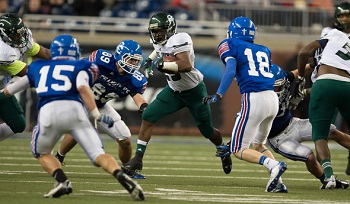 In the fourth quarter, with Cass Tech trying to put the game away, Campbell changed a pass to a draw play to running back Mike Weber on fourth-and-10 from Catholic Central’s 30-yard line. Weber exploded 26 yards to the 4-yard line, setting up a 3-yard touchdown run by Campbell that expanded the lead to 29-7 with 7:59 remaining.
“I saw they had only one linebacker in the back,” Campbell said. “Coach Wilcher really believes in me. He knows I will get the job done. He really trusts me.”
Catholic Central came in looking to avenge last year’s 36-point loss in the Final, but the Shamrocks fell behind 12-0 in the first five minutes on the 89-yard catch by Lewis and a 58-yard fumble return by 260-pound defensive tackle Kenton Gibbs.
The Shamrocks (9-5) slowed the momentum and got back in the game at 12-7 on an 18-yard pass from Garrett Moores to Zach Bock with 2:02 left in the first half. The Technicians (12-2) tacked on a 31-yard field goal by Ken Snapp to take a 15-7 lead into halftime.
A 57-yard run by Weber on third-and-17 set up a 30-yard touchdown run by Deon Drake Jr. on the following play, giving Cass Tech a 22-7 lead on the first series of the third quarter.
“We knew going in from last year’s experience that we can’t make mistakes, because they capitalize well on mistakes, but we did,” Catholic Central coach Tom Mach said. “They made a great throw and catch on the first touchdown. Then we made a couple of mistakes that they capitalized on. We found ourselves in a hole and had to try to get out of that hole. We were doing a good job of that, I thought. Then they exerted themselves and put another touchdown in.”
It became a 29-7 game when Cass Tech went 79 yards in 16 plays, taking 7:14 off the clock before Campbell scored on his 3-yard run with 7:59 left in the fourth quarter.
Catholic Central twice made it a two-possession game in the final 5:57 on touchdown passes by Moores, but the Technicians had an 84-yard interception return for a touchdown by Delano Hill in between them.
“It was no different than last year,” Catholic Central senior running back Anthony Darkangelo said. “We knew last year they were a fast team and we had to keep contain on the edges outside. They executed their game plan and we didn't execute the plan we had for the game.”
Click for full statistics and to watch a replay of the game. See below for the full press conference.
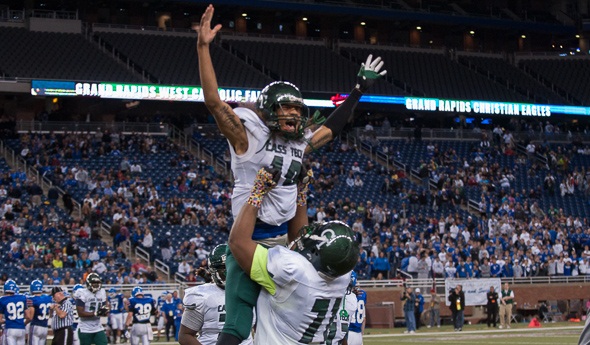
PHOTOS: (Top) Detroit Cass Tech David Dawson hoists quarterback Jayru Campbell (10) during Saturday's Division 1 Final. (Middle) Cass Tech running back Mike Weber runs into a crowd of Detroit Catholic Central defenders including Sean Birney (18) and Dylan Roney (89). (Click for more from Terry McNamara Photography.)