

Next Players Up Keep Whiteford Surging
October 5, 2017
By Doug Donnelly
Special for Second Half
OTTAWA LAKE – For many smaller Class C football teams, losing four starters to injuries during the first six weeks of the season would be devastating.
 In Ottawa Lake, however, probably only those close to the Whiteford football program have noticed.
Despite the injury bug, the Bobcats are rolling like never before in school history. They are 6-0, averaging 53 points per game and sit alone atop the Tri-County Conference. The key is an unusual amount of depth – and a 28-player roster with 14 seniors and 14 juniors.
“Some of it has to do with a couple of innate classes, with more than the usual amount of kids,” sixth-year Bobcats coach Jason Mensing said. “There’s always an ebb and flow from one grade to the next. But, what we are experiencing is different. In Hunter Lake, not only did we lose a running back, but he was also a cornerback, kick returner and punt returner. And, Alex (Kohler) is a second-year starting guard, but is also our punter and he kicked off.”
Typically, only two or three players start on both sides of the ball for the Bobcats – a rare occurrence for a team has played in the Division 8 playoffs each of the past four seasons (they were in Division 7 in 2012).
“We try and coach every kid the same,” Mensing said. “That’s a very important piece. We really try and develop every player into a starting player. The ultimate goal is to make sure every kid gets on the field.”
Part of the reason the Bobcats have developed such depth is their deep playoff runs the past couple of seasons. The 2015 team advanced to the Division 8 Semifinals, and last year the Bobcats played in the championship game at Ford Field against Muskegon Catholic Central. Since Mensing arrived at Whiteford, he has invited every junior varsity player to practice with the varsity for all of the playoff weeks.
 “Those playoff runs have allowed our JV players a ton of extra practice over the past couple of seasons,” Mensing said. “If you think about that, it’s another season and then some. That makes a really big difference, especially the first two weeks or so of the next season. The players come in and already know what to expect, and they know the routine and the pace. They are playing at a higher level at an earlier time.”
Mensing and his staff of 10 varsity coaches work with grades 9-12 in practice on a daily basis.
“That’s a critical piece of coaching – every kid is receiving the same instruction,” he said.
A Tecumseh graduate and former Adrian College football player, Mensing is 53-13 since becoming head coach of the Bobcats, giving him the highest winning percentage of any coach in school history. The program has never been stronger – six straight playoff appearances, a 9-0 regular season last year and two consecutive 9-0 seasons by the JV team. He said he developed his coaching style from playing small college football.
“My background is small college football,” he said. “It always seemed to me to be the best way to operate that I know.”
Whiteford’s offense has rushed for more than 2,200 yards heading into Friday’s game against Sand Creek – an average of about 10 yards a carry. Many of those yards are gained behind 6-foot-5, 280-pound all-state tackle Lucas Tesznar. Jacob Lewis, Jordan Book and Jaret Atherton all are starting for a second year on the offensive line. There are five solid backups in the mix, too, who have received plenty of playing time even though Whiteford has had a running clock at some point in each of its six games.
“At the line of scrimmage we have guys who can come in and play that would start in just about any other year,” Mensing said.
Whiteford lost two 1,000-yard running backs to graduation after last season, but have found several capable replacements in six juniors: Logan Murphy (823 yards on just 61 carries), Zach Bertz (266 yards and 10 touchdowns), Nathan Bauman (258 yards), Ty Eitniear (188 yards) and Lake (148 yards in three games). Bradyn Clark-Gilmore started the season at running back and had a 100-yard game but shifted to tight end and is now the leading receiver on the team (280 yards on 11 receptions).
 Thomas Eitniear is the Bobcats’ quarterback. As the starting signal-caller, Eitniear is 29-4, already setting a record for most starts and wins by a Whiteford QB. He holds the school record for career passing touchdowns and is nearing the school record for career passing yards. This season he has 567 yards passing and 409 yards rushing. He’s committed to play baseball at the University of Toledo next year.
“We’ve got a Division I athlete playing quarterback,” Mensing said. “He is a difference-maker. I can’t tell you how many drives or even games have changed over the last three years because of him making a big play.”
Inside linebacker Eli Shelton, safety Abba Risley, cornerback Ty Eitniear (three interceptions) and end Ethan Inman have been standouts on defense. Jack Garrison stepped up when Lake was injured and had several big games. One of the few two-way starters, Matthew Taylor, has been solid all season.
Mensing said players like Thomas Eitniear and Murphy won’t put up gaudy numbers because of the system they are in, but that doesn’t make them any less effective.
“It’s not about any one individual effort,” he said. “It’s about a collective group. That’s what we’ve always been about.”
Whiteford is seeking to win back-to-back league championships for the first time in more than 50 years, the last time when it was a member of the River Raisin Conference. They have games remaining against Sand Creek (3-3), Clinton (4-2) and Britton Deerfield (1-5) on the regular-season schedule. Then the playoffs begin. Lake and Kohler are expected back before the end of the season to help solidify the depth.
“We still have room to show improvement from week to week,” Mensing said. “As long as we continue to improve, and if we can continue to get better over the next three weeks, it will determine where we will end up on the season.”
 Doug Donnelly has served as a sports and news reporter and city editor over 25 years, writing for the Daily Chief-Union in Upper Sandusky, Ohio from 1992-1995, the Monroe Evening News from 1995-2012 and the Adrian Daily Telegram since 2013. He's also written a book on high school basketball in Monroe County and compiles record books for various schools in southeast Michigan. E-mail him at [email protected] with story ideas for Lenawee and Monroe counties.
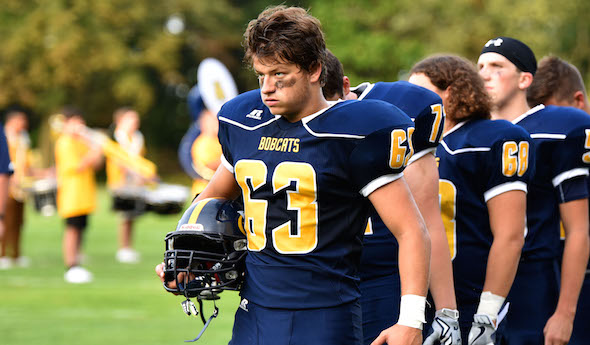
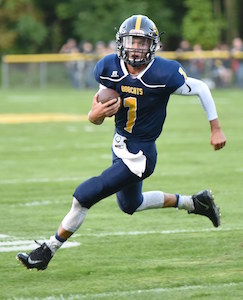
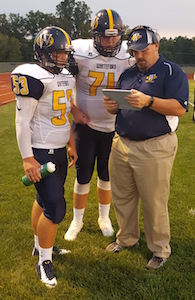
PHOTOS: (Top) Ottawa Lake Whiteford’s Eli Shelton, standing for the national anthem, is one of the defense’s standouts this fall. (Middle) Quarterback Thomas Eitniear takes off around a corner during his third season as a starter. (Below) From left: Jacob Lewis, Lucas Tesznar and coach Jason Mensing confer on the sideline. (Top and middle photos by Carl Hayes, below photo by Doug Donnelly.)

Longtime Crew Leader Harrelson Begins 32nd Season on Chains, Amid Cancer Fight
By
Tom Spencer
Special for MHSAA.com
September 11, 2026
First down! Move the chains.
 As a member of the Suttons Bay chain gang, Jim Harrelson doesn’t know how many more times he’ll follow the referee crew’s direction on the Norsemen sideline. Similarly, he has no idea how many times he’s already moved the chains.
But, in the meantime, every time he does, it will undoubtedly be a school record. An unofficial record of course, but a well-earned and appreciated achievement nonetheless.
Harrelson stepped on the field Wednesday night sporting a down marker for the 32nd straight year. This time, it was for the Norse’s middle school contest with Onekama. Harrelson was joined by Curt Murphy and Dave Faught. Mike Gordon, another regular member of the crew, was also on hand to celebrate Harrelson’s 32nd season.
Wednesday’s chain gang team was organized – no surprise – by Harrelson. It’s something he’s done on a volunteer basis for Suttons Bay the last 16 years.
Harrelson’s crews have staffed middle school, junior varsity and varsity football games, including the home contests during the Norsemen’s three straight seasons from 2019-21 that culminated in three trips to 8-Player Division 1 Finals. Harrelson, Faught, Murphy and Gordon are in their 10th season working together.
“The chain gang was always his baby, and he was always able to go find other people to help him out,” said Doug Periard, a long-time member of the Norse football coaching staff and former school athletic director. “Somehow he managed to get some of those who might not have done much in football, to suddenly come on board and enjoy doing it.”
Harrelson, who last spring retired from a coaching career spanning 35 years, has no intentions of letting anything get in the way of holding the down marker for the Norsemen.
 “I've always loved sports, and being a part of the chain gang was always big part of it,” Harrelson said. “The ADs didn’t have to worry about it, knowing it was taken care of.”
Jamie Hawkins, Suttons Bay’s principal and current athletic director, was on hand for Wednesday’s kickoff as well. Hawkins, one of the administrators who has relied on Harrelson, believes the community owes Harrelson a huge thank you, acknowledging he has marked more first downs than anyone could ever comprehend.
“Jim’s years as a coach and chain gang chief are an amazing commitment to our student-athletes, our football program, and the entire Suttons Bay community,” said Hawkins. “His time, energy, and passion have been a part of countless Friday nights and memories for generations of Norsemen.”
Harrelson, now 82, is battling cancer for the second time in his life. He was first diagnosed with colorectal cancer in 2010. Early this year, he was told cancer had returned.
Working with doctors and his wife of 53 years, Brenda, Harrelson picked a six-week treatment plan this summer timing it so he could return to the sidelines for the first football game. He’s awaiting word from his medical team on the outcome of the most recent treatment.
“I haven't let it dominate my life – everybody's going to have trials and tribulations no matter what,” Harrelson said of his cancer return. “Cancer is something that thousands of people find themselves having to deal with, and I'm pretty proud I've been able to function pretty much as normal as could be even though it’s obviously right there in front of me.”
Harrelson’s coaching journey began in 1991 with softball, drawn into the role as his children made their way through the Suttons Bay school system. He went on to serve as an assistant and head volleyball coach from 1996 through 2004.
Eventually he served as an assistant or head coach for Suttons Bay in golf, cross country and track.
 Among the highlights of his time on the volleyball bench was helping guide the 2001 squad all the way to the MHSAA Finals, where the team earned a runner-up finish in Class C.
A short while ago, Harrelson was honored with the Don Lukens Legacy Award at the Traverse City Record-Eagle John Lober Honor Roll Meet for his coaching of student-athletes from all four Leelanau County schools – Maple City Glen Lake, Leland, Lake Leelanau St. Mary’s and Northport (with some of that coaching was made possible through the schools becoming a part of a co-op with Suttons Bay).
Much of Harrelson’s coaching was on a purely volunteer basis – even while serving as a head coach responsible for running an entire program.
Now, Harrelson’s favorite thing is watching his grandchildren grow and compete in sports, while admiring his adult children’s great parenting.
Harrelson points to his first grandchild’s birth 15 years ago as a prime motivator during the first cancer round. The Harrelsons have seven grandchildren now, one of whom was playing volleyball Wednesday night for Suttons Bay’s middle school team – with Grandma in the stands.
And while he’s remembered fondly by Leelanau athletes and athletic directors for his coaching commitment and success, Harrelson has only one thought for his family legacy.
“I just hope if I’m remembered for anything by my grandchildren and my kids is that I handled cancer pretty well without letting it affect me in any way, shape, or form in how I behave, how I coach or whatever,” Harrelson said. “I am pretty doggone proud of the fact that I've been able to put that on the table and still be able to function.”
Periard already views Harrelson as a great student-athlete advocate and solution finder.
“It was an incredible amount of time he put in doing the stuff he did and how much he loved it,” recalled Periard. “Cross country, track, whatever he was called upon, he was there to help out. He's a jack of all trades, a great kids guy at heart.”
 Harrelson’s first paid coaching job was as an assistant for track in 2006. At the time he was hired by Cody Ingils, then the Suttons Bay athletic director and now a senior assistant director for the MHSAA.
Harrelson asked Inglis a decade ago to delivery his eulogy someday upon the veteran coach’s passing.
“Jim also always wanted the best for kids at every turn, and he wanted to be a positive force in kids’ lives – and I think Jim's ultimate takeaway is he met the kids where they were and tried to make sure that they got better,” Inglis said. “Jim was able to work with elite athletes, and he was able to work with kids that had never done that sport before. And that was the beauty of his coaching, is that it applied to anybody and everybody because of his positive way of dealing with kids.”
Harrelson, who points to track as his favorite sport to coach because of the camaraderie, is ready to keep moving the down marker as he battles the return of cancer.
“What I've been experiencing is part of who I am,” Harrelson said. “It’s just the cards I've been dealt. I just want to do it with class if I can.”
 Tom Spencer is a longtime MHSAA-registered basketball and soccer official, and former softball and baseball official, and he also has coached in the northern Lower Peninsula area. He previously has written for the Saginaw News, Bay County Sports Page and Midland Daily News. He can be reached at [email protected] with story ideas for Manistee, Wexford, Missaukee, Roscommon, Ogemaw, Iosco, Alcona, Oscoda, Crawford, Kalkaska, Grand Traverse, Benzie, Leelanau, Antrim, Otsego, Montmorency, Alpena, Presque Isle, Cheboygan, Charlevoix and Emmet counties.
PHOTOS (Top) Suttons Bay football chain gang leader Jim Harrelson plants his down marker on the sideline during Wednesday’s middle school game with Onekama. (2) Harrelson shakes hands with referee Ed Blough. (3) Harrelson stands for a photo with Suttons Bay principal and athletic director Jamie Hawkins, far left, past athletic director and longtime coach Doug Periard, far right, and his chain gang of (from left) Dave Faught, Curt Murphy and Mike Gordon. (4) Harrelson enjoys a break in the shade. (Top and sitting photos by Meredith McNabb Photography. Others by Tom Spencer.)