

Next Players Up Keep Whiteford Surging
October 5, 2017
By Doug Donnelly
Special for Second Half
OTTAWA LAKE – For many smaller Class C football teams, losing four starters to injuries during the first six weeks of the season would be devastating.
 In Ottawa Lake, however, probably only those close to the Whiteford football program have noticed.
Despite the injury bug, the Bobcats are rolling like never before in school history. They are 6-0, averaging 53 points per game and sit alone atop the Tri-County Conference. The key is an unusual amount of depth – and a 28-player roster with 14 seniors and 14 juniors.
“Some of it has to do with a couple of innate classes, with more than the usual amount of kids,” sixth-year Bobcats coach Jason Mensing said. “There’s always an ebb and flow from one grade to the next. But, what we are experiencing is different. In Hunter Lake, not only did we lose a running back, but he was also a cornerback, kick returner and punt returner. And, Alex (Kohler) is a second-year starting guard, but is also our punter and he kicked off.”
Typically, only two or three players start on both sides of the ball for the Bobcats – a rare occurrence for a team has played in the Division 8 playoffs each of the past four seasons (they were in Division 7 in 2012).
“We try and coach every kid the same,” Mensing said. “That’s a very important piece. We really try and develop every player into a starting player. The ultimate goal is to make sure every kid gets on the field.”
Part of the reason the Bobcats have developed such depth is their deep playoff runs the past couple of seasons. The 2015 team advanced to the Division 8 Semifinals, and last year the Bobcats played in the championship game at Ford Field against Muskegon Catholic Central. Since Mensing arrived at Whiteford, he has invited every junior varsity player to practice with the varsity for all of the playoff weeks.
 “Those playoff runs have allowed our JV players a ton of extra practice over the past couple of seasons,” Mensing said. “If you think about that, it’s another season and then some. That makes a really big difference, especially the first two weeks or so of the next season. The players come in and already know what to expect, and they know the routine and the pace. They are playing at a higher level at an earlier time.”
Mensing and his staff of 10 varsity coaches work with grades 9-12 in practice on a daily basis.
“That’s a critical piece of coaching – every kid is receiving the same instruction,” he said.
A Tecumseh graduate and former Adrian College football player, Mensing is 53-13 since becoming head coach of the Bobcats, giving him the highest winning percentage of any coach in school history. The program has never been stronger – six straight playoff appearances, a 9-0 regular season last year and two consecutive 9-0 seasons by the JV team. He said he developed his coaching style from playing small college football.
“My background is small college football,” he said. “It always seemed to me to be the best way to operate that I know.”
Whiteford’s offense has rushed for more than 2,200 yards heading into Friday’s game against Sand Creek – an average of about 10 yards a carry. Many of those yards are gained behind 6-foot-5, 280-pound all-state tackle Lucas Tesznar. Jacob Lewis, Jordan Book and Jaret Atherton all are starting for a second year on the offensive line. There are five solid backups in the mix, too, who have received plenty of playing time even though Whiteford has had a running clock at some point in each of its six games.
“At the line of scrimmage we have guys who can come in and play that would start in just about any other year,” Mensing said.
Whiteford lost two 1,000-yard running backs to graduation after last season, but have found several capable replacements in six juniors: Logan Murphy (823 yards on just 61 carries), Zach Bertz (266 yards and 10 touchdowns), Nathan Bauman (258 yards), Ty Eitniear (188 yards) and Lake (148 yards in three games). Bradyn Clark-Gilmore started the season at running back and had a 100-yard game but shifted to tight end and is now the leading receiver on the team (280 yards on 11 receptions).
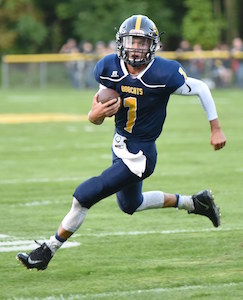
 Thomas Eitniear is the Bobcats’ quarterback. As the starting signal-caller, Eitniear is 29-4, already setting a record for most starts and wins by a Whiteford QB. He holds the school record for career passing touchdowns and is nearing the school record for career passing yards. This season he has 567 yards passing and 409 yards rushing. He’s committed to play baseball at the University of Toledo next year.
“We’ve got a Division I athlete playing quarterback,” Mensing said. “He is a difference-maker. I can’t tell you how many drives or even games have changed over the last three years because of him making a big play.”
Inside linebacker Eli Shelton, safety Abba Risley, cornerback Ty Eitniear (three interceptions) and end Ethan Inman have been standouts on defense. Jack Garrison stepped up when Lake was injured and had several big games. One of the few two-way starters, Matthew Taylor, has been solid all season.
Mensing said players like Thomas Eitniear and Murphy won’t put up gaudy numbers because of the system they are in, but that doesn’t make them any less effective.
“It’s not about any one individual effort,” he said. “It’s about a collective group. That’s what we’ve always been about.”
Whiteford is seeking to win back-to-back league championships for the first time in more than 50 years, the last time when it was a member of the River Raisin Conference. They have games remaining against Sand Creek (3-3), Clinton (4-2) and Britton Deerfield (1-5) on the regular-season schedule. Then the playoffs begin. Lake and Kohler are expected back before the end of the season to help solidify the depth.
“We still have room to show improvement from week to week,” Mensing said. “As long as we continue to improve, and if we can continue to get better over the next three weeks, it will determine where we will end up on the season.”
 Doug Donnelly has served as a sports and news reporter and city editor over 25 years, writing for the Daily Chief-Union in Upper Sandusky, Ohio from 1992-1995, the Monroe Evening News from 1995-2012 and the Adrian Daily Telegram since 2013. He's also written a book on high school basketball in Monroe County and compiles record books for various schools in southeast Michigan. E-mail him at [email protected] with story ideas for Lenawee and Monroe counties.
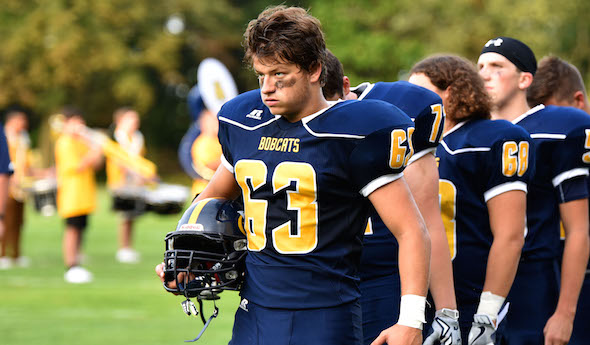
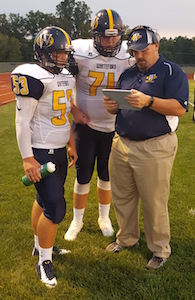
PHOTOS: (Top) Ottawa Lake Whiteford’s Eli Shelton, standing for the national anthem, is one of the defense’s standouts this fall. (Middle) Quarterback Thomas Eitniear takes off around a corner during his third season as a starter. (Below) From left: Jacob Lewis, Lucas Tesznar and coach Jason Mensing confer on the sideline. (Top and middle photos by Carl Hayes, below photo by Doug Donnelly.)
Drive for Detroit: Week 8 Preview
October 17, 2019
By Geoff Kimmerly
Second Half editor
How much should fans enjoy the final two weeks of this football regular season?
 There are 93 leagues for the sport statewide, and 35 championships remain completely up for grabs. Another 35 leagues have had one team clinch a share of the title but still have the possibility for another to join the celebration.
And the playoff picture is similarly a slightly-filled canvas. A total of 346 teams (out of 531 total) remain eligible for at least an additional qualifier berth in the 256-team 11-player field. A total of 110 teams have secured their spots – but 86 more teams can clinch with a win this week.
On the 8-player side, the 32 playoff spots will remain in flux through Week 9 – and it looks like up to 55 teams still have a chance to make that field.
Below again is a look at many games that will tilt these numbers this weekend. The MHSAA.tv live streaming schedule includes 33 games – click for the full listing and links to each game. All games below are Friday unless noted.
"Drive for Detroit" is sponsored by MI Student Aid.
Bay & Thumb
Marine City (7-0) at Marysville (5-2)
The Mariners handed St. Clair its lone league loss last week to earn a share of the Macomb Area Conference Silver title, and will finish the league schedule against the other team tied for second in Marysville. If the Vikings are able to break a two-game losing streak in this series, it will create a three-way shared Silver championship. But they will have to crack a Marine City defense giving up just 8.4 points per game.
Keep an eye on these: FRIDAY Fenton (6-1) at Goodrich (6-1), Flint Powers Catholic (5-2) at Grand Blanc (5-2), Bloomfield Hills Brother Rice (5-2) at Lapeer (6-1), Montrose (6-1) at Byron (5-2).
Greater Detroit
Romeo (6-1) at Clinton Township Chippewa Valley (7-0)
For the second straight season, Chippewa Valley enters this Macomb Area Conference Red finale with a perfect record and Romeo has a chance to break up the league title with a win. The Bulldogs and Utica Eisenhower are tied for second, one game behind the Big Reds, and Romeo fell only 41-34 last season in giving Chippewa Valley one of the toughest games of its undefeated Division 1 championship run.
Keep an eye on these: FRIDAY Royal Oak Shrine (6-1) at Clarkston Everest Collegiate (6-0), Clawson (4-3) at Clinton Township Clintondale (5-2), Farmington (7-0) at North Farmington (7-0), Belleville (7-0) at Livonia Franklin (6-1), Detroit Catholic Central (4-3) at River Rouge (6-1).
Mid-Michigan
Fowler (7-0) at Pewamo-Westphalia (7-0)
This season has been a little unfair to the Eagles, and be sure they’ll use that as motivation tonight. It’s hard to not talk about Pewamo-Westphalia – a lot – when the Pirates are outscoring their opponents by a combined 312-14 with five shutouts, including one over reigning Division 8 champion Reading (which is otherwise averaging 52 points per game). But a few miles over from that all-out domination, rival Fowler is outscoring its opponents 295-70, giving up more than 13 points in a game just once, and with a chance to take the Central Michigan Athletic Conference title outright if they get past the rival Pirates for the first time since 2014.
Keep an eye on these: FRIDAY Portland (7-0) at Mason (7-0), St. Joseph (6-1) at DeWitt (5-2), Fowlerville (6-1) at Lansing Catholic (6-1), Olivet (7-0) at Williamston (4-3).
Northern Lower Peninsula
Maple City Glen Lake (6-1) at Charlevoix (5-2)
The leaders of the Northern Michigan Football League Leaders division will meet for the outright championship tonight. A win would give Glen Lake its third straight league title, and of course it would be celebrated – especially bouncing back from last week’s loss to Kingsley. But a win for Charlevoix would be historic; the Rayders not only would clinch a first playoff berth since 2016, but the league title would be the program’s first since 1987 and after a number of runner-up finishes over the years. Glen Lake has won the last six meetings between these teams, including three over the last three years in NMFL play.
Keep an eye on these: FRIDAY Breckenridge (6-1) at Oscoda (7-0), Beal City (7-0) at McBain (4-3), Johannesburg-Lewiston (7-0) at Frankfort (3-4), Ogemaw Heights (5-2) at Grayling (3-4).
Southeast & Border
Milan (7-0) at Carleton Airport (5-2)
Milan claimed a share of the Huron League championship last week. And although third-place Airport can’t win a share as well whatever happens tonight, second-place Monroe St. Mary Catholic Central surely is cheering the Jets on. Milan has won the last eight against Airport, including once in the playoffs, but four of those games were decided by eight or fewer points – including last season’s when the Big Reds won 35-30.
Keep an eye on these: FRIDAY Ann Arbor Pioneer (4-3) at Saline (6-1), Manchester (5-2) at Grass Lake (6-1), Britton Deerfield (4-3) at Ottawa Lake Whiteford (4-3), Jackson (5-2) at Pinckney (5-2).
Southwest Corridor
Kalamazoo United (4-3) at Constantine (5-2)
As we consider what United will try to accomplish over the next two weeks – defeating Constantine and then unbeaten Schoolcraft to earn a third-straight playoff berth and repeat as Southwestern Athletic Conference Valley champion – it’s important to keep in mind the Titans’ start this fall. They began 0-3 – but the first loss was by two to still-unbeaten Jackson Lumen Christi, and the third defeat by just nine to still-undefeated Berrien Springs. Constantine is in a similar place, however – its losses to Berrien Springs and Schoolcraft were by a combined eight points.
Keep an eye on these: FRIDAY Muskegon Catholic Central (4-2) at Benton Harbor (4-3), Parma Western (5-2) at Marshall (4-3), White Pigeon (6-1) at Mendon (6-1), Dowagiac (4-3) at Vicksburg (5-2).
Upper Peninsula
Traverse City Central (6-1) at Escanaba (6-1)
The Eskymos’ chances of getting some help to climb back into the Great Northern Conference title race are getting slimmer by the week as a three-point Week 4 loss to Marquette still stands as the lone decider for first in that league. But Escanaba can continue to gear up for the playoffs and a run at a fourth-straight District title, and playing much larger Central is a great way to get ready. The Trojans have clinched a share of the Big North Conference title and haven’t lost since Week 1. Interestingly, their six-game winning streak started against Marquette – and they’d surely love to go 2-0 against the GNC’s best after falling to Escanaba by 17 a year ago.
Keep an eye on these: FRIDAY Hancock (4-3) at Calumet (6-1), Iron Mountain (7-0) at L’Anse (4-3), Kingsford (4-3) at Menominee (4-3), Lake Linden-Hubbell (4-3) at Bark River-Harris (5-2).
West Michigan
Muskegon (7-0) at Muskegon Mona Shores (6-1)
Championships could be decided all over the Ottawa-Kent Conference this weekend, but this annual matchup in the Black always is one of the most-hyped games in the state and again deserves lots of attention after both teams reached Ford Field last season. Since falling in the 2018 Division 3 Final, Muskegon has been challenged only by East Grand Rapids in a five-point Week 3 win. The reigning Division 2 runner-up Sailors fell to still-unbeaten Rockford by 13 in Week 4 but otherwise have won all of their games by at least 20 points. The Big Reds have won the last four in this series, and regardless of the outcome this latest chapter will be entertaining – the total points scored has increased every game over the last four, with Muskegon winning 55-35 in 2018.
Keep an eye on these: FRIDAY Rockford (7-0) at Grandville (6-1), Ravenna (6-1) at Muskegon Oakridge (7-0), Grand Rapids Christian (5-2) at East Grand Rapids (5-2), Byron Center (7-0) vs. Hudsonville Unity Christian (5-2) at Hope College.
8-Player
Deckerville (7-0) at Kingston (6-1)
A share of the North Central Thumb League Blue championship goes to the victor, and in Deckerville’s case would guarantee a fourth consecutive league title. Two of the last five years this matchup determined the league champion, and a third time Kingston defeated Morrice to help Deckerville take back a share of first place after falling to the Orioles a week earlier in 2017. The Eagles have won all 12 against the Cardinals since the teams began playing each other regularly in 2010, including a pair of victories last season as they also met in the playoffs.
Keep an eye on these: FRIDAY Burr Oak (5-2) at Climax-Scotts (6-1), Onekama (5-2) at Suttons Bay (7-0). SATURDAY Morrice (7-0) vs. Crystal Falls Forest Park (5-2) at Pickford, Mio (7-0) at Gaylord St. Mary (2-5).
Second Half’s weekly “Drive for Detroit” previews are powered by MI Student Aid, a part of the Office of Postsecondary Financial Planning located within the Michigan Department of Treasury. MI Student Aid encourages students to pursue postsecondary education by providing access to student financial resources and information. MI Student Aid administers the state’s 529 college savings programs (MET/MESP), as well as scholarship and grant programs that help make college Accessible, Affordable and Attainable for you. Connect with MI Student Aid at www.michigan.gov/mistudentaid and find more information on Facebook and Twitter @mistudentaid.
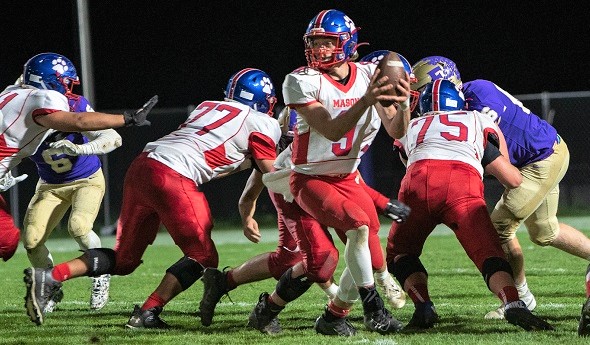
PHOTO: Mason works the ground game during a 21-14 league title-deciding win over Fowlerville on Oct. 4. (Click to see more from High School Sports Scene.)