


NFHS Voice: Campaign Touts Benefits of High School Football
By
Karissa Niehoff
NFHS Executive Director
May 21, 2021
A full return to high school sports and performing arts programs – that’s the hope for this fall in schools across the country.
After a year of unprecedented challenges in keeping these programs going due to the pandemic, which included 11 states that conducted their primary football season this spring, there is great optimism as we look to a new school year.
Even in those states that were able to conduct activities last fall, attendance restrictions kept many fans out of stadiums and watching games online. However, with vaccine eligibility now at 12 years of age and older and with vaccinations continuing during the next three months, the likelihood of routines and traditions returning this fall grows stronger each day.
And there is no tradition more anticipated than the full-scale return of high school football. While there were 34 states there were fortunate enough to conduct football at some level last fall, the routines were anything but normal.
This fall, however, we anticipate a return to the energy and excitement of the 2019 season when 1,003,524 boys participated in 11-player football. That total marked a decline of only 2,489 from the previous year and was a good sign of a renewed confidence on the part of parents and student-athletes that concerns about the risk of injury were being addressed.
While boys participation in 11-player football has exceeded one million participants every year since 1999 and is overwhelmingly the most popular boys sport, there have been concerns about declines in past years.
Last fall, the NFHS and the National Football League announced a partnership to promote the growth, understanding and support for football at the high school level. The NFHS and NFL have been studying participation trends, developing educational tools and striving to restore confidence in students and parents that the sport is, in fact, more focused on risk minimization than ever before.
As a result, the springboard to the return of high school football next fall begins this week with the launch of the #ThisIsHSFootball campaign. Through this effort over the next few months, the NFHS will be reaching out to coaches, students, parents, officials, athletic directors and others with research information, participation trends and data on various risk mitigation efforts that, we believe, continues to make high school football safer than it has ever been.
As a part of this effort, the NFHS produced a video entitled “This is High School Football” designed to detail the benefits of participation in high school football.
As the video states, more so than at any other level of play, parents should feel good about their kids playing high school football.
>Here are some of the many educational and medical safeguards put in place the past 12 years to offer parents a comfort level about the safety standards that are a part of high school football.
► Concussion research and education. All NFHS high school playing rules require a student who is exhibiting signs of a concussion to be removed from the game and not allowed to return until the student has been cleared by a medical professional. Thanks to education and training on the part of students, coaches, trainers, parents and others, research data has shown positive trends in concussion rates. In a recent five-year period, concussion rates during practices dropped from 5.47 to 4.44 concussions per 10,000 athletic exposures.
► Concussion in Sport Course. This free online education course has been available through the NFHS Learning Center since 2010, and millions of individuals have taken the course for a deeper understanding about concussions.
► Concussion Laws. By 2014, every state had adopted state concussion laws that established mandatory protocols, and every state high school association has adopted policies that limit contact during preseason drills and in practices during the season.
► Football equipment. Manufacturers continue to produce higher quality equipment every year, and high school coaches are doing a much better job at teaching and coaching the rules of the game and making attempts to minimize risk of injury for players.
► Emergency Action Plans. Thanks to the NFHS Foundation, a copy of the “Anyone Can Save a Life” emergency action plan originally developed by the Minnesota State High School League was sent to all state high school associations and their high schools, and all schools have access to an AED to help save lives.
► Playing Rules. Risk minimization is a major focus of every NFHS sports rules committee. In football, helmet-to-helmet hits are not allowed.
High school football has been a significant part of schools, towns and communities across America for almost 100 years. The NFHS is committed to making the sport as safe as possible for the millions of kids who will play the sport in the years to come.
Dr. Karissa L. Niehoff is in her third year as executive director of the National Federation of State High School Associations (NFHS) in Indianapolis, Indiana. She is the first female to head the national leadership organization for high school athletics and performing arts activities and the sixth full-time executive director of the NFHS, which celebrated its 100th year of service during the 2018-19 school year. She previously was executive director of the Connecticut Association of Schools-Connecticut Interscholastic Athletic Conference for seven years.
MHSAA Opposes Big Ten Friday Football
November 2, 2016
By Geoff Kimmerly
Second Half editor
The executive director of the Michigan High School Athletic Association said today that he is “disappointed and disheartened” by the Big Ten Conference announcement that it will play and televise football games on Friday nights beginning with the 2017 season.
Friday night football remains one of the strongest and longest-standing traditions in high school athletics, and the MHSAA has fought since the start of this century to keep Friday nights sacred against the overstepping of college football and the damage televised Big Ten games are now expected to cause to attendance and media coverage of the sport at the high school level.
MHSAA Executive Director John E. “Jack” Roberts was contacted by both Big Ten Conference commissioner Jim Delany and Michigan State University athletic director Mark Hollis before the decision was announced. Roberts said he is appreciative of Michigan State and University of Michigan’s low tolerance to be included in this venture – at most, both will host a Thursday or Friday night game during Labor Day weekend and play one Friday night away game during the remainder of a season – but remains frustrated that similar respect for high school football was not shown by the conference as a whole.
Michigan State has played Friday night games during Labor Day weekend the last six seasons, hosting five and playing at Western Michigan University in 2015. However, most Michigan high school games continue to be scheduled and played on the Thursday before Labor Day, relieving holiday travel conflicts in most communities. University of Michigan did play on the Thursday before Labor Day at University of Utah in 2015, but has not played on a Friday night of Labor Day weekend this decade. The Wolverines are one of five Big Ten schools without a Friday night game in 2017.
“We are saddened by this decision. We had hoped that the Big Ten Conference would stay above this. We think this cheapens the Big Ten brand,” Roberts said. “Fans won’t like this. Recruits won’t like this. And high school football coaches won’t like this.
“We are grateful that Michigan State University and the University of Michigan are trying to minimize the effects of this decision by the Big Ten. But overall, this is just the latest step by major college athletics in the pursuit of cash that is just crushing high school sports.”
The MHSAA has shown its opposition to the use of Friday nights for televised collegiate football games for more than 15 years, dating back to 2001 when the NCAA lifted its restrictions on Friday night telecasts, which at first led to the broadcasting of “mid-major conference” games on the same night traditionally reserved for high school athletes.
The MHSAA launched in 2001 its “Save Our Friday Nights” campaign to emphasize the role that Friday night high school athletic events play in communities and to rally MHSAA member schools to contact NCAA member school football coaches, athletic directors and conference commissioners to voice their concerns.
In addition to causing lower attendance at events going up against Big Ten football games, Roberts anticipates that Friday night college games also will leave high school football as a secondary priority in many media markets. More than 80 radio stations statewide cover high school games regularly, but many also carry Michigan State or University of Michigan football. High school football could lose significant time on local TV highlights shows and in print and online coverage as well, as resources are diverted to cover a college game – potentially quieting significantly the positive buzz that comes from the typical high school football Friday night.
“Everyone knows that football is struggling right now,” Roberts said. “It’s getting a lot of bad publicity. Participation is declining. And now this; there couldn’t be worse timing.”
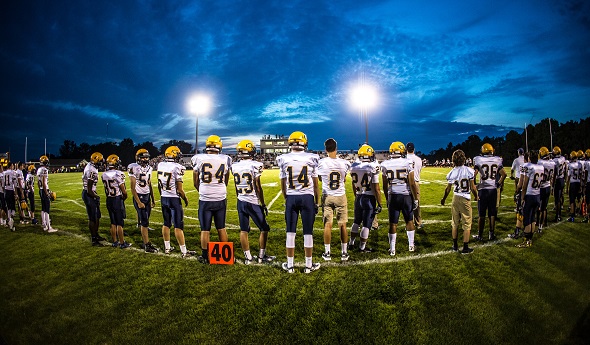
PHOTO: Grand Ledge takes on Okemos under the Friday night lights this season. (Click to see more from HighSchoolSportsScene.com.)