


NFHS Voice: Football Continues to Thrive
September 25, 2019
By Karissa Niehoff
NFHS Executive Director
When the annual High School Athletics Participation Survey was released by the National Federation of State High School Associations (NFHS) in August, many headlines across the country focused on the drop in the number of boys playing 11-player football. After all, the report showed 30,829 fewer participants than the year before. However, perhaps the most important number was overlooked – 14,247.
Yes, 14,247, the number of high schools with 11-player football teams. While there was a slight decline in the number of participants in many states, the number of schools sponsoring the sport was the highest in five years. In fact, the number of schools last year with 11-player teams has only been topped twice in the survey’s history – 14,262 in 2013-14 and 14,279 in 2010-11.
In addition, smaller schools in some states have shifted to 6-player, 8-player and 9-player football and have had good responses. The survey indicates an additional 156 schools and 1,594 participants involved in these alternate forms of the sport; and, in the past 10 years, participation by girls in 11-player football has doubled, with more than 2,400 participants this past year.
These numbers express the desire by high schools to keep alive one of the oldest and most treasured traditions in our nation – Friday Night Football Under the Lights. Although there are many options today for the entertainment dollar, nothing surpasses supporting the local high school football team on Friday nights. The No. 1 fan base in America? The answer is that number again – 14,247.
In Week 2 of the National Football League season, just under 1.1 million fans attended the 16 games. While impressive, it doesn’t come close to the number of fans who watched high school football during the corresponding week. It’s all in that number – 14,247.
With approximately 7,123 games every Friday night (14,247 divided by 2), and with a conservative estimate of 1,000 fans per game, there are more than 7 million fans in high school football stadiums every week. An unofficial attendance survey conducted by the NFHS in 2011 indicated about 165 million fans attended high school football games during that season, which included up to five weeks of playoffs and a weekly average of 11 million fans. Either way, the number of fans at high school football games dwarfs the numbers attending professional football games.
Early season crowds have been strong in many areas of the country with terrific fall weather – filled by current and former students; parents, grandparents and friends of players on the team; and longtime fans and supporters in the community. Unlike crowds at the college and professional levels where fans have little, if any, identity with the players, there is a connection between the players and fans at the high school level.
With concussion protocols and laws in place in every state, with a reduction in contact levels before the season and during practices, and with teaching of proper tackling skills at lower levels, we believe people, including parents of high school student-athletes, are seeing and believing that the sport of football at the high school level is as safe as it ever has been.
We urge you to support your local high school football team this Friday night.
Dr. Karissa L. Niehoff is in her second year as executive director of the National Federation of State High School Associations (NFHS) in Indianapolis, Indiana. She is the first female to head the national leadership organization for high school athletics and performing arts activities and the sixth full-time executive director of the NFHS, which celebrated its 100th year of service during the 2018-19 school year. She previously was executive director of the Connecticut Association of Schools-Connecticut Interscholastic Athletic Conference for seven years.
Western's White Enjoys 'Special' Career
By
Tom Markowski
Special for Second Half
May 4, 2016
WALLED LAKE – Seeking a higher level of performance, many high school athletes have channeled their energy to one sport.
 Many refer to this concentration as specialization – and Cody White, for one, isn’t buying it.
White, a junior at Walled Lake Western, is a three-sport athlete and he loves every minute of it. He plays basketball during the winter, baseball in the spring and football in the fall. During the summer he competes in AAU basketball, travel baseball, 7-on-7 football games with his Western teammates, and he participates in a few summer football camps.
White has played these same sports all throughout high school. His freshman year he competed in track and field, along with baseball. White hasn’t ruled out returning to track and field, in addition to baseball, as a senior – but this season he’s sticking with just baseball.
It’s a hectic schedule but, again, White wouldn’t have it any other way.
“I couldn’t see myself not competing in those sports,” he said. “I love them so much. I want to finish my senior year playing all three.”
White estimates that he’ll have two days off, away from sports, in June. In July he’ll take a week off, between his summer baseball team schedule ending and the start of football practice.
There’s no question White is driven, but it’s more than that. In some high schools, and with some coaches, playing multiple sports can be a challenge. There are some coaches who would prefer the students to play one sport and only one sport.
According to Western football coach Mike Zdebski, that isn’t the case at his school.
“We encourage them to play more than one sport,” Zdebski said. “For one, we want them to get their money’s worth. We have a pay-to-play policy of $425. You play one sport and it costs $425. You play three sports and it costs the same. And, two, playing other sports helps them develop other skills. In basketball you create space. In baseball you chase fly balls, and that helps with depth perception. Besides you get to work with other coaches and other teams.
“We’re lifting weights during the summer. If a kid is playing summer baseball or AAU basketball, if they have time they can come by and lift weights. And what we always tell them, if you’re tired let us know. You can take a break.”
Zdebski – whose team finished 12-1 last fall – was quick to point out some excellent athletes in the past, like former Kansas City Royals outfielder/Oakland Raiders running back Bo Jackson, who were multiple-sport athletes. And, more recently, there’s Luke Glendenning of the Detroit Red Wings. Glendenning was an all-state running back at East Grand Rapids.
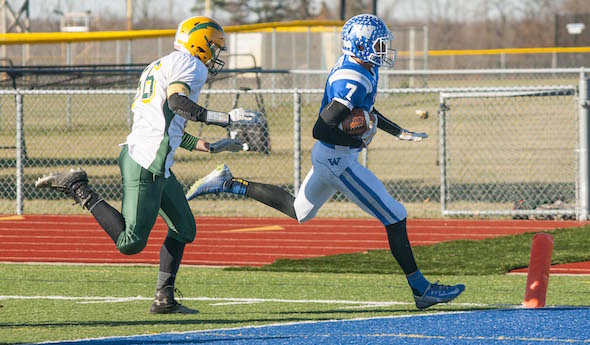
 When his high school career is done, White will play football in college. Two months ago he committed to sign with Michigan State this winter. At 6-foot-3 and 200 pounds, White played receiver, defensive back and also returned kicks last fall. He played a big role in Western’s run to the Division 2 Semifinals.
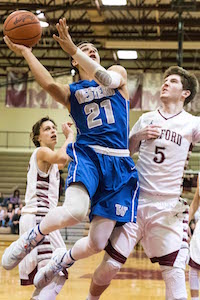
During baseball season, White pitches and plays middle infield and right field. He plays the wing and shooting guard in basketball.
His interest in playing a variety of sports came at an early age and, as is the case with most children, a family member was the one who introduced White to athletics. Former NFL player and Detroit Lions executive Sheldon White is his father, but the first sport White played, at age 3, was baseball. Two years later he began playing football and basketball.
Sheldon White also played three sports at his high school in Dayton, Ohio, (Meadowdale High) and helps his son manage his busy schedule, particularly during the offseason.
“Growing up was a little different (for me) than the usual kid,” Cody White said. “Going to Lions games and just being around football all the time. I think I love the game more because I was around it so much.
“But I think playing three sports helped me, too. The twisting of your hips in baseball, when you swing the bat, you’re using different muscles. And all the jumping you do in basketball. You have to move in tight spaces.
“With football, you’re with the football guys. By doing all three you meet different people.”
Playing multiple sports has definitely been the right road for White to follow. And his busy schedule hasn’t hindered his work in the classroom.
White has a 3.54 grade-point average pending his grades for this semester.
 Tom Markowski is a columnist and directs website coverage for the State Champs! Sports Network. He previously covered primarily high school sports for the The Detroit News from 1984-2014, focusing on the Detroit area and contributing to statewide coverage of football and basketball. Contact him at [email protected] with story ideas for Oakland, Macomb and Wayne counties.
PHOTOS: (Top) Cody White (right) runs away from a Midland Dow defender during their Regional Final this fall. (Middle) White works for a shot against Milford. (Photos by Teresa Presty.)