


NFHS Voice: Football Continues to Thrive
September 25, 2019
By Karissa Niehoff
NFHS Executive Director
When the annual High School Athletics Participation Survey was released by the National Federation of State High School Associations (NFHS) in August, many headlines across the country focused on the drop in the number of boys playing 11-player football. After all, the report showed 30,829 fewer participants than the year before. However, perhaps the most important number was overlooked – 14,247.
Yes, 14,247, the number of high schools with 11-player football teams. While there was a slight decline in the number of participants in many states, the number of schools sponsoring the sport was the highest in five years. In fact, the number of schools last year with 11-player teams has only been topped twice in the survey’s history – 14,262 in 2013-14 and 14,279 in 2010-11.
In addition, smaller schools in some states have shifted to 6-player, 8-player and 9-player football and have had good responses. The survey indicates an additional 156 schools and 1,594 participants involved in these alternate forms of the sport; and, in the past 10 years, participation by girls in 11-player football has doubled, with more than 2,400 participants this past year.
These numbers express the desire by high schools to keep alive one of the oldest and most treasured traditions in our nation – Friday Night Football Under the Lights. Although there are many options today for the entertainment dollar, nothing surpasses supporting the local high school football team on Friday nights. The No. 1 fan base in America? The answer is that number again – 14,247.
In Week 2 of the National Football League season, just under 1.1 million fans attended the 16 games. While impressive, it doesn’t come close to the number of fans who watched high school football during the corresponding week. It’s all in that number – 14,247.
With approximately 7,123 games every Friday night (14,247 divided by 2), and with a conservative estimate of 1,000 fans per game, there are more than 7 million fans in high school football stadiums every week. An unofficial attendance survey conducted by the NFHS in 2011 indicated about 165 million fans attended high school football games during that season, which included up to five weeks of playoffs and a weekly average of 11 million fans. Either way, the number of fans at high school football games dwarfs the numbers attending professional football games.
Early season crowds have been strong in many areas of the country with terrific fall weather – filled by current and former students; parents, grandparents and friends of players on the team; and longtime fans and supporters in the community. Unlike crowds at the college and professional levels where fans have little, if any, identity with the players, there is a connection between the players and fans at the high school level.
With concussion protocols and laws in place in every state, with a reduction in contact levels before the season and during practices, and with teaching of proper tackling skills at lower levels, we believe people, including parents of high school student-athletes, are seeing and believing that the sport of football at the high school level is as safe as it ever has been.
We urge you to support your local high school football team this Friday night.
Dr. Karissa L. Niehoff is in her second year as executive director of the National Federation of State High School Associations (NFHS) in Indianapolis, Indiana. She is the first female to head the national leadership organization for high school athletics and performing arts activities and the sixth full-time executive director of the NFHS, which celebrated its 100th year of service during the 2018-19 school year. She previously was executive director of the Connecticut Association of Schools-Connecticut Interscholastic Athletic Conference for seven years.
'Wakers' Continue Marching Together
November 5, 2019
By Geoff Kimmerly
Second Half editor
First the local media picked it up, which made sense – it was a great story, and easy to appreciate whether you’ve heard of Maple City or could find Fife Lake on the map.
In what was still perhaps surprising but a logical next step, The Associated Press and then Detroit Free Press and MLive took the story statewide. But then CNN and NPR told the rest of the U.S. – which was followed by interest from The Kelly Clarkson Show and a Skype interview with one of Ellen DeGeneres’ representatives.
There is no way Maple City Glen Lake athletic director Mark Mattson could’ve foreseen any of that publicity as he prepped for his football team’s home game Sept. 27. All he knew was that his high school didn’t have a marching band, and Fife Lake Forest Area – at least this season – didn’t have a varsity football team.
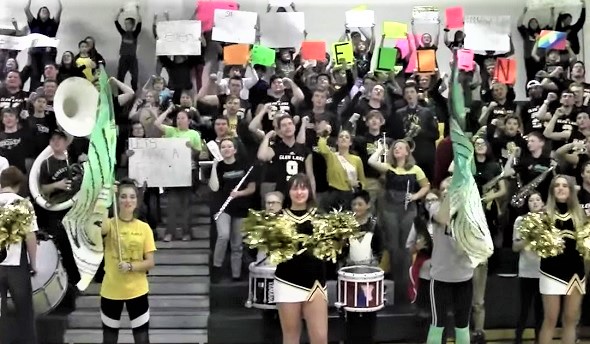
If you pay attention to high school sports in general or statewide news casually, you’ve probably heard some of the rest of this story. Mattson invited Forest Area director Brandon Deike and his band to play at Glen Lake’s game that night against Gladstone. A week later, after their story had been told all over the country, the schools combined for a “Marching for Ellen” spirit video hoping to land on the show.
Things have quieted back down substantially for the two small northern Lower Peninsula communities. But their march together continues.
“We don’t want it to end,” Mattson said. “Sometimes you see these initiatives begin, and it’s really cool, and they fizzle out. We want to work with our kids and their kids and Brandon over there to make cool things happen as we support each other – and at the end of the day to make his program grow and make our program grow over here.”
Glen Lake's athletic director said the Warrior marching band is welcome back anytime.https://t.co/RPXSNueHIx
— upnorthlive.com (@upnorthlive) September 29, 2019
A little background: Forest Area’s high school and Glen Lake’s are 45 miles away, or about an hour’s drive whether traveling through or around Traverse City. Glen Lake has nearly 250 students in its high school, and Forest Area has about 175.
Glen Lake’s football team is 9-1 and hosts Harrison on Friday in a Division 6 District Final. Forest Area started this fall playing 8-player football, and won its first game against Brethren 64-44. But the Warriors had started with a small roster that got smaller as the season got going – and by Week 3 didn’t have enough players to finish the season, so they canceled the rest of their games.
Meanwhile, Forest Area’s band has rebuilt mightily since the school’s music program was cut in 2011 – while Glen Lake’s band began this school year with one high schooler playing with a 10-member middle school group. In fact, Mattson asked his school’s football players and cheerleaders the last time they were at a home game where there was a band – and they couldn’t remember one.
So the Sept. 27 game happens, and all of the feel-good fanfare that came with it. With a few weeks, the statewide and national attention slowed way down – but the relationship between the schools was just beginning to grow.
A week later after the Gladstone game, Glen Lake hosted Elk Rapids on the night that was supposed to be Forest Area Homecoming – so during that school day, a group of Glen Lake football players and cheerleaders went over for Forest Area’s pep assembly, at first to be part of the “Marching for Ellen” video but then sticking around to take part in the Warriors’ festivities.
Then on a Monday night, Oct. 14, Mattson took a group of students to Traverse City to support Forest Area during the area’s band expo at Thirlby Field. There was some hope the schools might unite their forces again for Glen Lake’s final regular-season home game Oct. 25. But although that didn’t completely pan out, Forest Area did sent over 20 members of its band, who sat in bleachers on the track with Glen Lake’s student section, band and choir – and cheered on the now growing Glen Lake band, which included Mattson on the saxophone he’d stopped playing in sixth grade.
“One of the Forest Area kids called over from the bleachers, ‘Mr. Mattson, come here. I think we need to call our schools ‘Wakers,’” Mattson said (with the student referring to a combination of the mascot names Warriors and Lakers). “It really had gone from literally about zero to what we’ve got, and it’s a really collaborative partnership here."
“This isn’t their band director or myself making it happen. This is by and large kid driven. Our kids keep asking, ‘Are they coming for the game Friday night?’ Or their kids talk to Mr. Deike and say, ‘Can they come to our pep assembly?’ They know they’re welcome back to play with us any time.”
Mattson has recently taken over as administrator as well of Glen Lake’s fine arts department, and rebuilding the school’s band is a high priority. Glen Lake has brought in retired Traverse City West band directors Pat Brumbaugh and Flournoy Humphreys as “artists in residence” to revive the program. They’re teaching a two-day-a-week Intro to Band class, and Mattson said there are about 35 fifth and sixth-graders signed up.
Mattson also noted how the Forest Area band has opened up the perspective of his school’s football players, who have gained a real appreciation for all of the groups – cheerleaders and band especially – who join the players on the field in making for a great football night.
“What started from one simple gesture to help a school out and vice versa turned into, and I think Brandon would echo it, turned into valuable lessons for our society about teamwork and collaboration, and that kindness matters,” Mattson said. “When it’s driven by young people and really executed by our young people, how does it get better than that? They’re the next generation of leaders. To take it from simply, ‘Yeah, that sounds cool,’ to go and play at Glen Lake, to what it’s become, it’s a great lesson for all of us. That when these kids take the initiative and make it their own, special things happen – and that has happened.”