

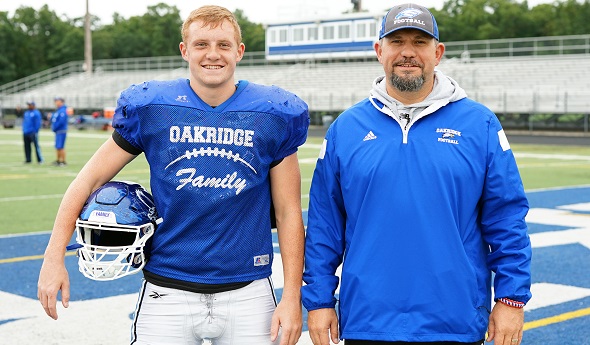
'Oakridge Family' True in Name & Purpose
October 3, 2018
By Tom Kendra
Special for Second Half
Every football team talks about being a family.
 But at Muskegon Oakridge, it’s more than just a motto.
Three of the Oakridge varsity coaches have sons on the team, including head coach Cary Harger with two-way starting senior lineman Cole Harger.
“It does make it extra special, being a senior and playing for my dad,” said Cole Harger of the Eagles’ high-flying start, which has them 6-0 and ranked No. 3 in Division 5 in the latest Associated Press poll.
“The family thing is real out here. This is such a tight-knit community, and we’re just together all the time. We know each other so well and know how to push each other.”
Oakridge faces its toughest test of the season Friday when it hosts conference rival Montague (5-1), which comes in riding a five-game winning streak and ranked No. 10 in Division 5.
Oakridge has been the dominant team for almost 40 years in the West Michigan Conference, a league which has put 14 teams in MHSAA state championship games and celebrated nine Finals winners. Oakridge has made it five times, winning titles in 1997, 2005 and 2008.
Early on in that stretch, the Eagles’ main league rival was North Muskegon, and later Ravenna. In the 2000s, the most competitive rivalries shifted north to the White Lake area in Whitehall and Montague, particularly Montague.
Oakridge is 7-4 against Montague over the past 11 years, with many of those games classic back-and-forth battles that came down to the final minutes (and sometimes, seconds). But the only game that anyone at Oakridge seems to remember is from a year ago, when host Montague pounded Oakridge 40-0 – the most lopsided conference loss in school history.
“We have waited 51 weeks for the opportunity to erase that memory,” said senior linebacker Jaden Parker, whose father, Tim, is the Oakridge defensive coordinator. “We got shell-shocked last year and didn’t fight back. This year we have more seniors, and we won’t let that happen again.”
 This year’s matchup features two of Michigan’s top running backs. Montague senior Bryce Stark, a returning Associated Press all-stater, has gained 542 yards on 74 carries (7.3 per carry), despite being slowed early in the year with a knee injury. Oakridge counters with battering ram junior fullback Leroy Quinn (6-1, 216), the leading rusher in the Greater Muskegon area with 111 carries for 1,119 yards (10.1 average) and 19 touchdowns.
Coach Harger is quick to point out that Stark is just one of many weapons on this Montague team who worries his team.
“The first thing that strikes you about Montague is their athleticism and the number of quality athletes we have to focus on,” said Harger, a 1990 Oakridge graduate. “But they are also big up front, so you have to be concerned with that, as well. We need to play our best game.”
The final father-son connection on the Oakridge varsity staff is offensive coordinator Nate Danicek and his son, Jacob, a sophomore who starts at safety and plays slot receiver on offense when the Eagles break out of their full-house backfield and go with a spread look.
But the Oakridge football family goes far beyond just the coaching staff – it’s a way of life.
After a long practice Tuesday evening, Coach Harger and Coach Parker (whose fathers coached them on an Oakridge youth football team almost 40 years ago) went down the varsity roster and quickly pointed out all of the players whose fathers also played varsity football at Oakridge.
On that list is senior starting quarterback Koleman Wall (6-3, 197), whose father, Scott Wall, was the starting fullback on the 1990 team, the first Oakridge team to reach the MHSAA title game. Other father-son duos are starting running back and linebacker Blake Masterman (father Dan Masterman), starting center Mavrick McLouth (Dude McLouth), Jacob Barber (Nate Barber) and Sander Brott (David Brott).
Sander Brott is also a third-generation Eagle, as his grandfather, Mark Fazakerley, played on the first Oakridge varsity team in 1966.
“We are doing our best to carry on the tradition that Jack Schugars started out here,” said Coach Parker, referencing Schugars, who had a 262-78 record in 31 seasons at Oakridge from 1979 to 2010. “It’s a point of pride that these are all Oakridge kids. We don’t have schools of choice, so almost every one of these kids has been playing together since the youth leagues.”
The Oakridge youth league still boasts more than 150 players and is the starting point for one of the state’s most consistent programs.
 With its six consecutive wins to open the season, Oakridge has qualified for the playoffs for the 15th straight year and 23rd of the past 24. Many believe this team could be good enough to get all the way to Ford Field for the first time since 2008.
The Eagles have an experienced backfield led by Quinn, but also featuring speedy senior Masterman (359 yards) and multi-talented senior Jalen Hughes (315 yards). Wall provides a fourth running threat and has been efficient through the air, completing 28-of-43 passes for 516 yards and 10 touchdowns, with just one interception.
The defense is led by senior tackle Brandon Wilde (5-9, 212), who has 38 tackles on the season with half of those tackles in the backfield for negative yardage, including six sacks. Masterman leads the team with 40 tackles, and senior cornerback Jaxon Fri has three interceptions.
Oakridge could possibly play Montague a second time in the playoffs. Montague has traditionally been a Division 6 playoff team, but with its enrollment up 36 students from last year to 445, it could end up with Oakridge in Division 5.
Another possible Eagles rematch down the road is with top-ranked Saginaw Swan Valley, which beat Oakridge in last year’s MHSAA Regional Final, 48-14.
The “Oakridge family” isn’t looking near that far ahead, but is focused on proving itself after last year’s lopsided loss at Montague.
“The way we played in that game last year was our biggest motivation all offseason,” said Cole Harger. “That wasn’t Oakridge football. I think one of our biggest strengths this year is our togetherness as a team, and we have the opportunity to prove that on Friday night.”
 Tom Kendra worked 23 years at The Muskegon Chronicle, including five as assistant sports editor and the final six as sports editor through 2011. E-mail him at [email protected] with story ideas for Muskegon, Oceana, Mason, Lake, Oceola, Mecosta and Newaygo counties.
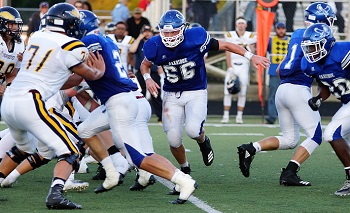
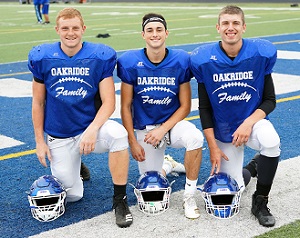
PHOTOS: (Top) Senior Cole Harger and Oakridge coach Cary Harger are one of three sets of fathers and sons on the varsity this season. (Middle) Harger (66), a two-way starting lineman, lines up his block during a Week 2 win over North Muskegon. (Below) Harger, with Jacob Danicek (middle) and Jaden Parker, whose fathers also are on the coaching staff. (Photos by Sherry Wahr.)
Drive for Detroit: Semifinals in Review
November 21, 2016
By Geoff Kimmerly
Second Half editor
After nearly four months, this drive for Detroit is nearly complete.
Sixteen teams remain for this weekend's eight MHSAA 11-Player Finals at Ford Field in Detroit. Below is a glance at how all 16 earned their end-of-season trips, with a number of them frequent visitors to the season's final days.
Division 1
Detroit Catholic Central 17, Romeo 0
The Shamrocks eliminated the reigning Division 1 champion in a matchup of last season’s Regional Final, a 40-29 Romeo win. Detroit Catholic Central (13-0) is on course for its best defensive season since 2011 and a win away from its first undefeated season since 2009. For Romeo (9-4), the loss ends a two-season run that saw the Bulldogs play in their second and third Semifinals ever (and first since 1992) while earning their first MHSAA team title and finishing a combined 22-5. Click for more from the Observer & Eccentric.
Detroit Cass Tech 32, Utica Eisenhower 28
Cass Tech standout receiver Donovan Peoples-Jones caught a 20-yard touchdown pass from quarterback Rodney Hall with only 24 seconds to play to push the Technicians (13-0) ahead of Eisenhower and soon after back into the Division 1 Final for the second straight season and fourth time this decade. The reigning runner-up in this division won its second straight nail-biter after downing Saline by one in the Regional Final, handing Eisenhower (12-1) its first loss after doing the same to the Hornets the week before. Click for more from the Detroit Free Press.
Division 2
Walled Lake Western 37, Lowell 34
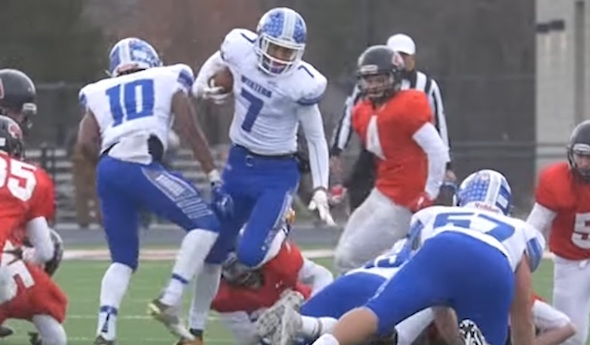
The Red Arrows (12-1), last season’s Division 2 runners-up, found themselves in a comeback quest for the second week in a row but couldn’t come all the way back in this rematch of a 2015 Semifinal. Walled Lake Western (12-1) led 31-14 at halftime and held Lowell off for the final 7:46 to advance to its first championship game since 1999. The Warriors had lost to Lowell 49-34 in the meeting a year ago. Click for more from the Oakland Press.
Detroit Martin Luther King 14, Birmingham Groves 7
King earned a chance to repeat as Division 2 champion with a defensive stand after heading into halftime up 14-0. The Crusaders (11-2) hadn’t scored fewer than 18 points since Week 1 of 2015, but were able to ride out the final two quarters relying on a defense that has given up only 35 points over four playoff games. Groves finished its first Semifinal run 11-2, setting a program record for wins for the second straight season after finishing 10-1 in 2015. Click for more from the Detroit News.
Division 3
Muskegon 19, Edwardsburg 8
This defensive standoff saw both teams easily score their fewest points this season – but Muskegon advance to its fourth championship game in five years while keeping Edwardsburg from advancing to the MHSAA Finals for the first time. The Big Reds (12-1) increased their school record points total to 653 and locked down an Eddies team that hadn’t scored fewer than 30. Edwardsburg finished 12-1, setting a program record for victories in one season. Click for more from the Muskegon Chronicle.
Orchard Lake St. Mary’s 49, Dearborn Divine Child 7
St. Mary’s will play for its third straight Division 3 championship and in its seventh MHSAA Final over the last eight seasons. Divine Child (10-3) was one of the surprises of the playoffs and finished with its most wins since 1985, but couldn’t come back after the Eaglets scored three times during the first quarter and three more times during the second. Click for more from the Oakland Press.
Division 4
Grand Rapids Catholic Central 31, Hudsonville Unity Christian 3
The Cougars (12-1) will play for a championship for the first time since 2010 after ending Unity Christian’s longest playoff run with another impressive defensive performance. GRCC has given up 10 points total over four playoff games and with Grand Rapids West Catholic in Division 5 gives the Ottawa-Kent Conference Blue two finalists this weekend. Unity Christian finished 10-3, two wins better than any season since the program began in 2003. Click for more from the Grand Rapids Press.
Detroit Country Day 20, River Rouge 14
After two straight Semifinal misses, Country Day will play in its second championship game in five seasons after eliminating last year’s Division 5 runner-up. River Rouge (11-2) held the Yellowjackets to their fewest points since opening night, but also scored its fewest since a 2014 Regional Final loss. Country Day (13-0) didn’t score during the second half, but Rouge didn't find the end zone again after scoring on its first possession of the third quarter. Click for more from State Champs! Sports Network.
Division 5
Menominee 23, Frankenmuth 20
Sam Larsen’s 1-yard touchdown blast up the middle with 9:27 to play stood as the winning points in a back-and-forth contest at the Superior Dome. Playing in its seventh Semifinal over the last 11 seasons, Menominee (12-1) earned its fourth championship game of this run and first since 2013. Frankenmuth (11-2) gave the Maroons their second-closest game of this season – the other was a loss to DeWitt in Week 8 – and tied its school record for wins with the most since the program’s last Semifinal run in 1997. Click for more from the Marinette (Wis.) Eagle Herald.
Grand Rapids West Catholic 17, Algonac 0
Reigning Division 5 champion West Catholic (11-2) completed an impressive even if not altogether unexpected run through three road games and a neutral-site semi to return to Ford Field. Defense has been the story for the Falcons this season, and they added a shutout after holding their first three playoff opponents to a combined 20 points. Algonac, in its first Semifinal appearance, held West Catholic to the latter’s second fewest points this season. But the Muskrats (11-2) failed to get on the board for the first time since Week 3 of 2014. Click for more from the Grand Rapids Press.
Division 6
Maple City Glen Lake 34, Leroy Pine River 20
Glen Lake’s earned it first trip to the Finals in football since 1996 on the success of a run game that was able to navigate the snowy conditions at Thirlby Field in Traverse City. Pine River (9-4), playing in its first Semifinal, had given up only 33 points total over the first three playoff games. Glen Lake (11-2), with the win, tied for its most in a season also since that 1996 run. Click for more from the Traverse City Record-Eagle.
Jackson Lumen Christi 27, Millington 7
Lumen Christi (11-2) is headed back to Ford Field for its first championship game since 2009 thanks in part to a second-straight single-digit performance by its defense. After holding Napoleon to only six points in the Regional Final, the Titans kept Millington to its fewest this fall (Millington also had scored only seven against Frankenmuth in Week 5). The Semifinal was the first for the Cardinals (11-1) since back-to-back trips in 2009 and 2010. Click for more from the Jackson Citizen-Patriot.
Division 7
Pewamo-Westphalia 34, Ubly 16
The Pirates (13-0) will return to the Division 7 Final after finishing runner-up a year ago. And they booked the trip by downing an undefeated team for the third straight week, handing Ubly (12-1) a first loss after doing the same to Traverse City St. Francis in the Regional Final and Saugatuck in the District championship game. After missing 100 yards rushing last week for the first time in three seasons, Pirates running back Jared Smith came back with 119 yards and two scores on 17 carries. Click for more from the Lansing State Journal.
Detroit Loyola 54, Cassopolis 22
Loyola will play in its fourth championship game in five seasons seeking to add to its 2014 title after continuing a playoff run that has seen the Bulldogs beat four league title winners and all by at least 23 points. Cassopolis (11-2), champion of the Berrien-Cass-St. Joseph Conference Red, was playing in its first Semifinal and set a program record this fall for victories. But the usually defense-strong Rangers couldn’t stop a Loyola attack that scored its second-most points this season. Click for more from State Champs! Sports Network.
Division 8
Muskegon Catholic Central 35, St. Ignace 0
The Crusaders (13-0) will play for a fourth straight Division 8 championship after improving on a Week 2 win over the Saints. MCC had beaten St. Ignace 21-6 in that first meeting, and led this one 21-0 by the end of its first possession of the second half. The shutout was the Crusaders’ third straight, and they’ve given up only seven points total over four playoff games. MCC also defeated the Saints (11-2) in a Semifinal last season. Click for more from the Muskegon Chronicle.
Ottawa Lake Whiteford 40, Saginaw Michigan Lutheran Seminary 21
Whiteford (13-0) has been building for years toward what will be its first championship game , and broke through after also playing but falling in a Semifinal a year ago. Jesse Kiefer ran for 183 yards and three touchdowns as the team piled up 526 yards of total offense, and the defense held mostly tight despite 152 yards rushing and two scores by MLS’s Casey Williams on only eight carries. The Cardinals finished 10-3 after reaching their second Semifinal in three seasons. Click for more from the Saginaw News.
PHOTO: Walled Lake Western's Cody White breaks through the line against Lowell in their Division 2 Semifinal on Saturday. (Photo courtesy of State Champs! Sports Network.)