

Oakridge's Schugars Always To Be 'Coach'
April 26, 2013
By Geoff Kimmerly
Second Half editor
Jack Schugars led five Muskegon Oakridge teams to MHSAA football championship games during his 32 seasons running the program. He finished his high school coaching career in 2010 with a record of 262-78.
And of course, he impacted hundreds of lives in a community that, according to a former assistant, considers him a "saint."
Schugars was honored last week with the Duffy Daugherty Award for his outstanding achievements in high school football. Each spring, the Duffy Daugherty committee – made up of football supporters and media from the Lansing area – recognizes a high school coach along with a past or current college coach. The college award is among those recognized by the College Football Hall of Fame.
Among previous high school honorees present to congratulate Schugars during Thursday's banquet in East Lansing were Farmington Hills Harrison’s John Herrington, Birmingham Brother Rice’s Al Fracassa and former East Lansing coach Jeff Smith.
Schugars – now an assistant at Ferris State University – led his 1997, 2005 and 2008 teams to MHSAA titles, while his 1990 and 2003 teams finished MHSAA runners-up. He is a member of the Muskegon Sports Hall of Fame (class of 2009), the Michigan High School Coaches Association Hall of Fame (2008) and the Michigan High School Football Coaches Association Hall of Fame (1993). He received the MHSFCA’s highest honor, the Jim Crowley Award, in 2000.
The Schugars family is rooted in education. He also taught biology at the high school for 38 years, while his wife Julie taught English. Their daughter Amanda teaches in Battle Creek, and son Eric teaches and is the defensive coordinator at Traverse City Central.
Below are brief excerpts from the introduction of Schugars by his former football assistant and current Oakridge softball coach Joe Coletta, followed by Schugars' closing words of wisdom.
‘Faith, Family, Football’
(Coletta) “To Jack, those are not just words of hollow meaning. They are his compass.
 “Jack has won countless awards for his accomplishments on the football field. He absolutely refused to let anyone outwork him or his teams in preparation for a football game.
“But in my opinion, his strength as a football coach is his ability to take a kid that most people would give up on: a kid that some might label as no good, troublemaker, not worth the effort. He found a way to love the unlovable.
“He would give those kids direction; he would mentor them to be young men and young women and take them to where they could not possibly take themselves.
"When you can do that for a person, you let them see their worth as a human being and make a lasting impact so you can change the rest of their lives.
“That, to me, is what sets Jack apart from most coaches.”
What's most important
(Schugars) “The reason I'm on this Earth is to love the Lord your God with all my heart and soul and love your neighbors as yourself.
“So when I speak at clinics, when I talk to coaches, I tell them the greatest thing they can do for their team is to love their players.
“That is the greatest thing a coach can do. Love your players and be true role models each day.
“I could not ask for a better career than when ... a (former) player in the Navy Seal team calls me Coach. Lawyers, doctors, bankers, they call you Coach.
"Wow, that's a great word: Coach. That's what it's all about. Being a coach. Building relationships that will last a lifetime.
"I love the hundreds of players that are part of the Oakridge football family. And I hope I continue to build men out of boys, continue at the college level."
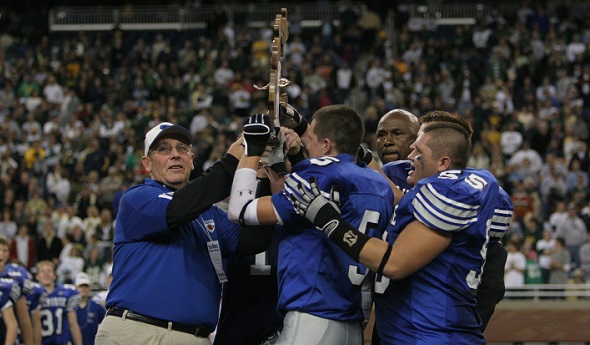
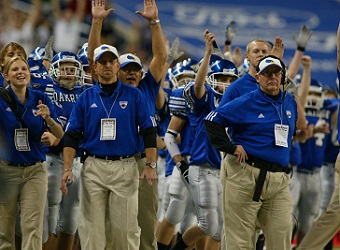
PHOTOS: (Top) Former Muskegon Oakridge football coach Jack Schugars holds up the 2005 Division 5 championship trophy with his players after their victory at Ford Field. (Middle) Schugars (right, with headset) monitors his team's play on the field against Jackson Lumen Christi.
A Game for Every Fan: Week 9
October 21, 2015
By Geoff Kimmerly
Second Half editor
This week more than any other requires a different perspective when considering what football games could turn out as the most significant when the final scores come in Saturday night.
There are still a few league titles to be contested, and we highlighted most of those below. There are 45 teams hoping to finish the regular season undefeated, and we’ve noted a number of those too – including the only game pitting 8-0 teams, Freeland at Frankenmuth.
But we’re also watching closely 90 teams that can guarantee a playoff spot with a Week 9 win – with 12 games pitting 11-player teams with 5-3 records and Parma Western and Detroit Edison Public School Academy needing a victory to join Detroit Cesar Chavez Academy among those this season earning postseason bids for the first time.
Be sure to tune in all weekend to the MHSAA Score Center for results as they come in, updated standings and playoff point averages, and watch Fox Sports Detroit at 7 p.m. Sunday to see the playoff field and brackets for the first time. (There are 13 games on Thursday this week. All games below are Friday unless noted.)
Bay & Thumb
Linden (7-1) at Fenton (7-1)
Four of these teams' last five meetings have been decided by a touchdown or less – and this one will decide an outright league champion. Fenton’s last loss in Flint Metro League play was on opening night 2012 to Linden, and the Tigers have shared or won outright the last four league titles – with Linden tying for first in 2012 and winning outright the year before Fenton’s streak started, in 2010.
Others that caught my eye: Freeland (8-0) at Frankenmuth (8-0), Midland (7-1) at Midland Dow (7-1), Lapeer (8-0) at Davison (5-3), New Lothrop (8-0) at Montrose (5-3).
Greater Detroit
Detroit Martin Luther King (8-0) vs. Detroit Cass Tech (7-1) at Ford Field
We detailed this rivalry before Week 5, when the two met in what eventually decided the Detroit Public School League East I championship for King. The Crusaders won 31-28 in overtime that day, and have given up a total of eight points over three games since – although two of those games were against the same team because of a rematch in the PSL Semifinals. Cass Tech no doubt has been waiting for this rematch – the Technicians haven’t lost two straight to King since the 2005-2006 regular seasons.
Others that caught my eye: Detroit Central Collegiate (6-2) vs. Detroit Collegiate Prep (8-0) at Ford Field; Warren DeLaSalle (6-2) vs. Orchard Lake St. Mary's (6-1) at Ford Field, Saturday; Detroit Loyola (6-2) vs. Pontiac Notre Dame Prep (7-1) at Ford Field, Saturday; Farmington Hills Harrison (7-1) at West Bloomfield (8-0).
Mid-Michigan
Grand Ledge (8-0) at Holt (5-3)
It’s fair to say few saw Holt competing for a league title after dropping its first two games to Hudsonville and Rockford by a combined score of 75-14. But the Rams, under first-year coach Chad Fulk, ran off five straight wins before coming up short last week against Jackson. Grand Ledge has won four of the last five against its biggest rival and has a share of the Capital Area Activities Conference Blue title regardless of what happens this weekend – but Holt can gain a share as well.
Others that caught my eye: St. Ignace (7-1) at Fowler (6-2), Marshall (7-1) at Portland (8-0), Clare (5-3) at Harrison (6-2), Novi (4-4) at Howell (5-3).
Northern Lower Peninsula
Charlevoix (5-3) at Harbor Springs (5-3)
There are a number of good matchups in the northern Lower Peninsula this week, but this is the only one that will guarantee the winner a playoff berth. Charlevoix is second and Harbor Springs tied for third in the Northern Michigan Football League Legends division, and neither can catch champion Frankfort. But the Red Rayders are looking for a second straight playoff appearance coming off back-to-back 1-8 finishes in 2012 and 2013, and Harbor Springs hasn’t had a .500 record or made the playoffs since 2000.
Others that caught my eye: Kingsley (5-3) at Traverse City St. Francis (8-0), Saturday; Onekama (7-1) at Frankfort (7-1), Walled Lake Northern (5-3) at Traverse City West (4-4), Indian River Inland Lakes (5-3) at Johannesburg-Lewiston (7-1).
Southeast & Border
Ottawa Lake Whiteford (7-1) at Clinton (8-0)
Clinton has won 27 straight Tri-County Conference games (and 35 straight total during the regular-season), and once again no league opponent has come within two touchdowns of the Redskins. But Whiteford has come as close as anyone the last few years, falling by only two points to Clinton in 2012 and scoring 30 in a 24-point loss last fall. The Bobcats have tied last season’s win total and guaranteed a fourth straight playoff berth, and have nothing to hold back in this league finale.
Others that caught my eye: Jackson (6-2) at Jackson Lumen Christi (6-2), Homer (7-1) at Manchester (7-1), Lansing Catholic (7-1) at Monroe St. Mary Catholic Central (8-0), Dexter (0-8) at Parma Western (5-3).
Southwest Corridor
St. Joseph (7-1) at Portage Central (8-0)
For the second time in three seasons, the Southwestern Michigan Athletic Conference West title will come down to this matchup. Portage Central already owns a share, but St. Joseph can snag one as well if it can end a three-game losing streak to the Mustangs. They almost ended it last season, falling to Portage Central 21-14 in the regular-season finale. The Mustangs know how to finish those games though; they’ve won two by seven or fewer points this fall.
Others that caught my eye: Portage Northern (4-4) at Benton Harbor (4-4), Delton Kellogg (5-3) at Schoolcraft (8-0), Mount Pleasant Sacred Heart (5-3) at Mendon (5-3), Buchanan (8-0) at Niles Brandywine (5-3).
Upper Peninsula
Crystal Falls Forest Park (5-2) at Lake Linden-Hubbell (8-0)
This has turned into a season of good-byes at least a little for Forest Park since the announcement a few weeks ago that it would move to 8-player in 2015. The Trojans have rallied to split the Mid-Eastern Conference title and make the playoffs for the 19th straight season, and can deal a massive blow to rival Lake Linden-Hubbell by extending a five-game winning streak over the Lakes, who haven’t had a game closer than 12 points this season.
Others that caught my eye: Negaunee (6-2) at Ishpeming Westwood (5-3), Escanaba (4-4) at Kingsford (6-2), L'Anse (5-3) at Munising (6-2), Menominee (8-0) at Marquette (3-4).
West Michigan
Hudsonville (6-2) at Rockford (5-3)
Not only is the Ottawa-Kent Conference Red title on the line – four teams are tied for first, guaranteeing there will be multiple champions – but Rockford needs a victory to continue a 20-season playoff streak, the third-longest in MHSAA history and active leader. These rivals have split their last four meetings – Rockford winning during the regular season and Hudsonville in playoff rematches the last two years.
Others that caught my eye: Grandville (5-3) at East Kentwood (6-2), Lowell (7-1) at Grand Rapids Christian (5-3), McBain (6-2) at Reed City (8-0), Ada Forest Hills Eastern (8-0) at Grand Rapids Forest Hills Northern (6-2).
8-Player
Battle Creek St. Philip (8-0) at Lawrence (7-1)
St. Philip is a combined 34-7 over the last four seasons, but Lawrence has been an obstacle since the latter went to 8-player football in 2013. St. Philip won their first meeting, 54-50, but Lawrence has won the last three and ended St. Phil’s last two seasons in Regional Finals. Lawrence has continued to roll despite graduating a strong nucleus from last season’s MHSAA championship-winning team. It hasn’t lost in-state in two years, with this season’s defeat to reigning Wisconsin champion Prairie Farm two weeks ago.
Others that caught my eye: Pickford (5-3) at Onaway (5-3), Morrice (7-1) at Portland St. Patrick (6-2).
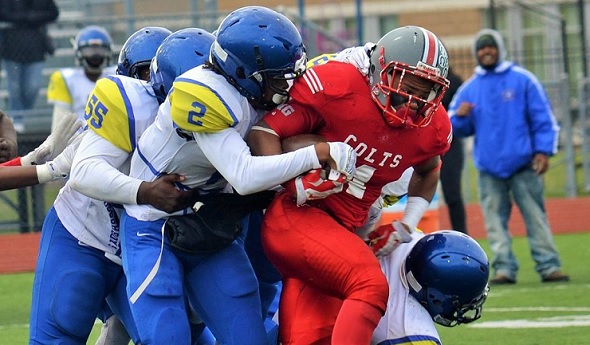
PHOTO: Detroit Collegiate Prep, in red, and enjoying its best season since 2007 (as Detroit Northwestern), will face Detroit Central Collegiate in the Public School League Division II championship game at Ford Field. (Photo courtesy of the Detroit Public School League.)