

Oakridge's Schugars Always To Be 'Coach'
April 26, 2013
By Geoff Kimmerly
Second Half editor
Jack Schugars led five Muskegon Oakridge teams to MHSAA football championship games during his 32 seasons running the program. He finished his high school coaching career in 2010 with a record of 262-78.
And of course, he impacted hundreds of lives in a community that, according to a former assistant, considers him a "saint."
Schugars was honored last week with the Duffy Daugherty Award for his outstanding achievements in high school football. Each spring, the Duffy Daugherty committee – made up of football supporters and media from the Lansing area – recognizes a high school coach along with a past or current college coach. The college award is among those recognized by the College Football Hall of Fame.
Among previous high school honorees present to congratulate Schugars during Thursday's banquet in East Lansing were Farmington Hills Harrison’s John Herrington, Birmingham Brother Rice’s Al Fracassa and former East Lansing coach Jeff Smith.
Schugars – now an assistant at Ferris State University – led his 1997, 2005 and 2008 teams to MHSAA titles, while his 1990 and 2003 teams finished MHSAA runners-up. He is a member of the Muskegon Sports Hall of Fame (class of 2009), the Michigan High School Coaches Association Hall of Fame (2008) and the Michigan High School Football Coaches Association Hall of Fame (1993). He received the MHSFCA’s highest honor, the Jim Crowley Award, in 2000.
The Schugars family is rooted in education. He also taught biology at the high school for 38 years, while his wife Julie taught English. Their daughter Amanda teaches in Battle Creek, and son Eric teaches and is the defensive coordinator at Traverse City Central.
Below are brief excerpts from the introduction of Schugars by his former football assistant and current Oakridge softball coach Joe Coletta, followed by Schugars' closing words of wisdom.
‘Faith, Family, Football’
(Coletta) “To Jack, those are not just words of hollow meaning. They are his compass.
 “Jack has won countless awards for his accomplishments on the football field. He absolutely refused to let anyone outwork him or his teams in preparation for a football game.
“But in my opinion, his strength as a football coach is his ability to take a kid that most people would give up on: a kid that some might label as no good, troublemaker, not worth the effort. He found a way to love the unlovable.
“He would give those kids direction; he would mentor them to be young men and young women and take them to where they could not possibly take themselves.
"When you can do that for a person, you let them see their worth as a human being and make a lasting impact so you can change the rest of their lives.
“That, to me, is what sets Jack apart from most coaches.”
What's most important
(Schugars) “The reason I'm on this Earth is to love the Lord your God with all my heart and soul and love your neighbors as yourself.
“So when I speak at clinics, when I talk to coaches, I tell them the greatest thing they can do for their team is to love their players.
“That is the greatest thing a coach can do. Love your players and be true role models each day.
“I could not ask for a better career than when ... a (former) player in the Navy Seal team calls me Coach. Lawyers, doctors, bankers, they call you Coach.
"Wow, that's a great word: Coach. That's what it's all about. Being a coach. Building relationships that will last a lifetime.
"I love the hundreds of players that are part of the Oakridge football family. And I hope I continue to build men out of boys, continue at the college level."
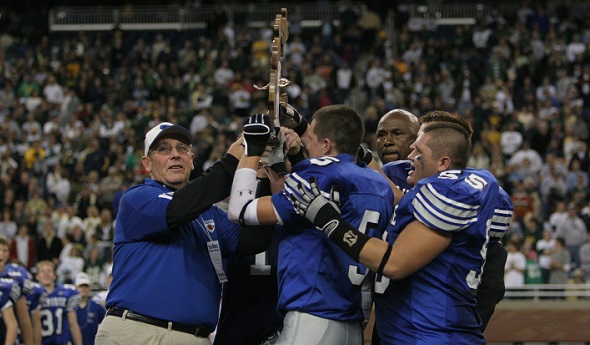
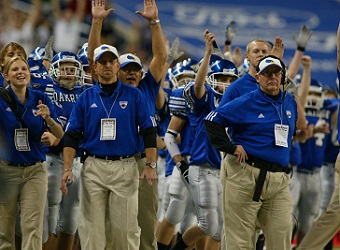
PHOTOS: (Top) Former Muskegon Oakridge football coach Jack Schugars holds up the 2005 Division 5 championship trophy with his players after their victory at Ford Field. (Middle) Schugars (right, with headset) monitors his team's play on the field against Jackson Lumen Christi.
Transformed Shores Continues to Rise
September 8, 2015
By Tom Kendra
Special for Second Half
This is not your father’s Muskegon Mona Shores football team.
Or even your older brother’s.
 This is not the team that went its first 51 years of football without making the MHSAA playoffs and whose only traffic jams leaving its parking lot occurred early in the third quarter – when the band was done performing.
Heading into one of the state’s marquee Week 3 matchups at home against perennial Division 1 powerhouse Rockford, Shores is looking to snap a 10-game losing streak against the Rams, which has included some forgettable affairs like a 49-7 loss in 2000 and 10-7 loss last fall, the Sailors’ lone regular-season defeat.
“Great job tonight,” Mona Shores coach Matt Koziak told his huddled players last Thursday night, allowing them a few seconds to enjoy their 2-0 start and a dominating 55-14 win over host Fruitport, before quickly shifting gears.
“But now we have Rockford coming to our place. We can’t make the mistakes we made tonight, or they will make us pay for it. We have to play top-notch.”
The emergence of Mona Shores as a power has changed the landscape of football, not only in the Muskegon area, but West Michigan as a whole. As other Muskegon-area schools struggle with declining enrollment – most notably Muskegon High, Muskegon Heights and Muskegon Catholic Central – Mona Shores is now the largest school in Muskegon County and a legitimate force, bursting onto the state scene with a memorable run to last year’s Division 2 championship game at Ford Field.
After putting up 55 points in back-to-back wins over Holland West Ottawa and Fruitport to open the season (and with their defense not allowing a single point), the Sailors are showing that the 2014 season was far from a flash in the pan.
“Last year we were the hunters; now we’re the hunted,” explained senior quarterback Tyler Trovinger, who set a school record with six TD passes in the Week 2 win over Fruitport. “We have to be great because no one is looking past us anymore.”
The Sailors’ fortunes, and attitudes, began to change in 2011 with the hiring of Koziak as head football coach. He turned out to be the perfect choice, as a 1994 Mona Shores graduate who cut his coaching teeth at Muskegon High School under Tony Annese, serving as offensive coordinator when the Big Reds won MHSAA titles in 2006 and 2008 and as head coach for one year in 2009.
His words upon taking the Mona Shores job in 2011 were prophetic:
“I'm tired of people badmouthing my school,” Koziak told The Muskegon Chronicle at that time. “I’ve heard people say the Shores kids are cake-eaters. It’s not true. There are a lot of blue-collar kids and families there. I’m excited to change the football culture.”
While Koziak knew Shores football history, he also was smart enough to recognize changes that needed to be made – beginning with the installation of the spread option, veer attack which was so effective across town at Muskegon High.
The most notable player was quarterback Tyree Jackson, who Koziak inserted into the starting lineup as a 5-foot-9 freshman. After struggling mightily and making people question whether the new coach was running the wrong system, Jackson sprouted to 6-4 and started throwing to targets like Asantay Brown and Marquon Sargent.
 Brown is now a starting safety at Western Michigan University, Sargent is at Grand Valley State University and Jackson is a freshman quarterback at the University of Buffalo, but the Mona Shores system and the athletes haven’t missed a beat.
Trovinger (5-11, 200 pounds) has stepped into Jackson’s big shoes and possesses a cannon for an arm and terrific running ability.
Trovinger’s passing options are nothing short of an embarrassment of riches. Three of the starters in the Sailors’ four-wide attack have already made Division I college commitments – Hunter Broersma (6-2, 190) and Darece Roberson (5-9, 165) to Western Michigan and Kobe Burse (6-3, 205) to Miami of Ohio – with the fourth starter being dangerous Deandre Oakes-Owens (6-0, 175), an all-league selection as a defensive back last season.
“We have a ton of weapons, no doubt,” Trovinger said. “When we’re all focused, we’re a force to be reckoned with.”
The defense is led by two more senior standouts who could possibly sign with Division I schools. Dom Shermeta (6-0, 215) is a Chris Spielman clone at middle linebacker and a battering-ram fullback, and Christian Boyd (6-2, 280) is a run-stuffer at left defensive tackle.
Koziak said a big part of the Shores turnaround is the supportive administration, notably seventh-year athletic director Ryan Portenga, the outspoken, energetic and unapologetic leader of the Shores athletic program.
Portenga has written a book about the Mona Shores football turnaround and the storybook 2014 season, entitled: “Flipping Football: A True Story of Resilience and Transformation.” The book, which costs $20, will be released Friday, in conjunction with the Rockford game.
“It’s a story that needed to be told,” said Portenga, who noted that half of the proceeds from the sale of the book will go to the Shores athletic program.
So … with all of this talent, all this excitement, all this momentum (even a book!), are the Sailors ready to take the next step and knock off the biggest kid on the block – Rockford? Or will the Rams’ mystique win out again?
It’s the same question Muskegon-area residents were asking last October, when the upstart Sailors traveled to historic Hackley Stadium to face the Big Reds, which had downed Shores 14 games in a row. Shores matched the athletes for Muskegon and made believers out of many in a convincing 48-27 victory.
While every eye in Muskegon was on that game, many eyes from around the state will now be on Sailor Stadium when a senior-laden Rockford team comes to town Friday, looking to swat away the latest challenger to its perch atop the West Michigan football heap.
Rockford (1-1) is coming off a 47-0 romp over visiting Holt, and will bring its usual big offensive line, bevy of running backs and unparalleled special teams – especially senior kicker and punter Quinn Nordin, who has committed to sign with Penn State University.
The Rams have extra motivation as coach Ralph Munger has 299 career coaching victories over his 36-year career, the first 12 spent at Frankenmuth and the past 24 at Rockford. His next win would make him the 11th coach in state history to register 300 wins.
Shores is not motivated to deny Munger, but rather to avenge last year’s 10-7 loss at Rockford. In that game, Roberson scored on a 79-yard run on the first play from scrimmage, but failed to score again, fumbling twice in the fourth quarter.
With a huge crowd expected for the rematch, Koziak said his players will be motivated to come out and not let another game against the Rams slip away.
“We talked about how Rockford beat us last year,” said Koziak, who is assisted on the varsity level by Brian Sikkenga, Holsey James and Aaron James, Chris Hilliker and Kyle Brott. “They have that in the back of their minds that they let one get away, and that’s motivation for them.
“I think there’s a new energy for football with what we’ve been able to build the last four years. The community has waited forever for this. They’re ecstatic.”
 Tom Kendra worked 23 years at The Muskegon Chronicle, including five as assistant sports editor and the final six as sports editor through 2011. E-mail him at [email protected] with story ideas for Muskegon, Oceana, Mason, Lake, Oceola, Mecosta and Newaygo counties.
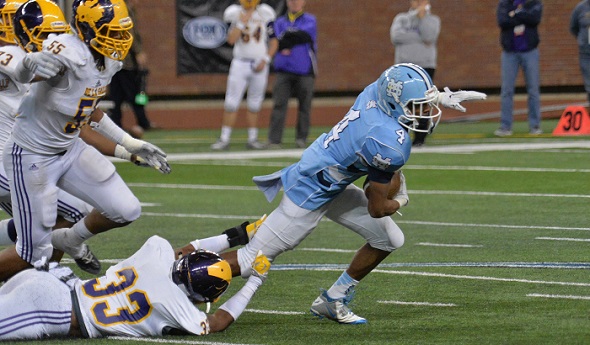
PHOTOS: (Top) Mona Shores’ Darece Roberson strides for additional yardage during last season’s MHSAA Division 2 Final against Warren DeLaSalle. (Middle) Tyler Trovenger, surrounded by teammates, celebrates his third-quarter touchdown catch at Ford Field. He moved to quarterback this fall.