

Oakridge's Schugars Always To Be 'Coach'
April 26, 2013
By Geoff Kimmerly
Second Half editor
Jack Schugars led five Muskegon Oakridge teams to MHSAA football championship games during his 32 seasons running the program. He finished his high school coaching career in 2010 with a record of 262-78.
And of course, he impacted hundreds of lives in a community that, according to a former assistant, considers him a "saint."
Schugars was honored last week with the Duffy Daugherty Award for his outstanding achievements in high school football. Each spring, the Duffy Daugherty committee – made up of football supporters and media from the Lansing area – recognizes a high school coach along with a past or current college coach. The college award is among those recognized by the College Football Hall of Fame.
Among previous high school honorees present to congratulate Schugars during Thursday's banquet in East Lansing were Farmington Hills Harrison’s John Herrington, Birmingham Brother Rice’s Al Fracassa and former East Lansing coach Jeff Smith.
Schugars – now an assistant at Ferris State University – led his 1997, 2005 and 2008 teams to MHSAA titles, while his 1990 and 2003 teams finished MHSAA runners-up. He is a member of the Muskegon Sports Hall of Fame (class of 2009), the Michigan High School Coaches Association Hall of Fame (2008) and the Michigan High School Football Coaches Association Hall of Fame (1993). He received the MHSFCA’s highest honor, the Jim Crowley Award, in 2000.
The Schugars family is rooted in education. He also taught biology at the high school for 38 years, while his wife Julie taught English. Their daughter Amanda teaches in Battle Creek, and son Eric teaches and is the defensive coordinator at Traverse City Central.
Below are brief excerpts from the introduction of Schugars by his former football assistant and current Oakridge softball coach Joe Coletta, followed by Schugars' closing words of wisdom.
‘Faith, Family, Football’
(Coletta) “To Jack, those are not just words of hollow meaning. They are his compass.
 “Jack has won countless awards for his accomplishments on the football field. He absolutely refused to let anyone outwork him or his teams in preparation for a football game.
“But in my opinion, his strength as a football coach is his ability to take a kid that most people would give up on: a kid that some might label as no good, troublemaker, not worth the effort. He found a way to love the unlovable.
“He would give those kids direction; he would mentor them to be young men and young women and take them to where they could not possibly take themselves.
"When you can do that for a person, you let them see their worth as a human being and make a lasting impact so you can change the rest of their lives.
“That, to me, is what sets Jack apart from most coaches.”
What's most important
(Schugars) “The reason I'm on this Earth is to love the Lord your God with all my heart and soul and love your neighbors as yourself.
“So when I speak at clinics, when I talk to coaches, I tell them the greatest thing they can do for their team is to love their players.
“That is the greatest thing a coach can do. Love your players and be true role models each day.
“I could not ask for a better career than when ... a (former) player in the Navy Seal team calls me Coach. Lawyers, doctors, bankers, they call you Coach.
"Wow, that's a great word: Coach. That's what it's all about. Being a coach. Building relationships that will last a lifetime.
"I love the hundreds of players that are part of the Oakridge football family. And I hope I continue to build men out of boys, continue at the college level."
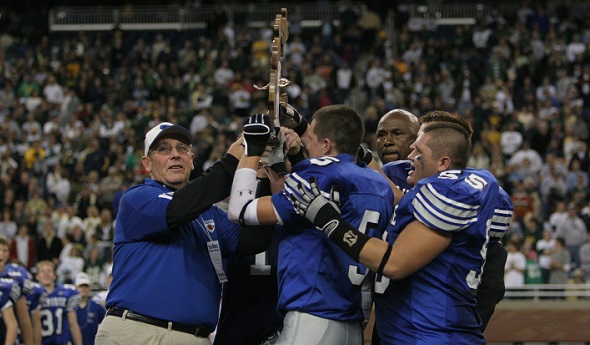
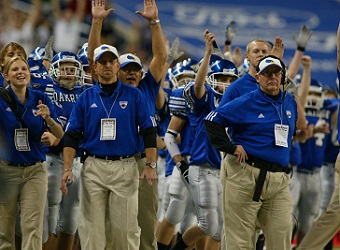
PHOTOS: (Top) Former Muskegon Oakridge football coach Jack Schugars holds up the 2005 Division 5 championship trophy with his players after their victory at Ford Field. (Middle) Schugars (right, with headset) monitors his team's play on the field against Jackson Lumen Christi.
Drive Completed: 2014 Finals in Review
December 1, 2014
By Geoff Kimmerly
Second Half editor
A total of 56,303 fans attended this weekend’s 11-player Football Finals at Ford Field, the most to watch the event live since 2010 and more than 9,000 more fans than only two years ago.
They witnessed five games decided by 10 points or fewer. Four games where the eventual winner was not the first to score. Three repeat champions, but also a first-time winner and the ends of two of the longest winning streaks in MHSAA history.
Second Half covered all nine championship games including the 8-player Final on Nov. 21, with quick recaps and links to those stories below followed by notations of performances entered into the MHSAA record book and a report on some of the biggest and best stories to emerge from the 2014 Finals.
Finals in Review
D1: Clarkston 33, Saline 25
The Wolves took over as holders of the longest MHSAA winning streak at 27 straight after claiming a second consecutive Division 1 championship. Junior running back Nolan Eriksen followed up the starring 2013 Finals performance of his brother Ian with 28 carries for 172 yards and three touchdowns. Saline finished 12-2 in making its first MHSAA championship game. Click to read more.
D2: Warren DeLaSalle 44, Muskegon Mona Shores 8
DeLaSalle came back from a 3-3 start to this season to win its first MHSAA championship. The Pilots shut down a Mona Shores offense averaging 39.5 points per game and got plenty of offensive boost from sophomore running back Allen Stritzinger, who ran for 175 yards and a touchdown. Mona Shores made its first championship game appearance after making the playoffs in 2013 for the first time. Click to read more.
D3: Orchard Lake St. Mary’s 7, Muskegon 0
This final game of the weekend was decided by one touchdown – scored by a player courageously carrying on only two days after his mother’s death. Brandon Adams scored the deciding points on a first-quarter run; his mother Katie died Thursday after fighting lung cancer. The Eaglets returned to the playoffs after missing in 2013; Muskegon finished MHSAA runner-up for the third straight season after falling to Birmingham Brother Rice in the Division 2 Finals in 2013 and 2012. Click to read more.
D4: Grand Rapids South Christian 28, Lansing Sexton 27
Sailors quarterback Jon Wassink capped his career and the team’s third straight trip to Ford Field with a second title over those three seasons. He threw for 179 yards and three touchdowns and ran for 122 yards and another score, and South Christian’s defense hung on late as Sexton made a pair of last attempts at the lead in its first MHSAA championship game appearance. Click to read more.
D5: Grand Rapids West Catholic 24, Lansing Catholic 20
West Catholic quarterback Travis Russell led a 17-play, 64-yard drive over the final seven minutes of the fourth quarter to bring the Falcons back to win their second straight MHSAA title and finish the season perfect for the first time since 1976. West Catholic opened with 17 straight points before Lansing Catholic took the lead with 7:38 to play. Click to read more.
 D6: Monroe St. Mary Catholic Central 22, Ithaca 12
The Falcons put an end to Ithaca’s national-best 69-game winning streak, adding some heavier impact to the team’s first MHSAA title since 1991. The Yellowjackets actually had defeated St. Mary in 2010 for their first of four straight championships, and fell just four wins shy of breaking the MHSAA record for consecutive football victories, held by Hudson. Click to read more.
D7: Detroit Loyola 29, Ishpeming 8
In the third straight Division 7 Final meeting between these two, Loyola won its first title and finished 14-0 thanks to 29 unanswered points and 297 yards rushing. Ishpeming had won 33 straight games, tied for the eighth-longest streak in MHSAA football history. Click to read more.
D8: Muskegon Catholic Central 31, Munising 6
The Crusaders became the first repeat champions in Division 8, running away after Munising scored the game’s first points. MCC had never trailed this season, but got three second-half touchdowns from senior Tommy Scott and held Munising to only 39 yards on the ground. Click to read more.
8-Player: Lawrence 56, Cedarville 12
Lawrence completed a turnaround from 1-17 over its final two seasons of 11-player in 2011 and 2012 to 8-player champion keyed by senior quarterback Derek Gribler and a speedy defense that locked down Cedarville, which also made its first 8-player Final appearance. Lawrence became the first program to win both 11 and 8-player championships. Click to read more.
Records Report
A number of team and individual entries have been added to the MHSAA Football Finals record book, found by clicking here. A breakdown:
- Warren DeLaSalle kicker Jake Townsley tied his career long field goal of 41 yards and set an MHSAA Finals record with three total, also making from 23 and 29 yards out. He also made the listing for connecting on all five of his extra-point attempts.
- DeLaSalle also became the 20th team to play in a Final and not punt in the game.
- Also in Division 2, Muskegon Mona Shores’ Darece Roberson caught what tied for the fifth-most receptions in a Final, 10.
- Muskegon Catholic Central’s Tommy Scott set the record for longest Finals kickoff return, bringing one back 99 yards for a touchdown in the first quarter of the Division 8 game against Munising. He also became the latest in a long list to score at least four touchdowns in a championship game, running for three more.
- Detroit Loyola’s Marvin Campbell also joined that list of players with at least four TDs in a Final, running for four in his team’s Division 7 victory over Ishpeming. His 215 rushing yards on 21 attempts made the championship game rushing list.
- Four quarterbacks joined the total offense list: Saline’s Josh Jackson with 319 yards – 82 rushing and 237 passing – against Clarkston in Division 1, Grand Rapids South Christian’s Jon Wassink with 312 yards – 122 rushing and 179 passing – in Division 4, and Lansing Catholic’s Tony Poljan (60 rush, 269 pass = 329) and Grand Rapids West Catholic’s Travis Russell (134, 203 = 327) in Division 5. Poljan’s 269 passing yards also made that list, and his 24 completions were fourth most for a Final.
- Muskegon Catholic Central became the sixth program in MHSAA history to play in 13 football championship games, and Orchard Lake St. Mary’s became one of nine to play in 12. Muskegon played in its eighth Final, South Christian in its seventh, Ishpeming and Monroe St. Mary in their sixth each, and West Catholic and Ithaca in their fifth each. Muskegon Catholic Central also became one of six with 10 MHSAA titles, and Orchard Lake St. Mary’s won its sixth.
- Lawrence quarterback Derek Gribler made the 8-player total offense list with 359 yards – 256 passing and 103 rushing. Lawrence as a team became the first to be listed for rushing offense – 341 yards – and set the 8-player Final record with 597 total yards and 23 first downs. Lawrence also made the most points in a quarter list with 28 in the first against Cedarville.
Stories behind the scores
End of an era: Ithaca’s winning streak began on opening night 2010 and just this month included a fourth-quarter comeback victory over Madison Heights Madison in the Regional Final and a near-goalline stand late against Boyne City in the Semifinal. The Yellowjackets’ magic ran out against Monroe St. Mary, but the streak will be remembered for years to come. Although Ithaca fell short of breaking the MHSAA football consecutive wins record, it did set a record for most in a row during the playoff era; Hudson’s 72-game winning streak ended in 1975 and included only one playoff win as that was the first season with an MHSAA tournament in the sport.
 Repeat by 3: Clarkston in Division 1, Grand Rapids West Catholic in Division 5 and Muskegon Catholic Central in Division 8 all repeated after winning 2013 championships. Although MCC became the first repeat champ in Division 8, winning back-to-back has become relatively common during the 16-season division era. There have been 25 repeat champions winning back-to-back in the same division since 2000, the first season a team could accomplish the feat.
QB Power: As explained above, four quarterbacks were added to the MHSAA Finals records listing for most total yards in a championship game. Two of those signal-callers – Saline’s Jackson and Lansing Catholic’s Poljan – are juniors expected to lead teams next season with good chances of returning to Ford Field.
Loyola Wins Round 3: With a group of players who also were standouts in the first two matchups, Loyola claimed its first MHSAA football title by defeating Ishpeming in their third straight face-off in Division 7. Bulldogs senior linebackers Paul Engram and Darryl Clemons had been their team’s leading tacklers in the 2012 loss and two of the top three last season, and senior running back Marvin Campbell was the team’s leading rusher in the 2013 defeat and second-leading rusher the year before.
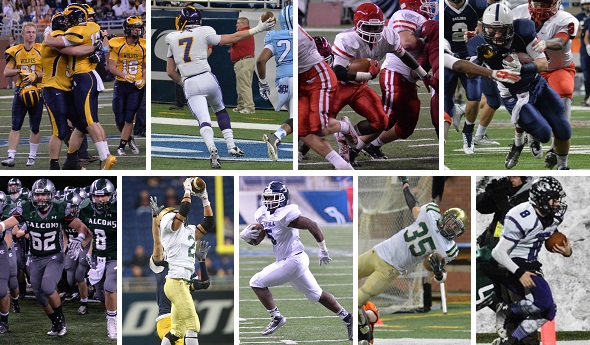
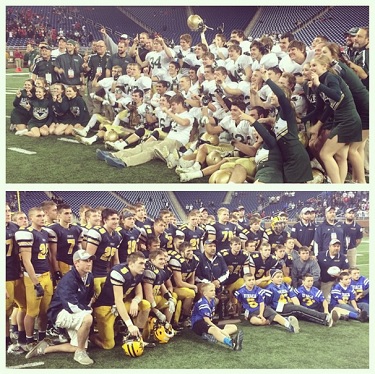
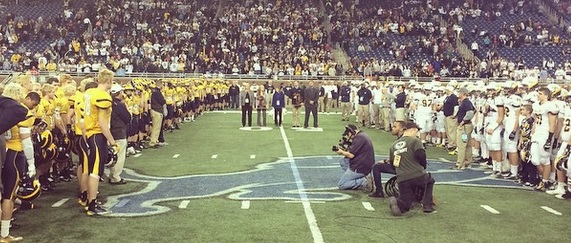
PHOTOS: (Top) Nine champions celebrated MHSAA titles over the last two weekends. (Middle) A jubilant Monroe St. Mary and disappointed Ithaca pose for team pictures after the Division 6 Final. (Below) Clarkston and Saline prepare to accept their trophies after the Division 1 Final. (Click to see more like the middle photos on the MHSAA Instagram page.)