

Oakridge's Schugars Always To Be 'Coach'
April 26, 2013
By Geoff Kimmerly
Second Half editor
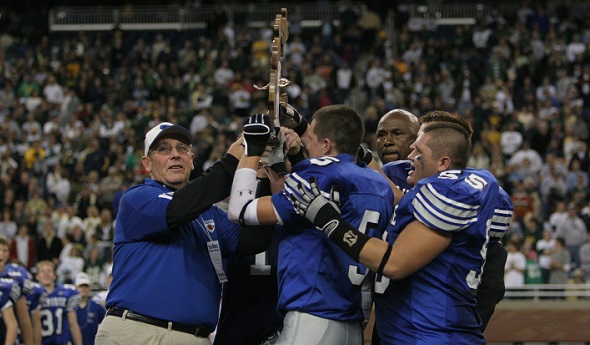
Jack Schugars led five Muskegon Oakridge teams to MHSAA football championship games during his 32 seasons running the program. He finished his high school coaching career in 2010 with a record of 262-78.
And of course, he impacted hundreds of lives in a community that, according to a former assistant, considers him a "saint."
Schugars was honored last week with the Duffy Daugherty Award for his outstanding achievements in high school football. Each spring, the Duffy Daugherty committee – made up of football supporters and media from the Lansing area – recognizes a high school coach along with a past or current college coach. The college award is among those recognized by the College Football Hall of Fame.
Among previous high school honorees present to congratulate Schugars during Thursday's banquet in East Lansing were Farmington Hills Harrison’s John Herrington, Birmingham Brother Rice’s Al Fracassa and former East Lansing coach Jeff Smith.
Schugars – now an assistant at Ferris State University – led his 1997, 2005 and 2008 teams to MHSAA titles, while his 1990 and 2003 teams finished MHSAA runners-up. He is a member of the Muskegon Sports Hall of Fame (class of 2009), the Michigan High School Coaches Association Hall of Fame (2008) and the Michigan High School Football Coaches Association Hall of Fame (1993). He received the MHSFCA’s highest honor, the Jim Crowley Award, in 2000.
The Schugars family is rooted in education. He also taught biology at the high school for 38 years, while his wife Julie taught English. Their daughter Amanda teaches in Battle Creek, and son Eric teaches and is the defensive coordinator at Traverse City Central.
Below are brief excerpts from the introduction of Schugars by his former football assistant and current Oakridge softball coach Joe Coletta, followed by Schugars' closing words of wisdom.
‘Faith, Family, Football’
(Coletta) “To Jack, those are not just words of hollow meaning. They are his compass.
 “Jack has won countless awards for his accomplishments on the football field. He absolutely refused to let anyone outwork him or his teams in preparation for a football game.
“But in my opinion, his strength as a football coach is his ability to take a kid that most people would give up on: a kid that some might label as no good, troublemaker, not worth the effort. He found a way to love the unlovable.
“He would give those kids direction; he would mentor them to be young men and young women and take them to where they could not possibly take themselves.
"When you can do that for a person, you let them see their worth as a human being and make a lasting impact so you can change the rest of their lives.
“That, to me, is what sets Jack apart from most coaches.”
What's most important
(Schugars) “The reason I'm on this Earth is to love the Lord your God with all my heart and soul and love your neighbors as yourself.
“So when I speak at clinics, when I talk to coaches, I tell them the greatest thing they can do for their team is to love their players.
“That is the greatest thing a coach can do. Love your players and be true role models each day.
“I could not ask for a better career than when ... a (former) player in the Navy Seal team calls me Coach. Lawyers, doctors, bankers, they call you Coach.
"Wow, that's a great word: Coach. That's what it's all about. Being a coach. Building relationships that will last a lifetime.
"I love the hundreds of players that are part of the Oakridge football family. And I hope I continue to build men out of boys, continue at the college level."
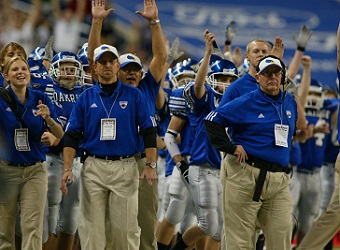
PHOTOS: (Top) Former Muskegon Oakridge football coach Jack Schugars holds up the 2005 Division 5 championship trophy with his players after their victory at Ford Field. (Middle) Schugars (right, with headset) monitors his team's play on the field against Jackson Lumen Christi.
Glen Lake Blazes Trail Back to Finals
November 23, 2016
By Dennis Chase
Special for Second Half
TRAVERSE CITY – Congratulatory messages streamed in Saturday after Maple City Glen Lake defeated Leroy Pine River 34-20 in a Division 6 football Semifinal at snow-covered Thirlby Field – a win that secured the Lakers’ first MHSAA Finals appearance in 20 years.
 Head coach Jerry Angers’ phone was particularly active. Among those calling or texting: Former Traverse City West coach Matt Prisk, who Angers previously worked under as a defensive coordinator; retiring St. Ignace coach Marty Spencer, whose Saints fell to defending Division 8 champion Muskegon Catholic earlier in the day; and Eric Gordon, the former Michigan State linebacker, who played for Prisk and Angers at West.
Angers, who was still fielding calls and texts late into the night Saturday, was “touched” by the show of support for his Glen Lake program.
Most of all, he was proud of his players, who kept improving every week to make this moment possible.
“They have worked hard for this opportunity,” he said. “I told them (after Saturday’s game), ‘You’re going to Ford Field. You’re one of 16 teams still playing. A lot of people will be watching, but I want you to enjoy it.’
“It’s like the Alan Jackson song ‘Remember When.’ I said in 20 years when you come back to see me I want you to say, ‘Remember when.’”
Glen Lake, which faces Jackson Lumen Christi for the title Friday, won the Class DD championship in 1994 under coach Bill Hollenbeck. The Lakers lost in the Class DD Final in 1996. Now, 20 years later, Glen Lake’s back.
“It’s an incredible feeling,” all-state linebacker Duke Angers, the coach’s son, said a few hours after the game. “It seems surreal right now. Growing up as a kid, you dream about playing at Ford Field. Now we get that opportunity. We’ll enjoy this for 24 hours and then get to work for Jackson Lumen Christi.”
Junior quarterback Cade Peterson, who rushed for 179 yards and three touchdowns in the win over Pine River, is also a coach’s son. His father, Tim, was head coach at Lake City for 15 seasons. The family moved into the Glen Lake school system this year. Tim is the quarterbacks coach for the Lakers.
“I’ve been going down to the state finals since I was 12,” Cade said. “And I would always think, ‘I want to play in this (state finals).’ Now it’s happening. You can ask any team in the state, and their ultimate goal would be to go to Ford Field and play for a state title. Only a few teams can say they accomplished that – and we did. As soon as that moment set in (Saturday), it was ‘Hey, we achieved our goal. Now let’s go win a state championship.’”
For Tim Peterson, who led Lake City to nine playoff berths, including Regional appearances in 2012 and 2013, it was a moment to savor.
“You work your whole life as a coach to try to get to the apex – and this is it,” he said. “We’re there. I couldn’t be happier for the kids, the program and the community.”
Now the task for the 11-2 Lakers is to a win a 12th game. Glen Lake will be taking on a program steeped in tradition. This will be Lumen Christi’s eighth MHSAA Finals appearance since 2000. The Titans have won five crowns during that span under coach Herb Brogan.
“Our kids have been facing challenges all year, and people keep underestimating them,” Tim Peterson said. “They just keep doing what they do – and they do it very well.”
Glen Lake’s losses were to Traverse City St. Francis (21-13) and Frankfort (26-21), teams that finished 11-1. The Lakers came in second to Frankfort in the Northern Michigan Football League’s Leaders division. Jerry Angers, now in his eighth season at the helm, said his team learned valuable lessons from those defeats.
“Sometimes losses are good for you,” he said. “We, as coaches and fans, never want to believe that, but in our two losses we had 15 or so penalties in one and five turnovers in the other. So you go back and you work on it. You try to reduce the penalties, reduce the turnovers. That became a great focus for our kids. I think we’ve had eight penalties in four playoff games – total. And we’ve kept our turnovers to a minimum. If you focus on the task at hand, and what’s in front of you, those things are going to be eliminated.”
Cade Peterson said the setbacks brought the team closer together, too.
“People can start pointing fingers (in defeat),” he said. “That didn’t go on here. Everybody picked each other up and kept fighting, kept going.”
 The 16 seniors on the team led the way.
“They set the tone,” Tim Peterson said. “The senior leadership has been phenomenal in keeping the focus.”
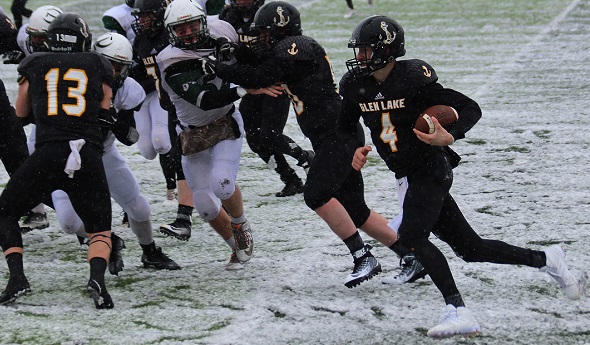
Glen Lake had to go on the road at Roscommon and Calumet to win two of its four playoff games. On Saturday, the Lakers, who were averaging 160 yards passing and 215 yards rushing per contest out of their spread offense, stuck to the ground to beat Pine River in blustery conditions that forced officials to clear snow off the artificial turf before and during the game.
Glen Lake rushed for 309 yards. In addition to Peterson’s 179 yards, Duke Angers picked up 59 and Nick Apsey 54. Apsey also hauled in two catches for 34 yards. The Laker backs – running behind a line that features tackles Jake Palmer and Brandon Tremble, guards Ryan Nadlicki and Zack Gushurst and center Tommy Kendall – averaged nearly five yards a carry. Nadlicki’s uncle, Mike, was a star on Traverse City’s state championship team in 1988.
“The weather forced us to be very one-dimensional (Saturday), but we’re real pleased with our ability to run the football as well as throw it,” Tim Peterson said. “That’s a good combination to have when you go deep into the playoffs because you never know what the weather will be.”
For the season, Cade Peterson’s completed 106 of 207 passes for 1,953 yards and 20 touchdowns. Jared Jackson, last year’s starting quarterback, has caught 30 passes, Apsey 23.
The 6-foot-4, 190-pound Peterson leads the team in rushing with 843 yards. Apsey, also a junior, has added 791 yards.
Defensively, Duke Angers, a four-year starter, is averaging 10 stops a game and Tony Duperon seven. Glen Lake is surrendering less than 200 yards in offense per game. Angers was the Traverse City Record-Eagle’s Defensive Player of the Year a year ago.
“As a football coach, he’s one of the best leaders and overall players that I’ve ever been associated with,” Jerry Angers said.
Jerry Angers led Glen Lake to back-to-back 9-2 seasons in 2012-13. The Lakers reached the District Finals those years.
Glen Lake qualified for the playoffs a year ago, finishing 5-5. This season, with a number of experienced players returning, coupled with the addition of Cade and Drew Peterson, the team has flourished. Drew is a sophomore defensive end and receiver. He had an interception Saturday.
Cade Peterson was a two-year starter at Lake City, throwing for 1,753 yards and 19 touchdowns as a sophomore.
“I feel a big part of why I’ve been successful (at Glen Lake) is because of how welcoming everybody was – not only the team and coaches, but the school and community,” he said.
“When those two (Peterson) boys walked in, our kids just grabbed them and said, ‘Hey, let’s go. You’re part of us now,’” Jerry Angers added.
Tim Peterson retired as a principal in June of 2015. He coached the Trojans that fall, but after the school year the family decided to make a move. Peterson was familiar with the Glen Lake area, since he worked camps with Hollenbeck. He was also good friends with Angers.
“It was time for a change,” Peterson explained. “We came up and looked at the academic piece of it, which is most important to us, and we said this is where we want to go.
“We’ve always said, at some point, we’d like to get here. This community is so supportive of their kids and of their school and that’s what you look for as a parent.”
Now the Lakers are one win away from a second MHSAA title. Regardless of what happens, though, Duke Angers said he believes his senior class has made an impact.
“We raised the bar a little,” he said. “We wanted to leave a trail to follow – and I think we have.”
 Dennis Chase worked 32 years as a sportswriter at the Traverse City Record-Eagle, including as sports editor from 2000-14. He can be reached at [email protected] with story ideas for Manistee, Wexford, Missaukee, Roscommon, Ogemaw, Iosco, Alcona, Oscoda, Crawford, Kalkaska, Grand Traverse, Benzie, Leelanau, Antrim, Otsego, Montmorency, Alpena, Presque Isle, Cheboygan, Charlevoix and Emmet counties.
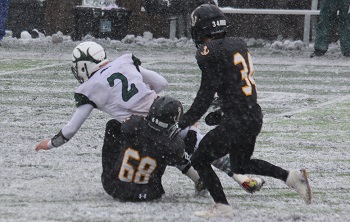
PHOTOS: (Top) Maple City Glen Lake’s Nick Apsey (5) follows his blockers on the way to the end zone during Saturday’s Semifinal win over Leroy Pine River. (Middle) Wes Peplinski (68) drops the Pine River quarterback in the 34-20 victory. (Photos by Kim Jackson.)