

Officials Sharpen Skills at MHSAA Clinic
June 28, 2012
By Geoff Kimmerly
Second Half Editor
ALMA --Frequently in pairs, they lined up beside linebackers, ran the sidelines and monitored the goallines earlier this week, next to many of Michigan's best recently-graduated high school football players.
The athletes were practicing for Saturday's Michigan High School Football Coaches Association All-Star Game at Alma College. But beside and all around them, officials also worked to hone their skills with the upcoming season only two months away.
A group of 34 attended the MHSAA's summer clinic Monday and Tuesday, run in coordination with the all-star game for the second year. Some were veterans brushing up on new rules, while others -- like Flushing's Tim Collick -- were newer officials hoping to pick up some knowledge from 12 clinicians providing instruction and feedback.
"The biggest thing is just the different tips from experienced guys you don't find in the books," said Collick, 32, who was one of 14 chosen from clinic participants to officiate Saturday's game. "Different, helpful clues like keys that made them successful, made things easier for them."
 Instructors shadowed Collick and other participants during two practices and a Monday night scrimmage, providing guidance and feedback along the way.
Those practice sessions are combined with classroom instruction, similar to what the MHSAA has conducted during previous summers with basketball officials at Michigan State University camps.
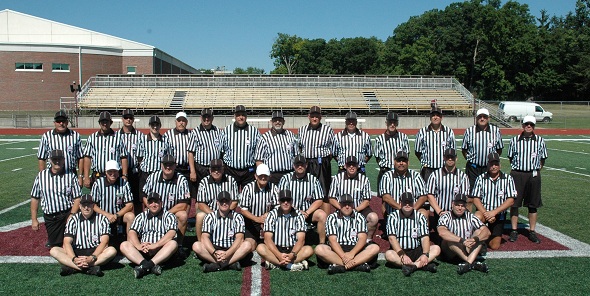
Every participant this week came from the Lower Peninsula, but as far north as just below Mackinac Bridge, east from Detroit and west from the Grand Rapids area.
Two crews of seven officials were chosen from the camp participants to work Saturday’s game. The crews will alternate quarters, with five instructors also on hand to provide feedback.
The MHSFCA has been putting on the All-Star Game for 32 years, and has been a fantastic partner in providing an opportunity football officials don't often receive during the offseason, MHSAA assistant director Mark Uyl said.
"Football is unique in that there isn't a way to get live reps, while basketball, baseball and softball have summer team camps," Uyl said. "This is an opportunity for football officials to get training in the real thing."
Collick, a Flint Hamady grad who has been mentored by longtime Flint-area official Tom Rau, is heading into his third season of football as a back judge with a crew from the Genesee County Coaches and Officials Association. Although he'd heard a few of the speakers at the clinic before, he didn't know any of the officials before Monday. But he was sure to soak up as much as possible, with an eye on officiating for years to come and eventually, perhaps, at the college level as well.
"For me, one of the biggest things (at the clinic) is getting to make contacts with much more veteran officials. I'm learning from those guys," Collick said. "The instructors have worked at high levels as college officials, as high school officials for many years. It's nice to pick their brains."
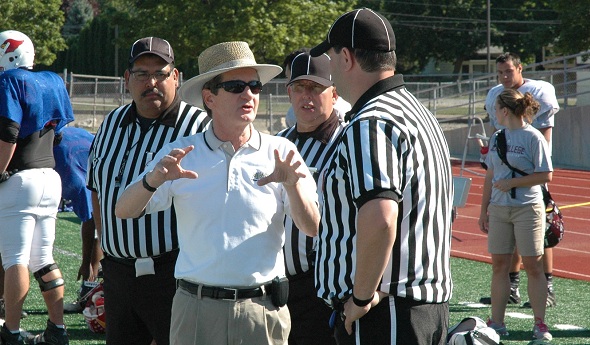
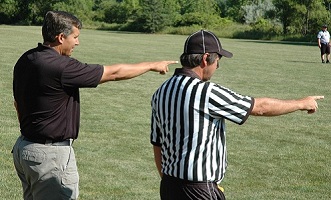
PHOTOS: (Top) Longtime official and recently-retired MHSAA assistant director Tom Minter (center) works with an official during Tuesday morning's East practice at Alma College. (Middle) MHSAA assistant director Mark Uyl (left) points something out to an official during the West practice. (Bottom) Officals at this year's clinic came from all parts of the Lower Peninsula, including the Detroit, Grand Rapids and Mackinaw areas.
MHSAA Opposes Big Ten Friday Football
November 2, 2016
By Geoff Kimmerly
Second Half editor
The executive director of the Michigan High School Athletic Association said today that he is “disappointed and disheartened” by the Big Ten Conference announcement that it will play and televise football games on Friday nights beginning with the 2017 season.
Friday night football remains one of the strongest and longest-standing traditions in high school athletics, and the MHSAA has fought since the start of this century to keep Friday nights sacred against the overstepping of college football and the damage televised Big Ten games are now expected to cause to attendance and media coverage of the sport at the high school level.
MHSAA Executive Director John E. “Jack” Roberts was contacted by both Big Ten Conference commissioner Jim Delany and Michigan State University athletic director Mark Hollis before the decision was announced. Roberts said he is appreciative of Michigan State and University of Michigan’s low tolerance to be included in this venture – at most, both will host a Thursday or Friday night game during Labor Day weekend and play one Friday night away game during the remainder of a season – but remains frustrated that similar respect for high school football was not shown by the conference as a whole.
Michigan State has played Friday night games during Labor Day weekend the last six seasons, hosting five and playing at Western Michigan University in 2015. However, most Michigan high school games continue to be scheduled and played on the Thursday before Labor Day, relieving holiday travel conflicts in most communities. University of Michigan did play on the Thursday before Labor Day at University of Utah in 2015, but has not played on a Friday night of Labor Day weekend this decade. The Wolverines are one of five Big Ten schools without a Friday night game in 2017.
“We are saddened by this decision. We had hoped that the Big Ten Conference would stay above this. We think this cheapens the Big Ten brand,” Roberts said. “Fans won’t like this. Recruits won’t like this. And high school football coaches won’t like this.
“We are grateful that Michigan State University and the University of Michigan are trying to minimize the effects of this decision by the Big Ten. But overall, this is just the latest step by major college athletics in the pursuit of cash that is just crushing high school sports.”
The MHSAA has shown its opposition to the use of Friday nights for televised collegiate football games for more than 15 years, dating back to 2001 when the NCAA lifted its restrictions on Friday night telecasts, which at first led to the broadcasting of “mid-major conference” games on the same night traditionally reserved for high school athletes.
The MHSAA launched in 2001 its “Save Our Friday Nights” campaign to emphasize the role that Friday night high school athletic events play in communities and to rally MHSAA member schools to contact NCAA member school football coaches, athletic directors and conference commissioners to voice their concerns.
In addition to causing lower attendance at events going up against Big Ten football games, Roberts anticipates that Friday night college games also will leave high school football as a secondary priority in many media markets. More than 80 radio stations statewide cover high school games regularly, but many also carry Michigan State or University of Michigan football. High school football could lose significant time on local TV highlights shows and in print and online coverage as well, as resources are diverted to cover a college game – potentially quieting significantly the positive buzz that comes from the typical high school football Friday night.
“Everyone knows that football is struggling right now,” Roberts said. “It’s getting a lot of bad publicity. Participation is declining. And now this; there couldn’t be worse timing.”
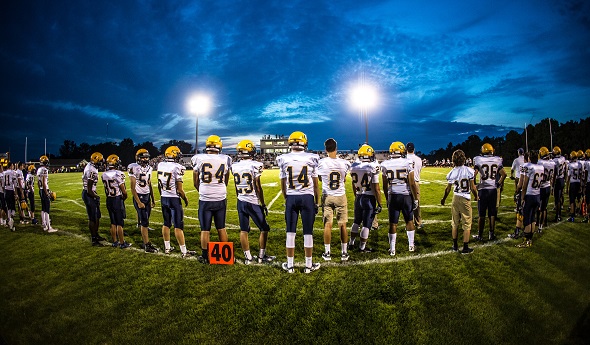
PHOTO: Grand Ledge takes on Okemos under the Friday night lights this season. (Click to see more from HighSchoolSportsScene.com.)