

Officials Sharpen Skills at MHSAA Clinic
June 28, 2012
By Geoff Kimmerly
Second Half Editor
ALMA --Frequently in pairs, they lined up beside linebackers, ran the sidelines and monitored the goallines earlier this week, next to many of Michigan's best recently-graduated high school football players.
The athletes were practicing for Saturday's Michigan High School Football Coaches Association All-Star Game at Alma College. But beside and all around them, officials also worked to hone their skills with the upcoming season only two months away.
A group of 34 attended the MHSAA's summer clinic Monday and Tuesday, run in coordination with the all-star game for the second year. Some were veterans brushing up on new rules, while others -- like Flushing's Tim Collick -- were newer officials hoping to pick up some knowledge from 12 clinicians providing instruction and feedback.
"The biggest thing is just the different tips from experienced guys you don't find in the books," said Collick, 32, who was one of 14 chosen from clinic participants to officiate Saturday's game. "Different, helpful clues like keys that made them successful, made things easier for them."
 Instructors shadowed Collick and other participants during two practices and a Monday night scrimmage, providing guidance and feedback along the way.
Those practice sessions are combined with classroom instruction, similar to what the MHSAA has conducted during previous summers with basketball officials at Michigan State University camps.
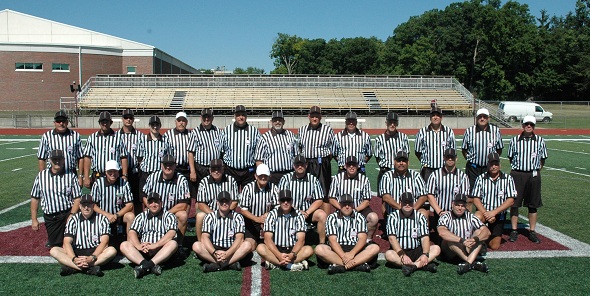
Every participant this week came from the Lower Peninsula, but as far north as just below Mackinac Bridge, east from Detroit and west from the Grand Rapids area.
Two crews of seven officials were chosen from the camp participants to work Saturday’s game. The crews will alternate quarters, with five instructors also on hand to provide feedback.
The MHSFCA has been putting on the All-Star Game for 32 years, and has been a fantastic partner in providing an opportunity football officials don't often receive during the offseason, MHSAA assistant director Mark Uyl said.
"Football is unique in that there isn't a way to get live reps, while basketball, baseball and softball have summer team camps," Uyl said. "This is an opportunity for football officials to get training in the real thing."
Collick, a Flint Hamady grad who has been mentored by longtime Flint-area official Tom Rau, is heading into his third season of football as a back judge with a crew from the Genesee County Coaches and Officials Association. Although he'd heard a few of the speakers at the clinic before, he didn't know any of the officials before Monday. But he was sure to soak up as much as possible, with an eye on officiating for years to come and eventually, perhaps, at the college level as well.
"For me, one of the biggest things (at the clinic) is getting to make contacts with much more veteran officials. I'm learning from those guys," Collick said. "The instructors have worked at high levels as college officials, as high school officials for many years. It's nice to pick their brains."
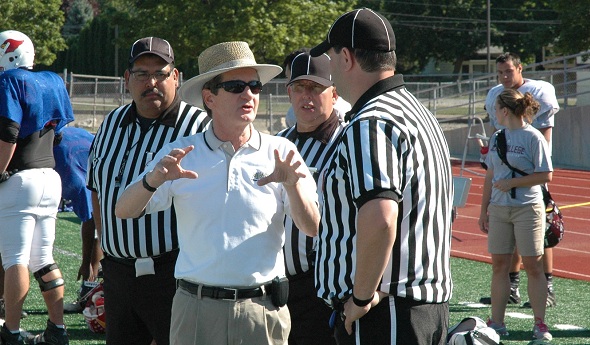
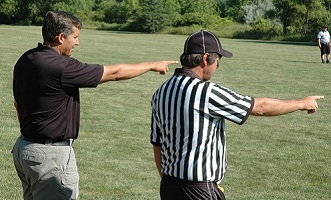
PHOTOS: (Top) Longtime official and recently-retired MHSAA assistant director Tom Minter (center) works with an official during Tuesday morning's East practice at Alma College. (Middle) MHSAA assistant director Mark Uyl (left) points something out to an official during the West practice. (Bottom) Officals at this year's clinic came from all parts of the Lower Peninsula, including the Detroit, Grand Rapids and Mackinaw areas.

NFHS Voice: Campaign Touts Benefits of High School Football
By
Karissa Niehoff
NFHS Executive Director
May 21, 2021
A full return to high school sports and performing arts programs – that’s the hope for this fall in schools across the country.
After a year of unprecedented challenges in keeping these programs going due to the pandemic, which included 11 states that conducted their primary football season this spring, there is great optimism as we look to a new school year.
Even in those states that were able to conduct activities last fall, attendance restrictions kept many fans out of stadiums and watching games online. However, with vaccine eligibility now at 12 years of age and older and with vaccinations continuing during the next three months, the likelihood of routines and traditions returning this fall grows stronger each day.
And there is no tradition more anticipated than the full-scale return of high school football. While there were 34 states there were fortunate enough to conduct football at some level last fall, the routines were anything but normal.
This fall, however, we anticipate a return to the energy and excitement of the 2019 season when 1,003,524 boys participated in 11-player football. That total marked a decline of only 2,489 from the previous year and was a good sign of a renewed confidence on the part of parents and student-athletes that concerns about the risk of injury were being addressed.
While boys participation in 11-player football has exceeded one million participants every year since 1999 and is overwhelmingly the most popular boys sport, there have been concerns about declines in past years.
Last fall, the NFHS and the National Football League announced a partnership to promote the growth, understanding and support for football at the high school level. The NFHS and NFL have been studying participation trends, developing educational tools and striving to restore confidence in students and parents that the sport is, in fact, more focused on risk minimization than ever before.
As a result, the springboard to the return of high school football next fall begins this week with the launch of the #ThisIsHSFootball campaign. Through this effort over the next few months, the NFHS will be reaching out to coaches, students, parents, officials, athletic directors and others with research information, participation trends and data on various risk mitigation efforts that, we believe, continues to make high school football safer than it has ever been.
As a part of this effort, the NFHS produced a video entitled “This is High School Football” designed to detail the benefits of participation in high school football.
As the video states, more so than at any other level of play, parents should feel good about their kids playing high school football.
>Here are some of the many educational and medical safeguards put in place the past 12 years to offer parents a comfort level about the safety standards that are a part of high school football.
► Concussion research and education. All NFHS high school playing rules require a student who is exhibiting signs of a concussion to be removed from the game and not allowed to return until the student has been cleared by a medical professional. Thanks to education and training on the part of students, coaches, trainers, parents and others, research data has shown positive trends in concussion rates. In a recent five-year period, concussion rates during practices dropped from 5.47 to 4.44 concussions per 10,000 athletic exposures.
► Concussion in Sport Course. This free online education course has been available through the NFHS Learning Center since 2010, and millions of individuals have taken the course for a deeper understanding about concussions.
► Concussion Laws. By 2014, every state had adopted state concussion laws that established mandatory protocols, and every state high school association has adopted policies that limit contact during preseason drills and in practices during the season.
► Football equipment. Manufacturers continue to produce higher quality equipment every year, and high school coaches are doing a much better job at teaching and coaching the rules of the game and making attempts to minimize risk of injury for players.
► Emergency Action Plans. Thanks to the NFHS Foundation, a copy of the “Anyone Can Save a Life” emergency action plan originally developed by the Minnesota State High School League was sent to all state high school associations and their high schools, and all schools have access to an AED to help save lives.
► Playing Rules. Risk minimization is a major focus of every NFHS sports rules committee. In football, helmet-to-helmet hits are not allowed.
High school football has been a significant part of schools, towns and communities across America for almost 100 years. The NFHS is committed to making the sport as safe as possible for the millions of kids who will play the sport in the years to come.
Dr. Karissa L. Niehoff is in her third year as executive director of the National Federation of State High School Associations (NFHS) in Indianapolis, Indiana. She is the first female to head the national leadership organization for high school athletics and performing arts activities and the sixth full-time executive director of the NFHS, which celebrated its 100th year of service during the 2018-19 school year. She previously was executive director of the Connecticut Association of Schools-Connecticut Interscholastic Athletic Conference for seven years.