

Onekama Celebrates New Stadium, Legends Past with Eyes on Another Playoff Run
By
Tom Spencer
Special for MHSAA.com
October 23, 2026
Pretty much every player who has put on the Portagers football jersey over more than six decades of Onekama High School football knows the name Jim Taylor.
 And if they didn’t know it before the team’s 52-8 win over Holton on Oct. 10, they do now.
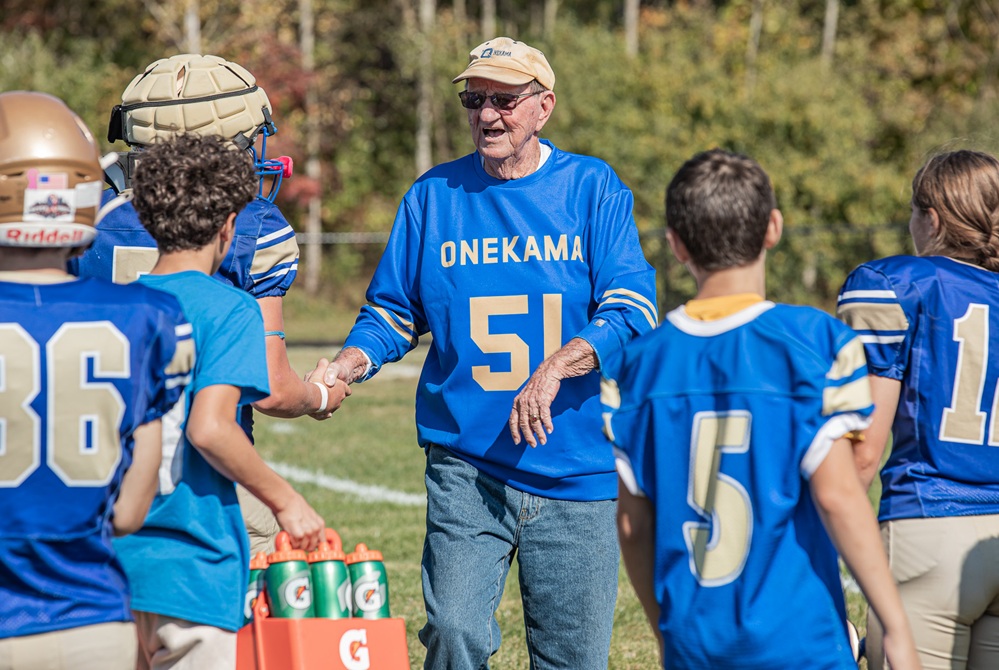
The community of Onekama honored their former coach, celebrated the 50th anniversary of the only undefeated squad in the Portagers’ history and dedicated the district’s new football stadium during the win over Holton – which also helped keep Onekama’s playoff hopes alive this fall.
The Portagers enter this weekend’s regular-season finale at Merrill ranked No. 14 on the 8-Player Division 2 playoff-points list. The top 16 qualify for the postseason, which begins next week.
“We love our history and traditions – all of the generations have just supported each other and built it into what it is today,” said fourth-year coach Justin Sedelmaier. “The former coaches are still involved, mentoring me. … Coach Jim Hunter and Coach Jim Taylor … still coming and seeing and saying hi to the team and stuff every now and then. The ’76 team, a lot of them like Jerry Brown, are always around supporting us.”
Brown, the quarterback of the only Onekama team to finish undefeated, was the primary organizer of the reunion. He was on hand for the celebration, along with Hunter and Taylor, and was even more excited about honoring Taylor than he was about the reunion.
“The motivation behind it for me anyway, personally, was to throw as much light on our coaching staff, and most specifically, the head coach, Coach Taylor, who had such a huge impact on so many lives – mine for sure,” Brown said. “This was all about shining a light on Coach Taylor and his wife, Lora – what a team. She's been right there with him all the way, supporting him.”
Lora Tayler was the school’s cheerleading coach during the first decade of football at Onekama. She was also on hand for the Oct. 10 festivities.
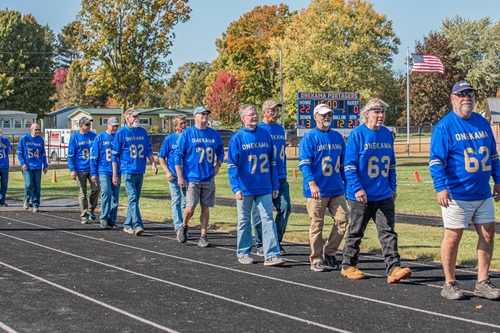
Brown was one of 14 players in attendance to honor the 1976 team, which finished 8-0 and won the Northwest Conference title but did not qualify for the MHSAA Playoffs, which were in only their second year and included only four teams statewide per Class at that time. (Other Onekama teams have since finished perfect for the regular season but lost in the playoffs.)
Taylor started the football program in 1964 and served as head coach until 1988. During his time guiding Onekama, Taylor compiled a 124–58–3 record with only two losing seasons over 22 years. He returned to coaching as an assistant at Onekama from 1997-2008 and was inducted into the Michigan High School Coaches Association Hall of Fame in 2005.
During Taylor’s early years, the Portagers played their home games at nearby Manistee High School while waiting for a home field of their own. The new stadium was built thanks to support of a successful 2024 bond proposal which also provided enhanced security technology, an updated gym, new playground equipment, pickleball courts, team rooms and a modernized press box.
The press box replaced the original built by students in a shop class at Onekama, including the grandfather of the current – and only fourth – coach in the Portagers’ history.
“The press box that just came down was built by the assistant coach, Mr. Foster's shop class, and my grandfather was part of that,” said Sedelmaier, who was the defensive coordinator for four years under John Neph, who with Taylor and Hunter has been the only other head coach Onekama varsity football. “The shop class built the press box and stuff on the first field and just finally now, 60 years later, we're able to make all these field upgrades. It's really been a vision for a long time, and something that I fought for, past players have fought for, the community fought for, and it's a vision that finally came together.”
Sedelmaier was a 2007 graduate of Onekama. Taylor was an assistant coach then. Sedelmaier’s grandfather, Phil Sedelmaier Sr., father Phil Sedelmaier, Jr. and uncle Todd Sedelmaier all played for Onekama during Taylor’s head coaching days.
Justin Sedelmaier has the Portagers primed for another playoff run. They are 6-2, a win tonight should guarantee them a spot in the playoffs and potentially an opportunity to host a game at the new stadium. A loss also won’t necessarily end the season for Onekama, which has reached the 8-Player Division 2 Semifinals the past two seasons. The Portagers’ strength of schedule is expected to boost their playoff chances, no matter the outcome in the regular-season finale.
Bennett Zeller leads the offense. The sophomore quarterback has completed 32 passes for 683 yards and eight touchdowns and picked up 762 yards and 12 touchdowns running the ball. His favorite target is junior Jason Sedelmaier, who has 11 catches for 260 yards and three touchdowns. The next rushing leader behind Bennett is Caleb Porter, also a junior, with five touchdowns while averaging 54 yards per game.
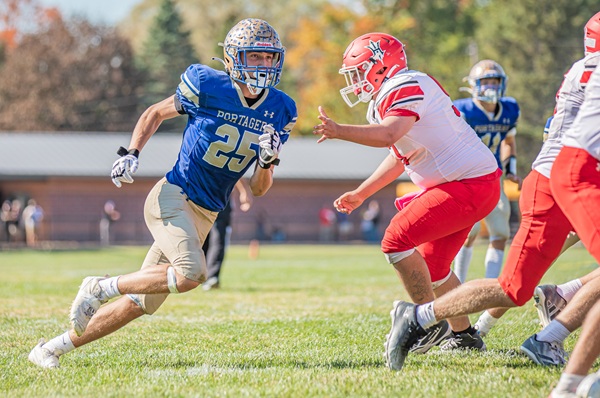
On the other side of the ball, Onekama is led once again by senior Ryan Hrachovina, an all-state defensive linemen last season. He has been credited 103.5 tackles this year – with 22 tackles for a loss and 18 sacks. He blocked a kick and ran it in for a touchdown earlier this fall. He’s also forced a fumble and recovered another.
Jason Sedelmaier also has been a big contributor defensively with 37 tackles, including four for a loss and one sack. He leads the team with 11 pass breakups and has an interception and a fumble recovery, along with a forced fumble.
The Portagers’ only loss last season came in a Division 2 Semifinal to Felch North Dickinson. Coach Sedelmaier is ready to build on the support of Onekama’s former players and coaches as his team prepares to make another run.
“To get to see them all coming back, wearing their replica jerseys and supporting us while we get a look back at some of the history and honoring that history was great for the kids to see,” Sedelmaier said. “That team was the first team to ever go undefeated in the regular season, and they're still the only team that's ever went the entire season total undefeated.”

Tom Spencer is a longtime MHSAA-registered basketball and soccer official, and former softball and baseball official, and he also has coached in the northern Lower Peninsula area. He previously has written for the Saginaw News, Bay County Sports Page and Midland Daily News. He can be reached at [email protected] with story ideas for Manistee, Wexford, Missaukee, Roscommon, Ogemaw, Iosco, Alcona, Oscoda, Crawford, Kalkaska, Grand Traverse, Benzie, Leelanau, Antrim, Otsego, Montmorency, Alpena, Presque Isle, Cheboygan, Charlevoix and Emmet counties.
PHOTOS (Top) Longtime Onekama coach Jim Taylor shakes hands with current players during the football program’s reunion and recognition night Oct. 10. (Middle) Ryan Hrachovina (25) works to get around a Holton blocker. (Below) Members of the 1976 Onekama team walk toward the field at the new stadium. (Photos by Meredith McNabb Photography.)
Writer-Turned-Coach Enjoys Debut
November 3, 2016
By Dennis Grall
Special for Second Half
ESCANABA — Sam Eggleston has seen high school football from two drastically different viewpoints. Now, even though he is an unpaid volunteer, he enjoys being on the sideline as a coach.
 Eggleston just completed his first season as a high school head coach, with Eben Superior Central winning its final three games to finish 4-5 in 8-player football. The Cougars were among the first teams in the state to join the 8-player format in 2010, their first year of football.
Eggleston was a sportswriter before becoming a coach, giving him different perspectives to watching the same event.
The 1998 Rock Mid Peninsula High School graduate worked at newspapers in Escanaba, Kenai, Alaska; Northville and Novi, and Marquette before becoming a freelance writer and website blog editor in 2008. He started the writing phase of his career in 2000 with the Daily Press in Escanaba, under my direction.
He served as a volunteer assistant football coach in Northville, then moved back to the Upper Peninsula and became a volunteer coach at his alma mater in 2011 when the Wolverines went to 8-player football. He joined Superior Central in 2014 and spent two seasons as a volunteer aide until landing the head job just two weeks before the 2016 preseason began.
“In both careers … you took a shot on me and I ran with it, and the same with coaching; they gave me a shot and I’ve run with it as best I can,” he said.
In addition to his unpaid position at Superior Central, in rural Alger County, Eggleston is responsible for fundraising for the self-funded football program, a major priority for his offseason.
“My coaching is over (for the season) now and the majority of my time will be spent on raising funds so we can get new helmets, get new pads to replace ones that are broke, spending money we don’t have so we’ve got to make that up now,” he said. “We have to win now to have successful fundraisers.”
As a sportswriter, Eggleston would simply switch gears and move on to coverage of the next athletic season, for instance once fall sports moved into winter. He also never had to worry about how coaches managed off-field X’s and O’s once their seasons concluded.
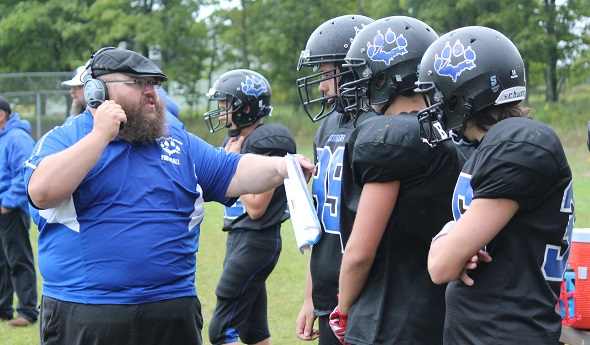
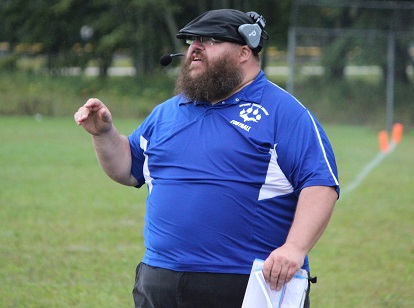
Life was totally different as a reporter. “I had a different approach, different viewpoint, different mindset to a game as a writer,” said Eggleston, who still has the heft of when he was a lineman but now looks like a lumberjack with his bushy beard and build.
“Now I have to worry about every kid and every position,” he said. “Sometimes I don’t even see the end result of the play because I’m watching the line play. I don’t even know how well my running back did until I see where they moved the stick.”
He may also be working on an injured player while the game goes on, trying to make play calls and other decisions at the same time.
As a sportswriter, he would be jotting down notes between plays or perhaps checking the result of a picture he took of the previous snap, totally unaware the coach was monitoring several assignments.
“I look back at the writer I was and as a coach now, and I would hate the type of writer I was,” he said.
Eggleston would analyze why a coach would switch to running a sweep rather than the counter that had been working, all while the coach may be working on an injured player that caused a change in offensive plans.
“As a writer I never had the insight to see everything. I just saw the overall game and kept track of every yard,” he said. “As a coach I can’t even tell if the play went five yards because I have three plays stacked up as the game goes on.”
While he was writing sports in the metro Detroit area, his weekly paper often covered games also being covered by the Detroit Free Press or the Oakland Press, with those stories appearing the next day. Eggleston’s story would appear maybe five days later, after everyone knew what happened.
 “I had to come in with a different angle. I tried to be a little more analytical and focus on strategy versus the flourish and try to get the meat of the game rather than get to the flowery parts,” he recalled. “I tried to take a different approach and make my stuff more interesting.”
His style apparently worked as the paper received several journalism awards and subscriptions remained strong.
Writing also provided some interesting backdrops. He had to use small charter planes to see some games in Alaska, or get to Nome to handle features about the Iditarod sled dog race.
He recalls covering a high school hockey game on an outdoor rink in Alaska and said “it was the first time I saw wind shear affect a hockey game.”
Eggleston also covered a football game where a kicker booted the ball off the uprights, then off a fence, and it bounced into the ocean in Homer.
He reported on a murder trial at that paper, where he would work the news desk in the morning, take time off and then handle sports at night. “It was super stressful,” he said.
Now walking the sidelines as a coach, he said “it definitely does feel like I’ve seen both sides of the coin, and I understand both sides of them better.”
He remembers just giving “little more rounded answers and (to) give both sides of the story” in postgame interviews. “A lot of coaches give canned answers. I try to be a little more in-depth and help try to write the story.”
In his early days as a sportswriter, he said “I would see the game unfold and see the pressures and why a coach would make a decision to go for it (on fourth down). I was a bit more critical of the coach and their decision,” he said, adding “I would probably have been a little more biting about it when I wrote the story.”
He admits in those days “I thought I knew everything there was to know about football. I played it,” he said. “I always approached the game like I was the professional and knew everything about the game. Now as a coach there are a host of responsibilities during every game. I am in completely different waters now. The hardest thing is keeping the kids pointed in the right direction as things go wrong.
“You’ve got the entire team and you’ve got to keep moving in a positive direction, keep the focus going forward. Forget the last play and work on the next one and get the kids to buy into that philosophy.”
He also compares his first writing assignment at the Daily Press with his first game this season at Ontonagon. “I did a (men’s baseball) story about the Escanaba Polecats, and you read my first line and said, ‘Did Yoda write this?’ I thought, oh my God, I don’t know what I’m doing.”
The Cougars lost their opener this fall 36-8, and Eggleston said “after being an assistant for four years, I still wasn’t prepared going into that Ontonagon game. We lost, and as I look back, if we played them right now I think we would beat them.
“I had no clue coming into that first game and didn’t have any idea how to get us back on track.”
He eventually figured enough out to finish 4-5 and found plenty of ways to enjoy being a coach.
Eggleston tries to eat lunch with his players every day, and he pays for his own meal.
“I want a family environment there; we all sit at the same table,” he said. “What I get back is relationships I never had before. I feel like I have 21 kids, and I love every minute of it.”
 Denny Grall retired in 2012 after 39 years at the Escanaba Daily Press and four at the Green Bay Press-Gazette, plus 15 months for WLST radio in Escanaba; he served as the Daily Press sports editor from 1970-80 and again from 1984-2012. Grall was inducted into the Upper Peninsula Sports Hall of Fame in 2002 and serves as its executive secretary. E-mail him at [email protected] with story ideas for the Upper Peninsula.
PHOTOS: (Top) Eben Junction Superior Central football coach Sam Eggleston speaks with some of his players during a game this season. (Middle) Eggleston monitors the action on the field. (Photos by Dennis Grall.)