

Opportunistic GRCC Breaks D4 Stalemate
By
Tom Markowski
Special for Second Half
November 25, 2016
DETROIT – One big pass, a solid kicking game and a handful of fine defensive plays were all Grand Rapids Catholic Central needed to lock up the school’s first MHSAA football title since 2010.
Trailing much of the game, GRCC scored a touchdown early in the fourth quarter and then relied on its defense to complete a 10-7 victory over Detroit Country Day in the Division 4 Final on Friday at Ford Field.
The championship was the Cougars’ third. Country Day finished runner-up for the fourth time in 11 seasons.
And this loss must be one of the more painful.
Country Day’s defense was outstanding. But the one time the Yellowjackets were caught out of position, it cost them.
The Cougars (13-1) faced a 3rd-and-7 from the Country Day 44 when junior quarterback Jack Bowen got the protection he needed and completed a pass to Michael Brown, who ran a delayed crossing pattern. Brown caught the ball at the 30 and split the Country Day defenders to complete the 44-yard touchdown pass to give GRCC the 10-7 lead with 11:11 remaining.
“We couldn’t draw it up any better,” Brown said. “I had to shut my feet down and get the corner to bite. (Bowen) threw a perfect pass. I just caught it.
“We knew coming in both teams had good defenses. Our defensive line didn’t stop. We had to hang in there.”
No one could have guess just how good these defenses would play.
GRCC gained one first down – on the touchdown reception. That set an MHSAA Finals record for fewest first downs; the previous record was set during the first playoffs, in 1975, when Flint Holy Rosary was held to four first downs by Crystal Falls Forest Park in Class D.
The teams also set a Finals record for fewest combined total yards, combining for 173. Farmington Hills Harrison and Muskegon Catholic Central set the previous record of 196 in the 1981 Class B title game.
It was fitting that Country Day’s final offensive play resulted in a sack by Derek Saukas, one of 10 recorded by the Cougars for a total of 82 yards lost by the Yellowjackets.
It was that type of game. GRCC totaled 15 yards on its first three possessions of the second half, which all resulted in Josh Steffes punts.
Jaylen Mayfield’s fumble recovery at the Country Day 47 with one second left in the third quarter gave the Cougars the field position they were hoping for and set up the go-ahead drive.
GRCC coach Todd Kolster said his defense has played like that all season, and the play Bowen and Brown made also had a familiar ring to it.
“These guys are bigtime football players,” Kolster said. “They’re great students. They’re great people.
 “Defensively this is what we’ve done all year. Our offense has been opportunistic. Our defense is as good as anyone’s. It’s something we believe in.”
With the defenses so dominant, it was apropos that Country Day’s touchdown was scored on a turnover.
Country Day (13-1) trailed 3-0, and GRCC faced a 3rd-and-8 from the Country Day 17 when linebacker Adam Fakih applied pressure on Bowen, hitting the quarterback as he tried to throw. The pass fluttered into the hands of Roy McCree IV, who raced down the right sideline for an 82-yard interception return touchdown and Country Day lead, 7-3, with 4:54 left in the half.
The Yellowjackets went to senior Steve Mann at quarterback on the next series and threatened to increase their lead. Mann took over for the starter, sophomore Jalen Graham, and moved his team from its 36 to the GRCC 25 – but a sack and a penalty pushed Country Day back, and a fourth down conversion attempt failed, ending the half.
GRCC scored with 1:18 left in the first quarter on Josh Steffes’ 31-yard field goal. That score was set up by Antonio Strong’s 58-yard punt return.
Country Day had 40 yards in the half; the Cougars did not gain a yard.
The loss was especially tough on Country Day coach Dan MacLean. He switched quarterbacks in an effort to add a spark.
Each quarterback was sacked five times. Graham was 3 of 5 passing for 18 yards, and Mann was 9 of 15 for 87 yards.
“We needed to,” MacLean said. “We had to get something going.
“Our defense has been a fantastic group. The (10) sacks, I have to see the film, but it wasn’t good.
“It’s very difficult to take right now.”
The MHSAA Football Finals are sponsored by the Michigan National Guard.
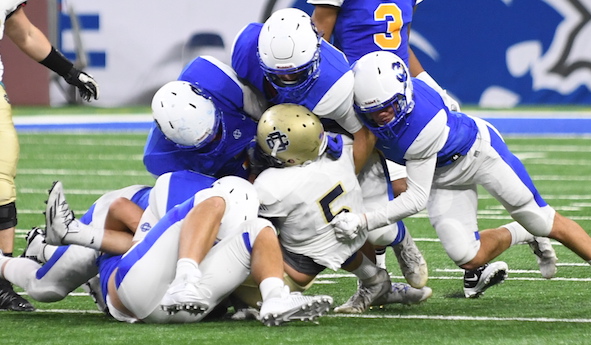
PHOTOS: (Top) A collection of Grand Rapids Catholic Central defenders tackle Country Day’s Chris Bergin (5). (Middle) GRCC’s Antonio Strong follows a block during Friday’s Final.

Playoff Proposal Pauses
May 10, 2013
During the MHSAA Football Finals at Ford Field last November, I was approached by representatives of the Michigan High School Football Coaches Association with a request to have the MHSAA’s computing capabilities crunch the numbers for a concept that a couple of the coaches association’s members had for revising the MHSAA Football Playoff point system.
Within a few weeks the MHSAA hosted a meeting that brought together the coaches who introduced the concept with our numbers crunchers; and within a few days our staff had outlined the principles, revised the point system and retrofitted it to show how the system would have affected the 2012 playoffs.
There was initial excitement that we might be onto something, but that brief infatuation began to wane as we dug deeper and discussed the plan more widely.
The key ingredients of the proposal are (1) that a school would gain playoff points for every game its opponent wins, whether or not that school defeated that opponent, and (2) that the number of automatic qualifiers would be reduced in favor of a larger group of additional qualifiers based on a revised playoff points system that would favor schools which schedule larger and more successful opponents.
In spite of our staff’s helpfulness in bringing this proposal forward, we’ve lost optimism that it will accomplish what is hoped. Rather than making regular-season scheduling easier, it could make it harder as the “six-wins-and-in” mindset is replaced by the even worse “seven-wins-and-in” mindset. And any system that ignores a minimum number of wins and relies entirely on playoff points is even less fair than the current system to schools in the less densely populated areas of Michigan.
From our retrofitting of the proposed concept to the 2012 season, we know that teams with 6-3 records would be displaced in the playoffs by teams with 4-5 records, which is certain to go down badly and be difficult to explain to those communities. The revised point system would make it even more difficult than the current system for schools in less populated areas to find opponents of the size and strength to generate high playoff point averages without these schools driving 100, 200, 300 or more miles, one way, several times each season. For individual schools and some entire leagues, this will make football scheduling tougher, not easier. It is likely to add stress to those league affiliations, and to football scheduling generally.
In any event, there is no need to rush to 2013 or 2014 a proposal that’s called “Enhanced Strength of Schedule System” because schedules are 99 percent set for 2013 and nearly so for 2014. Even if adopted today, few schedules would be impacted before 2015. If a change like this one is to be implemented, schools must have ample notice, and our technology department must have enough time to program the new point system and then test it through an entire season.
The Representative Council acted wisely on May 6 when it paused the progress of this proposal. Some elements of it may be discussed at the MHSAA’s scheduled meetings this summer and fall.