


Our Place in the Sun
August 22, 2017
Today’s blog was written by MHSAA Website and Publications Coordinator Rob Kaminski
Millions of people across the country yesterday were mesmerized and fascinated by a once-in-a-lifetime show staged by the solar system: a total solar eclipse, which spanned the contiguous United States from Oregon to South Carolina.
The “Great American Eclipse” (because everything needs a title these days) was preceded by countless hours of coverage to prep enthusiasts on a variety of topics: the best places in which to view “totality;” the time frame in which the phenomenon would occur; the manner in which to view the orbs without damaging retinas; and, for the more scientifically inclined, detailed explanations as to the cause of the event.
It is somewhat ironic that this temporary traveling blackout began in the Pacific Northwest where people often yearn for even a glimpse of the sun over periods of time, and ended off the coast of South Carolina where residents have endured more than their share of weather disasters and a day of total sun would have been greatly preferred. At widespread locations in between, how many citizens beg for just a little more sunshine each day when the clock runs out on Daylight Saving Time?
The attraction to Monday’s event, of course, was its rarity. Its peculiarity. Its deviation from the norm. The last time a total solar eclipse could be seen anywhere in the United States was 1979, and the last time it went coast to coast was 99 years ago. That was the hook. It was darkness’s day in the sun.
Another MHSAA football season kicks off around the state Friday just clear from the shadows of Monday’s historic, but fleeting, happening. The school sports spotlight shines brightest on fall Friday nights and has for decades, not only in Michigan, but also from shore to shore across the country. It is pep rallies and parades; pizza parlors and burger joints; neighborhood caravans and tailgates; perhaps even a Friday cross country meet or volleyball match, all leading up to the football game, for many years the only game in town.
Now, as college football continues its attempt to upset the natural balance and create its own eclipse, it is our hope that high school fans from state to state will consider this movement a fleeting attention grab. It is our hope that the people who have fueled our product over the course of time will turn their heads and focus on the brightest Friday night stars in their own back yards.
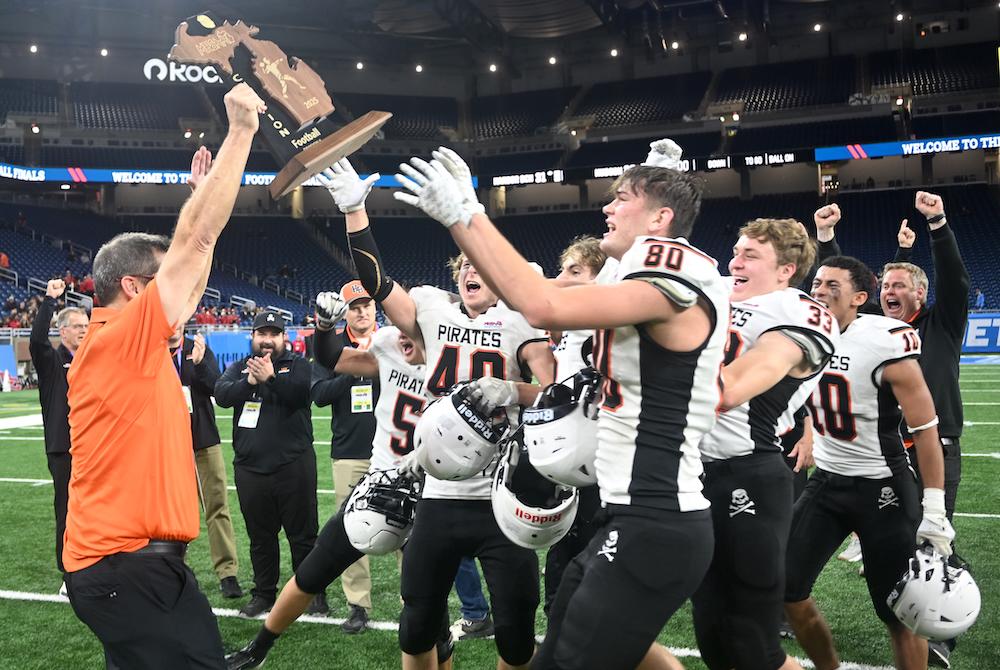
Harbor Beach Finds Stride Early, Holds Off Hudson in Matchup of Unbeatens
By
Paul Costanzo
Special for MHSAA.com
November 28, 2025
DETROIT – Caden Bucholtz walked out of Ford Field with more than a Division 8 Football Finals title on Friday.
He also took home family bragging rights.
Bucholtz and several of his Harbor Beach teammates had fathers who played on the school’s 1991 Class C runner-up squad.
“We got one up on them,” Bucholtz said with a smile.
Those fathers are likely OK with that after watching their sons defeat Hudson 31-20 to wrap up a perfect 14-0 season and claim the second Finals title in program history.
“Great game, the guys just played their hearts out just like they have all year,” said Harbor Beach coach Troy Schelke, who also coached the 2012 title team. “We knew we were going to play a tough game and we were going to play the best we could, and we did that. Hudson was a great opponent. They were here for a reason. We had to finish the play right until the end when we took the knee.”
Bucholtz led the way for the Pirates, with 146 yards and one touchdown on the ground, adding 82 yards and two TDs through the air on 5-of-8 passing.
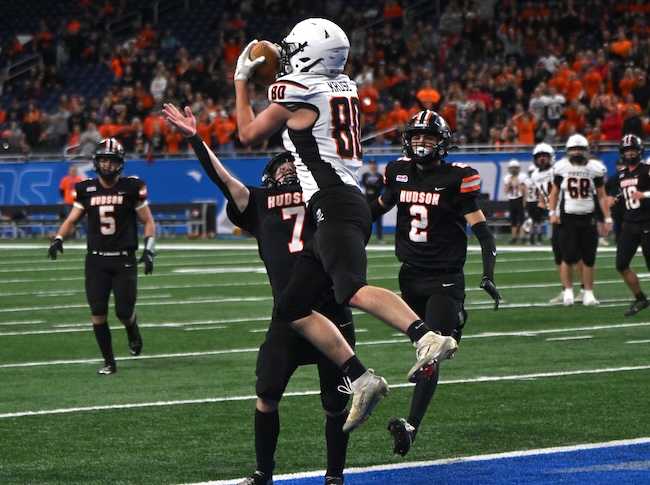 The 6-foot-1, 225-pound senior made play after play to keep Hudson at arm’s length throughout the game.
“We just couldn’t get off the field sometimes; their quarterback made some great plays,” Hudson coach Dan Rogers said. “Every time they needed a play and we needed to get off the field, their quarterback made great plays and he’s a great player. Credit goes to them.”
Harbor Beach looked to have put a stranglehold on the game early, building a 21-0 lead just inside 10 minutes remaining in the second quarter.
While Hudson’s offense had put up massive numbers all season, it didn’t seem built for comebacks, as it did nearly all of its damage on the ground leading up to Friday – rushing for more than 5,200 yards on the season, and attempting fewer than 50 passes.
The Pirates were similarly built, but it was Bucholtz’s arm that did a lot of the early damage.
He found Skiler Kruse for a 15-yard touchdown pass on Beach’s first drive, and tight end Matt Geiger on a 19-yard TD on its second.
Geiger’s TD was set up by a Harbor Beach fumble recovery at the Hudson 27.
“We knew they could throw,” Rogers said. “They haven’t had to much, but we knew the quarterback could run and throw, and they’ve got two really good tight ends. They have weapons, running backs out of the backfield. I wouldn’t say they threw more (than he thought), but they did a good job executing it.”
The Tigers did find some success on their next drive, but it ended on downs at the Harbor Beach 37.
Just four plays later, the Pirates had stretched their lead to three scores with a 25-yard touchdown run from Bucholtz.
While the Tigers (13-1) did get one stop and make enough big plays to keep things close, they never had the ball with a chance to tie, as Harbor Beach’s offense answered each time the lead was cut to a single score.
That included a 20-yard field goal by Kruse that made the score 31-20 with two minutes to play, all but sealing the victory.
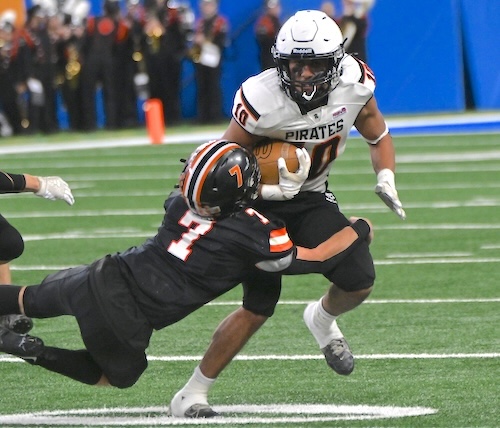 It was fully sealed when Benson Harper intercepted a pass in the endzone with 26 seconds to play.
“(The early lead) was huge because (Hudson) never quit,” Schelke said. “They kept coming back and kept cutting it, and we kept answering back. A 21-point lead, we’ll take that any time. We had to make some stops defensively, and had to finish some scores. Had to bang in a big field goal at the end, and pick one off at the end, then take a knee. Great game, great year, great program here.”
Grayson Bills had a pair of touchdown runs to help keep Hudson in the game, of 15 and five yards. He finished the game with 148 yards rushing, which included a 41-yard run in the final minute of the first half that set the Tigers up in the redzone. They were unable to cash in, however, and trailed 21-6 as they entered the break.
Colt Perry had the other Hudson score, with a 53-yard run on the Tigers’ first possession of the second half. That, as well as Bills’ second TD, brought Hudson to within a score.
“I knew we could come back,” Bills said. “All season we’ve been working together. I had hope in our team and knew what we were capable of.”
Beckett Campbell, who rushed for more than 2,300 yards on the season, had 103 on Friday. Liam Timm and Devon Brigman led the Hudson defense with seven tackles apiece.
Kruse finished with 60 yards receiving on three catches for Harbor Beach, and added an 11-yard touchdown run to answer Perry’s score in the third quarter.
John Learman led the Pirates defense with 16 tackles. Harper, who was slowed for much of the season because of an injury, had 10 tackles to go along with his game-sealing interception.
That pick set off a full-on celebration from the Harbor Beach half of the stadium, which had been plenty loud throughout.
“It was everything to us,” Bucholz said. “It felt like the whole town was behind us no matter what. They were just there to support us. Whatever the outcome I think they would have still been there no matter what.”
PHOTOS (Top) Harbor Beach coach Troy Schelke hands off his team’s championship trophy to his players Friday at Ford Field. (2) Skiler Kiser (80) elevates to haul in a touchdown catch. (Below) The Pirates’ Benson Harper (10) works to break out of the grasp of Hudson’s Colt Perry.