


Parking, Entrance Protocols Announced For Ford Field
November 25, 2013
By Geoff Kimmerly
Second Half editor
To provide for the convenience and safety of spectators attending the Michigan High School Athletic Association Football Finals at Ford Field in Detroit, Nov. 29 and 30, attendees are being advised of a variety of items related to transportation and security – including new policies regulating types of bags that are allowed into the stadium.
In cooperation with Olympia Entertainment, more than 2,000 parking spaces will be available in close proximity to Ford Field and Comerica Park to the west, east and north of the ball parks. These parking lots will be clearly marked with Olympia Entertainment signs and will be charging $6. A map identifying the designated Olympia Entertainment lots can be found on the Football page of the MHSAA Website. (There also are a number of privately-operated parking facilities close to Ford Field, but their pricing may differ.)
Fans also are advised that tailgating, including the setting up and use of grilling equipment, and the consumption of alcohol, is prohibited by City of Detroit ordinances.
Gates A, B and G will be available for public entrance during the event. Ticket sales will begin near Gates A and G at 8 a.m. each day, and the building will open its doors to spectators at 9 a.m.
Tickets are priced at $10 and will allow a fan to see all four games in a single day. Spectators leaving the stadium will be required to purchase another ticket for re-entry. Children under the age of 2 will be admitted without charge for this event. There will not be a public Will Call window.
Upon arrival in the building, fans will find their designated seating areas on the South side of the field if their team is the designated home team for their contest and on the North side for the designated visiting team. Home teams this weekend are Clarkston, Muskegon, Zeeland West, Grand Rapids South Christian, Menominee, Ithaca, Ishpeming and Beal City. Brightly lit video boards above the seating areas will display the names of the participating teams each day, and fans should sit on the side of the stadium where they see their school’s name. For general fans, the entire lower bowl of Ford Field will be open for the event.
Security measures also will be in place to help assure spectator safety. Fans will be subject to a visual search, and Ford Field personnel reserve the right to request patrons open their coats, bags and other item-carrying vessels for visual inspection and deny entrance to individuals who do not cooperate. The NFL this season has enhanced its safety policy to further monitor what type of bags may be brought into stadiums. Those additions are noted in bold below.
Items which fans will be prohibited from bringing into the building include, but are not limited to, the following:
- Purses larger than a clutch bag, coolers, briefcases, backpacks, diaper bags, fanny packs, cinch bags, grocery & paper bags, duffle bags, luggage of any kind, computer bags and camera & binocular bags or cases. Visit www.nfl.com/allclear for additional details.
- Aerosol cans (hairspray, mace, pepper spray, etc.)
- Animals (except service animals to aid guests with disabilities)
- Balloons (air or helium)
- Balls (beach balls, footballs, etc.)
- Banners
- Cameras with lenses longer than five inches
- Decals, stickers, confetti or flitter
- Electronic equipment including laptop computers, large video recorders and video cameras, and tripods (hand-held video cameras are allowed)
- Fireworks
- Food, beverages or liquids (cans, bottles, boxes, flasks, etc.)
- Illegal substances
- Knives, pocket knives, box cutters, scissors, etc.
- Laser pointers
- Markers (permanent) and/or paint
- Noisemaking devices (bells, horns, kazoos, whistles, etc.)
- Objects that can be used as missiles or projectiles (sticks, bats, clubs, Frisbees, etc.)
- Seat cushions
- Strollers and infant car seats or carriers
- Umbrellas
- Weapons
The following items will be permitted after inspection:
- Bags that are clear plastic, vinyl or PVC and do not exceed 12 inches by 6 inches by 12 inches
- One-gallon clear plastic freezer bags (Ziploc bag or similar)
- Small clutch bags, approximately the size of a hand, with or without a handle or strap. For details, visit www.nfl.com/allclear. An exception will be made for medically necessary items after proper inspection at a gate designated for this purpose.
- Small radios (no larger than the size of a football and used with an earpiece).
- Small hand-held video cameras (but no tripods or extension cords).
- Binoculars (but no cases).
The complete list of prohibited items can be found on the Ford Field Website under Policies & Info. Prohibited items that are discovered during security inspections at stadium entrances must either be returned to the owner's vehicle or discarded. Items will not be held for later pickup.
Fans are reminded that all image taking (still and video) may be only for personal, non-commercial use.
The MHSAA is a private, not-for-profit corporation of voluntary membership by more than 1,500 public and private senior high schools and junior high/middle schools which exists to develop common rules for athletic eligibility and competition. No government funds or tax dollars support the MHSAA, which was the first such association nationally to not accept membership dues or tournament entry fees from schools. Member schools which enforce these rules are permitted to participate in MHSAA tournaments, which attract more than 1.4 million spectators each year.
Cvengros Leaves Lasting Impact
By
Geoff Kimmerly
MHSAA.com senior editor
April 1, 2014
Retired Associate Director Jerry Cvengros, who served at the Michigan High School Athletic Association for more than 13 years after three decades at Escanaba High School, died Monday evening in Lansing. He was 80.
As lead assistant to Executive Director John E. “Jack” Roberts from August 1988 until retiring in January 2002, Cvengros served as director of football and briefly hockey in addition to coordinating the Program of Athletic Coaches Education (PACE), presenting annual in-service training for administrators and serving as MHSAA liaison to statewide principals, athletic directors and coaches associations.
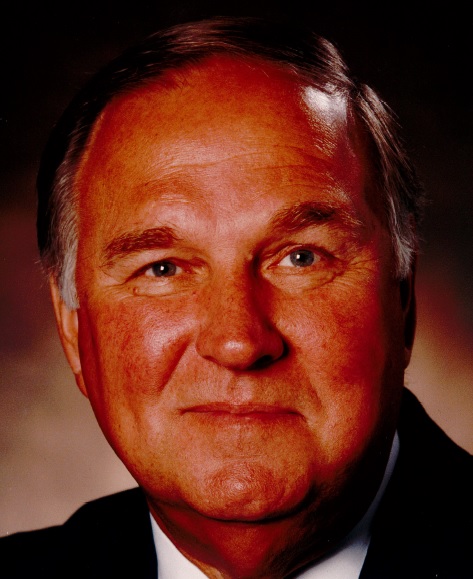 He came to the MHSAA after 30 years at Escanaba, where he taught, coached, served as athletic director and later principal during a tenure stretching from August 1958 through July 1988. While at Escanaba, Cvengros also represented Upper Peninsula Class A and B schools on the MHSAA Representative Council from 1983-88 and served as the Council’s president from 1986-88.
Cvengros received the MHSAA’s Charles E. Forsythe Award in 2000 in recognition of his many and significant contributions to interscholastic athletics.
“During his lifetime, Jerry Cvengros impacted every area of interscholastic athletics as a coach, athletic director, principal and then associate director of the MHSAA," Roberts said. “He was the perfect combination of fairness, toughness and diplomacy, able to draw on a vast knowledge of MHSAA rules and an understanding of educational athletics fostered by his various experiences.
“Jerry was known and respected statewide for his dedication, and his contributions have had a lasting impact.”
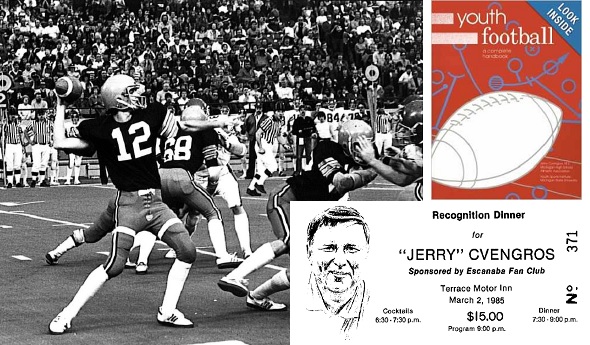
Cvengros built an elite football program at Escanaba as varsity head coach from 1962-84, leading the Eskymos to a 161-42-3 record, a Class A runner-up finish in 1979 and the MHSAA championship in 1981. That team remains the only Class A/Division 1 team from the Upper Peninsula to win an MHSAA football title. Cvengros was inducted into the Michigan High School Football Coaches Association Hall of Fame and served on its original Board of Directors.
His 1979 team fell to Detroit Catholic Central 32-7, but he brought the Eskymos back to the Finals for a 16-6 win over Fraser two seasons later. Cvengros' championship lineup included quarterback Kevin Tapani, who would go on to pitch for the Minnesota Twins among five major league clubs, and tailback Dean Altobelli, who later played at Michigan State University. The title run included a 15-14 Semifinal win over Dearborn Fordson that included a savvy two-point conversion call by Cvengros, who wanted to avoid overtime after a late score drew Escanaba to within a point of tying the score.
As the MHSAA’s director of football, Cvengros was instrumental in creating the current playoff format that expanded the field from 128 to 256 teams beginning with the 1999 season. He also co-authored “Youth Football: A Complete Handbook,” a guide to coaching at that level.
Among many additional honors, Cvengros was inducted into the Upper Peninsula Sports Hall of Fame and Michigan High School Coaches Association Hall of Fame and received the Distinguished Service Award from the Michigan Interscholastic Athletic Administrators Association. The National Federation of State High School Associations twice awarded Cvengros with a Citation – the NFHS’ highest honor – for his service as a coach and then as a member of the MHSAA staff.
Since his retirement, Cvengros and his wife Shelley have continued to reside in Okemos. A visitation will take place beginning at 10 a.m. Monday, April 7, at St. Martha Parish in Okemos, with a funeral Mass to follow at 11 a.m.
Cvengros was a 1951 graduate of Ironwood High School and went on to study and play football at the University of Wisconsin in Madison. He earned his bachelor’s degree in secondary education and teaching from the University of Wisconsin-Superior and a master’s from Northern Michigan University.
He taught English, history and physical education at Escanaba High School and also coached basketball and track and field. He became the school’s athletic director in 1970, added the duties of activities director in 1975 and became principal in 1983.
Cvengros is survived by his wife and children Michael, Steven and David, and seven grandchildren. He was preceded in death by his daughter Lee Ann (Cvengros) Swasey in May 2013.
PHOTOS: (Clockwise from left) Escanaba quarterback Mike Beveridge fires a pass during the 1979 Class A Final; Cvengros co-authored a book on coaching youth football; Cvengros was celebrated once more in Escanaba following his final season as football coach.