

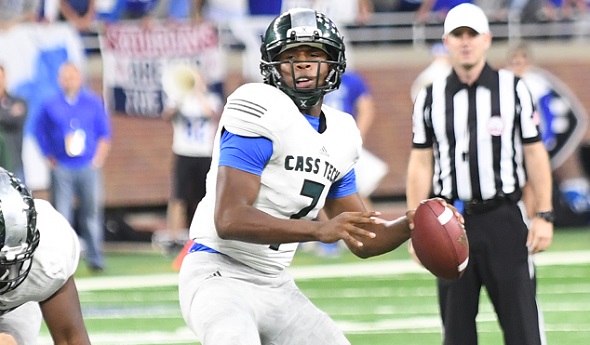
Performance: Cass Tech's Rodney Hall
December 1, 2016
 Rodney Hall
Detroit Cass Tech senior – Football
A year ago, Hall’s junior season ended on the Ford Field sideline, watching Cass Tech fall 41-27 to Romeo in the Division 1 Final after he suffered a lower leg injury two weeks before. But he came back this season fueled by championship motivation, and made it pay off. Hall threw for 220 yards and an MHSAA Finals record-tying five touchdown passes to lead the Technicians to a 49-20 win over Detroit Catholic Central in the Division 1 Final on Saturday and earn the Michigan National Guard “Performance of the Week.”
Hall started a pair of playoff games as a freshman before taking over the varsity fulltime in 2014 and leading Cass Tech to a 12-1 record. The Technicians were a combined 36-3 under him the last three seasons and scored a program-record 619 points (44.2 per game) this fall. The 6-foot-2, 210-pound signal-caller completed 10 of 18 passes in the Final and also ran for 58 yards on only seven carries. He finished this season 142 of 238 passing for 2,535 yards and 28 touchdowns, after a junior season when he threw for 2,232 yards and 20 touchdowns and ran for 1,053 yards and 14 scores.
 After admitting Saturday to being a little timid to run at the start of the fall, and with a steel plate still in his ankle, Hall ran for a combined 253 yards and three touchdowns over his final three playoff games. He has committed to sign to play football at Northern Illinois University but said he’s unsure which course of study he’ll pursue. MLive-Detroit reported Hall carries a 3.4 grade-point average in its feature on the Technicians standout as one of 10 finalists for MLive’s High School Football Player of the Year award.
Coach Thomas Wilcher said: Let's say it like this: He lost one game his first year, two games his second year, zero games his third year. That's enough said. ... I think the most important thing about Rodney Hall is you have to look at his stats. He has phenomenal stats. He has a phenomenal win-loss record. I haven't been around anything like that before. I just look at his game – (he's) the gamer. He's always bringing back a victory. We went down to the wire several times, and it was all about him. And I just told him this week, 'Look, I don't need you to run the ball. All I want you to do is throw the ball. You should throw the ball for over 300 yards.’ That’s it. And I told him, just stick with the game plan; no running. And I just kept telling the offensive coordinator, don't let him run. Let him throw it. That's it."
Performance Point: “Just to be able to make it back to this point and play in this game, I was just excited to come play, and glad we won,” Hall said. “The offense was clicking, and guys were open. They did the rest. I just put it to them. … (At last season’s Final) I was crying. I was hurt that I couldn't be out there to help my teammates. I wanted (this year) bad. We made history at Cass because I think we’re the first team to go 14-0 and win the state championship. We just wanted to win this game because we’ve been losing ever since we came into high school. We have a lot of wins, but we’ve been coming up short for the last three years – and it’s great to come out with the championship this year.”
Learning to run again: “I came in (to this season), I was a little timid to run, actually. I didn't want to get hurt again and miss this opportunity. Coach, he's been pressing me to run all year, and when I finally do, I get positive yards.”
 Star among the stars: “Quarterback is simple. You just have to keep everybody on the right track and make sure teammates don’t get down when we get behind. The last two weeks we’ve been losing, and I just remind my guys, ‘Come on, we can win this. We’re going to go back and score.’ Just remind them to keep scoring, remind the defense we’re going to keep getting stops, and just keep everybody’s heads up.”
Pass is present: “This year, I’ve been a way better passer. Because all offseason, I haven’t been able to run. I’ve just been working the pocket, making sure I’m looking at everything, making sure I’m reading the defense better. And I’ve had a better passing year this year, I believe.”
Leaving a legacy: “I just can’t believe it’s over with. I just want people to know I was a guy to go out there and give it all I’ve got. Just sell out for the team, and that’s what you should do – and you’ll end up a champion.”
- Geoff Kimmerly, Second Half editor
Every week during the 2016-17 school year, Second Half and the Michigan National Guard will recognize a “Performance of the Week" from among the MHSAA's 750 member high schools.
The Michigan Army National Guard provides trained and ready forces in support of the National Military Strategy, and responds as needed to state, local, and regional emergencies to ensure peace, order, and public safety. The Guard adds value to our communities through continuous interaction. National Guard soldiers are part of the local community. Guardsmen typically train one weekend per month and two weeks in the summer. This training maintains readiness when needed, be it either to defend our nation's freedom or protect lives and property of Michigan citizens during a local natural disaster.
Previous 2016-17 honorees:
Nov. 24: Ally Cummings, Novi volleyball – Read
Nov. 17: Chloe Idoni, Fenton volleyball – Read
Nov. 10: Adelyn Ackley, Hart cross country – Read
Nov. 3: Casey Kirkbride, Mattawan soccer – Read
Oct. 27: Colton Yesney, Negaunee cross country – Read
Oct. 20: Varun Shanker, Midland Dow tennis – Read
Oct. 13: Anne Forsyth, Ann Arbor Pioneer cross country – Read
Oct. 6: Shuaib Aljabaly, Coldwater cross country – Read
Sept. 29: Taylor Seaman, Brighton swimming & diving – Read
Sept. 22: Maggie Farrell, Battle Creek Lakeview cross country – Read
Sept. 15: Franki Strefling, Buchanan volleyball – Read
Sept. 8: Noah Jacobs, Corunna cross country – Read
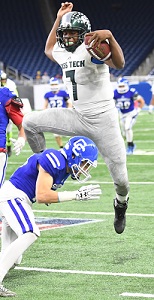
PHOTOS: (Top) Detroit Cass Tech's Rodney Hall prepares to unload a pass during Saturday's Division 1 Final at Ford Field. (Middle) Hall hurdles a would-be Detroit Catholic Central tackler.
5-0 Oakridge Healing 2018 Heartbreak
October 2, 2019
By Tom Kendra
Special for Second Half
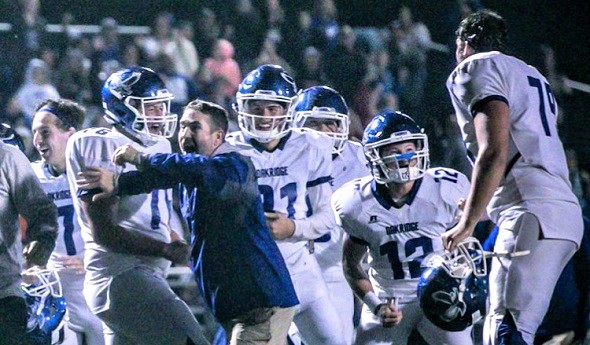
Muskegon Oakridge had an extra reason to celebrate in the rain on Friday night.
 It was about more than just overcoming sloppy conditions and the never-say-die Montague Wildcats in a matchup of No. 1 vs. No. 2 in The Associated Press’ Division 5 rankings. There was more to it than getting a leg up in the West Michigan Conference race with a thrilling 15-13 overtime win.
This was about overcoming two of the most heartbreaking losses imaginable one year ago – and dedicating the win to those who never got a shot at redemption.
“That win was for those seniors from last year,” said Oakridge running back Leroy Quinn, a four-year starter who rushed for both of his team’s touchdowns and a game-high 144 yards, putting him over 4,000 rushing yards for his career. “I love those guys, and I miss them. We all grieved together last year, and now we’re celebrating for them.”
Oakridge led Montague in their 2018 meeting 24-10 with 3:45 remaining, when the Wildcats roared back with two touchdown passes and then a game-winning, 2-point conversion run by Sebastian Archer with no time on the clock for a 25-24 win.
It was the type of gut-wrenching loss which is hard to shake off.
“It’s a helpless feeling,” said Oakridge senior nose guard and offensive tackle Will Scraver. “The only thing you can do is try to forget and focus on the next game.”
Unfortunately, less than one month later, Oakridge would experience an even more bitter defeat. The Eagles’ second loss had finality as it came in the MHSAA District championship game, as they squandered a seemingly safe 35-8 halftime lead in a stunning 40-37 loss to Hudsonville Unity Christian. Adding salt to the wound was having to sit home and watch Unity then roll over its next three opponents en route to the Division 5 championship.
“Sometimes it’s hard to put those losses behind when you have umpteen people coming up to you at the store or the gas station asking you what the heck happened,” said Harger, who is in his ninth year as the Oakridge coach after serving for 16 years under Jack Schugars, the all-time winningest coach in Muskegon-area football history.
“All we can do, as coaches and players, is to learn from our mistakes and to take care of all the little things so that we win those kind of games.”
Oakridge, 5-0 and now No. 1 in Division 5 in the latest Associated Press poll, has been focused and motivated this fall – starting with a tough road test at Belding and most recently with the big revenge win at Montague.
 Oakridge and Montague were scoreless through three quarters and tied, 7-7, after regulation. Quinn scored from three yards out in overtime, then added what proved to be the game-winning 2-point conversion run. Montague answered with a 10-yard pass from Drew Collins to Brennan Schwarz, but Nate Fair and Corey Vanderputte stuffed the 2-point conversion attempt.
Quinn, a 6-foot-1, 233-pound battering ram, has led the way with 465 rushing yards and eight touchdowns. He now has 4,065 career rushing yards, eclipsing David Nelson’s previous school record, and needs five more rushing TDs to pass Jamie Potts for that school mark.
Quinn’s play thus far has been no surprise, but how quickly others have stepped up in the backfield and on the line is the reason why Oakridge is back to No. 1 in the state.
Junior quarterback Ethen Dailey (5-11, 145) has done a solid job managing the Eagles’ offense, and speedy sophomore Vanderputte has emerged as the breakaway threat.
But it was the play of the offensive line, where Fair is the only returning starter, that keyed the win at Montague.
Oakridge, which lined up in a double tight end, full-house backfield look most of the game and threw only two passes (completing none), finished with a 222-70 edge in rushing yards.
“With the tradition out here, there are always new players ready to step up,” said Fair, who also starts at inside linebacker. “We might not have a lot of big names on the line, but we knew we were going to be good.”
Four of the Eagles’ five interior linemen are seniors, with the lone exception sophomore center Derek Driscoll. The guards are seniors Josh Havermans and Jason Pego and the tackles are Fair and Scraver. Starting at tight end are junior Luke Martin and sophomore Ethan Josza.
Harger is not ready to start talking about avenging last year’s playoff loss, as his team still has tough games remaining at North Muskegon in Week 7 and the final two weeks of the regular season at home against Ravenna and first-time opponent Traverse City St. Francis.
Oakridge could also have a couple of new playoff challenges close to home. While the Eagles appear a lock to be in Division 5, they may be joined by resurgent neighbor Muskegon Orchard View (on the bubble of Division 4 and 5) and Montague (on the Division 5 and 6 bubble).
“Our motto this year is: ‘Exceed Expectations’ and, considering the group we lost last year, these guys have done that so far,” said Harger, who is 75-16 and has made the playoffs in each of his first eight years as head coach.
“This is not a real rah-rah group of kids. I think they just love to play football and with the way last year ended, they are thankful for the opportunity to come out and play again.”
 Tom Kendra worked 23 years at The Muskegon Chronicle, including five as assistant sports editor and the final six as sports editor through 2011. E-mail him at [email protected] with story ideas for Muskegon, Oceana, Mason, Lake, Oceola, Mecosta and Newaygo counties.
PHOTOS: (Top) The Oakridge sideline celebrates late in the Eagles' 15-13 overtime win at Montague. (Middle) Oakridge senior Leroy Quinn, who became the school's all-time leading career rusher earlier this season, runs through a big hole into the end zone for a touchdown. (Photos by Tim Reilly.)