

Performance: Morrice's Hunter Nowak
November 15, 2018
 Hunter Nowak
Morrice senior - Football
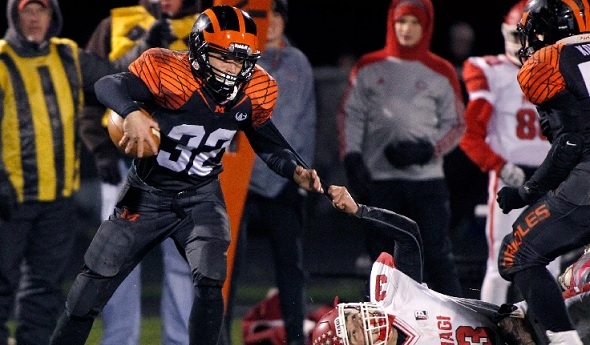
Morrice’s third-year varsity quarterback continued the play Friday that has helped his team to the best season in program history. Nowak ran 28 times for 158 yards and three touchdowns to lead the Orioles to a 40-8 win over Colon in an 8-Player Division 1 Semifinal, earning the senior signal-caller the Michigan Army National Guard “Performance of the Week.”
Nowak has run 204 times for 1,922 yards (9.4 yards per carry) and 33 touchdowns this season, and completed 24 of 49 passes for 529 yards and eight more scores. His 232 points rank third all-time since MHSAA-sponsored 8-player football was added a decade ago. He took over the QB spot in 2016, and Morrice went 4-5, but the Orioles improved to 9-2 last season and this fall finished the regular season 9-0 for the first time in the program’s 11 or 8-player history. Last week’s Semifinal was the team’s second ever and first since 1996, and this Saturday’s championship game against Pickford at Northern Michigan University’s Superior Dome will be the Orioles’ first trip to the MHSAA Finals in this sport. Along the way, Morrice avenged last season’s playoff loss to North Central Thumb League Red rival Deckerville – which went on to finish 2017 Division 1 runner-up – and handed Wyoming Tri-unity Christian its only defeat this fall in the Regional Final two weeks ago.
 Nowak plays only football at Morrice, but does also play on a high school-level rugby club team based in Howell. He carries a 4.0 grade-point average while dually enrolled at Lansing Community College, and hopes to study aviation after high school with aspirations of becoming a commercial airline pilot.
Performance Point: “The defense played great. They played shutout. The defense really won us the game, I think,” Nowak said of the Semifinal win over Colon. “We were able to put up 40 points, but that was a great offense they had. … It’s the first time we ever went to a state final for this, and we’re just really excited about it. We’ve been playing football since third grade, and we’ve always had successful seasons. We always thought that especially our senior year, we always thought, man, we really need to do really good that year. For it to happen, I think it’s great, because we’ve been working hard all year (and) ever since we started playing varsity. We’re thankful to the town for showing up at the games. Everyone comes out. It’s a big deal.”
That’s when we knew: “Our sophomore year, we didn’t do too great. We got four wins as sophomores; we could’ve done better. Last year we were OK – we lost to Deckerville in the second round (38-0). … Our first game (this season), we beat Deckerville (34-14). I think that was big. We went there, we won by 20 points, and that’s when we realized we’re a good team this year – we really have a shot to go far. We had lost the second round of playoffs the year before by a lot there. So to have our first game, since playing there, be right there again, and to be able to win – it put behind all the doubt that we had last year.”
 Taking this on together: “I think it’s the combination of a lot of us have been playing since third grade together. And there’s not a whole lot of us, so that bond has just grown through the years. And I think we’re just really good at football, and the whole speed thing really helps too. … I think it’s just knowing what someone else is going to do. If I’m running the ball, I can get a sense of where my lead blockers are going to go, what they’re going to do. We can try to get a sense of what other people are going to do. We can communicate easier. If something happens, we can fix it real quick, because we know how to talk to each other.”
It’s a speed thing: “I think 11-man was more about who’s going to be bigger on the line and then trying to work around that. (Eight-player) is not so much who is bigger on the line, it’s who can get off the line quicker and find the hole faster. We’re not the biggest team, but we’re a very fast team. That definitely helps us out.”
Revved and rallying: “When you’re done with the game and you’re walking back to the stands, there’s a lot of people I’ve never met before. But they’re all congratulating us, and they seem really excited about it. They’re there. They don’t know us personally, but they’re excited for the football team and they want to tell us, ‘Good job.’ There’s a lot of people talking about coming up (for the Final).”
- Geoff Kimmerly, Second Half editor
Every week during the 2018-19 school year, Second Half and the Michigan Army National Guard will recognize a “Performance of the Week" from among the MHSAA's 750 member high schools.
The Michigan Army National Guard provides trained and ready forces in support of the National Military Strategy, and responds as needed to state, local, and regional emergencies to ensure peace, order, and public safety. The Guard adds value to our communities through continuous interaction. National Guard soldiers are part of the local community. Guardsmen typically train one weekend per month and two weeks in the summer. This training maintains readiness when needed, be it either to defend our nation's freedom or protect lives and property of Michigan citizens during a local natural disaster.
Past 2018-19 honorees
November 8: Jon Dougherty, Detroit Country Day soccer - Read
November 1: Jordan Stump, Camden-Frontier volleyball - Read
October 25: Danielle Staskowski, Pontiac Notre Dame Prep golf - Read
October 18: Adam Bruce, Gladstone cross country - Read
October 11: Ericka VanderLende, Rockford cross country - Read
October 4: Kobe Clark, Schoolcraft football - Read
September 27: Jonathan Kliewer, Grand Rapids Forest Hills Northern soccer - Read
September 20: Kiera Lasky, Bronson volleyball - Read
September 13: Judy Rector, Hanover-Horton cross country - Read
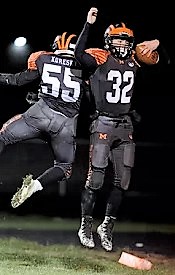
PHOTOS: (Top) Morrice quarterback Hunter Nowak (32) pulls away from a Colon defender during last week’s Semifinal win over the Magi. (Middle) Nowak and teammate Sam Koresky celebrate one of his touchdowns. (Photos courtesy of the Lansing State Journal.)
Cvengros Leaves Lasting Impact
By
Geoff Kimmerly
MHSAA.com senior editor
April 1, 2014
Retired Associate Director Jerry Cvengros, who served at the Michigan High School Athletic Association for more than 13 years after three decades at Escanaba High School, died Monday evening in Lansing. He was 80.
As lead assistant to Executive Director John E. “Jack” Roberts from August 1988 until retiring in January 2002, Cvengros served as director of football and briefly hockey in addition to coordinating the Program of Athletic Coaches Education (PACE), presenting annual in-service training for administrators and serving as MHSAA liaison to statewide principals, athletic directors and coaches associations.
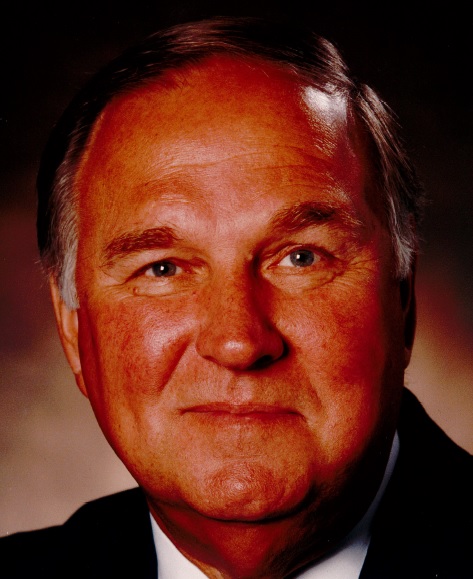 He came to the MHSAA after 30 years at Escanaba, where he taught, coached, served as athletic director and later principal during a tenure stretching from August 1958 through July 1988. While at Escanaba, Cvengros also represented Upper Peninsula Class A and B schools on the MHSAA Representative Council from 1983-88 and served as the Council’s president from 1986-88.
Cvengros received the MHSAA’s Charles E. Forsythe Award in 2000 in recognition of his many and significant contributions to interscholastic athletics.
“During his lifetime, Jerry Cvengros impacted every area of interscholastic athletics as a coach, athletic director, principal and then associate director of the MHSAA," Roberts said. “He was the perfect combination of fairness, toughness and diplomacy, able to draw on a vast knowledge of MHSAA rules and an understanding of educational athletics fostered by his various experiences.
“Jerry was known and respected statewide for his dedication, and his contributions have had a lasting impact.”
Cvengros built an elite football program at Escanaba as varsity head coach from 1962-84, leading the Eskymos to a 161-42-3 record, a Class A runner-up finish in 1979 and the MHSAA championship in 1981. That team remains the only Class A/Division 1 team from the Upper Peninsula to win an MHSAA football title. Cvengros was inducted into the Michigan High School Football Coaches Association Hall of Fame and served on its original Board of Directors.
His 1979 team fell to Detroit Catholic Central 32-7, but he brought the Eskymos back to the Finals for a 16-6 win over Fraser two seasons later. Cvengros' championship lineup included quarterback Kevin Tapani, who would go on to pitch for the Minnesota Twins among five major league clubs, and tailback Dean Altobelli, who later played at Michigan State University. The title run included a 15-14 Semifinal win over Dearborn Fordson that included a savvy two-point conversion call by Cvengros, who wanted to avoid overtime after a late score drew Escanaba to within a point of tying the score.
As the MHSAA’s director of football, Cvengros was instrumental in creating the current playoff format that expanded the field from 128 to 256 teams beginning with the 1999 season. He also co-authored “Youth Football: A Complete Handbook,” a guide to coaching at that level.
Among many additional honors, Cvengros was inducted into the Upper Peninsula Sports Hall of Fame and Michigan High School Coaches Association Hall of Fame and received the Distinguished Service Award from the Michigan Interscholastic Athletic Administrators Association. The National Federation of State High School Associations twice awarded Cvengros with a Citation – the NFHS’ highest honor – for his service as a coach and then as a member of the MHSAA staff.
Since his retirement, Cvengros and his wife Shelley have continued to reside in Okemos. A visitation will take place beginning at 10 a.m. Monday, April 7, at St. Martha Parish in Okemos, with a funeral Mass to follow at 11 a.m.
Cvengros was a 1951 graduate of Ironwood High School and went on to study and play football at the University of Wisconsin in Madison. He earned his bachelor’s degree in secondary education and teaching from the University of Wisconsin-Superior and a master’s from Northern Michigan University.
He taught English, history and physical education at Escanaba High School and also coached basketball and track and field. He became the school’s athletic director in 1970, added the duties of activities director in 1975 and became principal in 1983.
Cvengros is survived by his wife and children Michael, Steven and David, and seven grandchildren. He was preceded in death by his daughter Lee Ann (Cvengros) Swasey in May 2013.
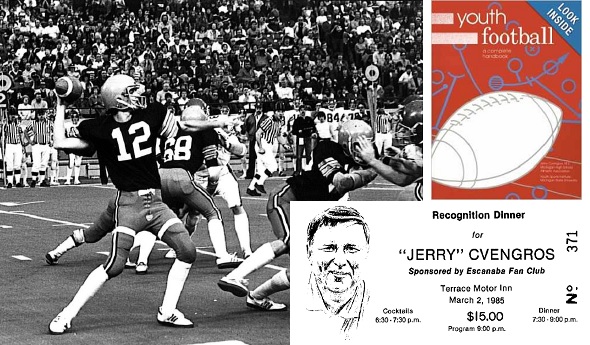
PHOTOS: (Clockwise from left) Escanaba quarterback Mike Beveridge fires a pass during the 1979 Class A Final; Cvengros co-authored a book on coaching youth football; Cvengros was celebrated once more in Escanaba following his final season as football coach.