

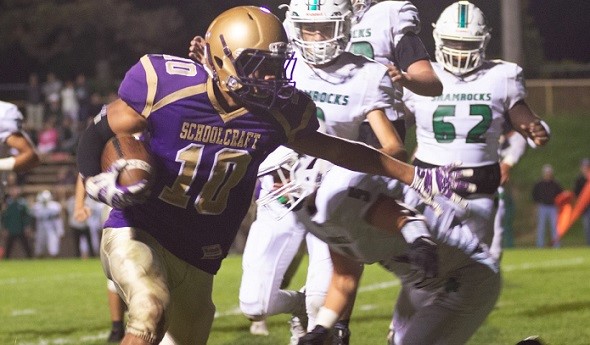
Performance: Schoolcraft's Kobe Clark
October 5, 2018
 Kobe Clark
Schoolcraft junior - Football
The 5-foot-10, 170-pound running back enjoyed in one game what for many is a season’s worth of scoring. Clark racked up an MHSAA-record nine rushing touchdowns in leading his team to a 63-27 win over Constantine to earn the Michigan Army National Guard “Performance of the Week.”
Clark ended the night with 26 carries for 380 yards, and after six games this season has run 110 times for 1,022 yards and 24 touchdowns – he also has four receiving scores. Clark joined the varsity for the eighth game of his freshman year in 2016, when Schoolcraft finished 10-1, and took on a fulltime role as a sophomore as the Eagles finished 5-5 and made the playoffs for the ninth straight season. Schoolcraft currently is 5-1 and tied for first in the Southwestern Athletic Conference Valley under first-year coach Nathan Ferency, as Clark helps shoulder the offensive load with 53 percent of the team’s yardage and 62 percent of its points.
 He’s also carrying on quite a family tradition; his older brothers Benny Clark III and Ricky both were stars for the Eagles, Benny as a running back and Ricky as a quarterback, and their father Benny Clark Jr. is the fifth-leading rusher in MHSAA history after gaining 7,212 from 1993-96 at Ravenna. Kobe Clark also plays point guard for the basketball team – he made first-team all-league last winter – and runs the 100 and 400 meters and on the 400 relay during track season. He advanced to the MHSAA Finals as part of that relay this spring.
Coach Nathan Ferency said: “Kobe has been so impressive because of his elusiveness. He is a tremendous athlete that can do things with his feet that most cannot. Kobe needs about six inches of space, and he is gone. His football intelligence and vision while carrying the football have to be noted too. He is hands-down capable of playing at the next level. I am thankful that isn't for another season!”
Performance Point: “All of this attention, it’s weird, but it’s nice. It’s crazy that I have the state record now, out of everyone in Michigan. … We were trapping a lot; that worked really good … when our guard pulls and leads through the whole for me. My guards and tackles were the guys who would make a block, and I would get to the next level.”
Unsung up front: I love those guys (on the line). My favorite guys on the team right there. They think (the record) is awesome, but it’s not just me, it’s them – a whole team effort. They should be getting just as much attention. They’ve been talking me up and saying it’s awesome for me, which I appreciate, but they’re the guys who helped me get it.”
 Next Clark in line: “(My dad) is glad for me. He just told me to thank the line, which I do. … I always looked up to (my brothers), and I always wanted to be better than everyone in my family, because that’s what you work for. They just said, ‘Keep working. You’re doing great things right now. Keep it going.’”
New year, new game: “I’ve gotten a lot faster, and I’ve just been working toward getting better every year – conditioning, and I’ve been in the weight room a lot. I’ve gotten a lot bigger, especially the last year. It seems a lot different, because we’re in a new offense this year too. We got a new coach and we have just bonded, and we have a good connection.”
Coaching us up: “This is the most fun I’ve had in a long time playing football. Everyone’s bonding on our team and getting along great. Coach just knows every player on our team and gets along with everyone, and he’s just a great coach. He makes everything so much more energetic and fun, and he just has a great competitive side to him, and he loves to win.”
- Geoff Kimmerly, Second Half editor
Every week during the 2018-19 school year, Second Half and the Michigan Army National Guard will recognize a “Performance of the Week" from among the MHSAA's 750 member high schools.
The Michigan Army National Guard provides trained and ready forces in support of the National Military Strategy, and responds as needed to state, local, and regional emergencies to ensure peace, order, and public safety. The Guard adds value to our communities through continuous interaction. National Guard soldiers are part of the local community. Guardsmen typically train one weekend per month and two weeks in the summer. This training maintains readiness when needed, be it either to defend our nation's freedom or protect lives and property of Michigan citizens during a local natural disaster.
Past 2018-19 honorees
September 27: Jonathan Kliewer, Grand Rapids Forest Hills Northern soccer - Read
September 20: Kiera Lasky, Bronson volleyball - Read
September 13: Judy Rector, Hanover-Horton cross country - Read
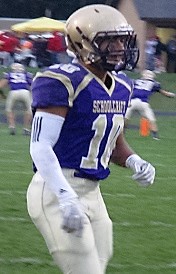
PHOTOS: (Top) Schoolcraft's Kobe Clark gets past a Berrien Springs defender. (Middle) Clark, during pregame. (Photos courtesy of JoeInsider.com.)

Football Finals Protocols Announced
November 21, 2016
By Geoff Kimmerly
Second Half editor
To provide for the convenience and safety of spectators attending the Michigan High School Athletic Association 11-Player Football Finals – presented by the Michigan National Guard – at Ford Field in Detroit, Nov. 25 and 26, attendees are being advised of a variety of items related to transportation and security – including policies regulating types of bags allowed into the stadium.
Parking will be available in Ford Field facilities and lots to the east and north of the stadium and costs $6. A map identifying the designated Ford Field lot (4) and parking deck can be found on the Football page of the MHSAA Website. (There also are a number of privately-operated parking facilities close to Ford Field, but their pricing may differ.)
Fans also are advised that tailgating, including the setting up and use of grilling equipment, and the consumption of alcohol, is prohibited in Ford Field parking facilities and lots.
Gates A, B and G will be available for public entrance during the event. Ticket sales will begin near Gates A and G at 8 a.m. each day, and the building will open its doors to spectators at 9 a.m. Tickets must be paid for in cash only.
Tickets are priced at $10 and allow a fan to see all four games in a single day. Spectators leaving the stadium will be required to purchase another ticket for re-entry. Children under the age of 2 will be admitted without charge for this event. There will not be a public Will Call window.
Upon arrival in the building, fans will find their designated seating areas on the South side of the field if their team is the designated home team for their contest and on the North side for the designated visiting team. Home teams this weekend are Detroit Catholic Central, Walled Lake Western, Muskegon, Grand Rapids Catholic Central, Menominee, Maple City Glen Lake, Pewamo-Westphalia and Muskegon Catholic Central. Brightly lit video boards above the seating areas will display the names of the participating teams each day, and fans should sit on the side of the stadium where they see their school’s name. For general fans, the entire lower bowl of Ford Field will be open for the event.
Security measures also will be in place to help assure spectator safety. Fans will be subject to a visual search, and Ford Field personnel reserve the right to request patrons open their coats, bags and other item-carrying vessels for visual inspection and deny entrance to individuals who do not cooperate.
Items which fans will be prohibited from bringing into the building include, but are not limited to, the following:
• Purses larger than a clutch bag, coolers, briefcases, backpacks, cinch bags, grocery & paper bags, duffle bags, luggage of any kind, computer and camera bags and large camera cases.
• Aerosol cans (hairspray, mace, pepper spray, etc.)
• Animals (except service animals to aid guests with disabilities)
• Balloons (air or helium)
• Balls (beach balls, footballs, etc.)
• Banners or large flags
• Cameras with lenses longer than five inches. Selfie Sticks also are prohibited.
• Decals, stickers, confetti or glitter
• Electronic equipment including laptop computers, video recorders (hand-held video cameras are allowed), tripods and wearable video cameras including Go Pros.
• Fireworks
• Food, beverages or liquids (cans, bottles, boxes, flasks, etc.)
• Illegal substances
• Knives, pocket knives, box cutters, scissors, etc.
• Laser pointers
• Markers (permanent) and/or paint
• Noisemaking devices (bells, horns, kazoos, whistles, etc.)
• Objects that can be used as missiles or projectiles (sticks, bats, clubs, Frisbees, etc.)
• Seat cushions
• Strollers and infant car seats or carriers
• Umbrellas (large size)
• Weapons
The following items will be permitted after inspection:
• Small bags, purses and fanny packs that do not exceed 8½ inches by 14 inches by 10 inches. An exception will be made for medically necessary items after proper inspection at a gate designated for this purpose.
• Diaper bags (only if accompanied by a child)
• Binoculars and binoculars cases
• Cameras and small camera cases (lenses may not measure longer than five inches)
• Small radios (no larger than the size of a football and used with an earpiece)
• Small hand-held video cameras (but no tripods or extension cords)
• Small, compact umbrellas (must be placed securely under seat)
• Posters and signs without poles or sticks, or larger than what one person can hold.
The complete list of prohibited items can be found on the Ford Field Website at the bottom of the web page under Stadium Info, Policies. Prohibited items that are discovered during security inspections at stadium entrances must either be returned to the owner's vehicle or discarded. Items will not be held for later pickup.
Fans are reminded that all image taking (still and video) may be only for personal, non-commercial use.