


Playmaking Sargent Powers Chargers
November 25, 2015
By Bill Khan
Special for Second Half
FLINT — Most high school football coaches aren't comfortable having their quarterbacks, no matter how athletic they are, perform double duty by playing defense.
 The risk of injury or excessive fatigue is simply too great.
Flint Powers Catholic's Bob Buckel is no different than the majority of his peers.
"I'll be honest, I don't feel comfortable having him on the field all the time," Buckel said of senior quarterback Noah Sargent.
And, yet, having Sargent play defensive back when he isn't running the offense is one of the reasons why Powers (11-2) will play Zeeland West (13-0) for the MHSAA Division 4 championship at 7:30 p.m. Friday at Ford Field.
Sargent's team-high third interception of the season played a major role in Powers' 21-14 come-from-behind victory over Detroit Country Day in the Semifinals last Saturday in a snowstorm at West Bloomfield
He had already ignited a comeback from a 14-0 halftime deficit by tossing a 38-yard touchdown pass to Peyton Beauchamp. Sargent's one-handed interception later in the third quarter at the Country Day 20-yard line set up a 20-yard touchdown run by Reese Morgan.
Showing off one more aspect of his skill set, Sargent scored the winning touchdown on a 2-yard run with 26 seconds left in the game, putting Powers in the MHSAA championship game for the third time in school history. The 2005 team won the Division 4 championship, while the 2011 squad won the Division 5 title.
Putting an exclamation point on his performance, Sargent knocked down Country Day's final desperation pass as time expired.
"Noah understands we don't want him to get killed on defense," Buckel said. "We really try to put him on the best receiver and keep him out of harm's way. I heard someone earlier in the year say, 'When you get to the playoffs, you've got to save him.' I said, 'When you get to the playoffs, you have to play every play like it's your last play.' You throw him out there and hope for the best; the best happened last Saturday."
Sargent has 19 tackles, ranking ninth on the team. He is part of a defense that has allowed only 21 points in four playoff games and posted a school-record six shutouts.
"Coach really only plays me as a cover guy," Sargent said. "He doesn't like to throw me down (near the line). He uses me in coverage on third-and-long situations and passing downs."
As a quarterback, Sargent has displayed the kind of dual-threat capability that was integral to Powers' last MHSAA championship four years ago. Garrett Pougnet ran for 159 yards and two touchdowns and threw for 258 yards and four touchdowns in Powers' 56-26 rout of Lansing Catholic in the 2011 title game.
Sargent is Powers' leading rusher, in addition to its leading passer. He's run 134 times for 1,026 yards and 15 touchdowns, including an 83-yard scramble on third down for a touchdown in the playoff opener at Goodrich. He's 104 for 181 for 1,563 yards, 18 touchdowns and only four interceptions. Five of those touchdown passes came in a 41-0 victory over Goodrich, as he had a hand in all six touchdowns.
 "We knew Sargent was the show," Goodrich coach Tom Alward said. "They've got good receivers, but Sargent's the one that makes them go."
Sargent is the son of Mike Sargent, an all-state linebacker at Powers in 1983 and a tight end on Michigan State's 1988 Rose Bowl championship team. Both of Sargent's parents went to Powers, and Noah attends his parents' alma mater with his sister, Nikole, who was the MHSAA Lower Peninsula Division 2 shot put champion as a junior last spring.
"He's a good leader," said senior tight end Nick Thompson, Powers' leading receiver with 27 catches for 448 yards and seven touchdowns. "He's humble. He's not selfish. He has the aspects of a good leader. You can see it on the field, obviously, and at practice. We trust him."
Sargent isn't the only Charger with a rich Powers pedigree.
Running back Reese Morgan and receiver Matt Wiskur had brothers on the 2011 championship team. Brooks Morgan was a starting receiver, while Ethan Wiskur was a starting defensive back who had an interception in the 2011 title game.
Watching in the stands as middle school students, the younger Morgan and Wiskur brothers had all the incentive they needed heading into high school.
"That's my main motivation," said Wiskur, who has 23 catches for 383 yards and five touchdowns. "They're the strongest team I've ever seen. They had great leaders. They were 5-4 going into the playoffs. They knew they were going to win states the whole time. They were confident in themselves, and they lived up to that."
A similarity between the 2011 and 2015 teams is their slow starts. Powers was on the brink of playoff elimination after six games, starting out 2-4 in Buckel's first season at the helm. This year's team lost its opener, 27-11, to a Flushing team that went 3-5 the rest of the way. The Chargers were 3-2 before winning their last eight games.
"I remember they didn't have a very good start, but they had a lot of heart and they made a big run in the playoffs and kind of shocked everyone," said Morgan, who has run 146 times for 987 yards and 10 touchdowns while catching 27 passes for 317 yards and two scores.
"The talent on that team was incredible. We have the same chance they did of winning."
When Powers steps foot onto the turf at Ford Field on Friday, the current team will play under the watchful eye of youngsters who hope to one day have the same experience.
"Any high schooler wants to leave a legacy when they leave," Sargent said. "Our whole team is trying to make a mark on Powers history."
 Bill Khan served as a sportswriter at The Flint Journal from 1981-2011 and currently contributes to the State Champs! Sports Network. He can be reached at [email protected] with story ideas for Genesee, Lapeer, St. Clair, Sanilac, Huron, Tuscola, Saginaw, Bay, Arenac, Midland and Gladwin counties.
PHOTOS: (Top) Powers Catholic quarterback Noah Sargent drops back to pass against Midland Dow this season. (Middle) Sargent unloads a throw during the 35-30 loss, but has led the Chargers to an 11-2 record this fall. (Click for more from HighSchoolSportsScene.com.)

Zeeland West Puts 'T' in 3rd MHSAA Title
November 30, 2013
By Bill Khan
Special to Second Half
DETROIT — Danny Bauder would rather trade touches for trophies.
In most other offenses, a player of Bauder's ability would be a featured running back. What team wouldn't want to keep feeding the rock to a kid who ran for 1,796 yards and 28 touchdowns this season?
Bauder did all of that damage, despite the fact he shares the load in the shell game that is Zeeland West's run-oriented Wing-T offense.
He once again had maximum impact on minimal carries, running eight times for 144 yards and a touchdown in West's 34-27 victory over DeWitt in the MHSAA Division 3 championship game Saturday at Ford Field.
Two teammates had more carries than Bauder, as the Dux rolled up 441 rushing yards on 66 carries. Cole Hession had 26 carries for 122 yards, quarterback Casey Brinks had 11 carries for 66 yards and Grant Postma had six carries for 71 yards and two touchdowns.
They all shared in the same accomplishment with their teammates — West's third MHSAA title in the nine-year history of the school. The Dux (13-1) were Division 4 champions in 2006 and 2011.
"I love (our offense), because everyone has a chance to get the ball," said Bauder, who got things rolling with an 80-yard touchdown run on the second play from scrimmage. "We have three backs. We rotate them like every other drive. It's a good team offense. It's a team. I don't mind, just as long as we win."
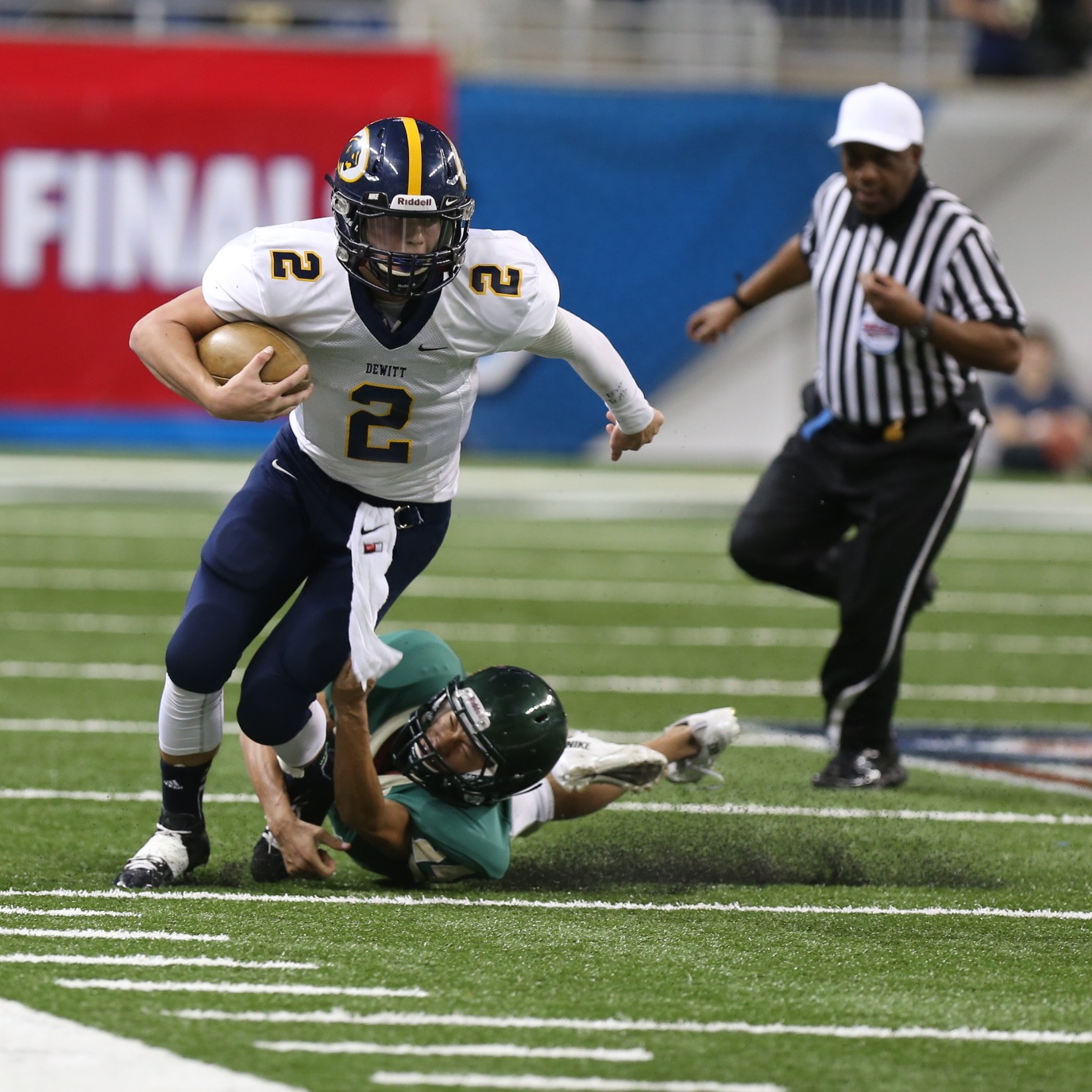 Led by its ground attack, West appeared to be on the verge of running away with this one, building a 28-7 halftime lead.
The Panthers wouldn't allow the Dux to coast to the championship that easily, however.
A 56-yard touchdown run by Chris Ruby and a 29-yard scoring strike from Jake Johnson to Josh Borta in a 72-second span got DeWitt within 28-20 with 6:50 left in the third quarter.
West responded with a 25-yard touchdown run by Brinks with 2:57 to go in the third, but an offense that averaged 48.9 points per game coming into the contest wouldn't score again. Junior defensive back Ben Zamiara led DeWitt's defensive charge with a game-high 20 tackles, 11 more than anyone else on either team. The Panthers held West to 1-for-4 on fourth-down conversions.
"I'm pretty sore right now," Hession said. "This is one of the games I've come out of the most sore. I can feel it right now, and my adrenaline is still rushing. Props to them, because they came out and they had three or four series where they stopped us on fourth down. Not many teams can do that. They're just good."
DeWitt closed the deficit to seven points when Johnson rolled left and hit a wide-open Borta for a 75-yard touchdown with 4:25 left in the game.
The Panthers' offense would watch the rest of the game on the sidelines. The Dux milked some clock by getting two first downs before dropping back to punt from its own 48 for the only time in the game. Postma barely got off the punt, but was knocked to the ground when a DeWitt defender caught him on the leg while going for a block. West retained the ball, running out the remaining 32 seconds by taking a knee one time.
"Our punter was already hurt," West coach John Shillito said. "He was on one leg. So, it was a great effort by Grant to get the ball off and it was a break for us. We knew the game was over. You knew that all you had to do was take a knee."
DeWitt coach Rob Zimmerman said going for the block was a risk the Panthers had to take, given the time on the clock and the potential field position.
"If they punt and pin us down at the 10, that's a long way to go," Zimmerman said. "We went for it. Obviously, it didn't turn out in our favor. You have to take chances when you're in that situation."
DeWitt tried in vain to play catch-up all night after falling behind 8-0 when Bauder took the ball around the left side of the Dux line and broke into the clear for an 80-yard touchdown just 45 seconds into the game. West, which attempted (and missed) only one extra-point kick all year, got two points on a pass from Brinks to Zach Poppema.
West scored on four of its five possessions in the first half, failing only on its second series when a fourth-and-five run from the DeWitt 13 came up a yard short.
The Dux shook off that temporary setback and scored on a 7-yard pass from Brinks to Hession on the first play of the second quarter. Hession ran for the 2-point conversion to make it 16-0.
Following a fumble at the West 49, the Dux took a 22-0 lead on an 18-yard run up the middle by Postma with 6:45 left in the first half. Brinks' conversion run failed.
DeWitt (13-1) finally put a drive together and got back in the game on a 4-yard touchdown pass from Johnson to Justice Shankel with 3:15 left in the first half. Cameron West's extra point made it a 22-7 game.
The Dux didn't get away from their ground game with time winding down in the first half, throwing only one pass on a seven-play, 80-yard drive that yielded a 12-yard touchdown run by Postma with 1:04 to go in the half. Postma's 2-point run failed, resulting in a 28-7 halftime lead for West.
"We dug ourselves too deep a hole," Zimmerman said. "I felt if we got one more possession, we had a shot."
Johnson, a junior, was 15 for 24 passing for 289 yards, three touchdowns and two interceptions for DeWitt. Brinks was 3 for 5 for 35 yards and a touchdown for West.
Borta grabbed five passes for 183 yards and two touchdowns.
PHOTOS: (Top) Zeeland West running back Danny Bauder scampers ahead during Saturday's Division 3 Final. (Middle) DeWitt quarterback Jake Johnson tries to pull away from a Dux defender's grasp. (Photos by Hockey Weekly Action Photos).