

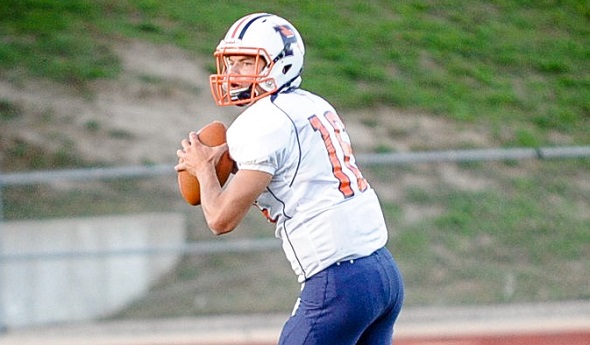
Playmaking Sargent Powers Chargers
November 25, 2015
By Bill Khan
Special for Second Half
FLINT — Most high school football coaches aren't comfortable having their quarterbacks, no matter how athletic they are, perform double duty by playing defense.
 The risk of injury or excessive fatigue is simply too great.
Flint Powers Catholic's Bob Buckel is no different than the majority of his peers.
"I'll be honest, I don't feel comfortable having him on the field all the time," Buckel said of senior quarterback Noah Sargent.
And, yet, having Sargent play defensive back when he isn't running the offense is one of the reasons why Powers (11-2) will play Zeeland West (13-0) for the MHSAA Division 4 championship at 7:30 p.m. Friday at Ford Field.
Sargent's team-high third interception of the season played a major role in Powers' 21-14 come-from-behind victory over Detroit Country Day in the Semifinals last Saturday in a snowstorm at West Bloomfield
He had already ignited a comeback from a 14-0 halftime deficit by tossing a 38-yard touchdown pass to Peyton Beauchamp. Sargent's one-handed interception later in the third quarter at the Country Day 20-yard line set up a 20-yard touchdown run by Reese Morgan.
Showing off one more aspect of his skill set, Sargent scored the winning touchdown on a 2-yard run with 26 seconds left in the game, putting Powers in the MHSAA championship game for the third time in school history. The 2005 team won the Division 4 championship, while the 2011 squad won the Division 5 title.
Putting an exclamation point on his performance, Sargent knocked down Country Day's final desperation pass as time expired.
"Noah understands we don't want him to get killed on defense," Buckel said. "We really try to put him on the best receiver and keep him out of harm's way. I heard someone earlier in the year say, 'When you get to the playoffs, you've got to save him.' I said, 'When you get to the playoffs, you have to play every play like it's your last play.' You throw him out there and hope for the best; the best happened last Saturday."
Sargent has 19 tackles, ranking ninth on the team. He is part of a defense that has allowed only 21 points in four playoff games and posted a school-record six shutouts.
"Coach really only plays me as a cover guy," Sargent said. "He doesn't like to throw me down (near the line). He uses me in coverage on third-and-long situations and passing downs."
As a quarterback, Sargent has displayed the kind of dual-threat capability that was integral to Powers' last MHSAA championship four years ago. Garrett Pougnet ran for 159 yards and two touchdowns and threw for 258 yards and four touchdowns in Powers' 56-26 rout of Lansing Catholic in the 2011 title game.
Sargent is Powers' leading rusher, in addition to its leading passer. He's run 134 times for 1,026 yards and 15 touchdowns, including an 83-yard scramble on third down for a touchdown in the playoff opener at Goodrich. He's 104 for 181 for 1,563 yards, 18 touchdowns and only four interceptions. Five of those touchdown passes came in a 41-0 victory over Goodrich, as he had a hand in all six touchdowns.
 "We knew Sargent was the show," Goodrich coach Tom Alward said. "They've got good receivers, but Sargent's the one that makes them go."
Sargent is the son of Mike Sargent, an all-state linebacker at Powers in 1983 and a tight end on Michigan State's 1988 Rose Bowl championship team. Both of Sargent's parents went to Powers, and Noah attends his parents' alma mater with his sister, Nikole, who was the MHSAA Lower Peninsula Division 2 shot put champion as a junior last spring.
"He's a good leader," said senior tight end Nick Thompson, Powers' leading receiver with 27 catches for 448 yards and seven touchdowns. "He's humble. He's not selfish. He has the aspects of a good leader. You can see it on the field, obviously, and at practice. We trust him."
Sargent isn't the only Charger with a rich Powers pedigree.
Running back Reese Morgan and receiver Matt Wiskur had brothers on the 2011 championship team. Brooks Morgan was a starting receiver, while Ethan Wiskur was a starting defensive back who had an interception in the 2011 title game.
Watching in the stands as middle school students, the younger Morgan and Wiskur brothers had all the incentive they needed heading into high school.
"That's my main motivation," said Wiskur, who has 23 catches for 383 yards and five touchdowns. "They're the strongest team I've ever seen. They had great leaders. They were 5-4 going into the playoffs. They knew they were going to win states the whole time. They were confident in themselves, and they lived up to that."
A similarity between the 2011 and 2015 teams is their slow starts. Powers was on the brink of playoff elimination after six games, starting out 2-4 in Buckel's first season at the helm. This year's team lost its opener, 27-11, to a Flushing team that went 3-5 the rest of the way. The Chargers were 3-2 before winning their last eight games.
"I remember they didn't have a very good start, but they had a lot of heart and they made a big run in the playoffs and kind of shocked everyone," said Morgan, who has run 146 times for 987 yards and 10 touchdowns while catching 27 passes for 317 yards and two scores.
"The talent on that team was incredible. We have the same chance they did of winning."
When Powers steps foot onto the turf at Ford Field on Friday, the current team will play under the watchful eye of youngsters who hope to one day have the same experience.
"Any high schooler wants to leave a legacy when they leave," Sargent said. "Our whole team is trying to make a mark on Powers history."
 Bill Khan served as a sportswriter at The Flint Journal from 1981-2011 and currently contributes to the State Champs! Sports Network. He can be reached at [email protected] with story ideas for Genesee, Lapeer, St. Clair, Sanilac, Huron, Tuscola, Saginaw, Bay, Arenac, Midland and Gladwin counties.
PHOTOS: (Top) Powers Catholic quarterback Noah Sargent drops back to pass against Midland Dow this season. (Middle) Sargent unloads a throw during the 35-30 loss, but has led the Chargers to an 11-2 record this fall. (Click for more from HighSchoolSportsScene.com.)

North Central Soars, Scores 1st Football Title
November 20, 2015
By Geoff Kimmerly
Second Half editor
GREENVILLE – The photos Powers North Central football players took Friday night after winning the first MHSAA championship trophy in program history were finishing touches on arguably the most impressive run yet during the short history of 8-player football in this state.
 Although the 8-player format is only half a decade old, it’s fair to surmise Michigan may not see an offense as potent as North Central’s for years to come – at least until the Jets take the floor this basketball season.
Sure, North Central was held to its season low in points Friday. But given the opponent and the stage, the Jets did more than enough to impress in defeating previously-undefeated Battle Creek St. Philip only 58-33 after scoring at least 64 points in every other game this fall.
North Central (13-0) ended this season, it’s first as an 8-player program, averaging 70.4 points per game. That was only half a point less than the basketball team, featuring many of these same players, averaged in winning the Class D title in March.
“When you go into a season, you know what you have and you know what you need to work on,” said junior quarterback Jason Whitens, who also was the basketball team’s leading scorer last winter. “With the group of guys we’ve got, we all love each other, we’re close-knit just like basketball, and we love to work hard. We come out here and perform and just work hard.”
North Central finished 13-0. Before St. Philip came within 25 points, no opponent had come closer to the Jets than 48.
A few key decisions gave them the momentum for such a dominating run.
 First came the decision to move to 8-player. North Central had had recent success in 11-player, making the playoffs three of the last five seasons and finishing 8-3 in 2013. But enrollment dropping to 119 students this fall justified the move.
Then came another switch. Whitens, a receiver last season, moved to quarterback to take over for his graduated cousin Rob Granquist after formerly serving as one of Granquist’s top targets.
Whitens threw for 217 yards and two touchdowns Friday, giving him 2,532 yards and 45 touchdown passes without an interception this fall. It’s a good argument, which was more incredible – the zero interceptions or that 25 percent of his 179 passes went for scores.
His development was quickened by work with cousin Granquist, but also by another sharp decision by coach Kevin Bellefeuil, who decided to keep the same offense as when the team was 11-player but drop the tackles and a slot receiver.
Still, St. Philip nearly wrote its own storybook ending as it sought its first football title since 1985.
The Tigers scored first – the first time North Central had trailed this season – and led by as many as nine points before a pair of plays changed the game’s course.
Holding a 21-20 lead with 2:15 left in the first half, St. Philip chose to go for a first down on 4th-and-1 from North Central’s 34 yard line – and was stuffed for a 3-yard loss by junior Tanner Poupore with help from a few teammates.
On the next play, Whitens dropped a 63-yard touchdown pass just over the shoulder of junior running back Bobby Kleiman, who outran a defender for the go-ahead score.
 “We’ve got a couple of guys, and we can just call their number and it seems to go for us every time,” Bellefeuil said. “We set up a couple of plays, and then we waited and waited and waited. And then we hit with that big pass to Bobby down the middle and it was just what we hoped would happen.”
Less than two minutes later, junior Dawson Bilski intercepted a fourth-down St. Philip pass again in North Central territory. With 30 seconds left in the first half, Whitens led a 56-yard drive that included 28 and 34-yard passes to Kleiman and ended with Whitens scoring on a 1-yard run with a second left in the half.
“They just had a ton of weapons and speed that we couldn’t contain, and that was the ballgame,” Tigers coach Dave Downey said. “Once we get down, we’re pressing. We’re throwing the ball a lot more than what we probably should have. We like to run the ball a little bit more. When we went to the air, they defended the pass pretty well and they got to our quarterback quite a few times, and that was the difference too.”
The North Central defense did give up a season high in points, but those 33 were also a season low for the Tigers. St. Phil did end up with 380 total yards – senior running back Brayden Darr ran for 104 and two touchdowns despite plenty of North Central attention, and senior quarterback Brendan Gausselin threw for 172 and two scores – but St. Philip couldn’t make up for a pair of interceptions and the Jets’ 572 yards of offense.
Darr also had 13 tackles to lead the Tigers, and Bilski had a team-high 12 for North Central.
Kleiman rushed for 205 yards on only 21 carries, good for an average of nearly 10 yards per attempt. He ran for five touchdowns to go with the sixth through the air.
Bilski and Kleiman are two more of six starters on the Jets’ offense who have another season to play. After averaging 70 points a game and dominating most of all 13 wins, what could be next?
“Keep working hard and just have fun,” Whitens said. “We’re in high school, having the time of our lives right now and doing things we love. We’re ready for next year, and I’m very excited.”
The MHSAA Football Finals are sponsored by the Michigan National Guard.
PHOTOS: (Top) North Central quarterback Jason Whitens runs toward the end zone while St. Philip’s Trevor Searls (70) and Grayson Obey (16) give chase. (Middle) St. Philip quarterback Brendan Gausselin moves upfield while the Jets’ Taylor Belongia (79) and Zach Estrada (68) close in. (Below) North Central’s Bobby Kleiman hauls in a 63-yard scoring pass during the second quarter. (Photos by John Johnson.)