


Playoff Berth Adds to Lincoln Park Surge
By
Tom Markowski
Special for Second Half
October 28, 2015
LINCOLN PARK – Steve Glenn has played baseball since he was 10 years old. It’s always been his favorite sport.
Not anymore. This football season changed things.
 Glenn is the starting quarterback at Lincoln Park. Though he doesn’t look like one. At 6-foot-3 and 250 pounds, Glenn is taller and weighs more than any of the starting offensive linemen. He started last season, too, as junior. It wasn’t as much fun then. Lincoln Park was 3-6 in 2014, the program’s 12th consecutive losing season.
This season, Glenn is having a blast. Last Friday, Lincoln Park (6-3) clinched it first playoff appearance since 2002 when the Railsplitters defeated a team also in search of a playoff spot, Downriver League rival Gibraltar Carlson, 21-19.
Lincoln Park will play another Downriver League team, Wyandotte Roosevelt (7-2), at 7 p.m. Friday in a Division 2 Pre-District game. On Sept. 18, Lincoln Park shocked Roosevelt and the rest of their league with an 18-15 victory.
This is the same program that set the state record for consecutive losses (66) from 2006-13, but this Lincoln Park team is different. This team has grit. It has determination.
“We did it differently,” Glenn said. “We communicate with our teammates. We are always positive. We have a no-lose attitude.”
In half of its victories this season, Lincoln Park trailed during the second half. Against Wyandotte Roosevelt, it scored on its final possession to win. Lincoln Park trailed Melvindale by 13 points with six minutes left before coming back to win, 38-35. And against Taylor Truman, it trailed by seven points before winning in double overtime, 40-34.
The turnaround began in 2013 when Jamie Grignon returned to the program as head coach. Grignon coached Lincoln Park from 1994-99 before leaving to become the offensive coordinator at Dearborn. His son, Alex, attended Dearborn, played football for coach Dave Mifsud, and Grignon was to be a part of his son’s development.
Lincoln Park ended its losing streak in Grignon’s first season back with a 34-20 win over Taylor Kennedy that Oct. 4, and changes started to happen. The players didn’t have to give excuses. No longer did they have to listen to the negatively that resonated in the halls and community.
Perceptions changed, too.
“After we broke that streak,” Grignon said. “I said my biggest challenge was to keep Lincoln Park kids in the program. Now we’re reaping the benefits.
 “After we beat a team this year that had three Lincoln Park kids, some of my kids said it was tough to see Lincoln Park kids on the other team crying, saying they wished they had stayed.”
Open enrollment contributed to Lincoln Park’s downturn. Students who attended middle school and junior high and played football often would go elsewhere to play and avoid being a part of a program seeking respect.
That thought never occurred to Glenn.
Without naming names, Glenn pointed to four players, two each at two other schools, who were teammates with him in middle school.
“Growing up, I was raised where I wouldn’t leave the city I grew up in,” he said.
He’s one of 12 seniors on the team of 32 players total, and one of three captains. The other two are two-way back Trevor Anderson and center Kalani Kapiko. Lincoln Park runs the read option to take advantage of Glenn’s size and surprisingly good speed for that size (4.7 second in the 40-yard dash). He’s rushed for nine touchdowns and passed for 10 more.
But those three are the only returning starters from a year ago. This is still a young team. Four starting offensive linemen and seven defensive starters are underclassmen. But it’s a team that’s athletic and likes to plays fast.
Still, it’s the seniors who lead the way.
“For the first time, Lincoln Park has that,” Grignon said. “Before they were afraid to motivate others by saying something.
“We had an OK four-way (preseason scrimmage), and once we beat Woodhaven in the opener that started it.
“We’re excited about being in the playoffs. We’re excited about the program. I don’t see us being a one-time team and going backwards.”
 Tom Markowski is a columnist and directs website coverage for the State Champs! Sports Network. He previously covered primarily high school sports for the The Detroit News from 1984-2014, focusing on the Detroit area and contributing to statewide coverage of football and basketball. Contact him at [email protected] with story ideas for Oakland, Macomb and Wayne counties.
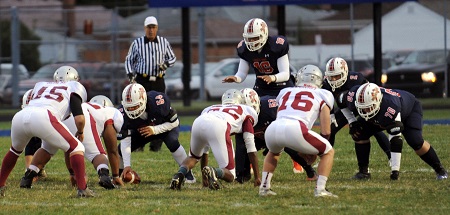
PHOTOS: (Top) Lincoln Park’s Elijah Cross (23) breaks away from a would-be tackler during his team’s Homecoming game against Southgate Anderson. (Middle) The Railsplitters prepare to run a play during that 25-13 loss. (Photos courtesy of Lynsey Schweizer.)

Scheduling Solution
September 27, 2016
One of our state's consistently best high school football programs needed a ninth game this season but could find no opponent within the state of Michigan. It was able to find a game with an equally prestigious football program in an adjacent state that was having the same problem – the "problem" of being such a formidable program year after year that other schools shied away from scheduling them.
Two different schools in two different states with two different football playoff formats and qualifying procedures, facing the same problem.
This helps to demonstrate that it is not any particular football playoff system that is at the heart of high school football scheduling difficulties. Much more at fault is human nature. One could change the qualifying system or double the number of qualifiers so that even winless teams make the playoffs, and some schools would still refuse to schedule others, which would then have to travel out of state to complete their schedules.
The solution to football scheduling will have very little to do with expanding the playoff field or changing the qualifying criteria. It is only when the scheduling of varsity football games is removed from the local level and assigned to the MHSAA that all teams will play the opponents that are closest to them in enrollment and location. Hard to fathom that will ever occur. But then, no team would have to travel out of state, or even across the state, to complete a varsity football schedule.