


Playoff Proposal Pauses
May 10, 2013
During the MHSAA Football Finals at Ford Field last November, I was approached by representatives of the Michigan High School Football Coaches Association with a request to have the MHSAA’s computing capabilities crunch the numbers for a concept that a couple of the coaches association’s members had for revising the MHSAA Football Playoff point system.
Within a few weeks the MHSAA hosted a meeting that brought together the coaches who introduced the concept with our numbers crunchers; and within a few days our staff had outlined the principles, revised the point system and retrofitted it to show how the system would have affected the 2012 playoffs.
There was initial excitement that we might be onto something, but that brief infatuation began to wane as we dug deeper and discussed the plan more widely.
The key ingredients of the proposal are (1) that a school would gain playoff points for every game its opponent wins, whether or not that school defeated that opponent, and (2) that the number of automatic qualifiers would be reduced in favor of a larger group of additional qualifiers based on a revised playoff points system that would favor schools which schedule larger and more successful opponents.
In spite of our staff’s helpfulness in bringing this proposal forward, we’ve lost optimism that it will accomplish what is hoped. Rather than making regular-season scheduling easier, it could make it harder as the “six-wins-and-in” mindset is replaced by the even worse “seven-wins-and-in” mindset. And any system that ignores a minimum number of wins and relies entirely on playoff points is even less fair than the current system to schools in the less densely populated areas of Michigan.
From our retrofitting of the proposed concept to the 2012 season, we know that teams with 6-3 records would be displaced in the playoffs by teams with 4-5 records, which is certain to go down badly and be difficult to explain to those communities. The revised point system would make it even more difficult than the current system for schools in less populated areas to find opponents of the size and strength to generate high playoff point averages without these schools driving 100, 200, 300 or more miles, one way, several times each season. For individual schools and some entire leagues, this will make football scheduling tougher, not easier. It is likely to add stress to those league affiliations, and to football scheduling generally.
In any event, there is no need to rush to 2013 or 2014 a proposal that’s called “Enhanced Strength of Schedule System” because schedules are 99 percent set for 2013 and nearly so for 2014. Even if adopted today, few schedules would be impacted before 2015. If a change like this one is to be implemented, schools must have ample notice, and our technology department must have enough time to program the new point system and then test it through an entire season.
The Representative Council acted wisely on May 6 when it paused the progress of this proposal. Some elements of it may be discussed at the MHSAA’s scheduled meetings this summer and fall.
Edwards, Lakers Run Away With 1st Title
January 23, 2021
By Jason Schmitt
Special for Second Half
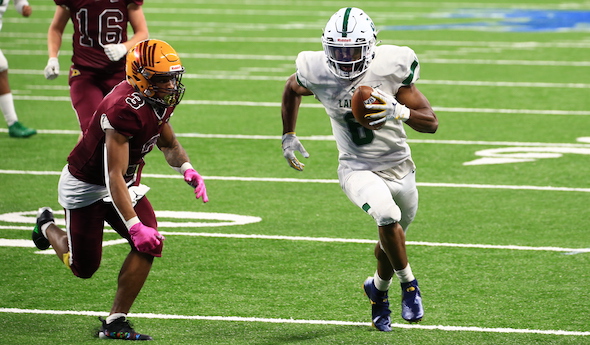
DETROIT – It was never really a matter of if, but rather when Donovan Edwards was going to bust a big run.
On Saturday, the West Bloomfield senior answered the call, scoring on runs of 71 and 78 yards en route to a three-touchdown afternoon while leading his Lakers to a 41-0 victory over 2019 champion Davison in the Division 1 Football Final at Ford Field.
Edwards, who has signed to play collegiately at the University of Michigan, finished the afternoon with 257 yards on just 14 carries. Despite not playing in the fourth quarter, he totaled the eighth-highest rushing total in MHSAA Finals history. And it was enough for West Bloomfield head coach Ron Bellamy to make a major declaration.
“This here is the best football player in the state of Michigan,” Bellamy said of Edwards. “Five star. Big college. Whatever it may be. Teams come to stop one football player, and he had 200-some yards (today).
“I’m from Louisiana, and I had a chance to play against Ed Reed in high school. I had a chance to play against Reggie Wayne, Eli Manning, I played against NFL Hall of Famers in high school, on the same field, and he looks like them. It ain’t the cliche, ‘Best player on the field.’ He looks like a dude that’s gonna play for a long time in the NFL and be an all-American at the University of Michigan. Obviously some things have to happen in his favor, but you saw it. He just looks different from everybody else on the field.”
Edwards’ talents were on display right away. After the two teams traded early fumbles, Edwards broke free on the first play from scrimmage for a 78-yard touchdown to give his team a 7-0 lead.
West Bloomfield would expand its lead to 17-0 by halftime thanks to a 39-yard field goal by senior Jake Ward and a 13-yard touchdown run by senior Mekhi Elam.
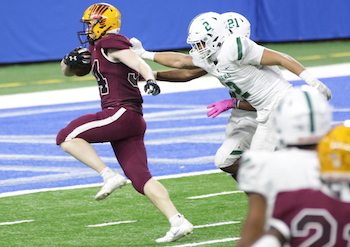 The Lakers defense was on display all afternoon, limiting the Cardinals offense to just 136 total yards. It forced a pair of fumbles and converted them into 14 points. Senior defensive end Niles King stripped the ball from the hands of Jay’len Flowers and returned it 40 yards to give his team a 24-0 lead less than a minute into the second half.
“We know that when you come to Ford Field you’ve got to play defense,” Bellamy said. “Davison has a heck of a defense, but our defense was better today. Those guys were lights out.
“We had an early fumble in the game and they were playing Davison smash-mouth football. They hit us in the mouth. I told the kids, defensively, ‘They’re going to hit us in the mouth early; it’s how you respond to adversity.’ Once they fumbled the ball and we got it back, our defense was balling out.”
Senior linebacker Travis Reece led the Lakers with seven tackles, two for a loss, and added a sack. Senior linebacker Jordan Hoskins had six tackles.
West Bloomfield kicker Jake Ward connected on a pair of field goals, from 39 and 45 yards out, while converting all five of his point-after attempts. All seven of his kickoffs went for touchbacks.
Davison, which defeated Brighton 35-25 to win the 2019 championship, was playing without its regular-season starting quarterback Brendan Sullivan, who enrolled early at Northwestern University. The Cardinals also suffered a loss in-game, when senior defensive end Harrison Unger went down with a leg injury. He left the game with eight minutes remaining in the first quarter.
“Harry is our best player,” Davison head coach Jake Weingartz said. “Defensive end, he plays tight end, slot receiver. He does a lot for us on both sides of the ball. It was unfortunate because he’s a huge part of our gameplan. It was rough.”
Without him, Davison had trouble stopping Edwards and Co. Senior Clarke Hamilton led the Cardinals (11-1) with six tackles.
“If anyone has watched us play, it was very uncharacteristic of us,” Weingartz said. “I just think we struggled with their speed. Their front six is real good. We missed a lot of opportunities. You just can’t miss them here, and you definitely can’t miss them against a team like West Bloomfield.
“I’m very proud of our kids for battling all the adversity this year, with the stop and start and losing our quarterback to early graduation. Obviously this is not how we wanted it to end.”
For West Bloomfield (10-1), Saturday’s championship was the first in school history. The Lakers lost to Clarkston, 3-2, in the 2017 Division 1 title game.
“It’s surreal. It’s so, so surreal,” Bellamy said. “We’ve waited so long for this moment. These last few years, since we lost (to Clarkston), everything in my power, in my coaching staff’s power, we wanted to develop a champion. We’ve been so close, but yet so far.
“It’s a special feeling. We’ve made many sacrifices this year. The kids’ mental health was challenged with the shutdowns. But we’re here, we made it here. We felt we had a good football team, and we had a chance to win a state championship.”
PHOTOS: (Top) West Bloomfield’s Donovan Edwards (6) strides toward the end zone Saturday, as Davison’s TeAvion Warren pursues. (Middle) The Lakers’ Travis Reece (2) and BJ Rankin (21) work to bring down the Cardinals’ Payton Pizzala. (Click for more from Hockey Weekly Action Photos.)