


Playoff Proposal Pauses
May 10, 2013
During the MHSAA Football Finals at Ford Field last November, I was approached by representatives of the Michigan High School Football Coaches Association with a request to have the MHSAA’s computing capabilities crunch the numbers for a concept that a couple of the coaches association’s members had for revising the MHSAA Football Playoff point system.
Within a few weeks the MHSAA hosted a meeting that brought together the coaches who introduced the concept with our numbers crunchers; and within a few days our staff had outlined the principles, revised the point system and retrofitted it to show how the system would have affected the 2012 playoffs.
There was initial excitement that we might be onto something, but that brief infatuation began to wane as we dug deeper and discussed the plan more widely.
The key ingredients of the proposal are (1) that a school would gain playoff points for every game its opponent wins, whether or not that school defeated that opponent, and (2) that the number of automatic qualifiers would be reduced in favor of a larger group of additional qualifiers based on a revised playoff points system that would favor schools which schedule larger and more successful opponents.
In spite of our staff’s helpfulness in bringing this proposal forward, we’ve lost optimism that it will accomplish what is hoped. Rather than making regular-season scheduling easier, it could make it harder as the “six-wins-and-in” mindset is replaced by the even worse “seven-wins-and-in” mindset. And any system that ignores a minimum number of wins and relies entirely on playoff points is even less fair than the current system to schools in the less densely populated areas of Michigan.
From our retrofitting of the proposed concept to the 2012 season, we know that teams with 6-3 records would be displaced in the playoffs by teams with 4-5 records, which is certain to go down badly and be difficult to explain to those communities. The revised point system would make it even more difficult than the current system for schools in less populated areas to find opponents of the size and strength to generate high playoff point averages without these schools driving 100, 200, 300 or more miles, one way, several times each season. For individual schools and some entire leagues, this will make football scheduling tougher, not easier. It is likely to add stress to those league affiliations, and to football scheduling generally.
In any event, there is no need to rush to 2013 or 2014 a proposal that’s called “Enhanced Strength of Schedule System” because schedules are 99 percent set for 2013 and nearly so for 2014. Even if adopted today, few schedules would be impacted before 2015. If a change like this one is to be implemented, schools must have ample notice, and our technology department must have enough time to program the new point system and then test it through an entire season.
The Representative Council acted wisely on May 6 when it paused the progress of this proposal. Some elements of it may be discussed at the MHSAA’s scheduled meetings this summer and fall.
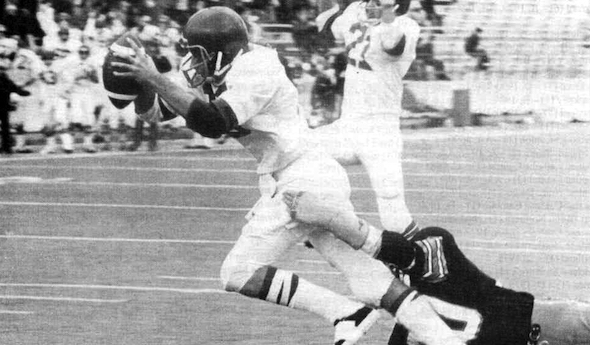
Moment: Streak-Ender Highlights 1st Finals
December 11, 2020
By John Johnson
MHSAA Director of Broadcast Properties
It’s been 45 years since the first MHSAA Football Playoffs took place, a two-week, 16-team tournament with the top teams of each of four regions in all four classes finally settling gridiron championships on the playing field.
In that first year, cries of “U.P. Power” thundered through the stands at Waldo Stadium in Kalamazoo and the new Perry Shorts Stadium in Mt. Pleasant as Crystal Falls Forest Park and Ishpeming claimed the 1975 titles in Classes D and C respectively. Bill Santilli ran wild for 179 yards on 37 carries and three touchdowns as the Trojans manhandled Flint Holy Rosary, 50-0, in the Class D game. But the Class C affair was one for the ages - perhaps the biggest upset in the history of the finals.
It was billed as David and Goliath. The mighty Hudson Tigers roared north to Mt. Pleasant riding a 72-game winning streak, which would stand as a national record until 1992; and is still a state record, only threatened once by a 69-game skein by Ithaca which ended in the 2014 Finals. Hudson had also laid claim to mythical state titles in Class C the three previous seasons. Ishpeming’s pedigree dated back to 1900, when it won the first of three straight - and of four in a five-year period - state titles in a championship conducted at and by the University of Michigan, primarily for the purpose of recruiting for Fritz Crisler’s Wolverines football program. The Hematites, having their best season in 15 years, had even lost a regular-season game along the way to a 9-0 Marquette squad that didn’t qualify for the playoffs.
On a cold, windy day at Central Michigan University, Ishpeming struck first and struck hard. Four minutes into the game, Tom Andriacchi blocked a Hudson punt and returned it to the Tigers' 10-yard line. Four plays later, quarterback Mark Marana kept the ball on the option and scored from two yards out. On its next possession just midway through the first period, the Hematites ripped off a 61-yard drive capped by a three-yard scoring run by Dave Farragh, and Ishpeming was up 16-0.
Hudson rallied following the ensuing kickoff with its first score, a 28-yard pass from Chris Luma to Dan Salamin, but the Hematites came right back with their third score of the opening frame, a 60-yard run by Mike Dellangelo to give Ishpeming all the points it would need.
The two teams traded scores in the second period, when Hudson then missed a golden opportunity to tighten things up just before halftime, fumbling at the Hematites' 2-yard line and with Ishpeming recovering for a touchback.
Dellangelo picked up a second TD in the third quarter, and finished the game with 156 of Ishpeming’s 336 rushing yards in the 38-22 victory.
“It wasn’t hard getting our guys up for the game,” Hematites coach Mike Mileski told Central Michigan Life after the game. “The emotion factor was a ready-made thing considering Hudson’s streak …”
Our action footage this week comes courtesy of Brian Sarvello, a member of that 1975 Ishpeming team. About 17 minutes film from that game was assembled with some of the local radio station call into a DVD that was shared with the team several years ago. We found it in a random internet search for this most recent series of MHSAA Moments, and appreciate Mr. Sarvello’s help in bringing it to you.
If you know of championship game footage from those pre-television years (1975-88) of the MHSAA Football Finals, we’d love to hear about it. Drop us a line at [email protected].
PHOTO: Ishpeming's Mark Marana works to break away from a tackler during the 1975 Class C Final. (MHSAA file photo).