


Playoff Proposal Pauses
May 10, 2013
During the MHSAA Football Finals at Ford Field last November, I was approached by representatives of the Michigan High School Football Coaches Association with a request to have the MHSAA’s computing capabilities crunch the numbers for a concept that a couple of the coaches association’s members had for revising the MHSAA Football Playoff point system.
Within a few weeks the MHSAA hosted a meeting that brought together the coaches who introduced the concept with our numbers crunchers; and within a few days our staff had outlined the principles, revised the point system and retrofitted it to show how the system would have affected the 2012 playoffs.
There was initial excitement that we might be onto something, but that brief infatuation began to wane as we dug deeper and discussed the plan more widely.
The key ingredients of the proposal are (1) that a school would gain playoff points for every game its opponent wins, whether or not that school defeated that opponent, and (2) that the number of automatic qualifiers would be reduced in favor of a larger group of additional qualifiers based on a revised playoff points system that would favor schools which schedule larger and more successful opponents.
In spite of our staff’s helpfulness in bringing this proposal forward, we’ve lost optimism that it will accomplish what is hoped. Rather than making regular-season scheduling easier, it could make it harder as the “six-wins-and-in” mindset is replaced by the even worse “seven-wins-and-in” mindset. And any system that ignores a minimum number of wins and relies entirely on playoff points is even less fair than the current system to schools in the less densely populated areas of Michigan.
From our retrofitting of the proposed concept to the 2012 season, we know that teams with 6-3 records would be displaced in the playoffs by teams with 4-5 records, which is certain to go down badly and be difficult to explain to those communities. The revised point system would make it even more difficult than the current system for schools in less populated areas to find opponents of the size and strength to generate high playoff point averages without these schools driving 100, 200, 300 or more miles, one way, several times each season. For individual schools and some entire leagues, this will make football scheduling tougher, not easier. It is likely to add stress to those league affiliations, and to football scheduling generally.
In any event, there is no need to rush to 2013 or 2014 a proposal that’s called “Enhanced Strength of Schedule System” because schedules are 99 percent set for 2013 and nearly so for 2014. Even if adopted today, few schedules would be impacted before 2015. If a change like this one is to be implemented, schools must have ample notice, and our technology department must have enough time to program the new point system and then test it through an entire season.
The Representative Council acted wisely on May 6 when it paused the progress of this proposal. Some elements of it may be discussed at the MHSAA’s scheduled meetings this summer and fall.
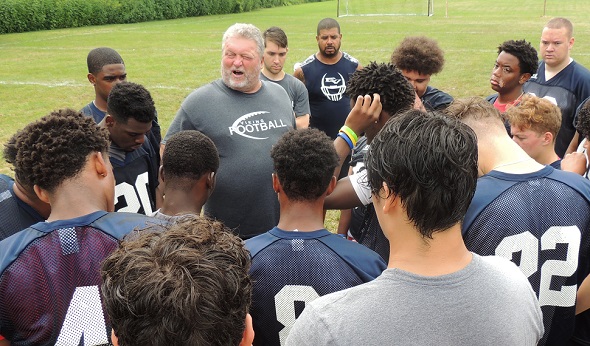
Smith Takes on Next Challenge at Everett
August 6, 2018
By Geoff Kimmerly
Second Half editor
LANSING – On a frequently stormy Monday in the shadow of iconic Archie Ross Stadium, the sun broke in for the end of Lansing Everett’s first football practice – just in time for coach Mike Smith to remind his players they have an opportunity to accomplish great things this fall.
Senior Noah Smith knows it. He may have been a first-grader in 2007 when Mike Smith left one of the state’s top Division 1 programs at Holt, but he’s heard plenty about those Rams – who finished the coach’s tenure with 25 straight league wins over four seasons and a District title.
Noah Smith was following mid-Michigan football much more closely in 2013, when Mike Smith took over an Eaton Rapids program that had never made the playoffs and immediately led the Greyhounds to two postseason appearances in his first two seasons.
“I knew that at Eaton Rapids, he came in and changed the program – and when I heard that he was coming here, I was hoping he would do that here,” Noah Smith said.
And Noah’s reaction after Monday’s first session?
“He’s going to change the program,” Smith adamantly added.
It’s not that easy, and even over-the-top to say Mike Smith has made it look that way. But it’s also impossible to argue with his work over the last 30 years.
The Detroit Denby and Michigan State University graduate took over a Dansville team in 1989 coming off a 1-8 finish and led the Aggies to a combined 32-6 run over four seasons including two they finished at 9-1.
After a one-year stop at Eaton Rapids in 1993 (the Greyhounds went 5-4, their last winning season before 20 straight below .500), Smith moved on to Holt in 1994, taking a Rams varsity that hadn’t won more than six games since 1981 to the Class A championship game in 1995. Holt was 98-54 over his 15 seasons with the Rams.
Smith left to assist at Olivet College, then assisted at Grand Ledge for a season before returning to Eaton Rapids in 2013 and leading the Greyhounds to 7-5 and then 8-4 records over his first two seasons – and a 25-26 run overall while navigating a league that has sent three of its six teams to Ford Field over the last eight seasons.
Add it up, and the first four high school varsities (including Eaton Rapids twice) that Smith has taken over were a combined 8-28 the year before – and a combined 24-15 his first seasons. All told, Smith enters this fall at Everett 160-90 for his career and raring for this next challenge and the greater opportunities to educate that come with it.
“I love to teach. I love this part about, it’s not just the football,” Smith said. “It’s about doing something for someone else, the greater good, the whole thing like that. I just really, really enjoy coaching. But it’s not just that – it’s the teaching as well.”
Everett welcomes Smith coming off a 1-8 finish a year ago after former coach Marcelle Carruthers – who turned the program into a local power over 17 seasons – stepped down in the spring to become principal at Lansing Eastern.
 Smith had 25 players on the field Monday, with three more for sure on the way, and he expects to end up with a roster in the low 30s – and with junior varsity and freshman teams as well, the freshman team possibly the largest of the three.
Smith also took over as the school’s athletic director in January. He knew his athletes coming into the first practice, but not as football players – and he admitted to being a little nervous Sunday night as he readied for another start.
Noah Smith said his classmates were a little anxious as well when Mike Smith was hired. But that’s eased as they’ve become familiar with their jolly new leader who long has been known for matching intensity with playfulness and genuine care for his athletes.
Noah Smith is entering his fourth season on varsity and earned all-league honors as a receiver last season in the Capital Area Activities Conference Blue. Mike Smith’s “calmer” approach caught his attention Monday, even as the new coach did make vocal points on occasion.
“It brings us together even more. You realize that he’s there. He’s actually coaching us. He’s a real coach for us,” Noah Smith said.
Mike Smith said he’s watching this week to see who shows up every day and works hard every day – another part of the culture he’s bringing from his previous stops.
Noah Smith knows it will be sinking in “when people start listening all the time instead of most of the time. We listen, I can honestly say we listen, but we need to listen all the time instead of most of the time because most of the time’s not going to cut it.”
This first practice was over by noon, and Mike Smith already was enjoying what he saw about 100 yards in front of him – players on both sides of assistant Jacob Wyatt, chatting up the former Sexton and Eastern Michigan standout on their way to the locker room.
“If you do the right thing every day, the game’s going to take care of itself,” he said. “You need to know what kind of offense and defense to run and put your kids in the best spots to be successful. (But) the other thing I’ve always stressed to my teams, this team can’t be my team. It’s gotta be your team. When you can get the kids all playing for each other, you’ve got yourself there.”
PHOTOS: (Top) First-year Lansing Everett football coach Mike Smith talks with his team at the end of their first practice of this season Monday. (Middle) A row of Vikings line up during a kickoff drill. (Photos by Geoff Kimmerly.)