

Port Huron Proud to Wear Perfection After First 9-0 Regular Season Since 1952
By
Paul Costanzo
Special for MHSAA.com
October 28, 2026
The T-shirts celebrating Port Huron High’s Macomb Area Conference Blue football title came in a little later this year, but for good reason.
 They were in need of a design tweak to add another, even bigger accomplishment: the school’s first 9-0 season since 1952.
“It was getting to be six and seven (wins), so I looked it up and I didn’t let anybody know except for the athletic director,” Port Huron coach Dan Perkins said. “We won our league and she shared with me the shirt design. and I said, ‘Well, hold off on those, we might want to add something to it.’ So it’s pretty neat.”
Port Huron defeated rival Port Huron Northern 13-10 this past Friday to finish off its perfect regular season. While the players may not have been aware of exactly how long it had been, they did know they were part of something special.
“It means the most to me, definitely, to do it with these guys and this type of team,” senior linebacker and tight end Aiden Forstner said. “Coming through, I haven’t seen a team do it (go undefeated), and I wanted to be the first to do it. All summer long, that’s what we thrived for. Every day in the weight room, all the conditioning, all the days that sucked, we thrived to be 9-0. Getting that accomplishment means a lot to me. (Beating Northern) definitely made it special, because everyone was expecting a blowout in that game, but it being as close as it was, and it being a nail-biter, it will stay with me forever. It being the school from the north, it made it 10 times better.”
It’s not as though the Port Huron program has lacked success. This year’s playoff berth extends the Red Hawks’ current streak to eight years. The 2019 team won a District title, as did the 2011 group, which came the closest to similar perfection, falling in its final regular-season game to finish 8-1.
“It’s crazy, and Northern’s last one was 1986, so for the whole town that’s quite an accomplishment,” Perkins said. “Doing that is very, very hard. We had a team in 2011 that’s getting inducted into the (Port Huron Sports Hall of Fame) that was a juggernaut, and we just slipped up the one game. It’s quite an accomplishment.”
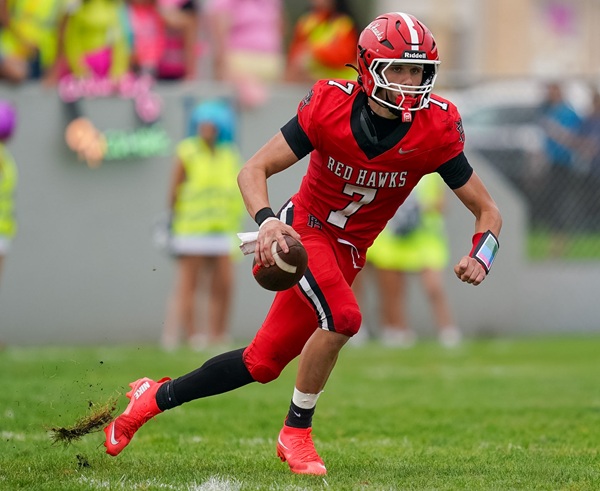
Led by a suffocating defense, the Red Hawks have been overpowering throughout the season, winning every game outside of Weeks 1 and 9 by at least two scores. For the season, they’ve held opponents to 12.3 points on average while scoring 37.2. The offense is quarterbacked by junior Jaxon Johnston, a 6-foot-2 junior with a big arm who is in his first year in the program.
He’s been able to grow into the system as Port Huron’s defense has been dominant from start to finish. Only Anchor Bay (in overtime) and Madison Heights Lamphere scored more than 14 against Port Huron this season.
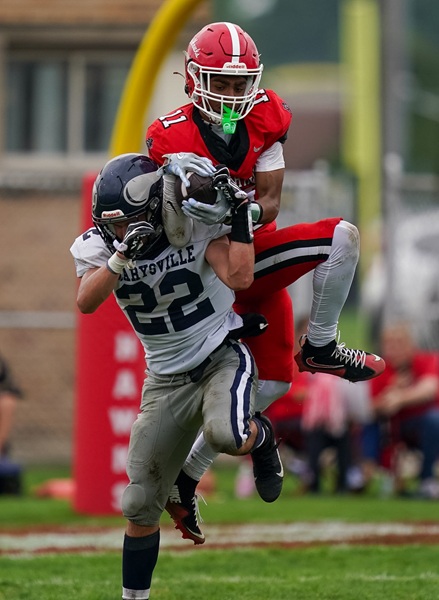
“We can hang our hat on our defensive crew, and that’s very nice,” Perkins said. “As long as our field position is right, going 80 yards against us is hard, real hard to do. And running the football has been real difficult for teams; we’re real stout up front. But every one of our defensive backs has multiple interceptions, and as a team we’ve got 19. The whole group has done a fantastic job, and coach (Brandon) Wardlow has done an awesome job with them, and the kids have really just responded. They take on the challenges. That’s been our calling card, and then the offense has been kind of a work in progress and has gotten better throughout the year.”
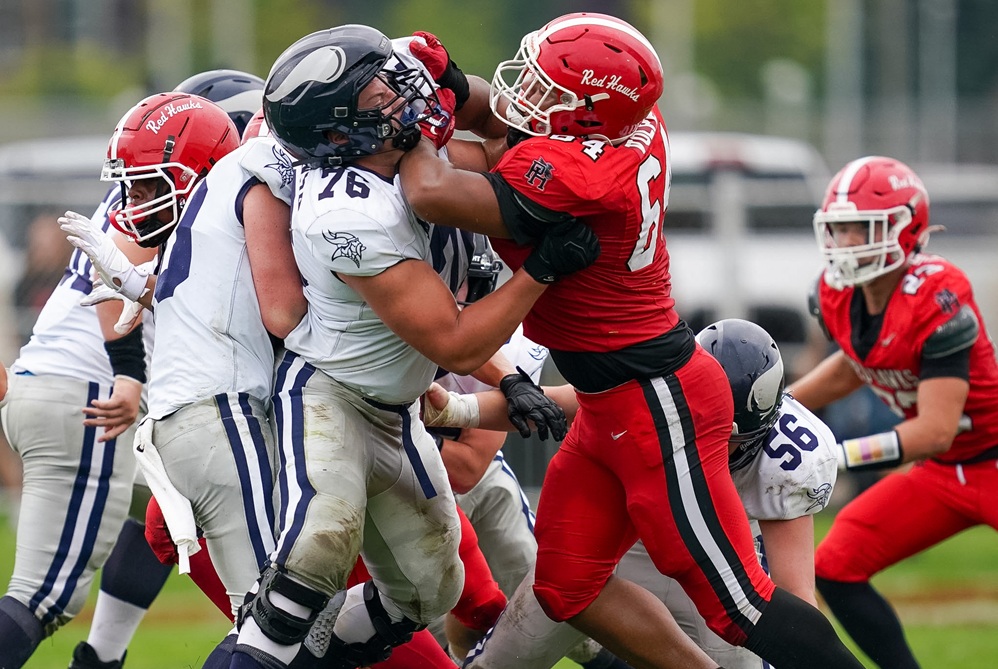
The defensive line is leading the charge on that side of the ball, paced by tackles Dylan Volpe and Ja’Michael Thomas, who create havoc up the middle. Both are juniors who stand over 6 feet tall and weigh in at 280-plus. Volpe has drawn interest from Division I college programs across the country, reporting offers from Florida State and Eastern Michigan.
And they’re surrounded by even more playmakers up front.
“Our D line is crazy. I think all of us have over three sacks,” Volpe said. “Me, Ja’Michael Thomas, Parrison Rome on the other end, Jayvon Bolar, Hunter Rock and Bryant (Braley), our D line is crazy.”
It’s also making things easier for the rest of the defense.
“It makes it so much easier,” senior linebacker Jaxon Winchester said. “Sometimes the linemen can’t even get to us because they’re putting in so much work. It’s just great to have, especially like Volpe and JT up there, they’re just so fast off the ball. It’s so nice to be part of, and I get some plays out of it.”
The next test for the Red Hawks is a matchup with New Boston Huron on Friday at Memorial Stadium in the opening round of the Division 3 playoffs. A win would give them a school record-tying 10th win and make them the first team in school history to reach 10-0.
Port Huron is the No. 1 seed in its region, meaning any game through the Regional Final would be played on the Red Hawks’ home field. But with Warren De La Salle Collegiate and Detroit Martin Luther King lurking as potential District and Regional opponents, the Red Hawks still feel as though they are doubted.
“I believe we’re very underlooked,” Forstner said. “Even if it’s like, ‘Where’s the competition that these guys have played?’ I feel like we’ve played at the level competition is, and where we need to be, and it will show when those weeks come.”
If they’re able to defend home field over the next three weeks, the Red Hawks would become the first team in program history to advance to a Semifinal, which would probably warrant one more shirt design.
“It would mean so much,” Winchester said. “Senior year, so it’s the last year, and I really think we can do it. We have the team, we have to come in and work every day like we have been all season. Port Huron Red Hawks coming, man. That’s all I have to say.”

Paul Costanzo served as a sportswriter at The Port Huron Times Herald from 2006-15, including three years as lead sportswriter, and prior to that as sports editor at the Hillsdale Daily News from 2005-06. He can be reached at [email protected] with story ideas for Genesee, Lapeer, St. Clair, Sanilac, Huron, Tuscola, Saginaw, Bay, Arenac, Midland and Gladwin counties.
PHOTOS (Top) Port Huron’s Dylan Volpe (64) works against a blocker during his team’s Week 2 win over Marysville. (Middle) Quarterback Jaxon Johnston surveys the field. (Below) Carter Bankston (11) contends for the ball with a Marysville player. (Photos by Ryan Dowd/Blue Leprechaun Photography.)
Talking Practice: Texas, Illinois Revise Policies
December 20, 2013
By Rob Kaminski
MHSAA benchmarks editor
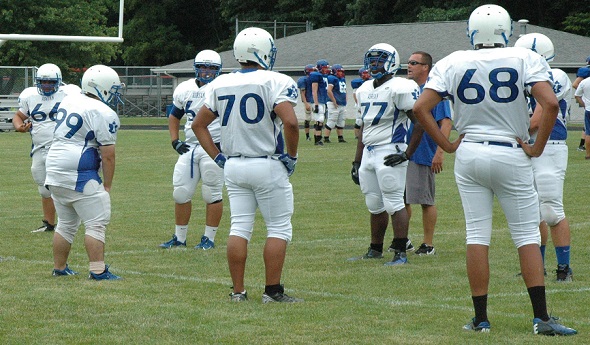
Coaches and players in Texas and Illinois adapted to new football practice limitations this fall, with the Texas policy focusing on contact, and the Illinois regulation emphasizing length of preseason practices.
Following are the main changes those states put in place heading into the 2013-14 season:
The University Interscholastic League, which governs school sports in Texas, put into writing that, “During the regular season and postseason, no football player is allowed to participate in more than ninety (90) minutes of full contact practice per week,” effective with the first day of practice this fall.
The complete policy follows:
For the purposes of the of rule, "full contact" is defined as football drills or live game simulations where "live action" occurs. Live action, as defined by USA Football, is contact at game speed where players execute full tackles at a competitive pace taking players to the ground. A team may continue to dress in full pads for practice, but may only participate in live action drills and game time simulations no more than ninety minutes per athlete per week. It is assumed that when players are in shells (shorts, shoulder pads, and helmets) no live action drills or simulations will occur. This rule is intended to limit live action drills and simulations and not the number of practices a team may participate in full pads. A team may participate in "air," "bags," "wrap," and "thud" drills and simulations at any point. These contact levels are defined below:
• Air - Players should run unopposed without bags or any opposition
• Bags - activity is executed against a bag, shield or pad to allow for a soft-contact surface, with or without the resistance of a teammate or coach standing behind the bag.
• Wrap - Drills run at full speed until contact, which is above the waist with the players remaining on their feet.
• Thud - Same as wrap but tempo is competitive with no pre-determined winner and the players are not tackling to the ground.
 The rule came to the UIL Legislative Council as a recommendation from the UIL Medical Advisory Committee, a permanent advisory committee to the Legislative Council which meets twice each year to discuss and review safety policies for UIL participants. The committee, which is made up of leading medical professionals in various specialties and includes representatives from the Texas High School Coaches Association, the Texas Girls Coaches Association, and the Texas State Athletic Trainer Association, unanimously recommended this limitation in full-contact football practice.
The rule formulates into a formal policy the existing actions of the majority of coaches across Texas, and most coaches have had to make few adjustments, if any. In fact, according to a story on statesman.com, the proposal caused more of an uproar on social media than from coaches.
“It’s not going to affect us in anyway,” Vandegrift HS coach Drew Sanders said in the story. “Most good coaches were way below that 90-minute amount already. Prior to legislation we still monitored it ourselves – the only change is now we have to keep up a log more publicly.”
Illinois put standards in place for its first 14 days of football practices, known as the state’s Preseason Football Acclimatization Practice Period. At the core of the policy is a three-hour practice limit for the first five days, during which teams can also conduct a one-hour walk-through.
 Teams must observe a minimum two hours rest between the practices and walk-throughs. Players may wear helmets only on the first two days, then helmets and shoulder pads for the next three. From days seven through 14 of the acclimatization period, schools may practice for a maximum of five hours per day, as long as that day is followed by a three-hour day, or an off day. During the five-hour days, no session can last more than three hours and must include a two-hour break between practices. Full pads may be worn for the final seven dates leading up to the first contest.
“This policy was the result of a collaborative effort between the IHSA Sports Medicine Advisory Committee and the Football Advisory Committee,” said SMAC committee member and University of Illinois Associate Professor of Orthopedic Surgery Dr. Preston M. Wolin. “The guidelines are based on the most recent scientific evidence, as well as the expertise of the coaches who will help implement them. Both committees believe the guidelines represent a significant positive contribution to the health of our athletes.”
“This new policy undoubtedly changes the way we, as coaches, approach preseason practice,” said Metamora HS coach Pat Ryan, who is a member of the FAC and a past President of the Illinois High School Football Coaches Association. “Coaches have to get more creative with when and how they schedule practices, as well what they do with their time. The proposals were strongly supported by both committees. It is a crucial final step to the process of being able to effectively prepare our teams in a safe manner. Change is always difficult, but the game is changing and we need to adapt to continue to put the safety of our players first.”
The IHSA offered multiple interactive online webinar meetings for high school coaches leading up to the start of practice where questions were answered, along with further clarifications on the policy and the science behind it.
“I think most coaches understood that changes were on the horizon,” said IHSA Executive Director Marty Hickman. “We wanted to be in a position to give our coaches as much information as possible to make sure they are comfortable with the new policy. Their input will be critical moving forward as we develop educational materials, like a best practices presentation. I commend our committees on a policy that is supported by medical experts, football coaches and school administrators.”