

Powers North Central Extends Title Legacy
November 18, 2016
By Geoff Kimmerly
Second Half editor
GREENVILLE – Their parents are taking credit for this, and for many reasons, rightfully so.
But the moms and dads who birthed the athletes rolling through Powers North Central’s football and boys basketball programs these last few years never stacked championships like this. For that matter, no class at any Michigan school has accomplished what the Jets seniors added to Friday night.
North Central’s 58-22 win over Deckerville at Legacy Field finished a second straight undefeated 8-player football championship season for the Jets, to go with two straight undefeated Class D championship teams for their boys basketball team – and ignited questions of how a school with only 115 students from a small Upper Peninsula community could come up with such a collection of talent.
Jets assistant coach Gerald Whitens provided his son, star quarterback and hoops guard Jason Whitens, with one explanation.
“Most of our parents went to North Central. It’s coming back around,” Jason Whitens said. “We had a good family group that stayed at Powers North Central, and we just kept filtering through and growing as a group. My dad said he blazed the path for us, and we just made it even bigger. So I have to give him a little credit.”
Added senior running back Bobby Kleiman, whose dad Scott also is a football assistant and played with Gerald Whitens on the school’s 1984 Class D champion basketball team: “(This kind of group) doesn’t come by often, I can tell you that. But we’re blessed to have the kids we have. The timing, everything, it just fell into place. We grew up with each other, we love each other, and it’s just a blessing to have the kids we have.”
That blessing to North Central athletics has been an unmovable obstacle for football opponents the last two seasons.
The Jets finished this run 13-0 to move to 26-0 since switching to 8-player before the start of the 2015 season.
But this most recent win didn’t come as smoothly as the score might indicate – at least during most of one quarter.
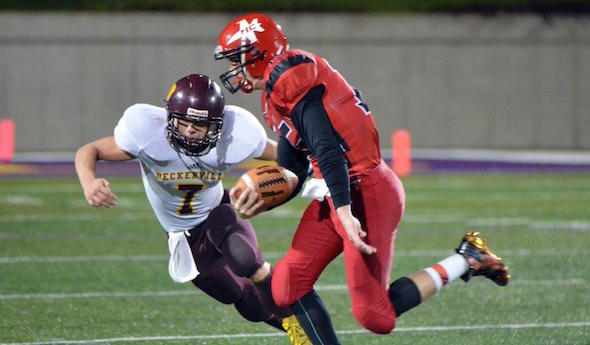
The first belonged to North Central, and the 6-foot-4, 210-pound Whitens in particular. In 2015, Kleiman became the first player in the then-five seasons of 8-player football to run for more than 200 yards in an MHSAA Final, finishing with 205. Whitens obliterated that record in the first quarter Friday, running for 231 yards and three touchdowns on only five carries as the Jets opened up a 20-0 lead.
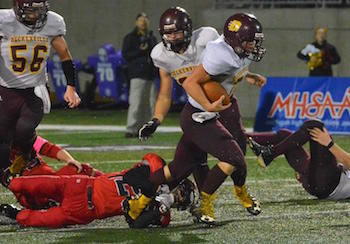 But Deckerville, also undefeated and making its first championship game appearance since winning 8-player in 2012, didn’t fold. In fact, the Eagles (11-1) rode the running of senior tailback Austin Fritch and senior quarterback Brandon Pattullo, who combined for 162 yards rushing and three touchdowns during the second quarter to put the Eagles up suddenly 22-20 with 1:57 to play before the break.
North Central had trailed only once before this season, into the third quarter Week 2 against Crystal Falls Forest Park before coming back to win 60-42.
“We’re not used to other people scoring on us and having close games,” Bobby Kleiman said. “But we played Crystal Falls two weeks ago (a 60-50 Regional Final rematch); they’re an exact replica of this team. We had one of the craziest games ever with them, and they really prepared us for this game.”
Indeed, Whitens scored on a 44-yard run a minute after Deckerville took its lead, and the Jets never trailed again. Kleiman added a 49-yard scoring run less than three minutes into the third quarter, and Whitens added 37 and 2-yard scoring runs and a 71-yard touchdown pass to senior Marcus Krachinski.
Whitens finished with an 8-Player Finals rushing record that may not be broken in some time, 352 yards on only 17 carries (20.7 yards per carry) with six touchdowns. His numbers could’ve been greater, or at least different if for just two plays, both dropped passes that likely would’ve resulted in touchdowns. Still, Whitens completed 6 of his 12 throws for 100 yards despite rain that blew sideways for most of the first three quarters.
Deckerville had given up only 50 points total this season and only 18 during the playoffs despite facing two other undefeated teams.
“We made a nice comeback there, but you’ve still got to keep going, and we weren’t able to make some plays,” Deckerville coach Bill Brown said. “We can’t give up big plays and expect to win. We don’t have a kid like that that can get 80-yard runs every time and score.”
Fritch and Pattullo did both finish with 133 yards rushing, Pattullo on only 12 carries for an average of 11.1 yards per attempt.
Kleiman added 123 yards rushing on 10 carries despite what North Central read as Deckerville aligning to stop him early on. That read led to Whitens’ big first quarter, including a 38-yard run on the first offense play of the game, on the “dart” quarterback keeper play that North Central continued to throw at the Eagles throughout the night.
 The addition of Friday’s performance gave Whitens 2,496 yards and 44 touchdowns passing this season, along with 943 yards and 22 touchdowns rushing.
He’s one of 11 seniors who played his last high school football game – and six of those seniors also played in last season’s Class D Basketball Final.
“This is the best class probably ever in the state, to do what they’ve done,” North Central coach Kevin Bellefeuil said. “Two basketball titles, two football titles, and they have to be a favorite to win a third one (in hoops).
“This is a special group of kids. We have the right mix of skill players, offensive linemen, linebackers; we have a little bit of everything.”
And some will take only a short break. Whitens said at first he’d be back to work for basketball Saturday morning. Then he self-corrected – he’ll wait until Monday instead.
“You’re never satisfied with who you were last year, or the day before. You’re always growing to get better each and every day of your life, and that’s how I go about my life,” Whitens said.
“We’ve got our eyes on the ultimate prize. This is our last year, last run at it, and we’re going to enjoy it. … I’m going to get home, join our community, let them bask in the glory with us. And then Monday morning, I’m ready to go.”
The MHSAA Football Finals are sponsored by the Michigan National Guard.
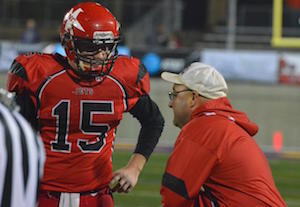
PHOTOS: (Top) Powers North Central quarterback Jason Whitens breaks away for one of his six rushing touchdowns Friday. (Middle) A Deckerville ball carrier works to get free of a North Central defender. (Below) Whitens confers with Jets coach Kevin Bellefeuil. (Photos by John Johnson/MHSAA.)
Eriksen, Clarkston Finish 'Dream' Run
November 30, 2013
By Bill Khan
Special to Second Half
DETROIT — Ian Eriksen's senior season was slipping away.
And so was his lifelong dream.
Eriksen and his football-playing buddies in Clarkston talked about earning an MHSAA championship back when they were in elementary school and winning the Super Bowl of the Northern Youth Football League in Oakland County.
But after rushing for 2,167 yards and 33 touchdowns as a junior, Eriksen came into his senior year with Achilles and ankle injuries, then underwent arthroscopic surgery for a partially torn meniscus in his right knee on Sept. 19.
Four Friday nights passed with Eriksen in street clothes, unsure of when — or if — he'd ever rejoin his teammates in pursuit of their shared dream.
"That was really tough, because I've never been injured that seriously," Eriksen said. "It could've been a lot worse. I tried to be positive. All you can do is be positive rather than mope over it."
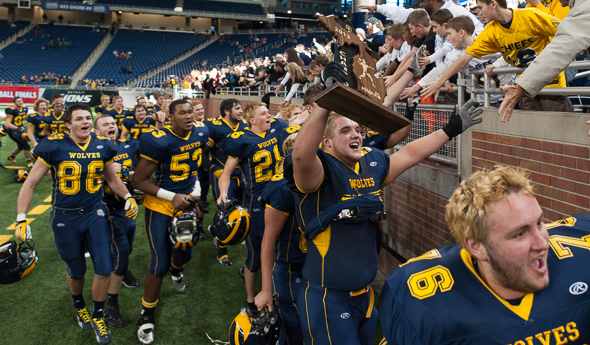
One positive out of the situation may be that Eriksen was fresh enough by the end of the playoffs to take on a heavy workload and help carry the Wolves to their first MHSAA football title.
Eriksen ran 32 times for 237 yards and three touchdowns in Clarkston's 32-14 victory over perennial power Detroit Catholic Central in the MHSAA Division 1 championship game Saturday at Ford Field.
He also had a 30-yard catch to extend Clarkston's first touchdown drive, and a sack. In Clarkston's last two games, Eriksen ran 76 times for 592 yards and nine touchdowns.
"He gave us a lot of problems," said veteran Catholic Central coach Tom Mach, who has built a dynasty with the power-running game. "He was a very good running back. He would be a good running back in our program. We would've loved to have him. We had a lot of trouble tackling him. He got the extra yard and put in the extra effort.
“They kept the ball away from us, getting those first downs, getting those first downs, getting those first downs. That's frustrating on a team, especially when you do get the ball when you're a ball-control offense like us."
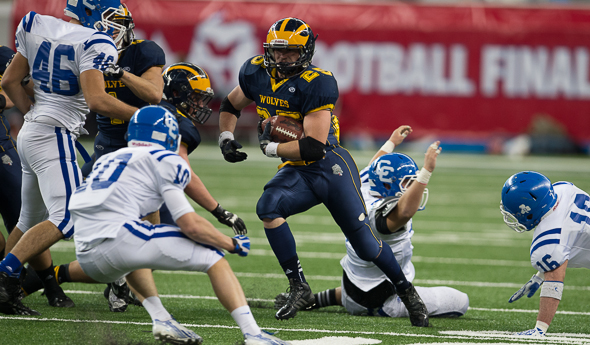 Bringing Clarkston its first MHSAA championship was the fulfillment of a dream for Eriksen and his teammates after the program reached three Semifinals and made the postseason 16 times under 27-year coach Kurt Richardson.
"In Little League, there's a Super Bowl," Eriksen said. "We won the Super Bowl together in 2006 when we were in fourth and fifth grade. The next thing we started talking about was winning a high school championship if we could do it. We knew we could."
Eriksen and some of the players who delivered that championship were in the stands at Troy Athens four years ago when Clarkston lost by two points in a Semifinal to Sterling Heights Stevenson.
"I remember when that happened," Eriksen said. "Everyone in the community was just so upset about that. Me and the other guys were like, 'That's not going to happen to us when we get there.'"
Clarkston made Catholic Central settle for a third straight runner-up finish by stealing a page from the Shamrocks' script.
Led by Eriksen and an outstanding offensive line, the Wolves ground out 288 yards on 45 carries. They had a 27:58 to 20:02 advantage in time of possession.
"The offensive line doesn't get enough credit," Richardson said. "They deserve it for this one."
After a punt and interception ended Clarkston's first two drives, the Wolves scored touchdowns on their next five possessions.
Both teams had promising drives end with interceptions deep in the opponent's territory before Clarkston broke through for the game's first score with 13 seconds left in the first half.
Converting three times on third down and once on fourth, Clarkston moved 91 yards in 17 plays, taking 6:36 off the clock, before D.J. Zezula hit Shane Holler with a 15-yard touchdown pass on a post route. The extra point failed.
The key play on the drive was a 30-yard pass to Eriksen on third-and-12 from Clarkston's 15-yard line.
"We knew we had to score, because we got the ball to start the second half," Zezula said. "It was 0-0 and we knew we had to get up on CC. They brought in an extra (defensive back). The play-action with Ian helps me out a lot with time and the O-line helps me a lot with time. We knew the play-action would work."
Catholic Central's best drive of the first half came following the opening kickoff. The Shamrocks marched to the Clarkston 24 before Tim Cason intercepted a pass, only the second pick thrown by Catholic Central all season.
Jack Van Acker made two big plays to keep Clarkston out of the end zone on the Wolves' second possession. First, he made a touchdown-saving tackle on a 35-yard run by Eriksen to the Shamrocks' 10-yard line. Then, two plays later, he picked off a pass in the end zone after Clarkston moved to the 6.
A 63-yard punt by Zach Bock pinned Clarkston at its own 9-yard line with 6:49 left in the second quarter before the Wolves drove for the only touchdown of the first half. Clarkston's average starting field position on three first-half possessions was its own 10.
Armed with a lead and momentum, Clarkston took the opening kickoff of the second half and marched 80 yards in eight plays, taking a 12-0 lead on a 37-yard run by Eriksen with 8:18 left in the third quarter.
The lead reached 18-0 on a 1-yard run by Eriksen with 3:59 left in the third.
Catholic Central got on the board when Dylan Roney scored on a 2-yard run with 45 seconds left in the third quarter, cutting Clarkston's lead to 18-7.
The Wolves responded with a seven-play, 71-yard drive that ended on a 47-yard pass from Zezula to Caine Watlington with 8:35 left in the game.
The Shamrocks scored again on a 48-yard pass from Sean Birney to Alexander Bock with 5:46 left, but Clarkston again had an answer, with Eriksen scoring on a 12-yard run to cap the scoring with 4:06 left.
Zezula was 10 for 15 for 154 yards, two touchdowns and one interception. Birney was 13 for 23 for 166 yards, one touchdown and one interception.
Clarkston won its final 13 games after a season-opening loss to Rochester Adams, a loss the Wolves avenged in the playoffs.
"A lot of these kids have been playing together since fifth grade," Richardson said. "They've played Chiefs together, so they've come up through the junior ranks. We all felt this could be a special season. We had some issues at the start. We talked to the kids at the time about turning a negative into a positive. You're going to get slapped in the face in life. We got slapped in the face in the first game. They learned from it. It was a huge coming-together point for us as a team."
Catholic Central (11-3) became the third team to finish runner-up three straight years. Utica Eisenhower was the Division 1 runner-up from 1999-2001 and Crystal Falls Forest Park was the Division 8 runner-up from 2004-06.
The Shamrocks' 2012 runner-up team was led defensively by sophomore middle linebacker David Widzinski, who had a game-high 15 tackles. Less than two weeks later, he died in his sleep.
Tributes to Widzinski were visible at Ford Field. Catholic Central's uniforms had a patch with his No. 33 inside a shamrock. In the student section, some students wore white and formed a 33 within a field of blue shirts worn by the others. Widzinski's jersey hung on the wall on the Catholic Central sideline.
"We brought up David a lot," Mach said. "He was a force behind our team all year long. Every day after practice, we would say a prayer for him and the people in our community who are suffering. It was a real learning experience for our kids to put something bigger than themselves in place of winning and losing."
PHOTOS: (Top) Clarkston players trade high fives with fans as they march off the Ford Field turf with their first MHSAA championship trophy. (Middle) Clarkston running back Ian Eriksen runs through the reaching arms of Detroit Catholic Central defenders Saturday. (Click to see more from Terry McNamara Photography.)