


Prep Zone: Pre-District Previews
December 13, 2011
A total of 272 Michigan high school football teams will begin driving this weekend for one of nine MHSAA state championships next month. And each week through the 11-player semifinals, the MHSAA Network will produce four games to be streamed live on FoxSportsDetroit.com’s Prep Zone.
Here’s a look at this week’s Prep Zone matchups. All kick off at 7 tonight, and all games also will be archived for on-demand viewing at MHSAA.tv.
DIVISION 1: Romeo (7-2) at Troy Athens (7-2)
Both are representing a Red division – Romeo from the Macomb Area Conference and Troy from the Oakland Activities Association – and both lean on a sturdy running attack to average roughly 26 points per game. Carrying the load for Romeo are seniors Zack Williams (638 yards, five touchdowns) and Brian Roth (605, seven TDs), while Sam Haskell leads Troy Athens with 718 yards rushing and nine scores. Both teams also capitalize on opportunistic defenses that averaged more than two takeaways per game during the regular season. Romeo is much more familiar with this time of year – the Bulldogs are in the playoffs for the seventh straight season, while Troy Athens is in the postseason for the first time since 2004. But despite multiple common opponents, it’s fair to say these teams aren’t too familiar with each other – this will be their first matchup since 1976.
Click to read more from Mlive.com or MIPrepZone.
DIVISION 2: South Lyon (6-3) at Holly (7-2)
Holly can add to what is likely to be considered its best season since 1952. The Bronchos split the Flint Metro League championship, their first league title since that long-ago fall, and with one more win would have their second-most victories for one season – again, behind only a 9-0 finish 59 years ago. After starting with losses to Lapeer East and Swartz Creek, Holly has won seven straight while outscoring those opponents 27-13 on average. South Lyon finished second in the Kensington Lakes Activities Association Central to Northville – the No. 7-ranked team in the final Division 1 state poll – and is back in the playoffs after a three-season hiatus. Holly junior quarterback John Williams has run for 1,123 yards and 15 touchdowns and thrown for five more scores. Offense isn’t South Lyon’s strong suit – it averages just 17 points a game – but the Lions also give up only 14 on average.
Click to read more from the South Lyon Herald or Flint Journal.
DIVISION 3: Sturgis (7-2) at Mason (8-1)
Mason was expected to be here and has won at least eight games for the fourth straight season. Sturgis, meanwhile, is one of the state’s most intriguing teams after beating usual powers Jackson Lumen Christi and Marshall on the way to earning its first playoff berth since 2004. The Bulldogs are led by a small nucleus of experienced seniors including three-year running back Saylor LaVallii, who has run for 975 yards and 22 touchdowns and will sign with Central Michigan this winter. Sturgis also has a big-time runner in junior Christopher Alexander – who has gained 1,205 yards and rushed for 13 scores – but another player turning eyes toward Sturgis is sophomore quarterback Chance Stewart. Already a two-year starter, the 6-foot-5 Stewart has thrown for 1,149 yards and 14 touchdowns this fall in far fewer attempts than some of his spread counterparts. He passed for 284 yards and three scores in a 35-28 loss to No. 3 Battle Creek Harper Creek, and may need to come up big tonight against the No. 7 Bulldogs.
Click to read more from the Sturgis Journal.
DIVISION 8: Saugatuck (9-0) at Muskegon Catholic Central (8-1)
This might be the game of the weekend for the entire state. Saugatuck is the reigning MHSAA runner-up for this division and ranked No. 5, and Muskegon Catholic is an eight-time champion and tied for the top spot in the final regular-season poll. Coming off its winningest season, Saugatuck didn’t surprise anyone and still won all of its games by at least 28 points. The Crusaders will host, though, after beating one Class A and five Class B schools this season, losing only to Class A Grand Rapids Forest Hills Northern – and by just seven points. Blink and tonight’s game could be over, as the teams have combined for just 117 passes this fall and should keep the clock moving. Muskegon Catholic has run for 2,876 yards and 37 touchdowns, led by junior Jessie Anderson’s 1,278 and 12, respectively. Saugatuck tops that with 3,858 yards and 55 rushing scores. Senior Lance Kleino has carried the bulk of the load with 1,425 yards and 17 TDs.
Click to read more from the Holland Sentinel or Muskegon Chronicle.
PHOTOS
Almost there: Mason running back Saylor LaVallii needs 25 rushing yards to reach 1,000 yards this season (Photo courtesy of Lansing State Journal).
(Site front) Good chance: Sturgis quarterback Chance Stewart hopes to lead his team to its first playoff victory since 2004 (Photo courtesy of Sturgis Journal).
A Game for Every Fan: Week 5
September 24, 2015
By Geoff Kimmerly
Second Half editor
Halftime of this weekend’s games will mark the midway point of the 2015 football regular season.
And the final results this Friday and Saturday could prove to be turning points for a number of teams playing for league titles all over the state.
The Week 5 slate is filled with matchups of teams tied for first place in their respective leagues, plus others pitting leaders against those in second and hoping to move up. The report below touches on many, but not all of these – tune in to the Score Center this weekend for scores and updated standings as those games are decided.
Bay & Thumb
Frankenmuth (4-0) at Millington (4-0)
The latest chapter in this Tri-Valley Conference East rivalry should again decide the champion. Millington handed the Eagles their only loss of the 2014 regular season – although these two then shared the title with Birch Run after the Panthers beat the Cardinals. Millington has won nine of the last 15 meetings, but Frankenmuth holds a slim 22-20 edge going back to their first reported meeting in 1956.
Others that caught my eye: Almont (4-0) at Richmond (4-0), Mount Pleasant (3-1) at Lapeer (4-0), Flint Powers Catholic (3-1) at Midland Dow (3-1), St. Clair Shores South Lake (4-0) at Marine City (3-1).
Greater Detroit
Detroit Cass Tech (4-0) at Detroit Martin Luther King (4-0)
This Detroit Public School League rivalry game always is anticipated, but this season more than most. King’s only regular-season loss last season was to Cass Tech, in the PSL championship game; the Crusaders then saw their season end in the first round of the playoffs the next week. However, they opened this fall by beating reigning Division 2 champion Warren DeLaSalle. Cass Tech hasn’t lost a regular-season game since Week 8 of 2012 – to King – but despite dominating four opponents that had winning records a year ago, might be behind the Crusaders in terms of generating statewide buzz.
Others that caught my eye: Warren Mott (4-0) at Clinton Township Chippewa Valley (3-1), Belleville (3-1) at Dearborn Heights Robichaud (4-0), Southfield (3-1) at Farmington Hills Harrison (3-1), Warren DeLaSalle (3-1) at Orchard Lake St. Mary's (4-0).
Mid-Michigan
Olivet (3-1) at Lake Odessa Lakewood (4-0)
Lakewood has plenty of history it would like to still make, but consider this from the Vikings’ start: they are 4-0 for the first time since 1974. Those four wins tie the total for all of last season and tie the team’s most for a season since 2005. Lakewood’s 176 points through four games is more than they scored during 14 of the last 20 seasons. But Olivet certainly can dampen the excitement by winning tonight’s Greater Lansing Activities Conference matchup, like the Eagles did last season 42-9 on the way to winning the league title.
Others that caught my eye: Jackson (3-1) at Grand Ledge (4-0), Flint Beecher (4-0) at Corunna (3-1), Haslett (3-1) at Mason (2-2), Holt (2-2) at East Lansing (2-2).
Northern Lower Peninsula
Boyne City (4-0) at Traverse City St. Francis (4-0)
By the smallest of margins, this game gets top billing over two others matching undefeated teams. For starters, Boyne City won the matchup last season 28-27 – and eventually, the Northern Michigan Football Conference Leaders division title. The Ramblers then made the Division 6 Semifinals, and then graduated a significant group of contributors – but has come back to shut out two of its first four opponents. Then again, St. Francis didn’t give up a point this season until last week and is sparking statewide chatter like its contending teams of a few years ago.
Others that caught my eye: Gaylord (4-0) at Traverse City Central (4-0), St. Ignace (4-0) at Johannesburg-Lewiston (4-0), Onekama (4-0) at Maple City Glen Lake (3-1), McBain (3-1) at Manton (2-2).
Southeast & Border
Clinton (4-0) at Morenci (4-0)
Morenci won 10 games last fall for the first time since 1996 – but the only blemish on an otherwise incredible regular-season run was a 28-26 loss to Clinton that ended up deciding the Tri-County Conference championship. All four of the Bulldogs’ wins this season are against teams .500 or better so far, lining this up as again a likely league title decider – Clinton has shut out two of its first four opponents and won 31 straight regular-season games.
Others that caught my eye: Brooklyn Columbia Central (4-0) at Ida (4-0), Monroe (3-1) at Ann Arbor Pioneer (4-0), Chelsea (4-0) at Tecumseh (2-2), New Boston Huron (2-2) at Milan (3-1).
Southwest Corridor
Berrien Springs (4-0) at Bridgman (4-0)
Both of these programs have enjoyed recent success; Bridgman has made the playoffs three straight seasons, and Berrien Springs made the postseason last year and two of the last four. But there’s a little more intrigue although these teams don’t play in the same division of the Berrien-Cass-St. Joseph Conference. Bridgman has never started 4-0 – and looks like the BCS Blue favorite. Berrien Springs likely will battle Buchanan in the BCS White and hasn’t allowed a point in two weeks, most recently shutting out BCS Red favorite Cassopolis.
Others that caught my eye: Saugatuck (4-0) at Decatur (3-1), Dowagiac (3-1) at Edwardsburg (4-0), Jackson Lumen Christi (4-0) at Marshall (3-1), Sturgis (3-1) at Vicksburg (3-1).
Upper Peninsula
Lake Linden-Hubbell (4-0) at L'Anse (3-1)
The Lakes are used to success and have made the playoffs nine of the last 11 seasons – but are 4-0 for the first time since winning 10 games in 2009 and on pace to score their most points since 1997. L’Anse has bounced back from 4-5 a year ago but has a tough schedule over the season’s second half – and would enjoy the momentum from playing a tough opponent well this weekend.
Others that caught my eye: Crystal Falls Forest Park (2-2) at Newberry (3-1), Detroit Country Day (3-1) at Escanaba (2-2), Ishpeming Westwood (2-2) at Iron Mountain (2-2), Felch North Dickinson (1-3) at Bark River-Harris (4-0).
West Michigan
Montague (4-0) at Whitehall (3-1)
The season’s first half has been one of resurgence for Montague, one of the state’s most successful programs during the first decade of the 2000s. The Wildcats are 4-0 for the first time since 2010 and after going only 2-7 a year ago. They’re giving up points, but scoring more including 70 on Ravenna and 55 against Shelby. Whitehall did fall by a score to undefeated Traverse City Central last week, but otherwise navigated well a solid nonleague slate – and beat Montague 48-20 a year ago.
Others that caught my eye: Hudsonville Unity Christian (3-1) at Byron Center (3-1), Grand Rapids Christian (3-1) at Hudsonville (3-1), Zeeland East (3-1) at Muskegon Mona Shores (4-0), Caledonia (2-2) at Rockford (2-2).
8-Player
Posen (4-0) at Pickford (3-1)
Pickford should be finding 8-player football to its liking so far. The Panthers, in their first season, have one more win than they earned all of 2014 and have lost this fall only to reigning MHSAA runner-up Cedarville. Posen has shown to be in a similar elite class so far, especially after last week’s 30-point win over always-tough Bellaire – and the Vikings have guaranteed tying their best finish since 2010.
Others that caught my eye: Webberville (4-0) at Waldron (4-0), Owendale-Gagetown (4-0) at Akron-Fairgrove (3-1).
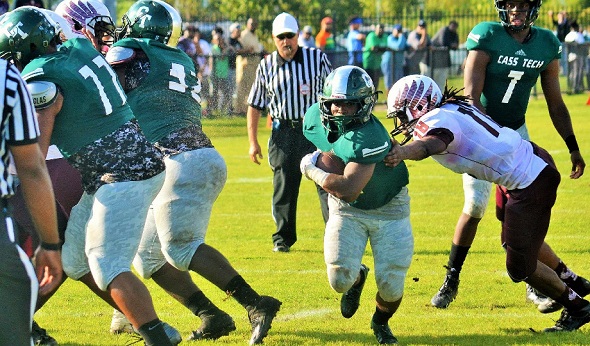
PHOTO: A Detroit Cass Tech ball carrier breaks through during the Technicians’ win this season against Detroit Renaissance. (Photo courtesy of Detroit Public School League.)