

Prep Zone: Semifinals Preview
December 16, 2011
And then there were 32. That's all that remains from the original 256 MHSAA playoff football teams heading into Saturday's Semifinals.
This week's Prep Zone games feature three top-ranked contenders and four that remain 12-0 with only two possible games left in this season. Next weekend, it's off to Ford Field and the Finals.
All four Prep Zone Semifinals begin at 1 p.m. and can be viewed at FoxSportsDetroit.com. They later will be archived at MHSAA.tv.
Here's a look at some of what you'll see. (Rankings below are by The Associated Press' panel of media voters.)
DIVISION 1: Rockford (11-1) vs. Detroit Catholic Central (11-1)
Battle Creek Central’s C.W. Post Field
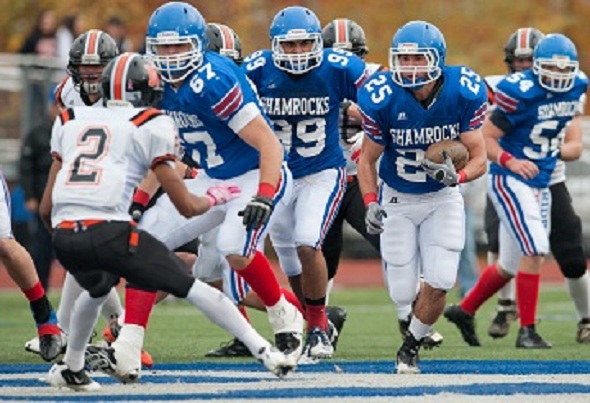
These two entered the postseason ranked Nos. 1 and 2, respectively. Oddly, this will be just the second time these powers will meet, and first since DCC’s 27-23 win over the Rams in the 1998 Class AA Final. The Shamrocks’ only loss this fall came to Orchard Lake St. Mary in Week 8, and DCC avenged it with a 21-7 win seven days later. Not much has changed during the postseason, aside from the Shamrocks’ defense getting a little bit stingier – they’ve given up 20 points total in three playoff games. Rockford has done a little more surviving, advancing with two wins by seven points or fewer. The Rams always run the ball hard, and both Brady Gent and Ryan Hartley have had 100-plus yards in playoff games so far. This game also pits two of the winningest coaches in MHSAA history – DCC’s Tom Mach has 314 victories since 1976 and Rockford’s Ralph Munger has 271 since 1980.
DIVISION 3: Mount Pleasant (12-0) vs. East Grand Rapids (9-3)
Ferris State University’s Top Taggart Field
The top-ranked Oilers have played their part in East Grand Rapids’ 28-game playoff winning streak, getting knocked out by the Pioneers two of the last three seasons. But this is the third straight Mount Pleasant team to post at least 11 wins, and might be the best of this recent run. Sophomore running back Michael Tweh is the name to know on offense, with 1,726 yards and 24 touchdowns rushing this season, while senior Dustin Lee has run for 14 touchdowns and scored four more on passes. As for No. 9 East Grand Rapids, it could well end up the final team standing again. The Pioneers have avenged two of their losses since the start of the playoffs – against Grand Rapids Christian and Holland – and have scored at least 42 points four weeks in a row. David Drummond has run for 1,739 yards and 16 touchdowns, and Travis Palmer has 15 TD passes.
DIVISION 3: Battle Creek Harper Creek (12-0) vs. Orchard Lake St. Mary (10-2)
Jackson Withington Stadium
Orchard Lake St. Mary, ranked No. 4, is used to reaching this round, going for its fourth Finals appearance in five seasons and third straight. At least defensively, this might be the best of those Eaglets teams – linebacker James Ross, who has committed to sign with Michigan this winter, is arguably the top defensive player in the state. This will be a much newer experience for No. 3 Harper Creek, which is in its first Semifinal since 1999 but also set a school record for wins. But the Beavers’ game is a great fit on what should be a chilly afternoon on fast turf – Harper Creek runs behind a massive offensive line, led by 6-foot-4, 300-pound Kelby Latta. He blocks for an offense averaging 41 points a game.
DIVISION 8: Mendon (12-0) vs. New Lothrop (12-0)
Howell High School
Top-ranked Mendon’s run through the playoffs has included a win over co-No. 1 Muskegon Catholic and another last week against No. 8 Climax-Scotts. But this might be the toughest test of all. The Hornets have given up fewer than four points a game this fall, and no more than eight since opening night. Oh, and they also score 52 points per game, led by multi-talented junior quarterback Austin Newman. Mendon keeps on trucking in its bid for a fifth MHSAA championship in 11 years. Junior Tyler Harris is up to 1,623 yards and 22 touchdowns running the ball, and two more teammates are over 900. Harris ran for 253 yards and four scores in last week’s Regional final.
(Photo courtesy of Terry McNamara Photography.)

The Boomerang Effect
March 6, 2013
The image of football on all levels, and the future of football at the youth level, are both worse off today as a result of the NFL’s recent years’ public relations and political campaigns.
The constant barrage of negative publicity about youth football as the NFL advanced its agenda to pass concussion legislation in all 50 states has, to levels not seen before, kicked off the concerns of moms and dads and the media nationwide. In state after state, kids with concussions have been paraded before state legislators, in the company of NFL staff. The NFL has administered a self-inflicted wound, shot itself in the foot, and made FOOTBALL the face of America’s youth sports concussion problem. How the NFL brain trust ever thought this would promote the game of football in America is a wonder.
School-based football today has no greater obstacle to promoting a safe game than the NFL. No brand of football captures the game’s brutal aspects for video more than the NFL. No brand of football celebrates it more. No brand of football CAPITALIZES on it more – so much so that the NFL can donate several million dollars to youth football to buff its “caring” conscience, when in fact it’s a miniscule portion of its multi-billion-dollar business.
Moreover, one of the NFL’s favorite groups for its self-promoted “philanthropy” is USA Football which promotes itself as the national governing body for amateur football in America. One of USA Football’s initiatives is an international championship for high school players, which of course means more hitting out of season for these players. The very activity the experts are telling us to reduce – out-of-season contact – is being promoted by this NFL underwritten organization! And WE get criticized as being against the promotion of football in America when we don’t go along with this backward thinking?