


Prep Zone: Semifinals Preview
November 18, 2011
And then there were 32. That's all that remains from the original 256 MHSAA playoff football teams heading into Saturday's Semifinals.
This week's Prep Zone games feature three top-ranked contenders and four that remain 12-0 with only two possible games left in this season. Next weekend, it's off to Ford Field and the Finals.
All four Prep Zone Semifinals begin at 1 p.m. and can be viewed at FoxSportsDetroit.com. They later will be archived at MHSAA.tv.
Here's a look at some of what you'll see. (Rankings below are by The Associated Press' panel of media voters.)
DIVISION 1: Rockford (11-1) vs. Detroit Catholic Central (11-1)
Battle Creek Central’s C.W. Post Field
These two entered the postseason ranked Nos. 1 and 2, respectively. Oddly, this will be just the second time these powers will meet, and first since DCC’s 27-23 win over the Rams in the 1998 Class AA Final. The Shamrocks’ only loss this fall came to Orchard Lake St. Mary in Week 8, and DCC avenged it with a 21-7 win seven days later. Not much has changed during the postseason, aside from the Shamrocks’ defense getting a little bit stingier – they’ve given up 20 points total in three playoff games. Rockford has done a little more surviving, advancing with two wins by seven points or fewer. The Rams always run the ball hard, and both Brady Gent and Ryan Hartley have had 100-plus yards in playoff games so far. This game also pits two of the winningest coaches in MHSAA history – DCC’s Tom Mach has 314 victories since 1976 and Rockford’s Ralph Munger has 271 since 1980.
DIVISION 3: Mount Pleasant (12-0) vs. East Grand Rapids (9-3)
Ferris State University’s Top Taggart Field
The top-ranked Oilers have played their part in East Grand Rapids’ 28-game playoff winning streak, getting knocked out by the Pioneers two of the last three seasons. But this is the third straight Mount Pleasant team to post at least 11 wins, and might be the best of this recent run. Sophomore running back Michael Tweh is the name to know on offense, with 1,726 yards and 24 touchdowns rushing this season, while senior Dustin Lee has run for 14 touchdowns and scored four more on passes. As for No. 9 East Grand Rapids, it could well end up the final team standing again. The Pioneers have avenged two of their losses since the start of the playoffs – against Grand Rapids Christian and Holland – and have scored at least 42 points four weeks in a row. David Drummond has run for 1,739 yards and 16 touchdowns, and Travis Palmer has 15 TD passes.
DIVISION 3: Battle Creek Harper Creek (12-0) vs. Orchard Lake St. Mary (10-2)
Jackson Withington Stadium
Orchard Lake St. Mary, ranked No. 4, is used to reaching this round, going for its fourth Finals appearance in five seasons and third straight. At least defensively, this might be the best of those Eaglets teams – linebacker James Ross, who has committed to sign with Michigan this winter, is arguably the top defensive player in the state. This will be a much newer experience for No. 3 Harper Creek, which is in its first Semifinal since 1999 but also set a school record for wins. But the Beavers’ game is a great fit on what should be a chilly afternoon on fast turf – Harper Creek runs behind a massive offensive line, led by 6-foot-4, 300-pound Kelby Latta. He blocks for an offense averaging 41 points a game.
DIVISION 8: Mendon (12-0) vs. New Lothrop (12-0)
Howell High School
Top-ranked Mendon’s run through the playoffs has included a win over co-No. 1 Muskegon Catholic and another last week against No. 8 Climax-Scotts. But this might be the toughest test of all. The Hornets have given up fewer than four points a game this fall, and no more than eight since opening night. Oh, and they also score 52 points per game, led by multi-talented junior quarterback Austin Newman. Mendon keeps on trucking in its bid for a fifth MHSAA championship in 11 years. Junior Tyler Harris is up to 1,623 yards and 22 touchdowns running the ball, and two more teammates are over 900. Harris ran for 253 yards and four scores in last week’s Regional final.
(Photo courtesy of Terry McNamara Photography.)
Drive for Detroit: Week 2 in Review
September 6, 2016
By Geoff Kimmerly
Second Half editor
Three overtime thrillers. Two matchups pitting arguably the best programs from their respective areas. One of the most intriguing games in Michigan 8-player football history.
If you missed following Week 2's results, you truly missed out – but we're here to help.
Catch up below for many of the most telling results from another Labor Day weekend.
Bay & Thumb
Algonac 14, Almont 7
This is turning into quite the Blue Water Area Conference rivalry series, with Algonac extending its run to three straight over Almont (1-1) after losing to the Raiders 72-7 in 2014. Last season’s win helped the Muskrats to an eventual share of the league title; this one definitely gives them an upper hand again only a game into the BWAC schedule. Offense was at a premium once again, but Algonac (2-0) scored in the second and fourth quarters and has given up only nine points over its first two games. Click for more from the Port Huron Times Herald.
Also noted:
Beaverton 39, Harbor Beach 22 – The Beavers (2-0) are already one win shy of tying last season’s total after dealing the frequently-powerful Pirates (1-1) a first defeat this fall.
Port Huron Northern 27, Marine City 24 – The Huskies (1-1) are looking to get back to the playoffs for the first time since 2010, and beating Marine City (0-2) for the first time certainly will help.
St. Clair Shores South Lake 54, Madison Heights Madison 28 – South Lake (2-0) could be a clear favorite in the Macomb Area Conference Silver after avenging last season’s 56-42 title-deciding loss to the reigning champion Eagles (1-1).
Davison 49, Mount Pleasant 14 – Tariq Reid ran for 309 yards and scored five touchdowns as Davison moved to 2-0 and dropped the Oilers to 0-2.
Greater Detroit
Southfield Arts & Technology 24, Clarkston 18 (OT)
What a start/bounce back for the first-year Warriors. The school, formed by a merger of the former Southfield High and Southfield Lathrup, opened this season and its football history by falling to Detroit Martin Luther King 39-0 during opening weekend. So that made this rebound win over the always-tough Wolves (1-1) at least a little unexpected – and gave Southfield A&T an early edge in a strong Oakland Activities Association Red as well. Click for more from the Oakland Press.
Also noted:
Utica Eisenhower 26, Macomb Dakota 13 – Only the stunner by Southfield A&T could trump this massive win by Eisenhower (2-0), which ended a five-game losing streak to its MAC Red rival; Dakota (1-1) beat the Eagles twice last season, including in the District Final.
Walled Lake Western 33, Canton 30 – These two combined to go 22-4 in 2015, but Western (2-0) is off to the better start so far after dealing a heartbreaker to the Chiefs (0-2).
Allen Park 38, Wyandotte Roosevelt 0 – The Jaguars (2-0) have outscored their first two opponents by a combined 100-0 after avenging last season’s loss to the Bears (1-1).
Detroit U-D Jesuit 20, Ann Arbor Pioneer 7 – The Cubs are 2-0 for the second straight season after bottling up a Pioneer team that went 7-4 a year ago.
Mid-Michigan
Grand Ledge 28, DeWitt 21
The game everyone in the Lansing area has waited years to see lived up to its billing, as the reigning Capital Area Activities Conference Blue champion Comets outlasted the annual powerhouse from the CAAC Red. Grand Ledge didn’t totally ground DeWitt’s high-powered offense, but did come up with necessary stops and multiple turnovers to improve to 1-1 with league play beginning this week. The Panthers, also 1-1, will move on to trying to extend their 38-game league winning streak that dates to 2008. Click for more from the Lansing State Journal.
Also noted:
Haslett 9, Flushing 6 – The Vikings (1-1) made it three straight over Flushing (1-1); they’ve won by a combined eight points over those three recent meetings.
Pewamo-Westphalia 64, Dansville 0 – The Aggies (1-1) are likely still one of the best teams in the Central Michigan Athletic Conference, but the reigning Division 7 runner-up Pirates (2-0) are likely just this good.
Portland 40, Hillsdale 0 – The Raiders (2-0) are another Lansing-area team looking elite so far after dealing Hillsdale (1-1) its first shutout loss since 2011.
Fowlerville 38, Charlotte 25 – The Gladiators have had some tough seasons since last making the playoffs in 2010, but are 2-0 for the first time since 2009 after downing the Orioles (0-2).
Northern Lower Peninsula
Charlevoix 22, Boyne City 14 (OT)
The Red Rayders (2-0) have come up with stunning wins from time to time over the last few years and are riding a streak of two straight winning seasons. But this still must qualify as the most stunning in recent memory – Charlevoix hadn’t scored on Boyne City over their last two meetings and hadn’t beaten the Ramblers since 2011. Boyne City (0-2), a Division 6 regional finalist last fall, isn’t far off its usual pace, however; the two losses this season are by only a combined 17 points. Click for more from the Petoskey News.
Also noted:
Manton 28, Johannesburg-Lewiston 24 – Aside from the Week 9 victory that gave the 2014 Rangers their only playoff appearance of the last two decades, beating the Cardinals (who were 43-12 over last five seasons) might be Manton’s best win since the early 1990s; both teams are now 1-1.
Alpena 33, Sault Ste. Marie 20 – The Wildcats (1-1) are looking for their first winning season since 2004, and getting past a 2015 playoff team like the Blue Devils (1-1) will help.
Traverse City St. Francis 21, Maple City Glen Lake 13 – This is the latest chapter in what’s become a strong rivalry, as St. Francis moved to 2-0 and Glen Lake to 1-1 with both likely contenders in their respective leagues.
Manistee 36, Hopkins 30 – The Chippewas (1-1) have improved yearly over the last three and bounced back from an opening-night loss by beating a Hopkins team (1-1) trying to rebound from its first sub-.500 season since 2006.
Southeast & Border
Concord 28, Homer 26 (OT)
Tune back in later this week for a feature on Concord, which struggled through back-to-back 1-8 seasons in 2013 and 2014 before making a huge jump to 7-3 last year. The Yellowjackets (2-0) hadn’t beaten Homer since 2009 and fell 32-30 last season as the Trojans went on to win the Big 8 Conference title. Click for more from the Jackson Citizen-Patriot.
Also noted:
East Jackson 30, Vandercook Lake 28 – The Trojans (1-1) have three wins total over their last four seasons, but got a huge one against a Jayhawks team (0-2) that finished 8-2 a year ago.
Hudson 8. Morenci 6 – The momentum in this rivalry swung back to the Tigers (2-0), who had lost two straight to Morenci (1-1) and have given up only 14 points total over two games this fall.
New Boston Huron 21, Carleton Airport 14 – The Chiefs (2-0) opened Huron League play with a second win by seven points or fewer, but also fourth straight over Airport (1-1)
Temperance Bedford 51, Fenton 28 – Last season’s 0-4 start is a distant memory for the Mules (2-0), who got past a Fenton team (0-2) coming off its eighth straight playoff appearance.
Southwest Corridor
Marshall 17, Coldwater 7
The Redhawks (1-1) came back from an opening-night loss to Benton Harbor to avenge last season’s 9-7 defeat to Coldwater (1-1) that ended up deciding the Interstate 8 Athletic Conference title. In doing so, Marshall also ended the Cardinals’ 13-game regular-season winning streak; the latter’s only loss last fall came in a Division 3 Semifinal. Click for more from the Battle Creek Enquirer.
Also noted:
Benton Harbor 28, Grand Rapids South Christian 21 – The Tigers (2-0) continued to show last season’s success wasn’t just a one-and-done by sending the Sailors to 1-1.
Paw Paw 22, Plainwell 9 – The Redskins (2-0) are off to their seventh straight 2-0 start despite missing the postseason a year ago; Plainwell (1-1) rebounded off last season’s Paw Paw loss to still make the playoffs and will look to do so again.
Schoolcraft 51, Watervliet 30 – This wasn’t as close as Schoolcraft’s one-point win last season, but similarly impressive as the Eagles moved to 2-0 by outscoring the offensively-talented Panthers (1-1).
Cassopolis 33, Mendon 14 – The Rangers (2-0) extended their winning streak over the annually-powerful Hornets (1-1) to two straight to open Berrien-Cass-St. Joseph Red play.
Upper Peninsula
Negaunee 14, Calumet 6
The Miners (2-0) sent back at least some of the disappointment left over from falling to Calumet in last season’s Division 6 playoff opener. Negaunee held the Copper Kings to 18 fewer points than in the playoff loss while riding two running backs who both gained more than 100 yards on the ground, and has now beaten Calumet (1-1) in five straight regular-season meetings. Click for more from the Houghton Daily Mining Gazette.
Also noted:
Bark River-Harris 52, Bessemer Gogebic 24 – This could end up a key win in the wide-open but tough Mid-Eastern Conference race; Bark-River Harris (2-0) is the reigning co-champion, but the Miners (1-1) are among additions from the old Great Western Conference.
Newberry 50, Munising 14 – The Indians (2-0) also beat Munising last season before tying with the Mustangs (0-2) for third in the Mid-Eastern standings; Newberry looks like a favorite this time.
Norway 41, Felch North Dickinson 14 – The Knights (2-0) have equaled last fall’s win total as they seek a first winning season since 2010; North Dickinson is 1-1 and sees Munising next.
Lake Linden-Hubbell 38, L’Anse 14 – The Lakes (2-0) are another Mid-Eastern transplant from the old Great Western Conference, and they continued to gear up by beating a Hornets team (0-2) with three winning seasons over its last four.
West Michigan
Lowell 21, Rockford 10
These Grand Rapids-area powers hadn’t faced each other since 2012, but Lowell (2-0) now owns wins in all three of their recent meetings. The Red Arrows came back this time from a three-point halftime deficit, which was especially impressive against a Rockford team chomping for a win after having to forfeit in Week 1 because an illness overtook a number of players. Lowell is a major favorite in the Ottawa-Kent Conference White but first must face rival East Grand Rapids this week, while Rockford (0-2) gets Mona Shores before a challenging O-K Red schedule begins. Click for more from the Grand Rapids Press.
Also noted:
Holland Christian 32, Ada Forest Hills Eastern 28 – The Maroons (1-1) got a nice boost as they seek their first winning season since 2009, handing a first regular-season loss since 2014 to reigning Division 4 semifinalist Forest Hills Eastern (1-1)
Muskegon Catholic Central 21, St. Ignace 6 – The Crusaders (2-0) are in midseason form defensively, giving up a combined 12 points over the last two weeks to opponents that averaged nearly 37 in 2015, including a Saints team (1-1) that put up 44 on opening night.
Zeeland West 32, Muskegon Mona Shores 28 – The first two wins have been close for the Dux (2-0, by a combined nine points, but extended a regular-season winning streak going back to Week 3 in 2013; this one ended a Mona Shores regular-season streak that had started in Week 3 of 2014.
Wyoming 38, Comstock Park 7 – The Wolves are 2-0 after going a combined 4-23 over the last three seasons and beat a Comstock Park team (1-1) coming off its sixth straight playoff berth.
8-Player
Powers North Central 60, Crystal Falls Forest Park 42
Reigning MHSAA champion North Central (2-0) earned the first of what could be multiple rounds this season with new 8-player force Forest Park, putting up 30 points during the third quarter to move to 15-0 since making the switch from 11-player. The Jets have scored 60 points in both of their games this season, but the Trojans (!-1) became only the second team over the last two seasons to come within 40 points of North Central, and the first to come within 20. Click for more from the Iron Mountain Daily News.
Also noted:
Cedarville 45, Posen 0 – These Trojans (2-0) split a pair of two-point games last season against Posen (1-1), but left no doubts this time.
Engadine 34, Onaway 12 – The Eagles have had a nice run in 8-player with five straight playoff appearances, and now are 2-0 for the first time since 2012 after handing Onaway (1-1) a first loss.
Lawrence 30, Morrice 18 – No team held Morrice (1-1) under 20 points last season, but the Tigers (2-0) have become known for defense while playing in this high-scoring format.
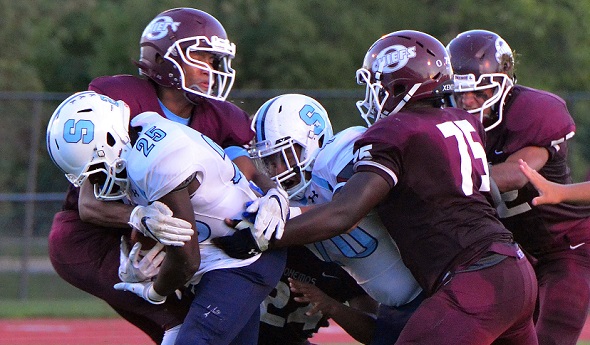
PHOTO: Okemos defenders stop an Ann Arbor Skyline ball carrier during the Chiefs' 30-6 win Thursday. (Photo by John Johnson.)