

Prepare to Compare: Clarkston Wins D1
November 29, 2014
By Bill Khan
Special for Second Half
DETROIT — Nolan Eriksen dislikes two things: Losing and comparisons to his older brother, Ian.
He's never had to experience a loss since being promoted to Clarkston's varsity football team before last year's MHSAA playoffs, so that's never been an issue.
But comparisons between the Eriksen brothers are plentiful — and valid.
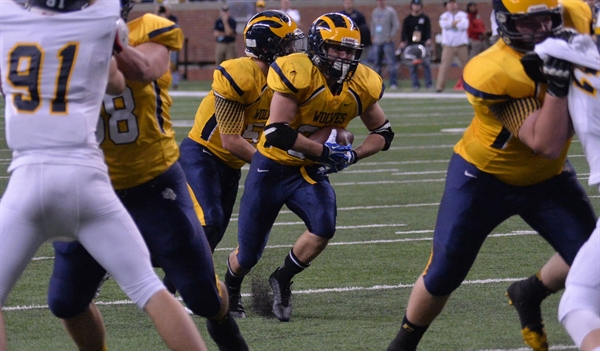
Nolan, a junior running back, ran 28 times for 172 yards and three touchdowns as the Wolves repeated as MHSAA Division 1 champions with a 33-25 victory over first-time finalist Saline on Saturday at Ford Field.
A year ago, Ian Eriksen ran 32 times for 237 yards and three touchdowns against Detroit Catholic Central, leading Clarkston to its first title.
So, you'd think that Nolan would've leaned upon his brother's advice now that he was the starting running back in the championship game.
Nope.
"I was just trying to do what I do," Nolan said. "People always try to compare us and stuff, but I just try to play my game and do the best I can for my team. No advice. ... Every now and then we'll talk about it a little bit, but mainly we try to keep it pretty separate. We just do our own thing."
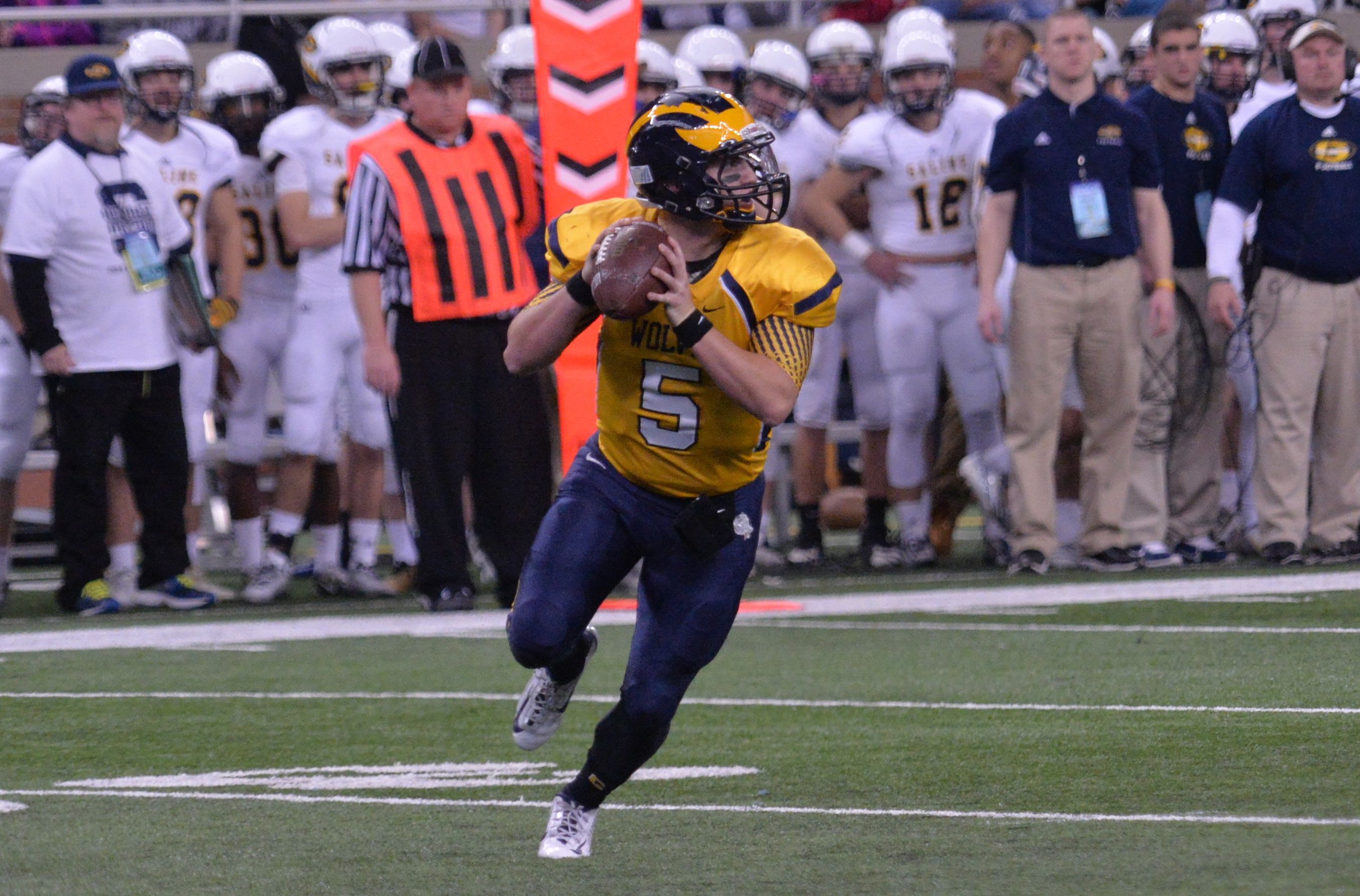
Senior quarterback D.J. Zezula has no problem comparing the brothers. He's got a unique perspective, having handed the ball to each during his three-year career as Clarkston's starter.
"Noah doesn't want to be compared, but they're twins in my eyes," said Zezula, who ran 17 times for 120 yards and a 70-yard touchdown. "They're both hard-hitting football players. Mr. (Mark) Eriksen coached me when I was younger; he's the same way. They're awesome kids. They want what's best for the team. I love both of them. I love Mr. Eriksen. They're great guys. He coached me my first two years of football that I ever played."
 While Ian Eriksen was the workhorse for Clarkston's first championship team, Nolan watched from the sidelines, as is typical for junior varsity players who are promoted after the regular season. He said he "got a couple plays" during the 2013 playoff run, but never saw action at Ford Field.
Just being part of the atmosphere last year was beneficial once he stepped onto the field Saturday, Eriksen said.
"We've been here before," he said. "We weren't too shocked looking around. We knew what the deal was. We knew what it felt like to be here. We knew what was riding on it. It was just the experience. It was incredible being able to look up there and see your whole town there and getting it done."
Eriksen had a solid first half, running 12 times for 61 yards and a touchdown, but he was a key reason why Clarkston took over in the second half after trailing 10-7 at halftime. Eriksen ran 16 times for 111 yards and two scores in the second half, as Clarkston scored touchdowns on four of its first five possessions after halftime.
"These guys have taught me something," Clarkston coach Kurt Richardson said. "The old Kurt Richardson would've blown up at half with two turnovers and stuff. We just said, 'Hey, we're fine. We're down three. We didn't play very well. We're getting the ball, so everything's fine.' I learned it from these guys."
Poise comes more naturally when a team has won 27 straight games — now the longest active streak in Michigan following Finals losses this weekend by Ithaca (69) and Ishpeming (33).
The Wolves needed only four plays after the second-half kickoff to take the lead for good on a 52-yard pass from Zezula to Merrick Canada with 10:09 left in the third quarter. A bobbled snap prevented an extra-point kick, leaving Clarkston up by a 13-10 score.
Clarkston's only three-and-out of the second half came on the next series, but the Wolves followed with three straight touchdown drives. A 2-yard run by Eriksen made it 20-10 with 47 seconds left in the third quarter before Zezula kept it and ran 70 yards for a touchdown with 8:17 remaining in the game, expanding the lead to 27-10.
Just before that touchdown, Saline missed a chance to make it a one-possession game. The Hornets had first-and-goal at the 8-yard line, but settled for a 24-yard field goal attempt that was wide left.
Saline also missed a field goal on the first series of the game, as linebacker Cole Chewins blocked the kick. Chewins, who has committed to Miami (Ohio) as a tight end, also batted down three passes.
"With the deflections and stuff, that was just playing the game," Chewins said. "I was able to make plays and just play football."
Saline coach Joe Palka tried to run plays away from Chewins, who had his blocked kick and two of his knockdowns early in the game.
"We had to adjust and go to the other side, just because he can cover so much ground and he's got such good range," Palka said.
Saline cut the deficit to 27-17 when quarterback Josh Jackson scored on a 1-yard run with 5:15 remaining.
Clarkston (14-0) recovered the onside kick, then marched 50 yards in eight plays, the final 22 yards coming on a touchdown run by Eriksen with 1:57 on the clock. The extra point failed, keeping it a two-possession game at 33-17.
That loomed as a potential issue when it took Saline only four plays to reach the end zone on a 2-yard run by Kevin Gross with 1:09 to go. Cameron Cole caught a 2-point pass from Jackson to make it an eight-point game.
Clarkston's Shane Holler recovered the onside kick, allowing the Wolves to clinch the title with two kneel-downs.
Jackson, a junior, was 20-for-31 for 237 yards while running 17 times for 82 yards and a touchdown to lead Saline, which won a school-record 12 games (to finish 12-2) and advanced beyond the Regional Final for the first time.
"It's an amazing thing for Saline football," Jackson said. "It's the best team ever in Saline. That we got to play on this stage was an amazing opportunity. Going into next year, that will just give us fire to come back here and try to win it."
Even though his career ended Saturday after starting at quarterback for teams that went 37-2 over three seasons, Zezula is mindful of what these back-to-back championships will mean for the future of the Clarkston program. The Wolves lost in Semifinals three times in 16 playoff appearances under Richardson before breaking through last year.
"Last year was kind of like breaking the mold, breaking this dark cloud over Clarkston that we could never win, could never get there," Zezula said. "This year was about building a legacy, a tradition here at Clarkston. ...
"It hits home when the little kids, the seventh-graders at our youth camps, wear my jersey and wear No. 5. That's where it really hits home, just to pave the way for the younger kids and start a legacy, start a tradition here that winning is what's got to happen at Clarkston."
PHOTOS: (Top) Clarkston's Nolan Eriksen takes a handoff as his lineman work to open a gap near the goalline Saturday. (Middle) Quarterback D.J. Zezula looks for a receiver while those on the Saline sideline look on. (Click for action photos and team photos from Hockey Weekly Action Photos.)
VIDEO HIGHLIGHTS:
GROSS GETS SALINE STARTED - Saline started the scoring in the second quarter against Clarkston with Kevin Gross running it in from 27 yards out.
OH CANADA! CLARKSTON GOES ON TOP - Clarkston took the lead to stay in the Division 1 championship game when D.J. Zezula hit a wide open Merrick Canada on a 52-yard pass.
Watch the entire game and order DVDs by Clicking Here.

MHSA(Q&)A: NFL official Ronald J. Winter
July 19, 2012
By Brian Spencer
Second Half
 Kalamazoo's Ron Winter has officiated in the National Football League for nearly two decades, and became a referee in 1999. But long before he joined the highest level of the game, he got his start on Michigan's high school fields.
Winter has officiated that sport at all three levels and also high school and college basketball. He's also served as a source of knowledge for officials around the state -- and an example for those hoping to start at the high school level and climb to the pros.
Winter remains registered as an MHSAA official, as he's been for 42 years. An associate professor emeritus of human performance and health education at Western Michigan University, Winter was appointed earlier this month to serve a two-year term on the Governor's Council on Physical Fitness, Health and Sports. The council focuses on increasing physical activity and health improvements.
He served on the WMU faculty first beginning in 1969 and then again from 1992-2008. Winter earned bachelor and master's degrees at Michigan State University.
Did you play any sports in high school or college?
I played football, basketball, baseball, and track in high school. However, once I got to Michigan State University, I started playing lacrosse. A couple guys that lived near me played lacrosse and asked me to come out to throw the ball around. After throwing with them a couple times they asked me to come out for the team. I ended up playing lacrosse for MSU for four years.
How did you decide to choose football as the sport you would officiate?
I started officiating as a student at MSU in their intramural program, officiating touch football and basketball. The next logical step was to then officiate in the high school leagues. From there, I began to proceed to all the different levels.
Are there specific requirements for becoming an NFL official?
The biggest requirement is experience. The progression that I went through went like this:
After officiating high school games, I went to the MIAA (Michigan Intercollegiate Athletic Association). They (MIAA) were looking for people that had 3-5 years of experience at the high school level. From there I went to the Mid-Continent conference. I wasn’t able to go to the Mid-American Conference because I was employed at Western Michigan University.
From there I went to the Big Ten. The Big Ten was looking for people with 5 to 10 years of experience in high school and people that had experience at different positions as an official. I ended up officiating in as a Big Ten football official for 10 years and a Big Ten basketball official for 15 years. I then submitted an application to the National Football League. Coincidentally, the NFL was scouting officials, and had followed me for four years before they finally asked me to be a part of the staff. The NFL decides on who they want to pursue through recommendations and personal interest. They look for personality traits as well as how (officials) carry themselves through different situations.
What has been your favorite level to officiate; High school, college or professional?
I enjoyed officiating all of them, but for different reasons.
I found high school to be the most fascinating because it’s all about the kids; they are playing the game for the love of the game. That is the purest sense of the sport. I loved being involved with kids simply because they love the game.
I found the Big Ten to be most exciting because of the kind of atmosphere that exists on a Big Ten campus on a Saturday afternoon. It’s electric. You don’t get that same sense or the same feel on Sunday afternoon in a pro stadium.
I found the NFL to be most intense. The NFL really has three or four different levels of play during the season. There is preseason play, the first third of the season, the second third of the season, and the last five games of the season. Each level is ramped up another notch as the season progresses. Playoffs are entirely different all together. In terms of the intensity and pure speed of the game, there is nothing like the NFL playoffs.
How important is getting along with your fellow officials on the field?
It’s imperatively important if you want to have a smooth and well-run game. This doesn’t mean that you have to buddy-buddy off the field, but on the field you have to be committed to one goal. We spend two or three hours on meetings Saturday afternoon to go over rules tests, tape, and more to prepare for the next game (and) to get over rough patches that develop on a personal level in a previous week. I need to know that the other six guys are focused and thinking about football like me. Everyone has to have confidence in one another. We spend plenty of time on Saturday to get to the point that we need to on Sunday.
What has been the most exciting game you’ve officiated?
I’ve been in plenty of exciting games from NFL playoff games, to the first Orange Bowl game, to the Rose Bowl, to the Division III Hope vs. Calvin basketball game, to when Indiana played Purdue in basketball. All of them were incredible to be a part of. During the Indiana vs. Purdue game, the arena was electric. The players, coaches, fans were intense. Everybody is totally focused on the game. Each coach had a tremendous respect for one another. Neither one wanted to show up or embarrass their counterpart. This game wasn’t that drastically different at the Division III level, however. The intensity of both was very similar.
Are there games that you get excited to officiate more than others, presently?
Not in terms of specific teams. It really just depends on the circumstances, of course. Pittsburgh vs. Baltimore is an intense game. The Jets vs. Patriots game is great. There are clearly rivalries that are very exciting to be a part of. The level of play and intensity of the athletes in the NFL is unmatched and can provide excitement every week.
What is the most difficult aspect of being a NFL official?
I would say that preparation and being able to maintain intensity on the field on Sunday are key aspects. The preparation is difficult because it’s time-consuming. It is a misconception that we simply show up on Sunday to work the game. By the time Sunday rolls around, I’ve spent over 20 hours during the week trying to prepare for a Sunday game. It isn’t hard in terms of physical labor, but difficult in terms of a time commitment. You have to have an understanding family to be in the occupational field that I am in.
Do you have any advice for aspiring officials who hope to make it to the league?
Practice, practice, practice. Be able to work any game at any level and get as much experience as you can. Be a good partner on the field. It takes time; it isn’t something that just happens. Like anything else, it takes practicing your trade to be able to make it to the top level.