

Program Builder Boyd Honored by Our Lady
October 12, 2016
By Keith Dunlap
Special for Second Half
WATERFORD – Mike Boyd always had a grand vision how his last home game as head coach at Waterford Our Lady of the Lakes would play out.
 As it got into the later stages of a nearly 50-year tenure as football coach, athletic director and so much more at the school, Boyd had one specific idea for how he wanted to go out.
“I always said that the last game I coached before I retired, I was going to play it here under the lights,” said Boyd, referring to the field at the school that doesn’t have permanent lights. “I didn’t get a chance.”
Boyd did not, since in April 2013 he decided to retire as football coach from WOLL after a 46 year-career in order to move full-time to Sarasota, Florida.
However, last Friday proved to be the next best thing for Boyd and the Our Lady of the Lakes community.
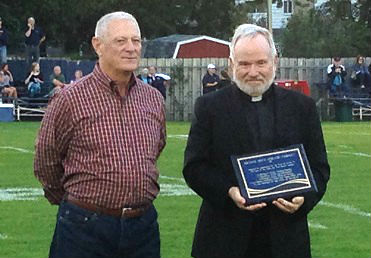
In a ceremony that was more than three years in the making after he made his retirement official, Boyd was brought back for the honor of having the entire athletic complex at Our Lady of the Lakes named after him.
To top it all off, the ceremony took place under portable lights in what doubled as the first night game ever at the school.
The game was against Royal Oak Shrine, which is not only the biggest rival for Our Lady of the Lakes, but coached by Boyd’s longtime best friend in coaching, John Goddard.
All anyone needs to do is look at MHSAA record book for evidence that it was a no-brainer for Our Lady of the Lakes to name the athletic complex after Boyd, one of the state’s all-time greatest prep athletic figures.
As football coach, Boyd won 357 games in his 46 years, which currently is good for fourth place on the all-time wins list for coaches in that sport.
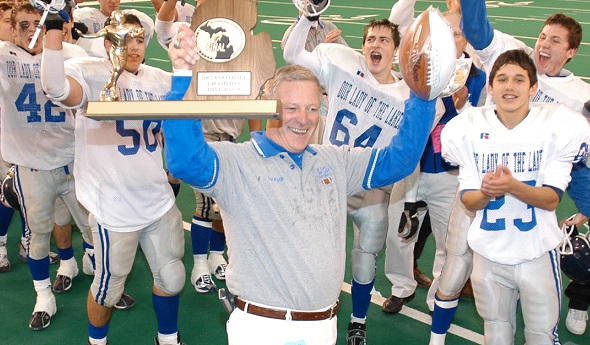
He led the Lakers to three appearances in MHSAA football championship games, with the zenith of his coaching career on the gridiron coming in 2002 when his Our Lady of the Lakes team won its only Finals title in school history with a 13-10 overtime win over Gaylord St. Mary in Division 8.
Facing a 4th-and-goal from the 1-yard line that day, Boyd didn’t hesitate in sending his offense out to go for the win on a do-or-die running play, and the decision paid off when running back Murray Percival broke the goal line to give Boyd his long-awaited title.
The jubilation was apparent on Boyd with how high he jumped over and over again in celebration following the handshake line.
While that was the only time Boyd celebrated an MHSAA championship in football, he did so plenty of times on the softball diamond.
Boyd led Our Lady of the Lakes to what remains a team state-record eight MHSAA championships in softball, going a perfect 8-for-8 in title game appearances and finishing with 703 career wins before retiring from that sport in 2007.
During his tenure, Boyd also coached two games for the hockey team, track & field and started the baseball program by coaching it for its first year of existence.
When not on a playing surface, Boyd was a principal, bus driver, the athletic director and overall face of not only what has become one of the state’s best small-school athletic programs, but the school as a whole.
One of Boyd’s big contributions was creating the home football field at Our Lady of the Lakes behind its school in stunningly quick fashion after some unexpected news.
Our Lady of the Lakes used to play home games at other high schools or middle schools in Waterford, but that changed suddenly in 2001 before a scheduled home game against Royal Oak Shrine.
“They got a new school board one year,” Boyd said. “We used to pay like $250 a game. They came back and said ‘We want $1,200 a game.’ The Dads club got together and put (the press box) up on one week and got the field ready.”
Indeed, in a matter of days a three-story press box was built (fully furnished later in the season) and space for a football field was created (the right side of it through the infield of the baseball diamond) to allow Our Lady of the Lakes to play games on its campus.
 It was fitting that the first home game in 2001 was against Shrine and that the ceremony last week was against Shrine, given his nearly 50-year friendship with Goddard.
The two had a nice chat on Shrine’s bench before the game last Friday, and one can only imagine the stories that were re-hashed.
In fact, when Boyd announced his retirement in 2013, he said how much he would miss playing against “that old turkey” in Goddard.
No doubt, Goddard misses competing against Boyd just as much.
“One year he had a kid that got hurt during practice during that week and he shows up at our place for a game, and after kickoff he comes out and starts running a single-wing,” Goddard said. “I go, ‘What the heck is this offense he is running?’ We beat them, but it took us half a game to figure what he was doing. He made it up on Saturday and we played on Sunday. He was a great coach.”
Boyd still follows the Our Lady of the Lakes program from Florida, watching film online and communicating regularly with current Our Lady of the Lakes head coach Josh Sawicki, a player on that 2002 title team – although Boyd was quick to point out he wants no part in decision-making with the Lakes team. “He’s his own coach,” Boyd said of Sawicki.
Boyd also returns to Michigan every August to help out with preseason practices for Lake Orion, which is coached by his son-in-law, Chris Bell, and he visits Sawicki at his preseason practices while in the area.
Before the game last Friday, Sawicki spoke about how little the topic of the ceremony came up with Boyd during conversations in the days leading up to the game.
“He was talking to me Wednesday or Thursday night, and there was not one question about (the ceremony),” Sawicki said. “It was all about the game plan. ‘What have you got? What have they got? What will you do if they do this? Watch out for Goddard because he likes to do this and likes to do that.’ Still to this day, that was all he was talking about.”
Sawicki said doing things without fanfare is who “Coach” has always been, and it’s a legacy that will be carried on in name now that the athletic complex is named after Boyd.
More importantly, it will also be carried on in spirit.
“He built that brand,” Sawicki said. “It’s the responsibility of the coaches and the players to continue that brand on. That is what we are focused on doing.”
PHOTOS: (Top) Our Lady of the Lakes football coach Mike Boyd hoists the Division 8 championship trophy in 2002 after his team defeated Gaylord St. Mary at the Pontiac Silverdome. (Middle) Boyd (left) receives a plaque from Rev. Lawrence Delonnay, Our Lady’s pastor, on Friday to recognize the naming of the school’s athletic complex in Boyd’s honor.
A Game for Every Fan: Playoffs Week 1
October 28, 2015
By Geoff Kimmerly
Second Half editor
This first week of the 41st MHSAA Football Playoffs will be filled with firsts and familiar faces.
Benton Harbor, Detroit Cesar Chavez Academy and Parma Western will take part in the first playoff games in their football programs’ histories. Ten more teams will be making their first postseason appearance in more than a decade.
Beal City will enjoy the playoffs for the 33rd time, most of any MHSAA school and one of 18 that have appeared in the tournament at least 25 seasons. Rockford will play in its 21st straight playoffs and Menominee in its 20th, those two enjoying the two longest active streaks. Eight of nine champions return from 2014 – and Clarkston, Grand Rapids West Catholic and Muskegon Catholic Central hope to be playing in five weeks for their third straight MHSAA titles.
But first things first – below are some of the most intriguing openers, all to be played Friday, unless noted. Keep up with the MHSAA Score Center all weekend as scores come in, and check out the Football Page for up-to-date pairings and scores by division.
Division 1
Clarkston (7-2) at Romeo (8-1)
A 1-2 start – albeit, with losses to eventual league champions Macomb Dakota and West Bloomfield – knocked Clarkston out of most conversations about the state’s elite this season, despite the Wolves coming off back-to-back Division 1 titles. But Clarkston won its next six games – including over playoff team Oak Park last week – and drew a Romeo team that started 8-0, beat Dakota by two touchdowns, but is coming off an unexpected three-point loss to Utica Eisenhower in Week 9.
Others that caught my eye: Grandville (6-3) at Rockford (6-3), Plymouth (6-3) at Northville (9-0), Ann Arbor Pioneer (6-3) at Belleville (8-1), Utica Eisenhower (6-3) at Clinton Township Chippewa Valley (7-2).
Division 2
Muskegon (7-2) at Traverse City Central (9-0)
Traverse City Central is undefeated for the first time since its Class A championship season of 1988, and at home, hosting a team with a few hours of road time ahead. And yet, it’s fair to assume most will consider the Trojans underdogs against a Muskegon program that has finished each of the last three seasons at Ford Field. The Big Reds are back in Division 2 after finishing Division 3 runner-up a year ago, and have lost only to Detroit Catholic Central and Muskegon Mona Shores – a possible opponent next week for the winner of this game.
Others that caught my eye: Midland (7-2) at Midland Dow (8-1). Farmington Hills Harrison (7-2) at Birmingham Groves (9-0), Lincoln Park (6-3) at Wyandotte Roosevelt (7-2), Detroit East English (7-2) at Warren DeLaSalle (6-3).
Division 3
Grand Rapids Christian (5-4) at East Grand Rapids (6-3)
The Pioneers held a 26-0 lead in the first matchup between these Ottawa-Kent Conference White rivals, in Week 6, before the Eagles outscored them 39-7 the rest of the way. The math worked out such that East Grand Rapids is the host this time after Christian qualified with an at-large bid, and it's fair to expect another close tilt between teams that have split their last eight meetings, including two during the playoffs.
Others that caught my eye: Haslett (6-3) at DeWitt (8-1), Parma Western (6-3) at Coldwater (9-0), Ortonville-Brandon (6-3) at Linden (7-2), Warren Fitzgerald (6-3) at Redford Thurston (5-4).
Division 4
Flint Powers Catholic (7-2) at Goodrich (7-2)
Both of these teams should be among the most prepared to up their games for the postseason. Powers quietly put together one of the most solid defensive performances in the state, giving up only 101 points total while shutting out four teams and finishing second to Division 2 contender Midland Dow in the Saginaw Valley League Blue. Goodrich emerged as one of five playoff teams from the seven-team Genesee Area Conference Red and played two more playoff teams nonleague, so it too is used to playoff-caliber competition.
Others that caught my eye: Dowagiac (6-3) at Benton Harbor (5-4), Big Rapids (6-3) at Escanaba (5-4), Detroit Denby (5-4) at Detroit Collegiate Prep (9-0), Harper Woods Chandler Park (6-3) at Detroit Country Day (8-1), Saturday.
Division 5
Marine City (6-3) at Almont (7-2)
With its proximity to Port Huron, it’s easy to forget that Marine City plays in the Macomb Area Conference Gold and not the Blue Water Area Conference, and actually has faced BWAC power Almont only once over the last 65 seasons – in a District Final a year ago. Both have deceiving records this time around; Marine City’s three losses were by a combined 12 points to three playoff teams, while Almont’s two defeats came by a combined 15 points to two playoff qualifiers (both fell to Algonac).
Others that caught my eye: Muskegon Oakridge (7-2) at Grand Rapids West Catholic (7-2), Hillsdale (6-3) at Buchanan (9-0), Clinton Township Clintondale (5-4) at Algonac (8-1), Harrison (7-2) at Kingsford (6-3), Saturday.
Division 6
Clinton (9-0) at Monroe St. Mary Catholic Central (8-1)
Division 6 might have the most intriguing set of opening games, topped by this matchup of the reigning champion Falcons against one of two undefeated teams that finds itself on the road this week. This is a rematch of last season’s District Final, won by St. Mary; in 2013 it was Clinton that reached Ford Field and finished runner-up in Division 6. St. Mary’s earned this home game with a schedule loaded with Class A and B teams, but that doesn’t mean Clinton doesn’t know how to ramp up for good competition – the Redskins are one of four playoff teams from the Tri-County Conference.
Others that caught my eye: Vassar (8-1) at Ithaca (9-0), Millington (8-1) at Sanford Meridian (9-0), Calumet (7-2) at Negaunee (7-2), Jackson Lumen Christi (6-3) at Vandercook Lake (8-1).
Division 7
Saugatuck (9-0) at Hesperia (9-0)
Matchups of undefeated teams in the first round are rare, but so is having three undefeated teams in the same District, which these two share with Pewamo-Westphalia. Hesperia is one of the incredible stories of this season. The Panthers, known best for their wrestling, were 1-8 a year ago and hadn’t made the playoffs since 2002 – but did have four 0-9 seasons during the drought. Only once this fall, in Week 4 against Morley-Stanwood, did an opponent come within 25 points of Hesperia. But Saugatuck has been both impressive and consistent on offense, scoring no fewer than 42 points in any game and beating their opponents by an average of 48.
Others that caught my eye: Flint Hamady (7-2) at Flint Beecher (6-2), Cass City (7-2) at Ubly (7-2), Concord (7-2) at Dansville (8-1), Harbor Springs (6-3) at Iron Mountain (6-3), Saturday.
Division 8
Mendon (5-4) at Climax-Scotts (9-0)
A first-round game between an at-large qualifier and an undefeated host is generally viewed as a slam dunk for the home team. But it’s doubtful anyone recently has considered Mendon and its eight straight seasons with at least 10 wins an easy out. The four losses this fall were all to playoff teams, three now playing in higher divisions. Climax-Scotts has seen its last four seasons end against the Hornets and is the last team that would take them lightly, even after giving up a total of only 27 points this season.
Others that caught my eye: Mount Pleasant Sacred Heart (6-3) at Muskegon Catholic Central (6-2), Bark River-Harris (7-2) at Munising (7-2), Ottawa Lake Whiteford (7-2) at Petersburg-Summerfield (7-2), Crystal Falls Forest Park (5-3) at Lake Linden-Hubbell (9-0), Saturday.
8-Player
Rapid River (6-3) at Engadine (7-2)
Engadine’s Week 5 62-30 win over Rapid River sent a shockwave through 8-player football, as it was Rapid River’s first regular-season loss since 2012. The Eagles still haven’t lost since Week 3, with only Stephenson coming reasonably close to taking a game. But the short history of 8-player football in this state has shown that this division allows more than any other for massive turnarounds between the regular-season and playoff meetings between teams – and Rapid River knows well the possibility this weekend after beating Cedarville 20-19 during the 2014 regular season and then falling to the Trojans 28-0 five weeks later in a Regional Final.
Others that caught my eye: Cedarville (7-2) at Owendale-Gagetown (9-0), Peck (7-2) at Deckerville (8-1).
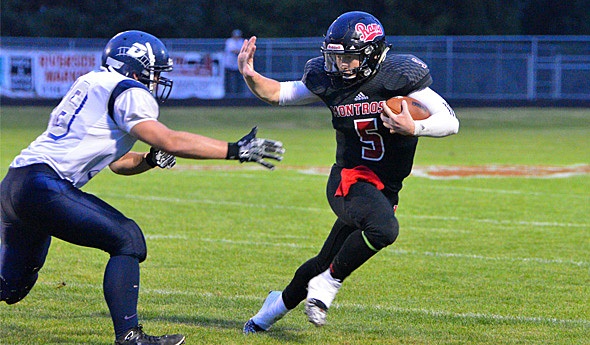
PHOTO: Montrose, carrying the ball, earned an at-large bid to its 23rd MHSAA Playoffs as one of five qualifiers from the Genesee Area Conference Red.