

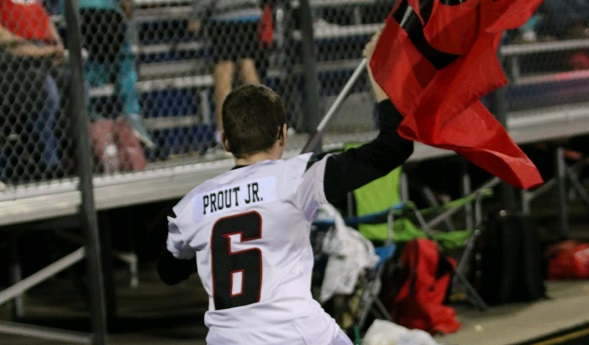
Prout Powers Pinckney with Inspiration
September 12, 2019
By Tim Robinson
Special for Second Half
Larry Prout, Jr., who wears Pinckney football jersey number 6, stands 4-foot-8 and 85 pounds.
 Or slightly less than one pound for each of the 105 surgeries he’s had in his young life.
He can’t play football — his body is much too fragile, despite a strong desire to play the game — but he makes his mark with the Pirates as an inspiration.
And the Pirates put a spark into a young man who has spent a large portion of his life in hospitals.
“Everyone gets pumped when he’s around,” Pirates senior quarterback Joe Bona says. “How could you not? Larry’s a great kid, an awesome, awesome character, and what he’s gone through should push us, because it’s way harder than what we’ve ever done. I think it pushes and makes us work harder.”
Larry is the sixth of six children of Kathy and Larry Prout Sr., who have made countless trips to emergency rooms when a medical emergency has cropped up in young Larry’s life.
At one point, their living room was a hospital room for Larry, complete with bed and medical equipment as the Prout family rallied around him.
He was born with no skin covering the lower half of his torso, leaving his internal organs exposed.
He spent most of the first 18 months of his life in the hospital, and didn’t breathe on his own until he was 3 years old.
“His first word was ‘lucky,’” Kathy Prout said in a 2016 interview. “It was the craziest word. It’s like a three-legged dog named Lucky, you know? That was his first word, and we would die laughing.”
He was included as much as he could be in his siblings’ hijinks, although he spent much of his time at C.S. Mott Children’s Hospital in Ann Arbor. But Larry Jr. became well-known among Wolverines fans during the 2016 season for the inspiration he was providing to the U-M football team, with Bleacher Report referring to him as the “heartbeat of Michigan football” in a 2017 report.
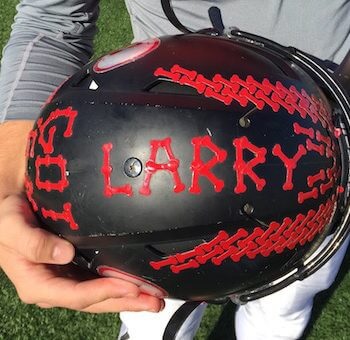 He’s making that level of impact on his favorite high school team now as well.
"Being part of Pinckney and Michigan means a lot," Larry Jr. said. "It’s been really fun, seeing the players and coaches; it’s the same as at Michigan. I love going to the games and sitting on the sidelines before kickoff, and seeing my players and my friends, my best friends, and seeing Coach Jim (Harbaugh) and Coach Rod (Beaton).
Larry is home-schooled because his body isn’t strong enough to allow him to attend school on a regular basis. He takes electives at Pinckney, including photography, and loves being at school, although his parents had to set some limits.
“We found out that every time we dropped him off at school, he would go out and find Rod (Beaton, Pinckney’s football coach),” Kathy said.
“We told him, once a week,” Larry Sr. said. “Rod’s got work to do.”
That may be, but Beaton returns Larry Jr.’s admiration.
“It goes without saying that he’s truly an inspiration,” Beaton says. “I’ve never met a young person with a more positive attitude than Larry. He really does bring it every single day, every time he’s here.”
Larry also has carried the flag during Pinckney's "No Quarter," the pause between the third and fourth quarters where a student picks up a black or red flag, depending on how the Pirates are faring, and runs back and forth in front of the bleachers to rev the Pirates crowd for the fourth quarter.
He practiced at home before carrying the flag in both of Pinckney's games so far this season.
His peers return the love, too.
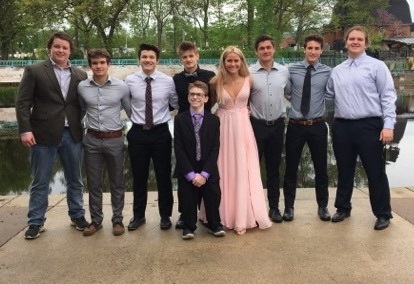
Last spring, Larry Jr. planned to attend Pinckney’s prom, but had to miss it due to a hospitalization.
When Larry Jr. got out of the hospital, a classmate, Alex Williams, put on her prom dress and with some fellow students put on a prom for Larry.
“We have some outstanding kids here,” Beaton said, “and it goes to speak to what we have in this community. Our kids come from such great households, with parents who raise these kids the right way. They understand what Larry’s situation is, and it uplifts us all, every time he’s out here.”
The same, the Prouts say, goes for Larry.
“I remember I loved school,” Kathy said. “I loved it when my older kids were in school. You get the pencils and the pictures and the new clothes. With Larry, I have anxiety and stress because he wants to fit in and make friends and take six classes when he can only do two or three.”
Including Larry Jr. in activities like the prom and football means a lot to all of the Prouts.
“We have a lot of gratitude, and we don’t know how to show it enough,” Kathy said, ‘We want to show our gratitude to Rod and all of the players because they’ve made Larry feel important, such a part of this Pinckney football team. It’s something we’ll never forget, something Larry will never forget.”
 Larry Jr. was a part of the Michigan football team for three seasons, and among his close friends is reserve Buck West, a former Pinckney standout who often is seen at the Prout house watching game shows with Larry Jr.
“I love watching Family Feud and Steve Harvey,” Larry Jr. said. “(The Pirates) are like my brothers, just like Michigan was.”
Larry Jr. got connected to the Michigan team through an organization called Team Impact, which connects youths with life-threatening or chronic illnesses to college football teams.
Dan Kraft, the son of New England Patriots owner Robert Kraft, invited the Prouts to Ford Field when the Patriots played a preseason game there last month and got them passes to be on the field during pregame.
“As I was hanging out, the camera was filming me and they said Team Impact had a surprise for me,” Larry Jr. said. “And the craziest thing is, I see Tom Brady coming up and giving me a fist-bump and a high five. I shook his hand and told him I loved seeing him play. He pointed to my (Michigan) hat and told me to make sure to beat the Buckeyes this season. I told him I would make sure to do that.”
After Brady left, Larry Jr. jumped for joy, no mean feat for a young man who uses a wheelchair for anything but short walks.
“When he gets excited, he jumps,” Kathy said. “He can clear eight inches, which is pretty awesome, because they said he would never walk.”
At Pinckney practice, Larry Jr. hands out encouragement and banters with players who are, in many cases, a foot taller than him.
While he basks in the glow of being part of a team, he contributes to the Pirates something they might not have learned otherwise.
“The lesson I take is that it’s not as bad as what it’s going to be,” senior running back Sal Patierno said. “What we go through, you just think of what he’s gone through, and it makes you want to go harder. Just keep fighting. I know he’s fought harder than any of us.”
“It makes you think,” Bona said. “It makes you work harder.”
“He uplifts us all, every time he’s out here,” Beaton said.
PHOTOS: (Top) Larry Prout Jr. carries the Pinckney "No Quarter" flag in front of the crowd during the Pirates’ Week 2 game at Chelsea. (Middle) Then-senior Pirates quarterback Jack Wurzer spelled out Prout’s name on his helmet in 2017 from bones the players receive for outstanding efforts. (Below) Prout’s friends put on a prom for him after Prout, in purple shirt and tie, missed the school’s event this spring while hospitalized. (Photos courtesy of the Prout family and Tim Robinson.)
1st & Goal: 2021 Week 2 Preview
By
Geoff Kimmerly
MHSAA.com senior editor
September 1, 2021
Last week's return to "normal" football was as good as anticipated, if not better. And the good news is we're just getting started.
As we cruise into Labor Day weekend, the great majority of Week 2 games will again be played Thursday. Additionally, more than 150 games will be viewable live on MHSAA.tv, with Bally Sports Detroit broadcasting Friday's Detroit Cass Tech at Muskegon game on its PLUS cable channel and State Champs! Sports Network streaming live Saturday's Grand Rapids Catholic Central game against Merrillville (Ind.) Andrean. See the full schedule from the MHSAA Score Center.
In addition to our weekly glance at some of the games to watch in every corner of our state, we're also introducing a new feature for this season -- an "Unforgettable 5ive" of highlights from MHSAA.tv and media partner broadcasts. See below for our Week 1 5ive, which includes the following:
► Marquette's Jordan Demay with the Pick 6 in Marquette's 49-14 win over Alpena.
► Clinton Township Chippewa Valley's Cephus Harris with the 60-yard TD run in a 45-20 win over Detroit Catholic Central.
► Dearborn Fordson's Alex Osman connecting with Antonio Gates Jr. for a 37-yard TD in Fordson's 38-23 win over Canton.
► DeWitt's Tyler Holtz throwing a 30-yard touchdown pass to Bryce Kurncz in DeWitt's 47-27 win over Traverse City Central.
► Grand Blanc's Elijah Jackson-Anderson sealing a 40-34 win over East Lansing with a 40-yard TD run.
Bay & Thumb
Elkton-Pigeon-Bay Port Laker (1-0) at Ubly (1-0), Thursday
Both got off to solid starts last week, Laker downing Flint Beecher and Ubly upending Unionville-Sebewaing. By October, both could be contending for league championships as well. Ubly was third in the Greater Thumb Conference East last season, while Laker came in third in the GTC West.
Keep an eye on these: THURSDAY Saginaw Swan Valley (0-1) at Frankenmuth (1-0), Saginaw Nouvel (1-0) at Millington (1-0). FRIDAY North Branch (1-0) at Croswell-Lexington (0-1), Lapeer (0-1) at Midland (0-1).
Greater Detroit
Muskegon Mona Shores (1-0) at Detroit Martin Luther King (0-1), Friday
Mona Shores began its drive last week for a third-straight Division 2 championship with a 42-point win over Lowell, and they’ve lined up 2019 Finals foe King for a second-straight regular-season meeting. The Sailors have won both of those last two matchups, and the Crusaders also have plenty driving them from last week’s 42-40 loss to Indiana power Carmel – decided on a 35-yard touchdown catch on the game’s final play.
Keep an eye on these: FRIDAY Davison (0-1) at Detroit Catholic Central (0-1), West Bloomfield (0-1) at Oak Park (0-1), River Rouge (1-0) at Warren De La Salle Collegiate (1-0), Dearborn (1-0) at Belleville (1-0).
Mid-Michigan
Lansing Catholic (1-0) at Williamston (1-0), Thursday
Formerly league rivals until 2018, both again have league title aspirations after the Capital Area Activities Conference didn’t award championships last season due to the shortened schedule. Williamston, from the CAAC Red, set the tone coming off last year’s Division 4 Semifinal trip by doubling up Croswell-Lexington on the road last week. Lansing Catholic, in the CAAC White, made the Division 5 Semifinals last season and doubled up Lansing Waverly in its opener.
Keep an eye on these: THURSDAY Lansing Everett (1-0) at Lansing Eastern (1-0), DeWitt (1-0) at Portland (1-0), Pewamo-Westphalia (1-0) at Laingsburg (1-0), Jackson (1-0) at Grand Ledge (1-0).
Northern Lower Peninsula
Maple City Glen Lake (1-0) at Kingsley (1-0), Thursday
These are two more who could emerge as league champions over the next eight weeks. Kingsley – from the Northern Michigan Football Conference Legends division – has made the best of last year’s unfortunate circumstance, when the undefeated Stags were unable to take the field for their District Final. Kingsley opened with a 54-8 win over McBain, last season’s Highland Conference champion. Glen Lake was second in the NMFC Leaders last fall, ending a four-year league title streak, but opened last week with a 35-6 win over 2020 Highland co-runner-up Houghton Lake.
Keep an eye on these: THURSDAY Marquette (1-0) at Traverse City Central (0-1). FRIDAY Grand Haven (1-0) at Traverse City West (1-0), Escanaba (1-0) at Petoskey (1-0), Grayling (1-0) at Traverse City St. Francis (1-0).
Southeast & Border
Erie Mason (1-0) at Hudson (1-0), Thursday
The Eagles were one of the best stories of the 2020 season, breaking a string of 15 straight sub-.500 finishes to win the Tri-County Conference in their first season in the league. If this fall’s Week 1 is an indication, former Lenawee County Athletic Association foe Hudson could be a candidate for a similar 2021. The Tigers earned some statewide attention with a 59-14 opening win over annual power Ithaca.
Keep an eye on these: THURSDAY Jonesville (1-0) at Homer (0-1), Ida (1-0) at Ottawa Lake Whiteford (1-0), Michigan Center (1-0) at Hanover-Horton (1-0), Harper Woods (1-0) at Pinckney (1-0).
Southwest Corridor
Three Rivers (1-0) at Edwardsburg (1-0), Thursday
Even with reigning Division 6 champion Montague undergoing a bit of a fresh start, few results jumped off the page more last week than the Eddies’ 38-0 win in their opening matchup. A little more undercover but intriguing also was Three Rivers’ 36-34 overtime win over Paw Paw, the most frequent runner-up of late to Edwardsburg’s Wolverine Conference dominance. Three Rivers’ victory also gave it as many wins as it totaled all last season, and this week will be another opportunity to show what’s possible.
Keep an eye on these: THURSDAY Niles Brandywine (1-0) at Cassopolis (1-0), Schoolcraft (0-1) at Centreville (0-1), Battle Creek Pennfield (1-0) at Marshall (1-0), Kalamazoo Hackett Prep (0-1) at Stevensville Lakeshore (1-0).
Upper Peninsula
Ishpeming Westwood (1-0) at Iron Mountain (1-0), Thursday
The Mountaineers have a chance to stake a pretty serious claim as Western Peninsula Athletic Conference Copper favorites if they can add a win over Westwood to last week’s two-pointer over Negaunee. The Patriots similarly would enjoy a major boost with another Copper contender, Calumet, up next. Iron Mountain and Westwood have split their last four meetings on the field.
Keep an eye on these: THURSDAY Calumet (0-1) at Negaunee (1-0), Bark River-Harris (1-0) at West Iron County (0-0). FRIDAY Gladstone (1-0) at Kingsford (1-0), Marinette, Wis. (0-2) at Menominee (1-0).
West Michigan
Detroit Cass Tech at Muskegon, Friday
This was another anticipated matchup that couldn’t be played last fall because of the late start, but this would be a massive draw any season. Both are coming off big wins, and as in years past both feature plenty of future college players. The Technicians are riding a 10-game regular-season winning streak – but Muskegon has lost only twice at home over the last six seasons.
Keep an eye on these: THURSDAY Cedar Springs (1-0) at Rockford (1-0), Muskegon Oakridge (1-0) at Whitehall (1-0). FRIDAY Grand Blanc (1-0) at Grand Rapids Forest Hills Central (1-0), East Grand Rapids (0-1) at Grand Rapids South Christian (1-0).
8-Player
Hale (1-0) at Pellston (1-0), Friday
Pellston is a combined 15-3 over the last two seasons, and Hale is 12-6 over the same span of time – and Pellston won their league matchups in 2018 and 2019 before both moved into different conferences and didn’t play each other last season. This return of the series could feature strength on strength. Hale hasn’t given up more than 20 points in a game since last season’s opener, while Pellston’s 64 points last week followed the 45+ they scored six times a year ago.
Keep an eye on these: THURSDAY Marion (1-0) at Brethren (0-1), Mount Pleasant Sacred Heart (1-0) at Deckerville (0-0). FRIDAY Rapid River (0-1) at Lake Linden-Hubbell (1-0), Ironwood (1-0) at Ontonagon (1-0).
PHOTO: Capac and New Haven kicked off their season last week. Capac, returning after playing only one game a year ago, won 22-0. (Photo by Robert Batzloff.)