

Prout Powers Pinckney with Inspiration
September 12, 2019
By Tim Robinson
Special for Second Half
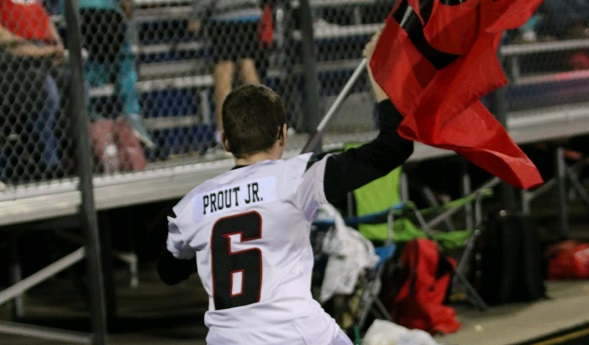
Larry Prout, Jr., who wears Pinckney football jersey number 6, stands 4-foot-8 and 85 pounds.
 Or slightly less than one pound for each of the 105 surgeries he’s had in his young life.
He can’t play football — his body is much too fragile, despite a strong desire to play the game — but he makes his mark with the Pirates as an inspiration.
And the Pirates put a spark into a young man who has spent a large portion of his life in hospitals.
“Everyone gets pumped when he’s around,” Pirates senior quarterback Joe Bona says. “How could you not? Larry’s a great kid, an awesome, awesome character, and what he’s gone through should push us, because it’s way harder than what we’ve ever done. I think it pushes and makes us work harder.”
Larry is the sixth of six children of Kathy and Larry Prout Sr., who have made countless trips to emergency rooms when a medical emergency has cropped up in young Larry’s life.
At one point, their living room was a hospital room for Larry, complete with bed and medical equipment as the Prout family rallied around him.
He was born with no skin covering the lower half of his torso, leaving his internal organs exposed.
He spent most of the first 18 months of his life in the hospital, and didn’t breathe on his own until he was 3 years old.
“His first word was ‘lucky,’” Kathy Prout said in a 2016 interview. “It was the craziest word. It’s like a three-legged dog named Lucky, you know? That was his first word, and we would die laughing.”
He was included as much as he could be in his siblings’ hijinks, although he spent much of his time at C.S. Mott Children’s Hospital in Ann Arbor. But Larry Jr. became well-known among Wolverines fans during the 2016 season for the inspiration he was providing to the U-M football team, with Bleacher Report referring to him as the “heartbeat of Michigan football” in a 2017 report.
 He’s making that level of impact on his favorite high school team now as well.
"Being part of Pinckney and Michigan means a lot," Larry Jr. said. "It’s been really fun, seeing the players and coaches; it’s the same as at Michigan. I love going to the games and sitting on the sidelines before kickoff, and seeing my players and my friends, my best friends, and seeing Coach Jim (Harbaugh) and Coach Rod (Beaton).
Larry is home-schooled because his body isn’t strong enough to allow him to attend school on a regular basis. He takes electives at Pinckney, including photography, and loves being at school, although his parents had to set some limits.
“We found out that every time we dropped him off at school, he would go out and find Rod (Beaton, Pinckney’s football coach),” Kathy said.
“We told him, once a week,” Larry Sr. said. “Rod’s got work to do.”
That may be, but Beaton returns Larry Jr.’s admiration.
“It goes without saying that he’s truly an inspiration,” Beaton says. “I’ve never met a young person with a more positive attitude than Larry. He really does bring it every single day, every time he’s here.”
Larry also has carried the flag during Pinckney's "No Quarter," the pause between the third and fourth quarters where a student picks up a black or red flag, depending on how the Pirates are faring, and runs back and forth in front of the bleachers to rev the Pirates crowd for the fourth quarter.
He practiced at home before carrying the flag in both of Pinckney's games so far this season.
His peers return the love, too.
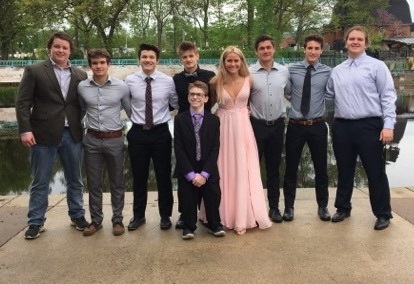
Last spring, Larry Jr. planned to attend Pinckney’s prom, but had to miss it due to a hospitalization.
When Larry Jr. got out of the hospital, a classmate, Alex Williams, put on her prom dress and with some fellow students put on a prom for Larry.
“We have some outstanding kids here,” Beaton said, “and it goes to speak to what we have in this community. Our kids come from such great households, with parents who raise these kids the right way. They understand what Larry’s situation is, and it uplifts us all, every time he’s out here.”
The same, the Prouts say, goes for Larry.
“I remember I loved school,” Kathy said. “I loved it when my older kids were in school. You get the pencils and the pictures and the new clothes. With Larry, I have anxiety and stress because he wants to fit in and make friends and take six classes when he can only do two or three.”
Including Larry Jr. in activities like the prom and football means a lot to all of the Prouts.
“We have a lot of gratitude, and we don’t know how to show it enough,” Kathy said, ‘We want to show our gratitude to Rod and all of the players because they’ve made Larry feel important, such a part of this Pinckney football team. It’s something we’ll never forget, something Larry will never forget.”
 Larry Jr. was a part of the Michigan football team for three seasons, and among his close friends is reserve Buck West, a former Pinckney standout who often is seen at the Prout house watching game shows with Larry Jr.
“I love watching Family Feud and Steve Harvey,” Larry Jr. said. “(The Pirates) are like my brothers, just like Michigan was.”
Larry Jr. got connected to the Michigan team through an organization called Team Impact, which connects youths with life-threatening or chronic illnesses to college football teams.
Dan Kraft, the son of New England Patriots owner Robert Kraft, invited the Prouts to Ford Field when the Patriots played a preseason game there last month and got them passes to be on the field during pregame.
“As I was hanging out, the camera was filming me and they said Team Impact had a surprise for me,” Larry Jr. said. “And the craziest thing is, I see Tom Brady coming up and giving me a fist-bump and a high five. I shook his hand and told him I loved seeing him play. He pointed to my (Michigan) hat and told me to make sure to beat the Buckeyes this season. I told him I would make sure to do that.”
After Brady left, Larry Jr. jumped for joy, no mean feat for a young man who uses a wheelchair for anything but short walks.
“When he gets excited, he jumps,” Kathy said. “He can clear eight inches, which is pretty awesome, because they said he would never walk.”
At Pinckney practice, Larry Jr. hands out encouragement and banters with players who are, in many cases, a foot taller than him.
While he basks in the glow of being part of a team, he contributes to the Pirates something they might not have learned otherwise.
“The lesson I take is that it’s not as bad as what it’s going to be,” senior running back Sal Patierno said. “What we go through, you just think of what he’s gone through, and it makes you want to go harder. Just keep fighting. I know he’s fought harder than any of us.”
“It makes you think,” Bona said. “It makes you work harder.”
“He uplifts us all, every time he’s out here,” Beaton said.
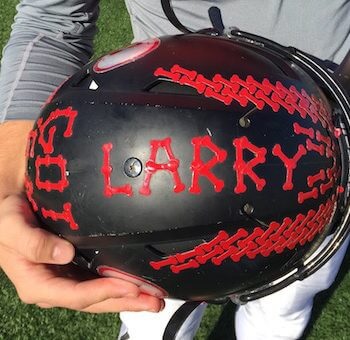
PHOTOS: (Top) Larry Prout Jr. carries the Pinckney "No Quarter" flag in front of the crowd during the Pirates’ Week 2 game at Chelsea. (Middle) Then-senior Pirates quarterback Jack Wurzer spelled out Prout’s name on his helmet in 2017 from bones the players receive for outstanding efforts. (Below) Prout’s friends put on a prom for him after Prout, in purple shirt and tie, missed the school’s event this spring while hospitalized. (Photos courtesy of the Prout family and Tim Robinson.)
Fracassa's Remarkable Records Still Rule
By
Tom Markowski
Special for Second Half
June 24, 2020
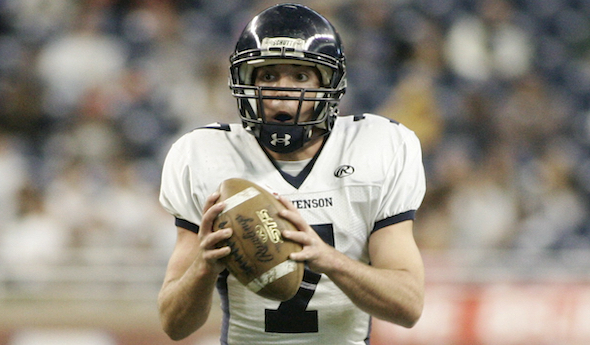
As a senior at Sterling Heights Stevenson during the 2009 season, Jason Fracassa lit up the high school football world with his aerial display.
 Fracassa shattered the MHSAA career totals for passing yards and touchdowns held by Mill Coleman of Farmington Hills Harrison. Fracassa also etched his name into the national record book in three career passing categories before the remarkable run ended with a 31-21 loss to Detroit Catholic Central in the Division 1 Final at Ford Field.
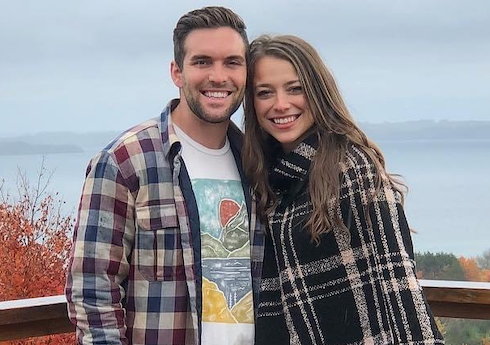
The numbers he posted at Stevenson indeed were staggering. And just more than a decade later, after securing two undergraduate degrees and a masters in finance from Walsh University in Ohio, Fracassa lives in Auburn Hills and continues to crunch numbers – now for a development company in Birmingham – while also planning for a Sept. 12 wedding to fiancé Kelsey Torzy.
Fracassa has always been a highly-motivated person, and that held true in the classroom and as a three-sport varsity athlete and continues now in the business world. But while driven by success, Fracassa doesn’t dwell on what he accomplished in the sports world – which also included Division II college careers in both football and baseball. What was important then remains so now, and those are the relationships he built through trust, hard work and having a little fun.
“I miss going to practice each day and hanging out with my friends,” he said. “Just walking around school and trying to set an example to the kids, that’s what was important. I’ll go to the golf course now and I’m with all of my friends. That’s what it’s all about. That was the best part. We had the best relationships, no matter if we won or lost. Playing for Coach (Rick) Bye and your friends, that’s the best memories I have.”
A four-year varsity starter for Bye, Fracassa led Stevenson to a combined 23-3 record over his last two seasons, culminated by that fourth trip in program history to an MHSAA Final.
During his junior season, Fracassa threw for 3,353 yards and 34 touchdowns over 12 games. He then took aim at Coleman’s career passing records for touchdowns (77) and yards (7,464), records that had stood for 20 years.
 Fracassa and his teammates put on a show that 2009 season as he threw for 4,433 yards and 44 touchdowns. His career (10,615) and single season (4,433) passing yards remain MHSAA records, the career total by nearly 2,000 yards. Fracassa also continues to own the records for career passing attempts (1,104) and completions (656), accrued over 44 games, and he briefly held the MHSAA record for career TD passes with 97 before it was broken in 2013. The career attempts and yards and senior-season yardage all rank in the National Federation record book as well.
Fracassa credits the coaching staff at Stevenson for the success he and his teammates enjoyed. He couldn’t have imagined playing for anyone but Bye and his staff. Fracassa said he’s spoken with many of Bye’s former players, and they all agree playing for Stevenson and Bye was a phenomenal experience.
Like Fracassa, Bye – who retired after 2009 with a record of 268-94 over 35 seasons – also keeps tabs of his cronies by playing golf once a week with former assistants like Ken Fiott, Jerry Lajeunesse, Larry Zimmerman, Joe Emanuele and D.J. Hill among others. Bye is quick to point out that many of his former players, including Fracassa, keep in touch on a regular basis.
“I saw (Fracassa) at a Stevenson playoff game,” Bye said. “He calls me at least once every two months or so to see how I’m doing. I appreciate that. He was always a highly-respected kid. He’s not a kid anymore.”
Bye recalls hearing about Fracassa when Fracassa was in the eighth grade at St. Lawrence in Utica. Fracassa enrolled at Davis Junior High, Stevenson’s feeder school, for his ninth grade and tried out for the football team not knowing whether he’d make the varsity or not.
“His dad wasn’t pushy one bit,” Bye said. “(Rick Fracassa) asked if Jason was going to be on the JV. A big reason he wanted his son to come (to Stevenson) was Joe Emanuele, who was our baseball coach, and Rick knew Joe had a good program. He wanted Jason to play baseball, too.
“Jason came out and won the (quarterback) job. He proved himself. And he had to win over our seniors.”
Jason Fracassa said that was the hard part – convincing a group of seniors that a freshman could come in, start at quarterback and lead the team can be daunting.
“I knew I could compete at that level,” Fracassa said. “It was more of my getting to associate myself with the older players. That was the most difficult part. The coaches were always there to back me.”
 Stevenson made the playoffs that 2006 season finishing 5-5. The next season was rough as the Titans lost a number of close games and finished 2-7. Stevenson improved substantially to 10-2 in 2008, losing to Lake Orion, 38-36, in a Regional Final.
That all built up to the memorable 2009 season, which included a tense Semifinal game against Clarkston won by Stevenson 37-35 on a Fracassa scoring pass on the final play.
Emotions also ran high the game before when Stevenson took on Detroit Public School League power Detroit Southeastern, led by Michigan State-bound and now-NFL defensive end William Gholston. Fracassa threw for a career-high 494 yards, and Stevenson defeated Southeastern, 38-32.
After a busy and accomplished prep career, Fracassa maintained a hectic athletic schedule in college first at Northwood University – where he started on the baseball team for three seasons and was a member of the football team for two.
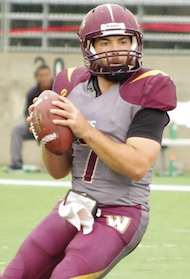
After sitting out a term, Fracassa transferred to Walsh, located in North Canton, Ohio. There he revived his football career starting at quarterback his last two years. Walsh, then a recent addition to the Great Lakes Intercollegiate Athletic Conference, nearly upset conference power and undefeated Ferris State in Fracassa’s final game. Fracassa threw his second touchdown pass of the game to give Walsh a 42-32 lead with 9:38 left before Ferris State came back with two touchdowns, the second with 36 seconds left, to win 46-42.
Fracassa hasn’t completely abandoned football since his last game at Walsh. He and his father coached the Oakland University club team in 2018 and that team reached a championship game. Jason was the offensive coordinator, his father the head coach – branches from the coaching tree rooted with Jason’s grandfather Al Fracassa, the second-winningest high school football coach in MHSAA history and Bloomfield Hills Brother Rice legend.
Jason’s competitive juices continue to flow.
“We had a great run,” Fracassa said, “and any other year could have taken the championship trophy.”
Made in Michigan 2020
June 16: Muskegon Grad Casts "Magic" in HBO Series - Read
 Tom Markowski is a correspondent for the State Champs! Sports Network and previously directed its web coverage. He also covered primarily high school sports for the The Detroit News from 1984-2014, focusing on the Detroit area and contributing to statewide coverage of football and basketball. Contact him at [email protected] with story ideas for Oakland, Macomb and Wayne counties.
PHOTOS: (Top) Jason Fracassa rolls out during the 2009 Division I championship game at Ford Field. (Middle) Fracassa and fiancé Kelsey Torzy. (Below) Fracassa drops back to pass while playing for Walsh. (Middle and below photos courtesy of Jason Fracassa.)