


QB Leads Ithaca Back to Legendary Level
November 27, 2015
By Geoff Kimmerly
Second Half editor
DETROIT – At halftime of Friday’s Division 6 Final, Ithaca coach Terry Hessbrook told his quarterback Jake Smith he was the best player on the field and needed to play like it.
Or something like that – no doubt a little more directly, with a few more words that got right to the heart of Smith’s importance in helping the Yellowjackets avoid the disappointment of taking home the second-place trophy for the second season in a row.
Two quarters later, the list of Ithaca quarterbacks who have put up memorable performances at Ford Field grew by one.
Cementing his place in a line of signal callers who have led Ithaca to 83 wins in 84 games, Smith directed a second-half rally that pushed the Yellowjackets past Clinton 27-20 for their fifth MHSAA championship in six seasons.
A year ago, Smith and his teammates left the field after a loss to Monroe St. Mary Catholic Central ended a national-best 69-game winning streak. This time, Ithaca trailed 13-0 early in the third quarter before scoring 27 straight points over 15 minutes to take a lead it wouldn’t relinquish.
“He knew he could get more out of me, and as an offense we definitely produced,” said Smith of his coach’s halftime cajoling. “I wasn’t really panicking. I knew if we get behind, we’ve still got to keep playing. I wasn’t going to let it happen like it happened last year. I didn’t want to experience that feeling again, so I just played as hard as I could.
“It means so much to everybody on our team. Everybody really just wants to go out on top. Everybody wants to be number one. We finished that climb this year and we stuck the flag in the mountain, and it just feels so great.”
And it surely was a bit of a relief too.
Many of the team’s 17 seniors saw the field for most of the 2014 trip to Detroit, perhaps offering a little more motivation to bounce back for the program’s fifth perfect season over the last six.
“It was immense pressure, and to be honest, that made me very nervous. I talked to the players about it before the game today, that I was so happy because since day one last year after we got beat their goal was to get back to Ford Field,” Hessbrook said. “And I thought we had a championship-caliber football team, but I think a lot of people had championship-caliber football teams and somewhere along the line they get caught up and something goes wrong.
“I was glad they were able to play their last game in an Ithaca uniform here at Ford Field and have a chance ... to play for a championship.”
The Yellowjackets (14-0) finished off their best defensive performance of the run in terms of points allowed, giving up only 107 this fall despite dealing the first and only losses to three contenders over the last four weeks.
That defense played a massive role Friday, holding a Clinton rushing attack that averaged 297 yards per game this season to only 179. The Redskins had only 14 yards rushing over five second-half possessions after taking the 13-0 third-quarter lead.
But while the Yellowjackets held Clinton’s offense in check, it came down to Smith to carry them over the top.
The Ithaca run of quarterbacks starring at Ford Field started with Alex Niznak, who ran for five touchdowns in 2010 to lead the Yellowjackets to their first title. Then came Jake’s older brother Travis Smith, who put his name all over the record book in 2011 and 2013 wins – sandwiched around 2012, when back-up Logan Hessbrook came in after Travis Smith was hurt and led Ithaca to another MHSAA Finals victory.
Jake Smith was decent in last season’s Final, running for 90 yards and a score and throwing for 147 yards and the other touchdown as Ithaca fell 22-12. But his first half Friday was not at all noteworthy – six yards rushing and 60 passing.
Then came Hessbrook's pep talk.
 “The first half, we did what we wanted to do,” Clinton coach Scott McNitt said. “We kept him in front of us. We didn’t let him get loose. But the third quarter, he found something. And he showed he was the best player on the field.”
Four minutes into the third quarter, Smith scored Ithaca’s first touchdown on a 14-yard run. Three and a half minutes later, Smith connected with senior Spence DeMull on a 22-yard pass in the seam, and two plays later connected with DeMull on the same route for a score that put the Yellowjackets ahead 14-13.
The next possession saw Smith's performance climb toward another level.
With 14 seconds left in the third quarter, he dropped back and rolled left, spun away from a near-sack, down the left sideline – and just as it looked like he would dive at the near pylon, Smith side-stepped right and whirled into the end zone. Ithaca 21, Clinton 13.
Smith added one more touchdown run from a yard out to put the Yellowjackets up 27-13 with 7:47 to play. Noah Poore’s 4-yard run at 4:59 pulled Clinton back within seven. But after Ithaca ran the clock down to 1:47 on its next possession, Clinton went to the air and completed only one of four passes before Ithaca senior Derek Teed ended the threat with a fourth-down sack.
Teed had three of his team’s 11 tackles for losses. Senior linebacker Jace Demenov led the effort on that side of the ball with 10 tackles, and junior linebacker Lane O’Boyle had eight.
Smith ended with 126 yards rushing to go with three scores and 180 yards passing with a touchdown.
For Clinton, senior running back/linebacker Mathew Sexton ran for 141 yards and a score and had six tackles. Senior linebacker Ken DeShano had 11 tackles.
Sexton also played a major role when Clinton fell to Ithaca 41-22 in the 2013 Final, and ran for more than 2,000 yards this season as the Redskins (13-1) charged through this run toward the rematch, eliminating reigning champion St. Mary among one of the most impressive slates of playoff opponents in any division.
“The gauntlet we’ve gone through these past four weeks – St. Mary, Madison Heights (Madison), (Jackson) Lumen Christi, (Grand Rapids) NorthPointe Christian, may have taken some of what we needed in the tank out of us,” McNitt said. “But these kids battled to the end … and had a chance at the end.”
Coaches almost always decline to compare teams from year to year, and especially championship winners.
But Hessbrook admitted this run was a little sweeter than some of the rest because of what it allowed for the players who walked off sadly a year ago and the legacy they were able to finish on a winning note.
“It would be hard for me to put them into numerical order and say this one is my favorite one or that one is my favorite one,” Hessbrook said. “But I’ll say this about this group of seniors: I don’t think that any class at Ithaca has ever dedicated themselves to winning a championship more than this class has, and that’s why it was so important for them to do that."
PHOTOS: (Top) Ithaca quarterback Jake Smith breaks a tackle during Friday's Division 6 Final. (Middle) The Yellowjackets celebrate their fifth MHSAA title in six seasons.
1st & Goal: Week 6 Preview
October 1, 2020
By Geoff Kimmerly
Second Half editor
We may have only just begun this abbreviated Michigan high school football season, but this weekend we’ll reach the midway point – and the beginning of another October full of opportunities.
Every game matters even more with a six-game schedule, and early league leaders are meeting everywhere over the next two days – including in five leagues in the Grand Rapids/Muskegon areas alone.
Below is a quick look at some of the especially intriguing matchups. Check out the MHSAA Score Center beforehand for kickoff times and locations of all games, and come back Friday and Saturday for scores as they’re reported.
This week’s broadcast schedule includes 48 varsity football games on MHSAA.tv; click the link for listings.
Bay & Thumb
Mount Pleasant (2-0) at Midland (2-0)
Seven of the last 10 meetings between these Saginaw Valley League Blue foes have been decided by eight points or fewer, including Midland’s 22-21 win a year ago that helped the Chemics to a shared conference title. Along with matchups both still face with Midland Dow, tonight’s should significantly shape this season’s league race.
Keep an eye on these: FRIDAY New Lothrop (2-0) at Montrose (2-0), Grand Blanc (1-1) at Lapeer (2-0), Midland Bullock Creek (1-1) at Hemlock (2-0). SATURDAY Croswell-Lexington (2-0) at North Branch (2-0).
Greater Detroit
West Bloomfield (2-0) at Clarkston (2-0)
The Wolves quickly are making last season’s uncharacteristic 3-6 finish – their first below .500 since 2002 – a distant memory, but this matchup will allow them the opportunity to avenge a 2019 loss for the first time. West Bloomfield claimed last year’s matchup 24-0 on the way to finishing 10-2, and more interestingly hasn’t lost a game by more than seven points since 2016. With both programs surging again, we could be in for another close contest.
Keep an eye on these: FRIDAY Detroit Denby (2-0) at Detroit Martin Luther King (1-1), North Farmington (1-1) at Birmingham Groves (1-1), Clinton Township Chippewa Valley (1-1) at Sterling Heights Stevenson (2-0). SATURDAY Warren De La Salle Collegiate (1-1) at Detroit Catholic Central (2-0).
Mid-Michigan
Lansing Catholic (2-0) at Portland (1-1)
Lansing Catholic rode last year’s first win in this rivalry since 2015 all the way to the Division 5 championship, and the Cougars have tuned up on both sides of the ball outscoring their first two opponents by a combined 85-3. The Raiders will hope for a result similar to last year’s first meeting with Lansing Catholic, a 21-20 win, before they fell 21-0 in that District Final rematch. Portland last week bounced back with a shutout of Charlotte after falling big in its opener to DeWitt.
Keep an eye on these: FRIDAY Reed City (2-0) at Central Montcalm (2-0), Canton (2-0) at Brighton (1-1), Stockbridge (1-1) at Lake Odessa Lakewood (1-1), Ortonville Brandon (2-0) at Corunna (1-1).
Northern Lower Peninsula
Kingsley (2-0) at Traverse City St. Francis (1-1)
The Stags ended their six-game losing streak to St. Francis last season with a 26-7 victory that eventually decided the Northern Michigan Football League Legends title. Kingsley hasn’t slowed down, running its regular-season winning streak to 16 last week. But St. Francis’ 14-7 loss to new league member Sault Ste. Marie in the season opener is looking even better after the Sault’s win over Marquette, and the Gladiators still have reason to hope for at least a three-way tie for the Legends championship.
Keep an eye on these: FRIDAY Traverse City Central (2-0) at Cadillac (2-0), Harbor Springs (2-0) at Manistee (2-0), Frankfort (1-1) at Johannesburg-Lewiston (2-0), Charlevoix (2-0) at Boyne City (1-1).
Southeast & Border
Clinton (2-0) at Blissfield (2-0)
Reshuffling among southeastern Lower Peninsula leagues took these teams’ regular Week 2 nonconference meeting up a few levels. It already was a solid nonleague matchup – they’ve played regularly since 2012 and split the last four meetings with Clinton winning last season 45-13. Now they find themselves tied for the early lead in the Lenawee County Athletic Association, with Blissfield coming off a 31-14 win over reigning champion Hillsdale last week.
Keep an eye on these: FRIDAY Saline (2-0) at Monroe (2-0), Hillsdale (1-1) at Ida (1-1), Battle Creek Harper Creek (1-1) at Jackson Lumen Christi (1-1). SATURDAY Schoolcraft (2-0) at Chelsea (2-0).
Southwest Corridor
Cassopolis (2-0) at Centreville (2-0)
The Rangers are up to 26-1 in league play since the Southwest 10 Conference was formed in 2017, and that means even more considering five of the remaining six 11-player football members made the playoffs in 2019. Cassopolis’ closest league win last year was 15-0 over Centreville, which has continued its rejuvenation and could have its sights set on more after losing four games in 2019 by a combined 28 points. The Bulldogs avenged one of those defeats downing White Pigeon 14-8 last week.
Keep an eye on these: FRIDAY Sturgis (2-0) at Paw Paw (2-0), Portage Central (0-2) at St. Joseph (2-0), Constantine (1-1) at Watervliet (2-0), Stevensville Lakeshore (1-1) at Battle Creek Central (1-1).
Upper Peninsula
Gladstone (1-0) at Sault Ste. Marie (2-0)
Gladstone provided an uplifting story last weekend, coming off short prep time to edge Negaunee 22-20 and after also missing out on opening weekend. Next up is the team generating the most buzz in the Upper Peninsula. Sault Ste. Marie has wins over Traverse City St. Francis and Marquette – and will be looking to avenge last season’s 20-8 loss to the Braves.
Keep an eye on these: FRIDAY Marquette (1-1) at Kingsford (2-0), L'Anse (1-1) at Negaunee (1-1), Menominee (1-1) at Escanaba (0-0), Norway (0-2) at Bark River-Harris (0-2).
West Michigan
Zeeland East (2-0) at Zeeland West (2-0)
This next-door showdown always means a lot. It might mean even more now that Muskegon Mona Shores and Muskegon High have joined the Zeeland schools to make what was a strong Ottawa-Kent Conference Green now one of the most powerful football leagues in the state. West won both meetings last year, by 20 and then 31 points in a Division 3 playoff opener.
Keep an eye on these: FRIDAY Cedar Springs (2-0) at Grand Rapids Catholic Central (2-0), Grand Rapids Forest Hills Central (2-0) at Byron Center (2-0), Grandville (2-0) at Hudsonville (2-0), North Muskegon (2-0) at Whitehall (2-0).
8-Player
Whittemore-Prescott (2-0) at Gaylord St. Mary (2-0)
Whittemore-Prescott was a late addition to 8-player before the start of this fall. But it looks like the Cardinals made a sound decision. Their two wins in two weeks equal their total for the entire 2019 season. That said, St. Mary certainly will be W-P’s biggest challenge to date. The Snowbirds have put 111 points on the board over just two games and could be prepping for a serious run in their second season of this format.
Keep an eye on these: FRIDAY Adrian Lenawee Christian (2-0) at Climax-Scotts (2-0), Brethren (1-1) at Mesick (1-1), Indian River Inland Lakes (2-0) at Onekama (1-1). SATURDAY Hillman (1-1) at Portland St. Patrick (2-0).
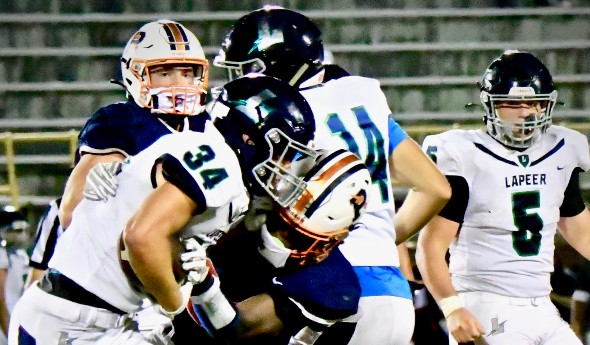
PHOTO: Lapeer is looking to improve to 3-0 after downing Flint Powers Catholic 36-21 last week. (Photo by Terry Lyons.)