


QB Leads Ithaca Back to Legendary Level
November 27, 2015
By Geoff Kimmerly
Second Half editor
DETROIT – At halftime of Friday’s Division 6 Final, Ithaca coach Terry Hessbrook told his quarterback Jake Smith he was the best player on the field and needed to play like it.
Or something like that – no doubt a little more directly, with a few more words that got right to the heart of Smith’s importance in helping the Yellowjackets avoid the disappointment of taking home the second-place trophy for the second season in a row.
Two quarters later, the list of Ithaca quarterbacks who have put up memorable performances at Ford Field grew by one.
Cementing his place in a line of signal callers who have led Ithaca to 83 wins in 84 games, Smith directed a second-half rally that pushed the Yellowjackets past Clinton 27-20 for their fifth MHSAA championship in six seasons.
A year ago, Smith and his teammates left the field after a loss to Monroe St. Mary Catholic Central ended a national-best 69-game winning streak. This time, Ithaca trailed 13-0 early in the third quarter before scoring 27 straight points over 15 minutes to take a lead it wouldn’t relinquish.
“He knew he could get more out of me, and as an offense we definitely produced,” said Smith of his coach’s halftime cajoling. “I wasn’t really panicking. I knew if we get behind, we’ve still got to keep playing. I wasn’t going to let it happen like it happened last year. I didn’t want to experience that feeling again, so I just played as hard as I could.
“It means so much to everybody on our team. Everybody really just wants to go out on top. Everybody wants to be number one. We finished that climb this year and we stuck the flag in the mountain, and it just feels so great.”
And it surely was a bit of a relief too.
Many of the team’s 17 seniors saw the field for most of the 2014 trip to Detroit, perhaps offering a little more motivation to bounce back for the program’s fifth perfect season over the last six.
“It was immense pressure, and to be honest, that made me very nervous. I talked to the players about it before the game today, that I was so happy because since day one last year after we got beat their goal was to get back to Ford Field,” Hessbrook said. “And I thought we had a championship-caliber football team, but I think a lot of people had championship-caliber football teams and somewhere along the line they get caught up and something goes wrong.
“I was glad they were able to play their last game in an Ithaca uniform here at Ford Field and have a chance ... to play for a championship.”
The Yellowjackets (14-0) finished off their best defensive performance of the run in terms of points allowed, giving up only 107 this fall despite dealing the first and only losses to three contenders over the last four weeks.
That defense played a massive role Friday, holding a Clinton rushing attack that averaged 297 yards per game this season to only 179. The Redskins had only 14 yards rushing over five second-half possessions after taking the 13-0 third-quarter lead.
But while the Yellowjackets held Clinton’s offense in check, it came down to Smith to carry them over the top.
The Ithaca run of quarterbacks starring at Ford Field started with Alex Niznak, who ran for five touchdowns in 2010 to lead the Yellowjackets to their first title. Then came Jake’s older brother Travis Smith, who put his name all over the record book in 2011 and 2013 wins – sandwiched around 2012, when back-up Logan Hessbrook came in after Travis Smith was hurt and led Ithaca to another MHSAA Finals victory.
Jake Smith was decent in last season’s Final, running for 90 yards and a score and throwing for 147 yards and the other touchdown as Ithaca fell 22-12. But his first half Friday was not at all noteworthy – six yards rushing and 60 passing.
Then came Hessbrook's pep talk.
 “The first half, we did what we wanted to do,” Clinton coach Scott McNitt said. “We kept him in front of us. We didn’t let him get loose. But the third quarter, he found something. And he showed he was the best player on the field.”
Four minutes into the third quarter, Smith scored Ithaca’s first touchdown on a 14-yard run. Three and a half minutes later, Smith connected with senior Spence DeMull on a 22-yard pass in the seam, and two plays later connected with DeMull on the same route for a score that put the Yellowjackets ahead 14-13.
The next possession saw Smith's performance climb toward another level.
With 14 seconds left in the third quarter, he dropped back and rolled left, spun away from a near-sack, down the left sideline – and just as it looked like he would dive at the near pylon, Smith side-stepped right and whirled into the end zone. Ithaca 21, Clinton 13.
Smith added one more touchdown run from a yard out to put the Yellowjackets up 27-13 with 7:47 to play. Noah Poore’s 4-yard run at 4:59 pulled Clinton back within seven. But after Ithaca ran the clock down to 1:47 on its next possession, Clinton went to the air and completed only one of four passes before Ithaca senior Derek Teed ended the threat with a fourth-down sack.
Teed had three of his team’s 11 tackles for losses. Senior linebacker Jace Demenov led the effort on that side of the ball with 10 tackles, and junior linebacker Lane O’Boyle had eight.
Smith ended with 126 yards rushing to go with three scores and 180 yards passing with a touchdown.
For Clinton, senior running back/linebacker Mathew Sexton ran for 141 yards and a score and had six tackles. Senior linebacker Ken DeShano had 11 tackles.
Sexton also played a major role when Clinton fell to Ithaca 41-22 in the 2013 Final, and ran for more than 2,000 yards this season as the Redskins (13-1) charged through this run toward the rematch, eliminating reigning champion St. Mary among one of the most impressive slates of playoff opponents in any division.
“The gauntlet we’ve gone through these past four weeks – St. Mary, Madison Heights (Madison), (Jackson) Lumen Christi, (Grand Rapids) NorthPointe Christian, may have taken some of what we needed in the tank out of us,” McNitt said. “But these kids battled to the end … and had a chance at the end.”
Coaches almost always decline to compare teams from year to year, and especially championship winners.
But Hessbrook admitted this run was a little sweeter than some of the rest because of what it allowed for the players who walked off sadly a year ago and the legacy they were able to finish on a winning note.
“It would be hard for me to put them into numerical order and say this one is my favorite one or that one is my favorite one,” Hessbrook said. “But I’ll say this about this group of seniors: I don’t think that any class at Ithaca has ever dedicated themselves to winning a championship more than this class has, and that’s why it was so important for them to do that."
PHOTOS: (Top) Ithaca quarterback Jake Smith breaks a tackle during Friday's Division 6 Final. (Middle) The Yellowjackets celebrate their fifth MHSAA title in six seasons.

Monroe SMCC Wins Championship Grind
November 29, 2019
By Geoff Kimmerly
Second Half editor
DETROIT – If Monroe St. Mary Catholic Central could draw up the perfect game for its preferred style of play, it might look a lot like Friday’s Division 6 Final.
Yes, the Falcons defeated Maple City Glen Lake to win their first championship since 2014, so that makes it memorable no matter what. And sure, SMCC would’ve loved to score more – the offense averaged 34 points per game heading into the night.
But look past all of that and consider: The Falcons had 63 plays to Glen Lake’s 32, and ran the ball 58 times. They had 22 first downs to Glen Lake’s six. They had the ball nearly twice as long – 31:17 to 16:43 – and didn’t have one penalty called against them. And the defense posted its first shutout of the season.
Offensive efficiency and defensive prowess have been hallmarks of a program that was playing in its eighth MHSAA Final – and the victory was proof again that the workmanlike approach remains a viable a championship approach during an era dominated by wide-open and fast-paced attacks.
“It’s not really the score that we anticipated, but it’s OK – we’re a grinding team, we have faith in our defense and our offense to eat up time on the clock,” SMCC senior quarterback Wyatt Bergmoser said. “We just rep our plays, and if it does come down to the defense we let them do their thing and it’s not a big deal – we have trust in the other players on the field.
“We were on different teams (before high school) but we knew we’d come together and play together in the future, and that’s something we dreamed of and hoped for forever. As a kid, I went to the 2014 state championship game. I just remember sitting in the stands and thinking to myself, I want to be here one day. I want to be here with my friends, with my other players and grind it out and get a state championship for myself. And that’s what we did, and I love all my players and teammates for that.”
The Falcons finished 12-1, their only defeat this season 28-21 to Division 4 Milan in Week 3.
 That close loss, which eventually decided the Huron League title, provided a lesson that would serve St. Mary as it worked to finish off its mission for the ultimate playoff prize.
SMCC led in the fourth quarter by a point, and punted on 4th-and-4 with just under seven minutes to play. Milan went ahead on the next possession, and the Falcons ran out of time.
On Friday, SMCC punted only twice and converted on four of five fourth-down tries, including two during a 14-play, 55-yard fourth-quarter possession that didn’t result in a score but did drain 7:48 off the clock. That possession also left Glen Lake to try to tie beginning at its own 7-yard line with 2:27 to play.
“Earlier in the year we were hitting some big runs, but three, four, five yards are great plays for our offense,” SMCC coach Adam Kipf said. “We don’t need to hit a home run. We don’t need to get 10 yards every time we touch it. But if we’re getting three yards a pop … 2½ yards, we’re in great position. We like to do that, and we’ll chew up 35, 36, 37 seconds on the play clock too, and that’s by design. We want to keep it out of their hands.”
The game’s lone score came on a Bergmoser six-yard touchdown run just under five minutes into the second quarter, which capped a 10-play, 94-yard drive lasting 5:22.
The Falcons ran for 249 yards total, led by senior Alex Morgan’s 123 on 22 carries. They held Glen Lake (12-2) to 127 yards total, 75 of it coming through the air on passes by senior quarterback Reece Hazelton. The Lakers got no deeper into SMCC territory than the 36-yard line.
“They were probably the biggest team we faced all year, since we’re pretty big ourselves,” Glen Lake junior receiver/defensive back Finn Hogan said. “It was a little different change of pace for us. It took a drive or two for us to get used to, and they capitalized.”
The seven points tied the fewest Glen Lake gave up in a game this season – seven times the Lakers gave up seven, and they allowed a solid 16.2 on average over the entire fall. Hogan and senior linebacker Jonathan Wright led Friday’s effort with 12 tackles apiece, and as a team Glen Lake had six tackles for loss.
Bergmoser also was his team’s high tackler with seven.
Glen Lake had last appeared in a Final in 2016, also finishing Division 6 runner-up that year. The Falcons, meanwhile, finished a rare 4-5 that fall, but came back with seven wins in 2017 and nine last season to set up this year’s run.
“Going into high school my freshman year, I knew we had a special group in our class. I think everyone knew we were special,” Morgan said. “My sophomore year we had 11 starters on the team that made the playoff run. Our junior year we had a ton of juniors starting on that team. So we had one goal in mind this senior year, and it was to be right where we are right now.”
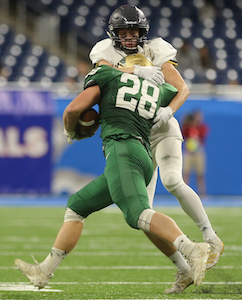
PHOTOS: (Top) St. Mary’s Alex Morgan (26) is slowed by Glen Lake’s C.J. Helfrich (2) and Finn Hogan. (Middle) A Glen Lake defender works to bring down the Falcons’ Samuel Cousino.