


Ready for Some Football
August 12, 2014
A Game for Every Fan: Week 5
September 26, 2013
By Geoff Kimmerly
Second Half editor
Rivalry games develop for a variety of reasons: proximity, a history of close finishes and league ties are just the obvious. And finding one of these matchups worth watching is an easy task just about every week of MHSAA football season..
But tonight and Saturrday might feature the best set of rivalry games, collectively, this state has seen during one weekend in a long time.
All featured below are tonight unless noted. Be sure to monitor all the scores as they come in at the MHSAA Score Center.
Greater Detroit and Southeast
Birmingham Brother Rice (4-0) at Detroit Catholic Central (4-0) - Saturday
Although DCC hasn’t played a Catholic League Central game yet (it was the odd team out during last week’s openers), the Shamrocks and Warriors are the only teams in the division still undefeated overall. Both are playing for their third trips to the MHSAA Finals – Brother Rice has won back-to-back Division 2 titles, and DCC has finished runner-up the last two seasons in Division 1. But first comes this weekend; they’ve split the last four meetings, and DCC’s defense already has three shutouts this fall.
Others that caught my eye: Detroit Loyola (4-0) at Pontiac Notre Dame Prep (4-0), Farmington Hills Harrison (4-0) at Southfield (3-1), Melvindale (4-0) at Wyandotte Roosevelt (4-0), Rochester Hills Stoney Creek (4-0) at Clarkston (3-1).
Southwest and Border
Portage Northern (3-1) at Portage Central (4-0)
Portage Northern is coming off a heart-breaking 17-10 loss last week to St. Joseph. But the Huskies surely will bounce back quickly for this rivalry game – especially after falling to Central in last season’s playoff opener after beating the Mustangs by 29 just two weeks before. Central got its first challenge of the season last week as well, from Stevensville Lakeshore, but hasn’t scored fewer than 34 points in a game so far.
Others that caught my eye: Decatur (4-0) at Lawton (4-0), Edwardsburg (4-0) at Three Rivers (3-1), Hartford (3-1) at Watervliet (4-0), Portland St. Patrick (4-0) at Burr Oak (3-1).
Upper Peninsula
Kingsford (4-0) at Menominee (4-0)
A year ago in Week 5, Kingsford beat Menominee 14-13 and then went on to win the Great Northern UP Conference title. But that’s been the norm; beginning in 1999, one of these two has won or shared the league title every season. This matchup often during that run decided which finished on top. The Maroons might have a little momentum after coming back to beat Kingsford 48-14 in a 2012 District Final.
Others that caught my eye: Negaunee (4-0) at Gwinn (2-2), Bessemer (3-1) at Hurley, Wis. (3-1), St. Ignace (3-1) at Sault Ste. Marie (2-2), Detroit Country Day (1-3) at Escanaba (1-3).
Lower Up North
Maple City Glen Lake (4-0) at Kingsley (3-1)
Glen Lake jumped into the Northwest Conference title conversation last season for the first time in a decade and earned the championship thanks in large part to a 29-7 win over Kingsley – which similarly was enjoying its finest conference run since 2005 before finishing second. The Stags no doubt would like to finish the job by winning this rematch to move into first place alone; they then finish with winless league opponents Benzie Central and Mesick.
Others that caught my eye: Traverse City St. Francis (3-1) at Boyne City (3-1), Petoskey (2-2) at Cheboygan (3-1), Bellaire (4-0) at Posen (2-2), West Branch Ogemaw Heights (3-1) at Cadillac (4-0).
West Michigan
East Grand Rapids (3-1) at Grand Rapids Christian (3-1)
Grand Rapids Christian enjoyed its best season ever last fall, winning the Division 3 championship, which coincided with East Grand Rapids’ first playoff miss since 2000. But the Pioneers are looking like themselves again, and the Eagles remain elite despite graduating a star-filled class and losing standout receiver Drake Harris for the first part of the regular season with an injury. Three of these teams' last five games against each other have come down to seven points or fewer, and this could be another classic.
Others that caught my eye: Belding (4-0) at Comstock Park (4-0), Ludington (3-1) at Fruitport (2-2), Rockford (3-1) at Holland West Ottawa (3-1), Muskegon (3-1) at Muskegon Mona Shores (4-0).
Mid-Michigan
DeWitt (4-0) at Haslett (3-1)
This once was the best rivalry in the Lansing area – until DeWitt won 10 straight (including three times in the playoffs), dating to Haslett’s last win in the series in 2005. Regardless, the Vikings have come closer than most to beating the Panthers during this latest run. And last season’s game seemed to signal a return to the grudge match, with DeWitt surviving 28-27. The Panthers are always strong offensively but have given up only 23 points this fall and have two shutouts. Haslett, meanwhile, is off to its best start since 2009.
Others that caught my eye: Holt (2-2) at East Lansing (3-1), Reading (2-2) at Homer (4-0), Coleman (4-0) at Carson City-Crystal (4-0), Jackson Northwest (2-2) at Jackson Lumen Christi (4-0).
Bay and Thumb
Midland (4-0) at Mount Pleasant (3-1)
With three wins – and only a 12-point loss to a strong DeWitt team – Mount Pleasant already has one more victory than all of last season, a rare down finish for the Oilers. Midland took advantage by breaking a three-season losing streak to Mount Pleasant and winning the Saginaw Valley Association North. As we reach the midpoint, these two have been the league’s most impressive teams so far.
Others that caught my eye: Harbor Beach (3-1) at Elkton-Pigeon-Bay Port (4-0), Flint Beecher (4-0) at Lake Fenton (3-1), Warren Woods Tower (3-1) at St. Clair (4-0), Yale (3-1) at Almont (3-1).
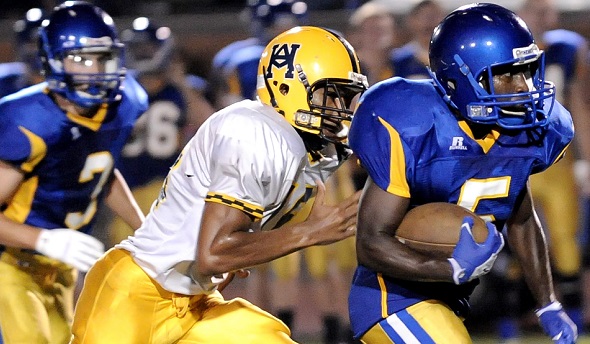
PHOTO: Midland (blue uniforms) ran past Saginaw Arthur Hill last week to remain in first place in the SVA North. (Click to see more from High School Sports Scene.)