


Ready for Some Football
August 12, 2014
A Game for Every Fan: Week 3
September 12, 2013
By Geoff Kimmerly
Second Half editor
This week has some of the best of everything for the Michigan high school football fan.
Two powers meet again in one of the most followed rivalry games in the state. Two neighbors face off in another that should draw an entire town. On perhaps a sadder but immediately urgent note, two more will meet again but for the final time.
See below for some of the best games to see in every corner of the state this weekend, and be sure to monitor all the scores at the MHSAA Score Center.
West Michigan
Rockford (2-0) at Muskegon (2-0)
Most seasons, this is arguably the most anticipated regular-season matchup in Michigan. And the excitement was tempered only slightly by Muskegon’s move to another division of the O-K Conference in 2012. Rockford holds a 4-2 advantage in the regular-season series since it began in 2007, but four of those games have been decided by eight or fewer points and Muskegon won last season, 21-9. The Big Reds, also last season’s Division 2 runner-up, have opened with big wins over Grand Haven and reigning Division 3 champ Grand Rapids Christian. Rockford’s slate has been similarly impressive – double-digit wins over Utica Eisenhower and Holt.
Others that caught my eye: Muskegon Mona Shores (2-0) at Caledonia (2-0), Grand Rapids West Catholic (0-2) at Grand Rapids South Christian (1-1), East Grand Rapids (2-0) at Holland West Ottawa (1-1), Ravenna (1-1) at Montague (1-1).
Bay and Thumb
Lapeer West (2-0) at Lapeer East (2-0)
These two schools will merge next fall, making this the final matchup between the rivals. West owns a 28-10 edge in the series dating to 1975, including seven wins in the teams’ last eight against each other. That said, East has bounced back from last fall’s three-win showing and outscored its first two opponents by a combined score of 51-0. West is playing this fall for a third straight playoff berth but this week for its first 3-0 start since 2009.
Others that caught my eye: Birmingham Brother Rice (2-0) at Flint Carman-Ainsworth (2-0), Essexville Garber (2-0) at Frankenmuth (1-1), Bay City Western (1-1) at Saginaw Arthur Hill (2-0), Freeland (2-0) at Saginaw Swan Valley (2-0).
Lower Up North
Traverse City Central (1-1) at Traverse City West (1-1)
The Nowak-Olson Memorial Trophy is again on the line with these rivals having split their last eight games against each other. This matchup also could go a long way toward deciding the Big North Conference champion. Central won 42-28 last season and finished undefeated in the league, while West settled for a second-place tie. Both rebounded from opening-night losses to win their first league game last week.
Others that caught my eye: Petoskey (2-0) at Cadillac (2-0), Traverse City St. Francis (1-1) at Elk Rapids (2-0), Suttons Bay (0-2) at Kingsley (1-1).
Upper Peninsula
Crystal Falls Forest Park (2-0) at Hurley, Wis. (2-0)
These two have built quite a rivalry in the Great Western Conference. At least one has won the league title over the last three seasons, and twice during that time they shared it – last season with Bessemer in a three-way split. The Trojans haven’t been tested yet, but Hurley had to fend off a challenge last week from Lake Linden-Hubbell in an eventual 30-20 win.
Others that caught my eye: Gwinn (1-1) at Manistique (0-2), Marquette (2-0) at Sault Ste. Marie (1-1), Powers North Central (2-0) at Lake Linden Hubbell (1-1), Kingsford (2-0) at Ishpeming Westwood (0-2).
Southwest and Border
Kalamazoo Central (2-0) at Portage Northern (2-0)
The Maroon Giants are back in some conversations they’ve missed out on the last few seasons thanks to their first 2-0 start since 2008 that could become their first 3-0 kickoff since 2004 – also the last season Kalamazoo Central made the playoffs. Portage Northern has beaten the Giants in eight straight, however, including 48-0 last season.
Others that caught my eye: Saugatuck (2-0) at Decatur (2-0), Plainwell (2-0) at Dowagiac (2-0), Portage Central (2-0) at Mattawan (1-1), Stevensville Lakeshore (2-0) at St. Joseph (2-0).
Greater Detroit and Southeast
Clinton Township Chippewa Valley (2-0) at Utica Eisenhower (1-1)
Chippewa Valley also has made its way back into the spotlight with its first 2-0 start since 2006 that’s included wins against regular playoff qualifiers Romeo and Dearborn. The good news for the Big Reds is they beat Eisenhower by two touchdowns in 2012 – which has be a confidence builder heading into a rematch with a rival that lost to a powerful Rockford team on opening night and is expected to be in Macomb Area Conference Red mix again.
Others that caught my eye: Warren Woods Tower (2-0) at Madison Heights Madison (2-0), Oak Park (2-0) at Rochester Adams (1-1), Harper Woods Chandler Park (2-0) at Warren DeLaSalle (1-1), Ottawa Lake Whiteford (2-0) at Clinton (2-0).
Mid-Michigan
Grand Ledge (0-2) at Lansing Sexton (2-0)
The surging Big Reds have made this game the no-brainer best in this area this week. Sexton has opened with solid wins over Chelsea and Monroe, and the smallest school in the Capital Area Activities Conference Blue now takes on the second-largest school in the entire Lansing area. Keep in mind the Comets’ start didn’t come against slouches; East Kentwood and Holland West Ottawa are among the strongest programs on the west side of the state. But Grand Ledge has to feel some urgency heading into a competitive league schedule.
Others that caught my eye: Fowlerville (1-1) at DeWitt (2-0), Portland (2-0) at Lansing Catholic (0-2), Haslett (1-1) at St. Johns (1-1), Charlotte (2-0) at Eaton Rapids (1-1).
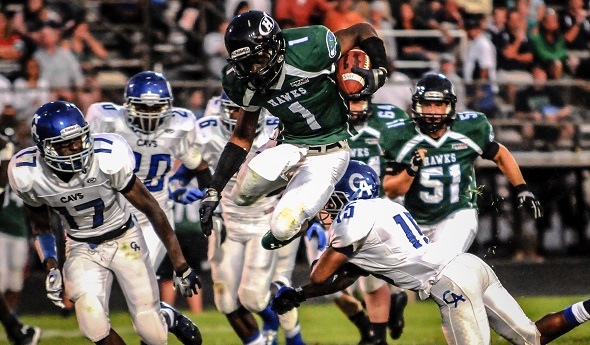
PHOTO: Flint Carman-Ainsworth (blue helmets) handled a solid Saginaw Heritage team last week, but gets another challenge this weekend in Birmingham Brother Rice. (Click to see more from High School Sports Scene.)