


Restarted Fall Becomes Madison Dream Season
October 30, 2020
By Doug Donnelly
Special for Second Half
ADRIAN – It’s always fun to be first.
 Tonight, when the Division 6 football game between Adrian Madison and Quincy ends, one of the two teams will walk off the field by enjoying its first-ever playoff win.
For the Madison Trojans, it’s been a dream season. As they get set to host their first playoff game in school history, however, the team isn’t just resting on its 5-1 record and best season since 1974.
“We’re certainly not just happy being in the playoffs,” said head coach Taz Wallace. “We’re going to enjoy it, but it’s time to get to work.”
Madison is making just its third football playoff trip ever, and first since 2009. But the school certainly is familiar with athletic success, across a variety of sports.
The track & field teams both have long Tri-County Conference winning streaks. In fact, the current senior class of boys was in grade school the last time Madison wasn’t the TCC track champion. The boys basketball team won three league titles between 2013 and 2016 and contended almost every year since. The volleyball team won its fifth-straight league title this fall. The golf teams have won multiple titles. Madison’s girls basketball team is the perennial league favorite having won eight titles over the last nine seasons.
Football success, however, has eluded the school. The last winning record for the Trojans was 6-4 by that 2009 playoff team. They’ve sent multiple players into the college ranks the last couple of years, but a winning record on the field just hasn’t been in the cards.
Until now.
This year, something is different. Wallace says the Trojans are playing for each other like never before.
“They’ve always had the ability,” Wallace said. “The difference is they believe in themselves. They hold each other accountable.”
The season started when Madison beat Ottawa Lake Whiteford, a Division 8 powerhouse in recent years. Madison won 42-24, breaking a string of losses against the Bobcats that dated back to 1980. It was a monumental win for the program.
“It was huge for our kids,” Wallace said. “To go out and win that game started all of it. In that moment, our kids realized they could play at that level.”
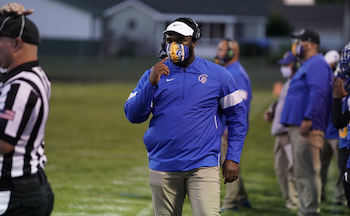 Although Madison lost in Week 2 to still-undefeated Erie Mason, the Trojans have won four straight games since to finish 5-1 and earn the No. 3 seed in their Division 6 District.
“For us, it doesn’t change,” said Wallace. “It’s about our kids and how we execute. We need to keep getting better.”
Madison’s done it this season with a superior ground game. Three Madison backs have run for at least 200 yards in a game. Rovahn Roberts is averaging an amazing 23.5 yards per carry with 446 yards in just 19 attempts. Dante Cerasuolo was leading Lenawee County in rushing at one point before hurting his foot. Now, Isiah Casarez-Ruiz leads the team in rushing and is second in the county.
Sophomore center Xavier Soss, senior guard Robert Gauna and senior tackle Davion Wheeler have led the Trojans up front.
“Davion is our energy guy,” Wallace said. “He plays with great emotion. They all feed off each other.”
End Marcel Theriot, linebacker Vince Williams and the electric Roberts lead the Trojans on the defensive side of the ball.
Wallace is a Madison graduate, having moved to Adrian from Tuscaloosa, Ala., while in high school. He was a multi-sport athlete at Madison and went to Adrian College, where he grew into an All-American linebacker. After four outstanding seasons with the Bulldogs, he earned a tryout with the Detroit Lions as an undrafted rookie free agent and survived several cuts before ultimately his NFL dream ended.
He is the student success coach at Madison and in his ninth season as varsity football coach. In August, Wallace announced he was stepping down as head coach saying he felt it was just time. When the MHSAA announced football was going to re-start in September, school officials went to Wallace and asked that he stay on for the season.
This season, the hard work has paid off and Wallace has Madison on the brink of its best-ever finish.
“It’s never been about me,” Wallace said. “I love all of these kids. It’s about them. As soon as I was back, it was all-in. There’s no other way to approach it.
“I love our kids like they are my own. Once I came back, I gave these kids everything I had. There’s no other way to do it. I love these kids. They deserve the best.”
 Doug Donnelly has served as a sports and news reporter and city editor over 25 years, writing for the Daily Chief-Union in Upper Sandusky, Ohio from 1992-1995, the Monroe Evening News from 1995-2012 and the Adrian Daily Telegram since 2013. He's also written a book on high school basketball in Monroe County and compiles record books for various schools in southeast Michigan. E-mail him at [email protected] with story ideas for Jackson, Washtenaw, Hillsdale, Lenawee and Monroe counties.
PHOTOS: (Top) Adrian Madison coach Taz Wallace, far left, confers with Ryan Fisher (58) and Mario Garcia (27). (Middle) Wallace this fall has led the Trojans to their best football season in more than a decade. (Photos by Mike Dickie.)

All Eyes on Ithaca's Winning Streak
November 1, 2012
By Geoff Kimmerly
Second Half editor
Terry Hessbrook has sensed this level of buzz around Ithaca's football program once before.
He was a senior running back during the 1984 "dream season" when the team finished the regular season 9-0 and made the playoffs for the first time. The Yellowjackets' postseason run lasted only a week – Ithaca fell to Grand Rapids South Christian 20-0 in the first round, which in those days of shorter playoffs was the Regional Final – but the excitement was reminiscent of the attention his program is getting heading into Friday's Division 6 District Final against Hemlock.
Except this hype extends far outside the city limits of his 2,900-resident hometown. Ithaca has won 38 straight games, the fifth-longest streak in MHSAA football history, and is only three more wins from a third straight trip to the Finals at Ford Field.
“It’s been really neat to have people take a look at what we’re doing in Ithaca,” Hessbrook said. “We’re not doing anything different. We’re not reinventing the wheel. We’re not a bunch of geniuses or anything like that. We just have a coaching staff that works really hard and supports each other, and we don’t care who gets the credit. And the players don’t care who gets the credit.”
How much the ninth-year coach is beaming comes through the phone as he talks of his players' handling of the growing expectations or how fortunate he is to be surrounded by assistants he's been close with, in at least a few cases, for decades.
And winning makes everything more fun. The Yellowjackets get a Second Half High 5 this week as they work toward becoming just the fifth school to win three straight MHSAA titles since the first playoffs were held in 1975. The winning streak is the third-longest among those that included at least one season since the postseason was added.
Ahead of Ithaca on that consecutive wins list are Hudson (72), Morenci (44), Cheboygan (43) and New Lothrop (39). But only Cheboygan accomplished its streak completely within the playoff era, with Hudson’s coming to an end in the first MHSAA Class C Final.
Making this run more special is that half the team has been together for nearly all of it.
Hessbrook brought his players into a huddle at the start of practice this August, and as he started looking at their faces, a thought crossed his mind.
“Wow, you guys have been around for a long time,” he told them.
Ithaca’s football players haven’t been around any longer than those on any other team in Michigan. But it sure feels that way. The Yellowjackets have played in 12 playoff games over the last three years, and five seniors who moved to varsity at the start of 2010 – receiver Markes Gadlen, linebackers Tyler Gibson and Jacob Barnes and linemen Bradley Martyn and Josh Capen – have played in 38 varsity games. That’s the equivalent of more than four regular seasons. And the team's other 12 seniors all came up for the playoffs in 2010, giving them more postseason experience than perhaps any group currently playing in this state.
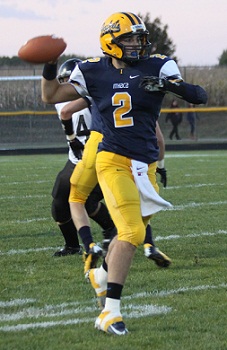
During that 2010 run, they felt like they were along for the ride. Last season’s championship was about seniors like Garrett Miniard and David Brown showing they could win one too after following all-state quarterback Alex Niznak’s lead the year before. Now, these seniors similarly want to be the leaders of another title run.
But Hessbrook is sure to credit one more group – the 2009 team that played in the team's first MHSAA Semifinal.
“In 2009, that group of players raised the bar, and they made it possible, although they didn’t win,” Hessbrook said. “They didn’t get to the big game. But in 2009, for one quarter (in the Semifinal), we played with Montague (which went on to finish 14-0).
“The bar has been raised. I don’t know that the goal now is to (just) get into the playoffs. I think the kids are hungry enough that they don’t want to just get in. They want to get in and make noise.”
The name statewide observers are coming to know is that of junior quarterback Travis Smith. He took over in the 2011 opener and quarterbacked the team through the 42-14 championship game win over Constantine, throwing for 299 yards – fifth-best all-time for an MHSAA championship game.
His numbers this fall say plenty – 107 completions in 175 attempts for 1,696 yards and 30 touchdowns, with only four interceptions. Smith also leads the team with 610 rushing yards and 12 touchdowns on the ground. He’s 6-foot-2 and 200 pounds and already getting the college looks that came to Niznak during his senior season after he’d already committed to Central Michigan.
Total, the team is outscoring opponents on average 53-6. The defense is a little smaller but faster this fall, and is averaging exactly three turnovers per game.
Another stat helps it all make more sense. Teams submit the grade-point average for their top 11 players for academic all-state – and Ithaca’s group comes in at 3.85.
And visitors to Ithaca don’t get the feel they’re in a small town once they enter the stadium. Recent renovations included the addition of viewing platforms 15 feet above the track that put fans closer to the field than the first row of bleachers. There are new bathrooms and a larger concessions area, but the biggest blast comes from the 13 by 24-foot Jumbotron scoreboard that’s made the stadium feel more like the home of a Division II college team.
Hessbrook estimates at least 2,000 fans are showing up for home games, and similarly large crowds have followed his team on the road.
To Ithaca’s credit, the team is taking all of this in stride. It’s not that the streak isn’t a big deal – “It is what it is,” Hessbrook said – but the players just don’t talk about it too much.
“They’re really a mature group of seniors, really grounded, from great families with great parents who are very supportive of what we’re doing and just keep their kids grounded. The coaching staff does a good job keeping the kids grounded," Hessbrook said. "You’re only as good as your last game. Nobody’s going to care what you did last week or last month. And I think the players believe that.”
PHOTOS: (Top) Ithaca's Caden Kipp and Zach Allen (12) celebrate after a touchdown during last week's win over Grandville Calvin Christian. (Middle) Quarterback Travis Smith already is in the MHSAA record book for his performance during last season's Division 6 Final. (Click to see more from HighSchoolSportsScene.com).