

Rice Sends Out 'Coach' on Winning Note
November 29, 2013
By Bill Khan
Special to Second Half
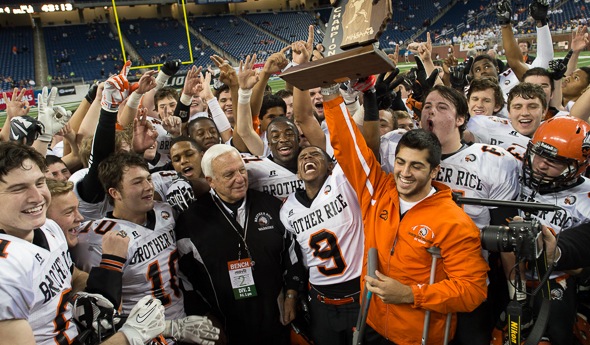
DETROIT — What do you get the football coach who has everything?
How about a perfect 14-0 season?
Better yet, how about a third straight MHSAA championship as a nice going-away present?
Al Fracassa had accomplished just about everything during his legendary 45-year career at Birmingham Brother Rice, but his final three teams embraced the school's tradition and elevated it to an even higher level.
Brother Rice won its ninth MHSAA title — all under Fracassa — with a 38-21 victory in a rematch against Muskegon in the Division 2 championship game on Friday at Ford Field.
Before this current run, Brother Rice hadn't won back-to-back MHSAA championships. The school record for victories was set by the 2000 team, which went 13-1. The school's last undefeated team was in 1983. The Warriors' 23-game winning streak is one short of the school record set from 1976-78.
"I wish I was young enough to coach some more," said Fracassa, 81. "When you love something so much, it's very difficult to leave. I'm going to still love football; it's done a lot for me."
Fracassa finished his career with a 430-117-7 record, ranking first in Michigan history and sixth nationally in victories. That included eight seasons at Royal Oak Shrine before he was hired as Rice's head coach in 1969.
"I'm glad I made it," Fracassa said. "Now I can rest easy. I'll probably be very sad for awhile, and hopefully I'll be strong enough mentally to handle this."
 Friday's game was such a special occasion that even his wife, Phyllis, was in the stands.
"My wife never comes to games," Fracassa said. "She used to come, but she'd be so nervous that she'd beat everybody up next to her. Today, she came with my daughter, who flew in from Omaha. It was nice for her to see us play and have a great victory. I can't wait to see her."
Whoever takes over at Brother Rice has an excellent chance of extending the Warriors' championship and winning streaks.
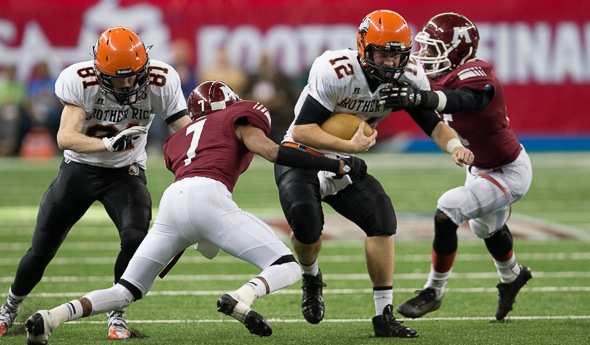
Brother Rice will return junior quarterback Alex Malzone, who has been outstanding in two MHSAA Finals appearances. Malzone completed his first nine passes against Muskegon, finishing 20 for 24 for 263 yards and four touchdowns. In two title games, he is 28 for 34 for 430 yards, six touchdowns and no interceptions. Malzone was in a rotation last year with Cheyne Lacanaria.
Malzone also ran 17 yards as the holder on a fake field goal attempt with 4:33 left in the game.
"For him to go out with what we've done is an overall great feeling," Malzone said. "It's going to be different without him on the field every practice. He's the best coach I've ever had. I'm going to miss him a lot."
Corey Lacanaria caught 10 passes for 125 yards and a touchdown, while Grant Perry had five catches for 91 yards and two touchdowns.
The teams picked up where they left off in their wild finish in 2012, when a 91-yard kickoff return by Jason Alessi off a lateral gave Brother Rice a 35-28 victory.
Last year, they combined for 42 points during the final 13 minutes and 58 seconds after staging a defensive battle most of the way. On Friday, they scored on the first four possessions of the game, creating a 14-14 deadlock with 1:09 left in the first quarter. Going back to last year, that added up to 70 combined points in only 24:49 of playing time.
Malzone started out 9 for 9 for 125 yards and two touchdowns, hitting Damaris Woods with a 16-yard touchdown pass on the first series of the game and Perry on a one-handed 34-yard grab with 4:24 left in the first quarter.
Muskegon responded to each of those scores with touchdown runs by quarterback Deshaun Thrower, whose 6-yard run capped the Big Reds' first drive and whose 16-yarder tied the game at 14-14 on the next possession.
Perry's second touchdown catch, an 18-yard play with 1:07 left in the first half, gave Brother Rice a 21-14 halftime lead.
The key to the game was that Brother Rice shut down Muskegon's ground game after halftime. Thrower ran 12 times for 117 yards and two touchdowns in the first half, leading a rushing attack that piled up 216 yards on 21 carries. In the second half, Thrower was held to minus-18 yards on 10 carries. As a team, the Big Reds had minus-9 yards on 13 carries in the second half.
Muskegon didn't have the ball beyond its 36-yard line in the second half until 3:30 left in the game when Thrower hit Justin Foster with an 86-yard touchdown pass. But by then Brother Rice had extended its lead to 38-14 on a 21-yard touchdown pass from Malzone to Lacanaria and Malzone's 17-yard touchdown run on the fake field goal.
"They changed defenses in the second half," Thrower said. "A couple of missed opportunities set us back. We couldn't get in a rhythm again."
Muskegon has five MHSAA titles, but has been denied a sixth by Brother Rice two years in a row. The Big Reds last won the championship in 2008.
"I'm going to go back and evaluate what we're doing wrong in the championship game," Muskegon coach Shane Fairfield said. "It's my responsibility and my duty to put these kids in the right position and give them a better chance to win a state championship. It must be something I'm doing. These kids played a heck of a game. They fought through a lot. They're tough as nails. They played 28 games for our fans the last two years. There's going to be a winner and a loser. Unfortunately, the last two years we fell on the other end of it."
While Fairfield works on bringing a title back to the state's all-time winningest program, Fracassa will be a spectator while Brother Rice goes for a fourth consecutive MHSAA title in 2014.
"It's hit me the whole season when I'd go home every night," Fracassa said. "I couldn't believe it's going to be my last year. I try not to think about it. Football kept me busy, but it's here. It's time for someone else to take over. I'd like to mention my coaching staff. ... They did an outstanding job coaching my boys. I hate to take all the credit. They coached and did most of the coaching. I did most of the yelling."
PHOTOS: (Top) Brother Rice coach Al Fracassa celebrates one more MHSAA championship with his team Friday. (Middle) Warriors quarterback Alex Malzone tries to break away from Muskegon's Terry Copeland (5) and Jordan Waire (7). (Click to see more from Terry McNamara Photography.)
A Game for Every Fan: Week 2
September 5, 2014
By Geoff Kimmerly
Second Half editor
Week 2 of the MHSAA football season generally means the start of league play for schools across Michigan.
Five leagues were formed and nine reshuffled significantly for 2014 – so we’ll do our best to guide you through some of the new names and title chases as they unfold over the next two months.
Also new for this week’s look at the best games from every corner of the state – by request from one of our readers – a look at top 8-player games to be played (previously those were included in regional outlooks with the 11-player matchups.)
See below for the places to be this Friday and Saturday. All games are Friday unless noted.
West Michigan
Zeeland West (1-0) at Zeeland East (0-1)
These rivals – literally neighbors on the same piece of property – continued an intriguing trend in 2013 when for the second straight season Zeeland East won the regular-season matchup and West then eliminated the Chix in the playoffs with a victory of 30-plus points. West went on last season to win the MHSAA Division 3 championship.
Others that caught my eye: Caledonia (1-0) at Grand Rapids South Christian (0-1), Fruitport (0-1) at Muskegon Mona Shores (1-0), Montague (0-1) at Muskegon Oakridge (0-1), Grand Rapids Christian (1-0) at Muskegon (1-0).
Mid-Michigan
Eaton Rapids (1-0) at Mason (0-1)
Eaton Rapids burst onto the scene in 2013, ending a streak of 19 losing seasons by making the playoffs for the first time and then winning a District championship as well. The positive vibes continued with a 34-14 win over Jackson Northwest last week, while Mason – an annual Lansing-area power with five playoff appearances in the last six seasons – fell to rival Okemos by two scores. The Bulldogs have won 20 straight over the Greyhounds, but this should be the best tilt between the two in some time.
Others that caught my eye: Holland West Ottawa (0-1) at Grand Ledge (1-0), Clare (0-1) at Beal City (1-0), Rockford (1-0) at Holt (0-1), Grandville (1-0) at Okemos (1-0).
Southwest and Border
Schoolcraft (1-0) at Constantine (1-0)
This is another pair with a history of multiple meetings in the same season. They are clear favorites in the Kalamazoo Valley Association again this fall – and also have faced each other in the playoffs four of the last eight seasons. Schoolcraft has won the last two regular-season meetings, including 37-28 in 2013. But Constantine has won all five times they’ve met in the postseason.
Others that caught my eye: Decatur (1-0) at Fennville (1-0), Gobles (1-0) at Hartford (1-0), Battle Creek Lakeview (0-1) at Portage Central (1-0), St. Joseph (1-0) at Richland Gull Lake (1-0).
Upper Peninsula
Traverse City Central (1-0) at Escanaba (1-0)
These two faced off the last two seasons, and it wasn’t really close – Central won by 44 and 21 points, respectively. Another victory would put the Trojans in nice position heading into Big North Conference play after missing the playoffs a year ago. But Escanaba also won last week and would love to take another step toward a first winning season since 2011, especially with 2013 playoff teams Cheboygan, Detroit Country Day and Sault Ste. Marie still coming up on the nonleague schedule.
Others that caught my eye: Negaunee (1-0) at Calumet (1-0), DeWitt (1-0) at Kingsford (1-0), Munising (0-1) at Powers North Central (1-0), Alpena (0-1) at Sault Ste. Marie (0-1).
Greater Detroit
Macomb Dakota (0-1) at Clinton Township Chippewa Valley (1-0)
These Macomb Area Conference Red rivals are front-loaded this fall with high-profile games – Dakota opened with a three-point loss to reigning MHSAA Division 1 champion Clarkston, while Chippewa Valley survived a three-point victory over perennial power Lake Orion. And the Big Reds definitely have been waiting for this one, having lost the league title by falling to Dakota 52-7 in Week 8 last season, and then seeing their season end against Dakota 34-14 in the District Final.
Others that caught my eye: Detroit U-D Jesuit (1-0) at Detroit Country Day (0-1), Rochester Hills Stoney Creek (1-0) at Oxford (1-0), Utica Eisenhower (0-1) at Sterling Heights Stevenson (1-0), Detroit Douglass (0-1) at Detroit Mumford (0-1).
Lower Up North
Grayling (1-0) at Gaylord (1-0)
These two, located a mere 27 miles apart on I-75, were regular opponents for decades – but this is their first matchup since 1996. Back then, Grayling was in the midst of a decade-long string of losing seasons; now they’ve had 11 straight above-.500 finishes. Gaylord had a nice run of success soon after these two suspended their series – but more recently won a combined four games over the last five seasons. The Blue Devils equaled last fall’s victory total last week by beating Cheboygan 40-0.
Others that caught my eye: Pickford (1-0) at Indian River Inland Lakes (1-0), Hudsonville (1-0) at Traverse City West (1-0), Oscoda (1-0) at Whittemore-Prescott (1-0), McBain (0-1) at Traverse City St. Francis (0-1) on Saturday.
Bay and Thumb
Marine City (1-0) at St. Clair (1-0)
These two decided the MAC Gold title in Week 8 last season – St. Clair winning 43-33 – but they face off in the league opener this time. St. Clair renewed a series with Croswell-Lexington last week for the first time since 1993 and won 26-21, while the reigning MHSAA Division 4 champ Mariners continued their high-scoring ways beating Algonac 49-28.
Others that caught my eye: Yale (1-0) at Richmond (1-0), Harbor Beach (1-0) at Vassar (1-0), Lansing Catholic (1-0) at Saginaw Nouvel (0-1), Ovid-Elsie (0-1) at Freeland (1-0).
8-Player
Carsonville-Port Sanilac (0-1) vs. Lawrence (1-0), Saturday at Webberville
The inaugural MHSAA champion in 2012, Carsonville-Port Sanilac was an early standard-setter for the 8-player game – and Lawrence, a semifinalist last season, has helped raise the level of play since joining the scene a year ago. CPS is coming off an opening loss to Morrice, a program new to 8-player this fall.
Others that caught my eye: Dryden (1-0) at Caseville (1-0), Burr Oak (1-0) at Waldron (1-0).
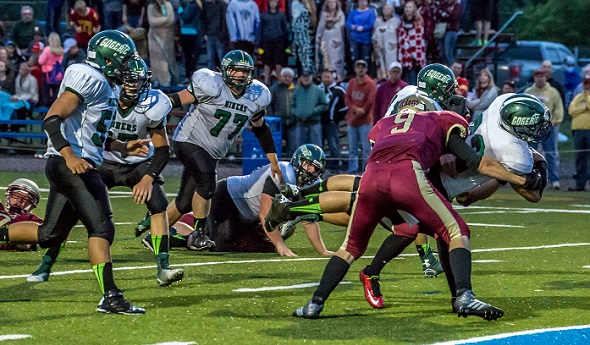
PHOTO: Bessemer’s Gogebic Miners opened this season with a 36-14 win over Hancock. (Photo courtesy of Norman Tesch/Wakefield.)