

Rice Sends Out 'Coach' on Winning Note
November 29, 2013
By Bill Khan
Special to Second Half
DETROIT — What do you get the football coach who has everything?
How about a perfect 14-0 season?
Better yet, how about a third straight MHSAA championship as a nice going-away present?
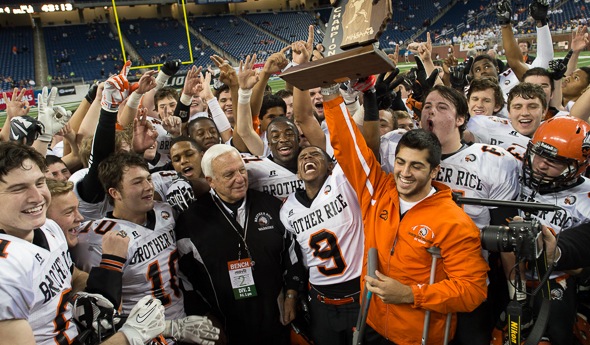
Al Fracassa had accomplished just about everything during his legendary 45-year career at Birmingham Brother Rice, but his final three teams embraced the school's tradition and elevated it to an even higher level.
Brother Rice won its ninth MHSAA title — all under Fracassa — with a 38-21 victory in a rematch against Muskegon in the Division 2 championship game on Friday at Ford Field.
Before this current run, Brother Rice hadn't won back-to-back MHSAA championships. The school record for victories was set by the 2000 team, which went 13-1. The school's last undefeated team was in 1983. The Warriors' 23-game winning streak is one short of the school record set from 1976-78.
"I wish I was young enough to coach some more," said Fracassa, 81. "When you love something so much, it's very difficult to leave. I'm going to still love football; it's done a lot for me."
Fracassa finished his career with a 430-117-7 record, ranking first in Michigan history and sixth nationally in victories. That included eight seasons at Royal Oak Shrine before he was hired as Rice's head coach in 1969.
"I'm glad I made it," Fracassa said. "Now I can rest easy. I'll probably be very sad for awhile, and hopefully I'll be strong enough mentally to handle this."
 Friday's game was such a special occasion that even his wife, Phyllis, was in the stands.
"My wife never comes to games," Fracassa said. "She used to come, but she'd be so nervous that she'd beat everybody up next to her. Today, she came with my daughter, who flew in from Omaha. It was nice for her to see us play and have a great victory. I can't wait to see her."
Whoever takes over at Brother Rice has an excellent chance of extending the Warriors' championship and winning streaks.
Brother Rice will return junior quarterback Alex Malzone, who has been outstanding in two MHSAA Finals appearances. Malzone completed his first nine passes against Muskegon, finishing 20 for 24 for 263 yards and four touchdowns. In two title games, he is 28 for 34 for 430 yards, six touchdowns and no interceptions. Malzone was in a rotation last year with Cheyne Lacanaria.
Malzone also ran 17 yards as the holder on a fake field goal attempt with 4:33 left in the game.
"For him to go out with what we've done is an overall great feeling," Malzone said. "It's going to be different without him on the field every practice. He's the best coach I've ever had. I'm going to miss him a lot."
Corey Lacanaria caught 10 passes for 125 yards and a touchdown, while Grant Perry had five catches for 91 yards and two touchdowns.
The teams picked up where they left off in their wild finish in 2012, when a 91-yard kickoff return by Jason Alessi off a lateral gave Brother Rice a 35-28 victory.
Last year, they combined for 42 points during the final 13 minutes and 58 seconds after staging a defensive battle most of the way. On Friday, they scored on the first four possessions of the game, creating a 14-14 deadlock with 1:09 left in the first quarter. Going back to last year, that added up to 70 combined points in only 24:49 of playing time.
Malzone started out 9 for 9 for 125 yards and two touchdowns, hitting Damaris Woods with a 16-yard touchdown pass on the first series of the game and Perry on a one-handed 34-yard grab with 4:24 left in the first quarter.
Muskegon responded to each of those scores with touchdown runs by quarterback Deshaun Thrower, whose 6-yard run capped the Big Reds' first drive and whose 16-yarder tied the game at 14-14 on the next possession.
Perry's second touchdown catch, an 18-yard play with 1:07 left in the first half, gave Brother Rice a 21-14 halftime lead.
The key to the game was that Brother Rice shut down Muskegon's ground game after halftime. Thrower ran 12 times for 117 yards and two touchdowns in the first half, leading a rushing attack that piled up 216 yards on 21 carries. In the second half, Thrower was held to minus-18 yards on 10 carries. As a team, the Big Reds had minus-9 yards on 13 carries in the second half.
Muskegon didn't have the ball beyond its 36-yard line in the second half until 3:30 left in the game when Thrower hit Justin Foster with an 86-yard touchdown pass. But by then Brother Rice had extended its lead to 38-14 on a 21-yard touchdown pass from Malzone to Lacanaria and Malzone's 17-yard touchdown run on the fake field goal.
"They changed defenses in the second half," Thrower said. "A couple of missed opportunities set us back. We couldn't get in a rhythm again."
Muskegon has five MHSAA titles, but has been denied a sixth by Brother Rice two years in a row. The Big Reds last won the championship in 2008.
"I'm going to go back and evaluate what we're doing wrong in the championship game," Muskegon coach Shane Fairfield said. "It's my responsibility and my duty to put these kids in the right position and give them a better chance to win a state championship. It must be something I'm doing. These kids played a heck of a game. They fought through a lot. They're tough as nails. They played 28 games for our fans the last two years. There's going to be a winner and a loser. Unfortunately, the last two years we fell on the other end of it."
While Fairfield works on bringing a title back to the state's all-time winningest program, Fracassa will be a spectator while Brother Rice goes for a fourth consecutive MHSAA title in 2014.
"It's hit me the whole season when I'd go home every night," Fracassa said. "I couldn't believe it's going to be my last year. I try not to think about it. Football kept me busy, but it's here. It's time for someone else to take over. I'd like to mention my coaching staff. ... They did an outstanding job coaching my boys. I hate to take all the credit. They coached and did most of the coaching. I did most of the yelling."
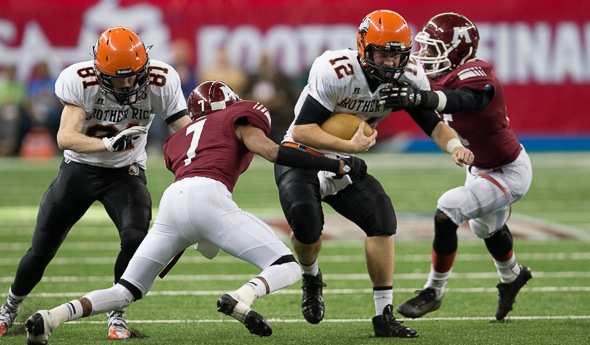
PHOTOS: (Top) Brother Rice coach Al Fracassa celebrates one more MHSAA championship with his team Friday. (Middle) Warriors quarterback Alex Malzone tries to break away from Muskegon's Terry Copeland (5) and Jordan Waire (7). (Click to see more from Terry McNamara Photography.)
Behind Scenes, St Mary's Goes to Goddard
September 27, 2016
By Keith Dunlap
Special for Second Half
As a coach and athletic director at Orchard Lake St. Mary’s over nearly three decades, George Porritt has been asked plenty of times to recall details from his football program’s storied past.
 That comes with coaching a program that annually has a roster full of highly-touted high school players coveted by college recruiters and has seen the best not only shine for prominent college programs but also NFL organizations (see Allen Robinson of Jacksonville).
“When was the last time a player did that?”
“What is the school record in this category?”
“How often has your team done this in a season?”
“When was the last time you lost to this opponent?”
Porritt’s answer is usually quick and consistent.
“Ask Robin Goddard,” Porritt typically says.
For the past 40 years, turning to Goddard has been a frequent option for anyone around St. Mary’s, and for that matter, other schools around the state.
It is why there will be lots of people in the prep sports community thinking of him when he has surgery on Thursday to break up kidney stones that have been bothering him during recent weeks.
Goddard each year puts together media guides with records and teams at St. Mary’s that go all the way back to the early 1900s. (See "Michigan's Football Past: A Must Read")
He can easily point out the fact that St. Mary’s won a state basketball championship in 1933, lost in the state basketball semifinals in 1919 and won its first state baseball championship in 1913. (Note: The MHSAA was not formed until Dec. 1924; previous championship tournaments were hosted by various entities around the state.)
“If he doesn’t have it in something, he finds it right away,” Porritt said. “He goes to the library and he tries to dig it up. He calls the other school and has done it for years. He keeps a great history of our school.”
Surely though, there have to be times when people raise their eyebrows at Goddard and wonder how he can possibly get accurate information from a century ago, right?
Actually, not really.
Not around St. Mary’s, anyway, even if it is hard to fathom for many others that high school sports in Michigan actually did exist before the start of World War I.
“I won’t even challenge him,” Porritt said. “I know he found it somewhere. He’ll tell other schools what their records are historically, and they don’t even know what theirs is. He has fun doing it and will go anywhere and find any way to find out the history of whatever he is looking into.”
Goddard’s importance to the school isn’t limited to being arguably the Encyclopedia Britannica of prep sports in the state of Michigan.
Also a facilities coordinator and valuable fundraiser, Goddard has spearheaded projects to put a track and lights at the football field, and was the architect of one of the most ambitious and out-of-box ideas ever seen at the school – the red artificial playing surface now on the football field.
 During Labor Day weekend in 2011, Goddard flew to Cheney, Wash., to meet with officials at Eastern Washington University, which at the time had the only red-colored artificial football field in the country.
Goddard picked the brains of the folks at Eastern Washington, came home and started a fundraising effort to try and secure $600,000 to bring a red-colored artificial surface to St. Mary’s.
By the following spring, the funds were raised and construction began on the field that was ready by the start of the 2012 season.
At the time, it was the third red-colored field in the country in addition to Eastern Washington and a high school field at Canyon High School in Texas.
Goddard also helped start the annual Polish Country Fair that takes place on the St. Mary’s campus every Memorial Day weekend, which is one of the most regularly-attended festivals in the Detroit area.
Len Karschnia, an administrator and assistant coach for the both the football and basketball teams at St. Mary’s, said when Goddard gets in touch with alums who have the means to donate back to the school, there usually is no hesitation because of their respect for Goddard.
“They always trust Robin to do that,” Karschnia said. “Everything he does (is) for the kids and the school, and that is why nobody is really reticent to give back to any projects that he runs because if he tells you on Tuesday he wants $500 to put up a banner in the gym, on Thursday the banner is up and done and there is a plaque on the wall saying thanks to whoever gave it to him.”
A staple at the school since he arrived in 1976, there obviously will be a lot of prayers and well-wishes around the state for a speedy recovery from surgery.
“He is a guy that whatever St. Mary’s needs, he’ll do it and he doesn’t need any fanfare for his good deeds,” Karschnia said. “It’s all for the kids, for George and for the school. That is really his value.”
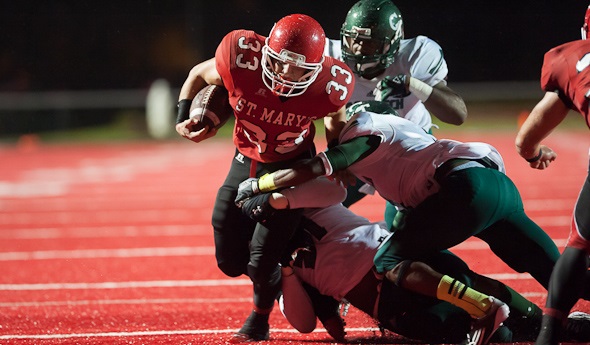
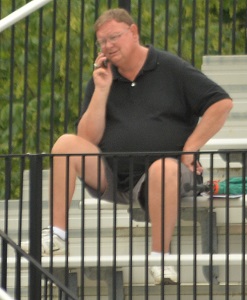
PHOTOS: (Top) Orchard Lake St. Mary's takes on Detroit Cass Tech on its home red turf in 2012. (Middle) Tucked away in the McLane Stadium bleachers, Robin Goddard watches the Eaglets' run to the 2015 Division 2 baseball championship. (Top photo by Terry McNamara.)