

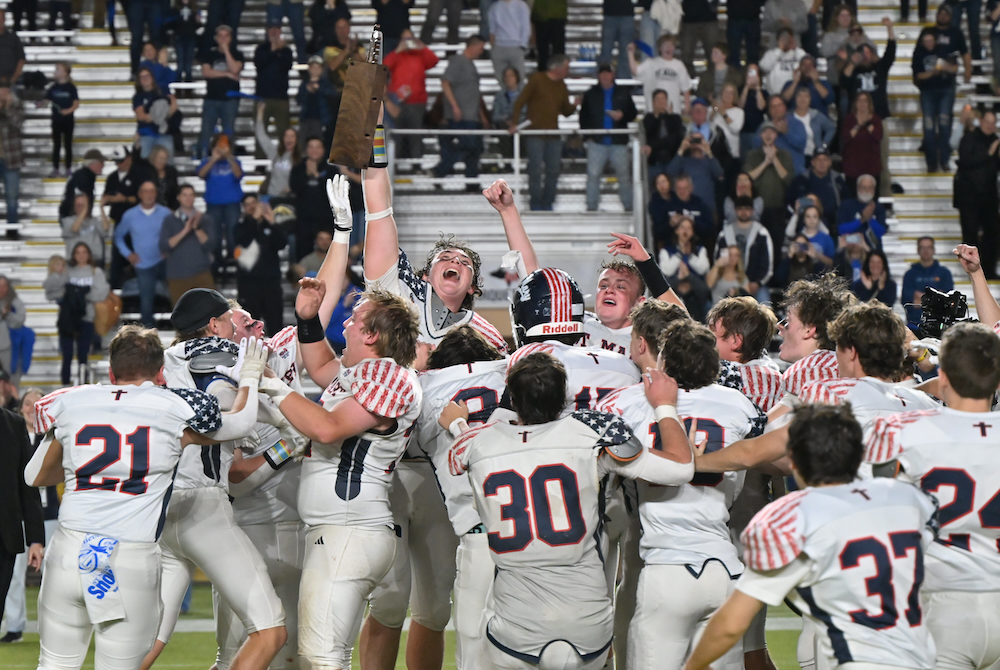
Rolling with Royce, Gaylord St. Mary Pulls Away from Mendon for First Finals Title
By
Jason Juno
Special for MHSAA.com
November 21, 2026
MARQUETTE — Gaylord St. Mary breezed through the first nine games of the season for the most part, winning all but one by at least 42 points.
Then adversity hit. The Snowbirds’ quarterback got hurt during the second game of the playoffs. And, separately, the team that no one could score on all season — St. Mary gave up just 14 points during the entire regular season — started giving up points, lots of them.
So new quarterback Cal Royce and the St. Mary offense won a couple of shootouts, first in the Semifinal over Portland St. Patrick, 39-36, and then in Saturday’s Final. Royce accounted for 451 yards of offense and seven touchdowns as St. Mary won a thrilling Division 2 championship game 49-34 over Mendon at the Superior Dome.
The state title was the football program’s first.
“We talked about it, we dreamed about it, and I was nervous as heck this morning when we even talked about it,” St. Mary coach Kevin O’Connell said. “So the fact that it’s reality, it hasn’t sunk in yet. You know, (little) Catholic school, in northern Michigan, nobody thought we could do this, so it’s pretty special.”
They were led by a pretty special athlete in Royce. He had played pretty much every skill position this year but rarely quarterback, even though he took equal reps there in practice.
O’Connell indicated there wasn’t a freak-out moment having to switch to a new quarterback when Nathan O’Connell got hurt the last time the Snowbirds were in the Upper Peninsula, in a Regional Final win over Lake Linden-Hubbell. That’s because they went to Royce, more of a running quarterback than they had been used to, but he was ready – and what an athlete he showed to be.
On Saturday, he went 8 of 12 passing for 252 yards and four TDs – including a 70-yarder to Joe Jacobson – and carried the ball 14 times for 199 yards and three more scores. Oh, and he led the team with 13 tackles (11 solo), besides making a field goal before halftime.
“He’s a gifted athlete, and if we can get the ball in that kid’s hands, it’s magic,” Coach O’Connell said. “He’s just goofy. He’s just an incredible athlete. He just, he loves competition. The beauty about him is the mindset. You either love to win or you hate to lose. He hates to lose.”
Royce made something out of nothing late in the third quarter with the biggest play of the afternoon to propel St. Mary to the win.
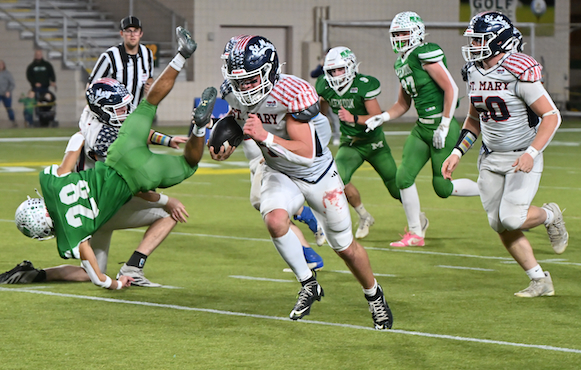
The Snowbirds had taken the lead back on their previous possession, 29-26, and went for it on 4th-and-goal from the 1. Royce tried to run right, and Mendon was there in the backfield for a big loss. But he threw it up, falling backward almost from a seated position — why not on fourth down? — and Jackson Vernier caught the ball in the end zone.
That put the Snowbirds up two scores, 35-26.
“It was something else,” Royce said. “I don’t know what I was really doing there. It was kind of just a Hail Mary, Johnny Manziel little thing right there, and it worked out.”
“He was able to contort and control back,” O’Connell noted. “It was pretty fun. … It was huge for us at that time.”
It certainly was because Mendon kept coming.
The Hornets pulled within a point, 35-34, on a four-yard touchdown run by Logan Stuart. The drive took 18 plays, went 80 yards and consumed 7:30. There were nearly five minutes left when St. Mary took over at its 49.
Four plays into the drive, though, Royce went 27 yards up the middle for a 41-34 lead with 2:52 left.
He then intercepted a Mendon pass over the middle, and once the Snowbirds took over on offense, broke free up the middle again for a 39-yard touchdown with 1:54 on the clock. His conversion pass to Cash Wcisel made it 49-34.
It was a great game throughout.
St. Mary took a 16-12 lead into halftime and made it 23-12 50 seconds into the second half when Royce hit Wcisel on a 50-yard touchdown pass.
It didn’t look great for the Hornets, but they had an answer.
First, they scored on the ensuing possession with Owen Klinger throwing a 24-yard touchdown pass to Zak Iobe. Stuart then recovered an onside kick and Mendon took advantage, scoring on a two-yard run by Xavior Zinsmaster, his third touchdown of the day. Mendon led 26-23 with 5:30 left in the third quarter.
The lead, and the good vibes that came with their rally, lasted two plays. Royce threw to Wcisel, who was open in the middle and broke a couple of tackles on his way into the end zone. The 49-yard pass play made it 29-26 just 23 seconds after Mendon took the lead.
St. Mary didn’t trail again, but it was a long road to celebrating with the championship. The Snowbirds forced a punt and then scored on Royce’s crazy 4th-and-goal toss while almost sitting on the turf.
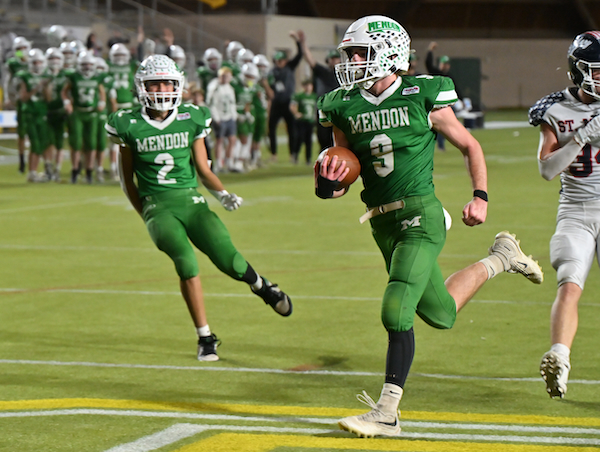
The Hornets made it a one-point game, only to have St. Mary score the next two touchdowns and get the win in one wild ballgame.
“I thought it was a hell of a game,” Mendon coach Robert Kretschman said. “I mean people got their $12 worth, there’s no doubt about that.”
The Hornets certainly had chances to win it. Kretschman said it all started with St. Mary’s quarterback.
“We had opportunities, he’s a tough runner, we had him bottled up and then the next thing you know, he’d slip out of a tackle,” he said. “We played our style of football and how we wanted to play it, the first half, and controlled the clock and the time of possession. And we just couldn’t get out of our way and we gave up some big plays. But part of that, that’s going to happen when we’re playing a good team like them. They were the better team today. They didn’t make mistakes.”
A number of St. Mary players were overcome with emotion after the game.
“It means everything,” Royce said. “We put everything into it, all year, all offseason, and this is what we get for it. It’s a reward like no other.”
O’Connell needed a second to answer what emotions he was feeling.
“I love what I do, where I’m at and who I get to coach,” he said. “It is a special day for these kids that show up every day and work their tails off. It really is. It’s a labor of love, I love these guys, I really do. We’re with them four to six days a week, year round, it’s a genuine love.”
The Snowbirds finished with a perfect 13-0 record while Mendon finished 12-1. Kretschman said he’s certainly proud of his players and what they accomplished this season. They lost the leading career scorer in 8-player history to graduation in the spring.
“Starting the year, I don’t think anybody put money on Mendon ending up in the state final, and we proved a lot of people wrong and did a lot of good things,” he said.
Football’s a big deal in Mendon. The Hornets have made at least the Semifinals three of the past five years, and were going for their 12th Finals title, but their third runner-up finish was well-earned, too.
“My kids just worked hard,” Kretschman said. “You can take a community of kids in a rural area like Mendon, and these kids just worked the way they worked. That’s pretty awesome that we’re still relevant, we’re proud of that. … These kids have been together a long time, and our senior leadership is really good. Just fell a little short today.”
PHOTOS (Top) Gaylord St. Mary players raise their trophy in celebration Saturday at the Superior Dome. (Middle) The Snowbirds’ Cal Royce (4) breaks away on a touchdown run. (Below) Mendon’s Zak Iobe (9) cross the goal line while the Hornets’ bench celebrates. (Photos by Cara Kamps – Click for more.)
Hackley Stadium Celebrating Century as Monument to Community Dedication, Football Glory
By
Ron Pesch
MHSAA historian
September 4, 2026
Mounted on the brick wall of Hackley Stadium, facing Sanford Street in Muskegon, is a bronze plaque. In raised type, it details a successful “GoFundMe” effort – 1920s style.
The approach was a bit different then, but the fundraising efforts were successful and created an iconic landmark that still stands – now ready to celebrate its 100th year.
Seated, rectangularly, in the middle of a residential neighborhood, directly behind the high school, the site itself has served as home to Muskegon High School’s football team for 120 years. The sport dates to 1895 at MHS.
The wooded lot was gifted in 1902 by Muskegon’s greatest benefactor – lumber baron Charles H. Hackley – to the Board of Education. Hackley desired the space to be developed into an athletic field and playground for use by the school and area youth.
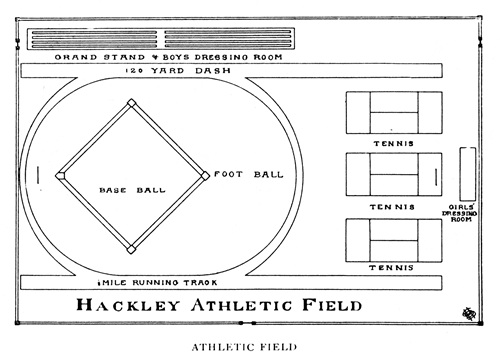 Quickly dubbed Hackley Field, it took four years before administration cleared trees from the lot. Initial plans for the parcel, laid out by a former coach and director of athletics, envisioned a site that would accommodate multiple sports, including a gridiron at the center of the property, surrounded by a track, with tennis courts placed at the site’s four corners.
Bob Zuppke – hired in August 1906 as the school’s newest coach and director – learned that the school board was ready to act on the design. He immediately spotted the planned layout showed a football field of just 50 yards. Recognizing the site could accommodate a full-sized gridiron, his redesign reduced the number of tennis courts to three and pushed them to one end of the site. He expanded the gridiron to regulation size and surrounded it with a 1/5-mile cinder track. His plan included space for a baseball diamond within the gridiron. An extensive wooden grandstand along the northeast side of the site would stretch the length of the football field to handle growing crowds at sporting events.
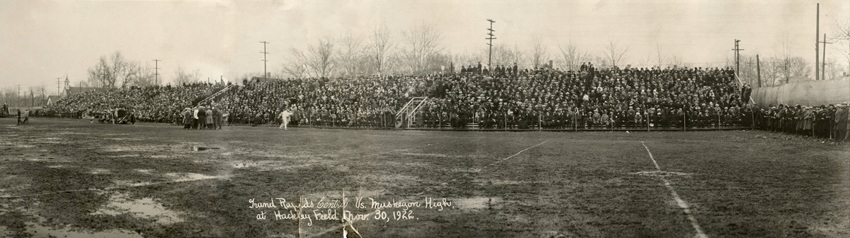
Zuppke’s modifications were promptly accepted, and Hackley Field was ready in mid-May 1907 for an initial track meet with Muskegon’s biggest rival, Grand Rapids Central. That fall, Muskegon played seven consecutive football home games at the new location. Recognizing the financial value of the annual clash with Central, that contest was moved to the last game of the year and staged on Thanksgiving Day. Crowds soared in size.
Dropping just a single game each season during his four years in town, Zuppke built Muskegon into a football powerhouse before moving on to even greater gridiron success over three years at Oak Park High School in Illinois. In 1913, he was named head football coach at the University of Illinois, earning national titles in 1914, 1919, 1923 – with a team that featured three-time All-American Harold ‘Red’ Grange – and 1927. Zuppke retired following the 1941 season. During his 35-year prep and college career, he introduced numerous innovations that remain hallmarks of the game today.
Plans for a Cement Stadium
From a comfortable chair, stationed in his room at a retirement home in Kalamazoo, 85-year-old C. Leo Redmond, former coach at Muskegon, recalled the story behind the construction of Muskegon High School’s historic Hackley Stadium. The concrete structure, built in 1927, replaced greatly expanded wooden stands (tennis courts were never added) originally placed on the site by Zuppke’s design.
Born in 1900 in Kalamazoo, Redmond arrived at MHS in 1925. A recent graduate of Western State Normal School – today’s Western Michigan University – he wasn’t Muskegon’s first choice to replace his predecessor, the highly-successful J. Francis Jacks.
A 1912 graduate of Muskegon, Jacks had turned the team’s football games into a huge draw between 1920 and 1924. During the span, his teams earned three mythical state titles over five years and produced an array of talented athletes, including University of Michigan great Bennie Oosterbaan.
But in the spring of 1925, Jacks passed away unexpectedly. Gus Cohrs, another Muskegon alum, was experiencing success in basketball and football at Grand Haven High School. He’d accepted the Muskegon job to succeed Jacks, but an outcry by Grand Haven fans and an immediate pay raise kept him from moving.
Fortunately for all, Redmond’s teams went 7-1-2 in 1925, then repeated as Michigan’s mythical champion in 1926. Immediately after the completion of that season, however, the school faced its next challenge.
“We walked out to the bleachers at the football field and Joe Bicknell (the Hackley Manual Training School director and facility manager for athletics) pulled out his pocketknife,” said Redmond. “He then pushed the blade completely into one of the wooden beams supporting the bleachers and said, ‘They will fall down if they have to support another season.’ So, we started a fund drive for Hackley Field’s reconstruction by selling stadium bonds.”
Muskegon contacted The Osborn Engineering Company of Cleveland, Ohio, to discuss the task. Peter P. Evans, vice president of the firm, visited Muskegon to inspect possible sites. “Mr. Evans’ company planned and built Navin Field, Detroit, the Polo Grounds, New York, and is now building the new stadium for the University of Michigan at Ann Arbor,” noted the Muskegon Chronicle.
Visiting in December, Evans advised “it would be best if it could replace the present seating arrangements at Hackley Field,” noting “it would not be architecturally objectionable to anyone in the neighborhood nor spoil the landscape effects of the campus.”
Building a stadium made with cement had been pondered by Bicknell and administration as early as 1913, but cost – then estimated at $25,000 – was viewed as insurmountable.
 It took until April 1927 for final approval of a plan, and Osborn Engineering was authorized to prepare specifications. Time was of the essence, as the existing bleachers were now condemned and needed to be removed and replaced by fall.
The design would include “two team rooms” and restrooms under the stands, with the project financed by sale of bonds. A total of 1,500 were issued, priced at $50, earning 4 percent interest. The structure would feature seating for 6,000, with a block of 1,100 seats located between the 35-yard lines reserved for bondholders. The $75,000 campaign launched the first week of May.
The district tapped into a young sales force to help execute the plan – the student body. The classes of '27, '28, '29 and '30 – over 2,000 strong – were asked to distribute pamphlets and sell bonds to the public.
Years later, Gont Miller remembered walking home with Bub Meier – both would serve as future captains of Big Reds football teams.
"Principal John Craig talked to us Thursday night after practice,” recalled Miller. “He said, 'We're going to ask you to get out and sell some bonds.'
The pair talked about their frustration at being assigned the unwanted task.
“Together, we decided we weren't going to do it. After I got home, I told my mother about the bonds.”
She reframed it for her son, highlighting the community that surrounded them.
"Boy, that will be easy,” she said. “After dinner, go on over and see Mr. Runzel across the street, and the Nelsons on the side of us. I'm sure they will be interested.
"Well, I guess she got me inspired. I went over and saw Mr. Runzel, and he bought four. And Lester Nelson bought three, and Otto Meeske bought six. Mr. Runzel said, 'Go down and see my son,' and I did, and he bought two. People really supported Big Red football. We sold all the bonds, and they built the stadium. It was quite an experience for a kid."
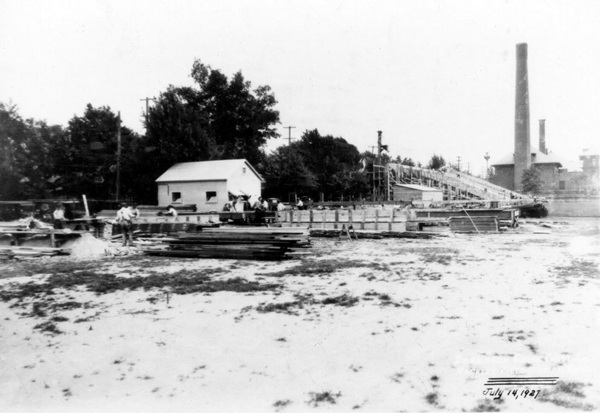
Construction contracts were awarded by June 1, and actual work on the site started on Wednesday, June 15. According to the files of Osborn Engineering, the concrete and brick structure itself was completed over just 24 days – July 20 to August 12. Final plumbing and electrical preparations were completed in time for the first game against Muskegon Heights on Saturday, September 17.
Dedication and the Birth of a Rivalry
"Impressive and colorful flag-raising ceremonies marked the dedication of the new stands," wrote Jimmy Henderson in the Muskegon Chronicle. "A massed assemblage of over 2,000 students who paraded on the field following the Heights and Muskegon high school bands, and close to 3,000 spectators in the stands stood at attention while the massed bands under the leadership of Ronald Hinchman played the national anthem, as the new flag was slowly raised to its position over the stadium."
The Big Reds posted a crushing 89-0 victory over the Heights and their new coach, Oscar E. "Okie" Johnson – a former teammate of Redmond’s at Western – in the season opener. It was the first of nine shutouts posted by Muskegon en route to a 10-0 campaign and another mythical state title. Outscoring opponents 445-6, the team remains among the greatest in school history.
 Muskegon claimed a second-consecutive shutout over Johnson’s Tigers in 1928, this time 19-0, and finished the season with another state crown. In ’29, they again blanked the Tigers, but by just seven points. In 1930, Johnson’s squad tied Redmond’s Big Reds, 6-6, and established themselves as Muskegon’s chief rival. Come 1936, the game was moved to the season finale, replacing the matchup with Grand Rapids Central. Lights were added to Hackley in 1940, with most games shifted to Friday nights. Annual classic battles between the Big Reds and Tigers were all played at Hackley (until 1948) and still staged on Saturday afternoons (until 1953) to accommodate the massive crowds.
The 1945 season-ending contest between the schools – both undefeated – was a battle for the state title. A record crowd of 13,500 packed every square inch of the grounds. Heights opened a 7-0 lead early, but Muskegon responded with a touchdown midway through the second quarter. A missed extra point pinned the score at 7-6. It remained stuck there until an intense goal-line stand late in the fourth quarter would determine the game’s outcome. The Big Reds had advanced the ball to the Tigers’ 1 on second down. A charge at the center of the line on third down was stopped.
“The ball, three inches from the goal line when play started, still was an inch from the line when it was set down,” wrote Henderson, still covering the rivalry. “When (the defense) stopped the forward motion of (Muskegon’s quarterback), the air went dark with the applause of the Heights fans, and the groans of Muskegon’s.” The win capped the first of three consecutive state crowns won by the Tigers, and the loss was the first in 16 starts for the Big Reds, the defending state champion.
In 1946, Muskegon installed its first electronic scoreboard, retiring the one manually operated by the Boy Scouts. Redmond retired as coach following the season with a 156-29-13 record and seven state titles over 22 seasons. (His victory total remained tops in school history until recently surpassed by current head coach Shane Fairfield.) Most fittingly, the remarkable gridiron rivalry between coaches Redmond and Johnson ended dead even at 9-9-2.
Reduced revenue during the depression years forced default on bond payments. After a restructuring of obligations, a final payout distributed in 1950 to bondholders meant the stadium was now out of debt. That fall, $8,000 in repairs and waterproofing helped stabilize a structure starting to show wear and tear.
Coach Harry Potter – another Western teammate of Redmond’s, and his longtime assistant – took the reins in 1947 and guided the 1951 Big Reds to another gridiron state championship. That team featured future NFL quarterback Earl Morrall.
Over the years, Hackley Stadium has served the community with World War II events to sell war bonds, practice drill formations, events to honor local industries’ wartime outputs, and VFW Memorial Day gatherings. There have been countless halftime shows, marching band competitions, high school assemblies, and commencement exercises. It has hosted opera, concert performances, and music reviews. In 1951, evangelist Rev. Billy Graham and his music director Cliff Barrows visited. In 1957, a massive Water Follies show with a dive tank, stage, and swim tank – spanning 150 feet – filled Hackley Stadium, raising money for the local ‘Police and Fireman Benevolent Association’.
More than 10,000 fans packed the stands in the fall of 1971 to watch another pair of unbeatens as the Big Reds topped Traverse City on their way to another state championship. Members of the Lake Michigan Athletic Conference, the Trojans became firmly established as new primary rivals on Muskegon’s annual slate.
 After four uncharacteristic down years on the gridiron during the early 1980s, huge crowds returned to pack Hackley’s stands beginning in 1985, especially during Muskegon’s march to MHSAA playoff titles in 1986 and 1989.
Continued maintenance over the years ensured the stadium’s survival. In 1996, extensive renovations and rejuvenation of the concrete stadium ensured the safekeeping of the ‘Home of the Big Reds’. Concession stands were moved from beneath the seating to structures at the north and south ends of the stadium. Modern requirements meant removal of the track that once surrounded Hackley to expand the concourse that leads to seating. But proximity and sight lines to the playing surface – always a feature of Hackley for fans – were not sacrificed.
The Tunnel
Terry Foster, writing for the Detroit News, visited the stadium as part of his “Terry’s Tour” in 2006. Kicking off a series of articles where he visited high school football games across the state, Foster’s opening paragraphs focused on another unique feature of the stadium.
Postgame, the Big Red Band ends home game festivities by marching – shoulder-to-shoulder, students aligned three-or-four-or-five across, with instruments swinging up-and-down and side-to-side, beneath the stands.
“Fans lined both sides of the cramped corridor as the band paraded through the narrow human tunnel …
“‘Ok. You got to hang tight against the wall,’ Muskegon head coach Tony Annese told Foster. … You will get hit if you are not careful.’ … Like Annese, they wanted to feel the booming drums vibrate off the concrete walls as the band marched underneath the stadium. …
“The march that eventually took the musicians (down Sanford Street) to their music room has been going on for decades. So has winning football.”
A new video scoreboard was installed in 2015. Field turf replaced Hackley Field’s natural grass in 2020. Also added was a brick fence similar in placement to one that surrounded the site back in 1914 and was removed in phases between 1927 and 1946.
Muskegon continues to lead the state in all-time football victories, earning additional MHSAA titles in 2004, 2006, 2008, 2017 and 2023. Many feel that rich tradition, combined with the classic backdrop of Hackley Stadium packed with alumni and passionate football fans, has played a huge role in those wins.
For the Big Reds, Hackley has always been more than brick, concrete, and rebar.
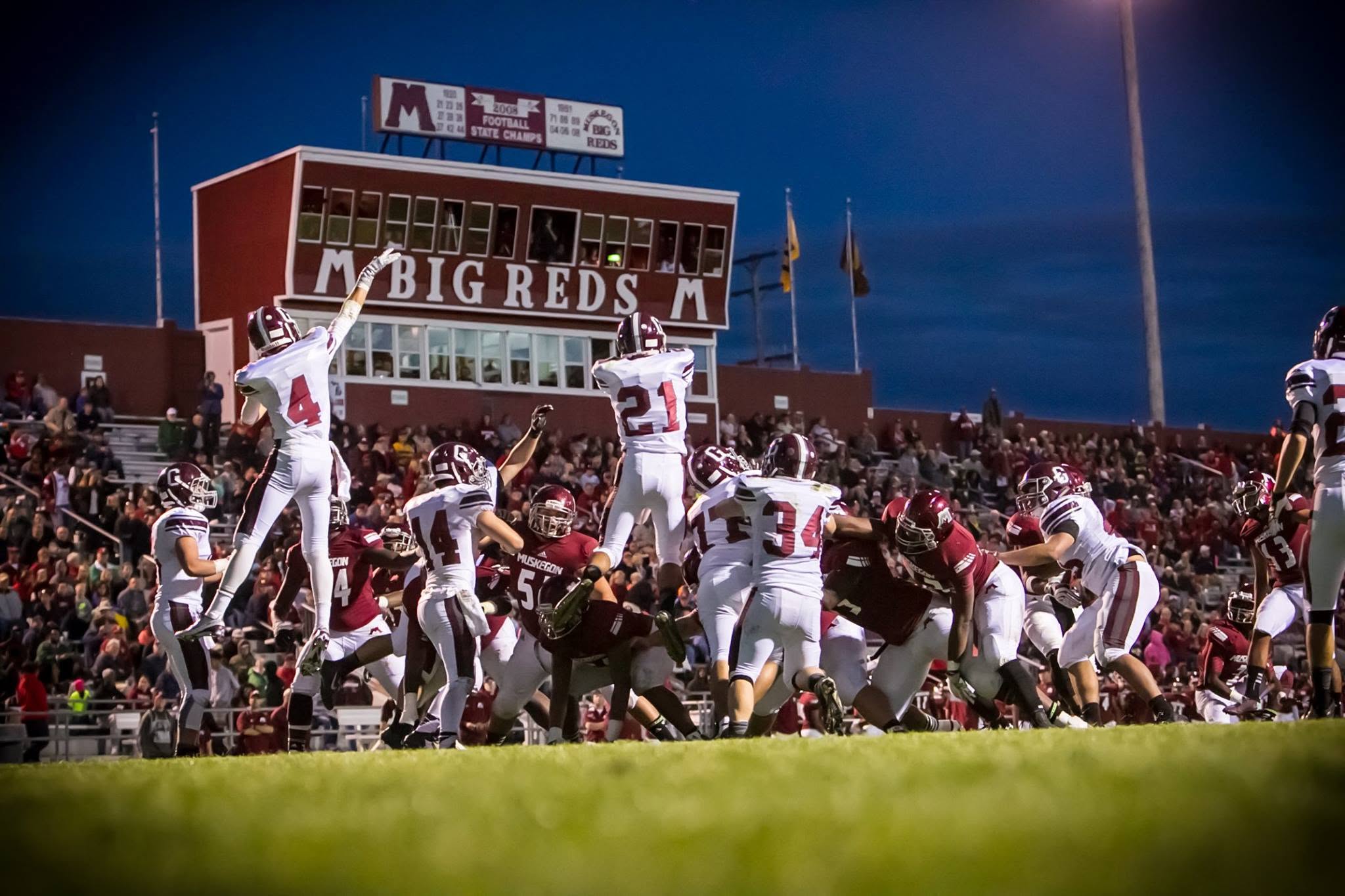
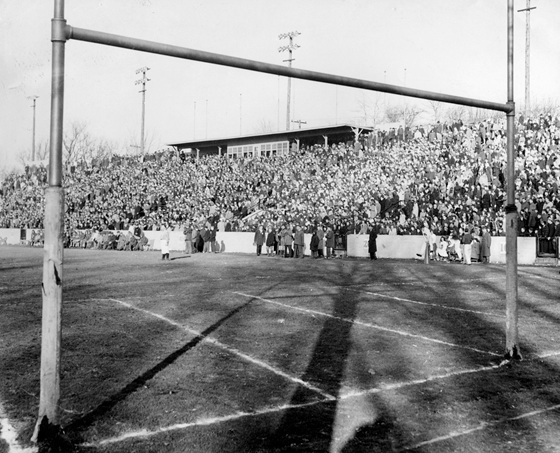
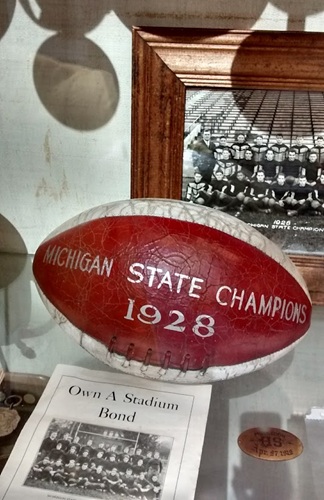
PHOTOS (Top) Muskegon takes on Grandville in 2015 at Hackley Stadium in what would end as the program’s 800th victory. (2) The proposed stadium plan from 1906 shows the football field, baseball diamond, track and tennis courts among other proposed features to the new athletic field. (3) Muskegon takes on Grand Rapids Central in 1922. (4) Osborn Engineering works on the renovated stadium during the summer of 1927. (5) The stands are filled for a game in 1942. (6) This display includes a photo of the 1928 state championship team and brochure for stadium bonds. (Top photo by Tim Reilly. Other photos collected by Ron Pesch.)