

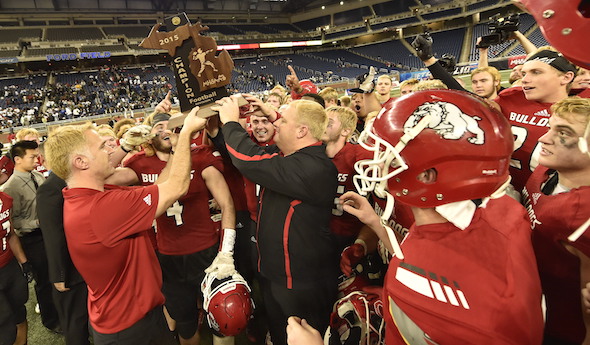
Romeo Raises 1st Champion's Trophy
November 28, 2015
By Bill Khan
Special for Second Half
DETROIT — With a championship on the line and the margin for error too thin, Paul Hurley couldn't have been faulted if he started looking elsewhere to throw the football.
 But Romeo's senior quarterback never lost faith in tight end Mitch Heimbuch, not even after the Western Michigan University recruit dropped two passes while wide open.
"Mitch probably has the best hands on the team, so it was really bizarre for us to see him drop two passes today," Hurley said. "It was never in my head when I was throwing to him. I knew if I was throwing to him, he was catching it."
Heimbuch was sure-handed when it mattered the most, catching three passes for 46 yards on the game-clinching drive, as Romeo beat Detroit Cass Tech, 41-27, in the MHSAA Division 1 championship game Saturday at Ford Field. Heimbuch even grabbed the 2-point pass following Brad Tanner's 16-yard touchdown run with 1:29 remaining in the game.
"Everyone still believed in me. Everyone was still coming up to me telling me to just get over it, forget about it," Heimbuch said. "I just knew I had to make a play if it came back to me. I forget my drops. You can't think too much on them or else they'll kill you."
Romeo scored six touchdowns, blocked a punt and recovered an onside kick to start the second half, but one of the key plays in the Bulldogs' first championship victory was a 12-yard catch by Heimbuch on second-and-13 on the second play of the final drive. That set up a manageable third-and-one and got the drive rolling. He also had catches of 12 and 22 yards on an 11-play, 75-yard march that consumed 5:45 from the clock, leaving Cass Tech little time to produce a miracle comeback similar to Detroit Martin Luther King's in the Division 2 Final on Friday.
Just when it looked like Romeo (13-1) would simply run out the clock, Tanner broke free from 16 yards out for his third touchdown of the game. He finished with a game-high 130 yards on 13 carries.
The drive began after a 36-yard touchdown pass from Aaron Jackson to Donovan People-Jones got Cass Tech within 33-27 with 7:15 remaining.
"I knew I just had to run hard on the play and good things would happen," Tanner said. "On that last drive, the whole time I knew if we just killed the clock, we'd be victorious."
Even before his three key catches on the final drive, Heimbuch made a major contribution to the victory on defense.
He blitzed Jackson and got a sack to force a fumble, which was recovered by Romeo's Austen Malczewski at the Cass Tech 40 with 10:36 left in the second quarter. Four plays later, Tanner's second touchdown run from 31 yards out gave the Bulldogs a 19-7 lead.
"We changed the call at the last second to a two-linebacker blitz," Heimbuch said. "It just opened up. The D-linemen took away their guard and center. I shot the gap. He just lost the ball; he panicked, I think."
Romeo scored on its first three possessions before Heimbuch's first drop on third-and-seven ended the fourth drive. The Bulldogs took that 19-7 lead into halftime.
Taking a page out of Sean Payton's book from the New Orleans Saints' Super Bowl victory in the 2009 season, Romeo's coaches called for an onside kick to start the second half. Kicker Zach Nies recovered his own kick at the Cass Tech 48-yard line. Six plays later, Domenico Bongiorno bulled his way 10 yards up the middle for a touchdown, extending Romeo's lead to 26-14 with 9:49 left in the third quarter.
"They have unbelievable return guys, so we were not supposed to kick it to them at all," Romeo co-coach Curt Rienas said. "We actually thought there was a 70-percent chance we would recover it. When you look at only a 15-yard difference in field position, we thought that was a good gamble on our part."
Recovering onside kicks was a priority in practice all week for Cass Tech (11-3) after it failed to cover three in its Semifinal victory over Canton.
 "That really ticked me off the most, out of anything that happened today," Cass Tech coach Thomas Wilcher said. "As far as trick plays or big plays, that one hurt the most, because we taught the kids what to do. We talked about it, met about it; they just froze. We lost three onside kicks, so that was the most important thing going into the game, just making sure we got all the short kicks."
Special teams had another huge impact when John Verellen blocked a punt and Anthony Quas returned the loose ball 18 yards to the Cass Tech 20. Hurley scrambled for a 20-yard touchdown on the next play, putting Romeo ahead 33-14 with 7:00 left in the third quarter.
One day after Detroit Public School League rival King rallied from 18 points down to win the Division 2 title, Cass Tech provided the host city some hope for another miracle comeback.
Jackson threw a 17-yard touchdown pass to Demetric Vance with 2:14 left in the third quarter, following a Khalid Jordan interception, and a 36-yarder to People-Jones with 7:15 remaining to make it a six-point game.
It was only the second start for Jackson, a sophomore who took over in the Semifinal game when junior starter Rodney Hall was injured. Jackson finished 19 for 27 for 194 yards and two touchdowns Saturday.
"These two starts have really been a big confidence booster for me," Jackson said. "I have a great offense, a great defense. I really love my teammates. These great athletes right here did this; I played a really small role."
Jackson wouldn't get the ball back until Romeo had run the clock down to 1:29 and added eight more points to the deficit.
People-Jones caught eight passes for 85 yards and a touchdown, with his first seven catches going for nine yards or fewer.
"They tackled great," the highly-recruited junior receiver said. "They rallied to the football, which made it harder to escape and make big plays."
To win its first championship, Romeo had to knock off three teams that combined for five of the last six Division 1 titles.
The Bulldogs opened the playoffs by ending Clarkston's two-year reign, 28-14. In the Regional Final, they beat a Detroit Catholic Central team that won the 2009 championship and was runner-up three years in a row from 2011-13. Romeo completed the journey against a Cass Tech squad that won the 2011 and 2012 championships.
It was only the second MHSAA championship for the school, the other won a year ago by the volleyball team.
"The Romeo community was a sea of red," Romeo co-coach Jason Couch said. "I would like to see if anybody else brought as many as Romeo did. If they did, I applaud them. The community shut down. They were here. Businesses were closing. That just shows the support.
"The reason they come out and support the boys is because they're busy in the offseason and in season supporting them with community service and doing other events and activities throughout the community. That's why we graduated from Romeo and we're back in Romeo; it sucks you in. We're proud to be Bulldogs."
The MHSAA Football Finals are sponsored by the Michigan National Guard.
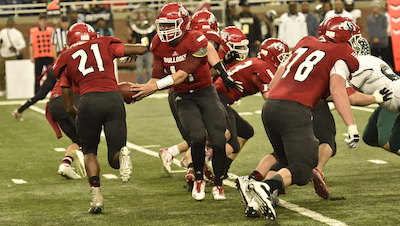
PHOTOS: (Top) Romeo’s coaches and players host their first football championship trophy Saturday at Ford Field. (Middle) Quarterback Paul Hurley hands off to Bradley Tanner (21) during the Division 1 Final.
A Game for Every Fan: Regional Finals
November 8, 2012
By Geoff Kimmerly
Second Half editor
Let's face it. In high school football especially, it's tough to predict which teams will be around when the big trophies are awarded Thanksgiving weekend. It wouldn't take much research to figure out how many top-ranked favorites have fallen long before finishing the drive for Detroit.
But here's a little indicator that's bearing out as this season's playoffs rush into their third weekend.
Of 64 teams still alive in the 11-player brackets, 53 ranked among the top half of their respective divisions in playoff point average. The four teams remaining in the 8-player bracket all ranked among the top six in that division.
That's rather logical, you might say. But it's also an endorsement for playing tough competition, and further makes it special when a team with a lower average breaks through at the end.
Those teams still alive despite bottom-16 playoff point averages? Congrats on great efforts by Detroit Catholic Central, Caledonia, St. Johns, Three Rivers, Clare, Newaygo, Constantine, Britton-Deerfield, Pewamo-Westphalia, Flint Beecher and Johannesburg-Lewiston.
This week's games are split evenly between Friday and Saturday, with 17 each day. Four Friday games will be streamed live on FoxSportsDetroit.com's Prep Zone: Montrose at Ithaca, Detrot Cass Tech at Saline, Saginaw Swan Valley at Croswell-Lexington and Three Rivers at Grand Rapids South Christian.
Below are all of the Regional Finals with a little extra on some of the best matchups, plus a look at both 8-player Semifinals. Visit the MHSAA Score Center for game times and dates, and all weekend for updated scores and schedules.
Division 1
Rockford (9-2) at Clarkston (11-0)
These two easily come to mind when Division 1 football is discussed. But oddly enough, they've never met. The Wolves are playing for their fourth Semifinal berth and second in four seasons, and were the most popular pick in Division 1 heading into the playoffs. But three-time MHSAA champion Rockford is finally humming after opening 1-2 this fall and losing quarterback Kyle Short for a time. He’s back, and the Rams are playing in their fifth-straight Regional Final.
Other Regional Finals: Detroit Catholic Central (7-4) at Plymouth (9-2), Detroit Cass Tech (9-2) at Saline (10-1), Macomb Dakota (10-1) at Lake Orion (10-1).
Division 2
Muskegon (10-1) at Midland (11-0)
The Big Reds no doubt enjoyed a sigh of relief after edging Lowell in last week’s District Final. But life gets no easier. Midland is working toward what would be the first 14-0 season in its similarly-impressive history, and is keyed by a likely all-state candidate at quarterback in Alec Johnson. Not that Muskegon will be intimidated – this will be its eighth game this fall against a playoff team.
Other Regional Finals: Caledonia (8-3) at Mattawan (10-1), Birmingham Brother Rice (9-2) at Walled Lake Western (9-2), Oak Park (9-2) at Wyandotte Roosevelt (10-1).
Division 3
Grand Rapids Christian (10-1) at Stevensville Lakeshore (11-0)
This may be the game of the weekend in Michigan. Neither has lost to an in-state team – Christian’s only defeat was to Ohio power Cincinnati Moeller – and both have crushed the majority of their opponents this fall. The Eagles scored a season-high 68 points against Zeeland West last week thanks to four touchdown passes plus four touchdown runs by quarterback Alex VandeVusse. This is Lakeshore’s fifth Regional Final over the last decade, and comes after a perfect run through the Southwest Michigan Activities Conference West – one of the state’s most competitive leagues this season.
Other Regional Finals: St. Johns (8-3) at DeWitt (9-2), Tecumseh (9-2) at Battle Creek Harper Creek (9-2), Detroit East English (9-2) at Orchard Lake St. Mary (9-2).
Division 4
Grosse Ile (10-1) at Detroit Country Day (9-2)
The Red Devils have won 10 games for the second straight season after making the Semifinals in 2011. This fall’s success has come against a schedule that has included six playoff teams. Country Day’s slate has included only three teams that made the postseason, but the Yellow Jackets beat a strong one last week in Pontiac Notre Dame and opened the playoffs by dropping previously-undefeated Clinton Township Clintondale 35-0.
Other Regional Finals: West Branch Ogemaw Heights (8-3) at Comstock Park (10-1), Three Rivers (8-3) at Grand Rapids South Christian (8-3), Saginaw Swan Valley (9-2) at Croswell-Lexington (11-0).
Division 5
River Rouge (11-0) at Ann Arbor Gabriel Richard (10-1)
As written on 2H on Monday, River Rouge is one of the best stories of the season – the Panthers are 11-0 for the first time and before last month had won a playoff game only once, in 2001. But this week’s opponent easily will be their toughest this season. Gabriel Richard hasn't given up a point in the playoffs, with a 24-0 win last week over a strong Lake Fenton team.
Other Regional Finals: Clare (9-2) at Menominee (10-1), Newaygo (9-2) at Grand Rapids West Catholic (8-3), Portland (10-1) at Flint Powers Catholic (11-0).
Division 6
Montrose (10-1) at Ithaca (11-0)
One of these weeks, an opponent is going to provide a strong challenge to Ithaca’s 39-game winning streak. Montrose might be it. The two have met in the playoffs the last two seasons, with Ithaca winning only 28-13 in last season’s District Final. Granted, it doesn't look as good for the Rams after surviving by a point in the District Semifinal and by just five against a good Millington team last week. But expect Montrose to bring its best, and Ithaca to match in front of a crowd that could approach 3,000 fans.
Other Regional Finals: Shelby (9-2) at Negaunee (10-1), Constantine (9-2) at Hillsdale (11-0), Monroe St. Mary Catholic Central (9-2) at Grass Lake (10-1).
Division 7
Britton Deerfield (8-3) at Detroit Loyola (11-0)
The Britton-Macon Tories hadn't made the MHSAA playoffs since reaching the Semifinals in 2000, before the school combined in 2010 with Deerfield – which hadn't fielded a football team since 1992. Britton-Deerfield has made the playoffs both years of its existence and has improved two wins on last season’s finish so far. Loyola had easily the highest playoff point average in Division 7 entering the playoffs and is in the Regional Final for the second year in a row. The Bulldogs also entered 11-0 last season and were shut out by Hudson, but have upped their offensive average this fall by a touchdown to more than 46 points per game.
Other Regional Finals: Lake City (10-1) at Ishpeming (10-1), Pewamo-Westphalia (8-3) at Decatur (9-2), Flint Beecher (7-4) at Saginaw Nouvel (9-2).
Division 8
St. Ignace (11-0) at Felch North Dickinson (10-0)
The Saints are playing for their second straight Semifinal berth, but it’s fair to say they’re even better this time around. After giving up a respectable 16 points per game last season, St. Ignace is giving up an average of only five and has five shutouts (not counting the forfeit win over Rudyard in Week 3). North Dickinson’s most noticeable improvement this fall has come on offense – the Nordics have upped their points per game from 38 in 2011 to 50 this fall.
Other Regional Finals: Johannesburg-Lewiston (9-2) at Beal City (11-0), Muskegon Catholic Central (8-3) at Mendon (11-0), Waterford Our Lady (9-2) at Harbor Beach (10-1).
8-Player (Semifinals)
Bellaire (8-3) at Rapid River (10-1)
It’s fair to call these teams two of the original powers in MHSAA 8-player football. Bellaire is 24-8 since making the switch in 2010, and that season finished “mythical” runner-up, that being the term because the championship game was organized by the two leagues and was not an MHSAA playoff game. Rapid River is 20-4 in two seasons as an 8-player program, and was the runner-up in last season’s inaugural championship game. The Rockets stunned the 8-player community last week by beating Cedarville 22-14 after falling to the Trojans 72-12 on Sept. 28.
Deckerville (10-1) at Portland St. Patrick (11-0)
These are both first-year 8-player programs, and it’s fair to say their moves were good ones. Deckerville’s only loss also was to Cedarville, but that was back on the final day of August. The Eagles' run opened with a 42-39 win over reigning MHSAA champ Carsonville-Port Sanilac. All but one of the Shamrocks' opponents were from the southwest part of the Lower Peninsula, but St. Patrick shouldn't be stunned by facing a little bit tougher competition after years of 11-player in the highly-competitive Central Michigan Athletic Conference.
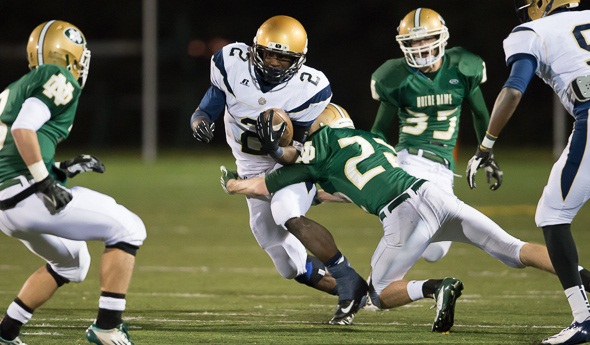
PHOTO: Detroit Country Day senior Trevor Woodland (2) tries to break a tackle by Pontiac Notre Dame senior Mark Juriga during last week’s District Final win for the Yellow Jackets. (Click to see more at Terry McNamara Photography.)