

Russell Drives West Catholic to Repeat
November 29, 2014
By Geoff Kimmerly
Second Half editor
DETROIT – Travis Russell had faced this situation plenty over the last three years – first at the end of the 2012 Division 5 Final, then while lying in bed at night before games over the last two seasons.
As a sophomore quarterback that season, attempting to lead Grand Rapids West Catholic on a go-ahead drive in the fourth quarter, Russell was the listener – to his then-senior receivers and linemen offering encouragement – as the Falcons came up 12 yards short of overtaking Portland for an MHSAA title.
On Saturday, in the last of his three championship game appearances and final of 42 high school games, Russell entered the huddle as leader – encouraging teammates who stood 64 yards and three points from the school’s second straight title.
He told them, “This is what we live for, guys. We worked so hard all season for this moment. It’s going to pay off. Give everything you have, and it’s going to be fine.”
More than six minutes and 17 plays later, Russell ran three yards through the middle of Lansing Catholic’s defense to give West Catholic a 24-20 lead it would defend over the final minute to claim the school’s third MHSAA championship in five seasons and first perfect season since 1976.
“Definitely I lived it in the past; sometimes the night before games I’d think about it,” Russell said of the failed final possession in 2012, which stalled at Portland's 12-yard line as the Falcons lost 12-9. “Today, it wasn’t on my mind at all. Really, all I thought about was what can we do for each other right now to get it done.”
Russell ran for 134 yards and two touchdowns and threw for 203 and another score as the Falcons opened with a 17-0 lead, allowed the previously-undefeated Cougars to score 20 unanswered points, and then went back ahead late with Russell either running or throwing on all 17 plays of the final drive.
Lansing Catholic (13-1) completed a pass to its 32-yard line to begin its last-ditch possession to retake the lead, but senior Brett Wildman came down with an interception on the next play to effectively end the game.
Grand Rapids West Catholic (14-0) rarely trailed this season in outscoring its opponents on average 41-14. The Falcons fell behind last week early in its Semifinal against Menominee, also its opponent in the 2013 Final (a 27-14 win), but had never trailed in the fourth quarter this fall.
But after scoring on three of its first four possessions, West Catholic didn’t again for more than 24 minutes while Lansing Catholic scored on three of its next four after Russell’s 8-yard scoring run with 1:43 to go in the first half.
Cougars junior quarterback Tony Poljan – who also ran for a 7-yard score and threw a 41-yard touchdown pass to senior Zac Baker during the comeback – gave Lansing Catholic a 20-17 lead with a 22-yard scoring pass to junior running back Tony Palmer with 7:38 to play.
“We talk all the time (about) don’t get rattled, stay focused, teams are going to make plays,” West Catholic coach Dan Rohn said. “This is state championship football; you don’t get here with a bad football team. We had to make adjustments, they made some big plays and we were a little down on ourselves. But we stayed focused and made sure when we got the ball back that we chipped away a little bit.
 “We have 24 seniors, and we need those kids to stay focused and play like leaders down the stretch. You don’t get to this level without those kind of kids and that kind of effort.”
That’s something Lansing Catholic has known as well in making the Finals twice over the last four seasons. In 2011, the Cougars were led by another sizable quarterback in Cooper Rush (now starting at Central Michigan University) but fell to Flint Powers Catholic 56-26 in that championship game. The 6-foot-7, 230-pound Poljan had never played quarterback before last season; he finished the Final with 60 yards rushing and a touchdown and 269 passing with two scores – giving him 2,806 yards and 34 touchdowns passing and 1,013 yards and 23 touchdowns rushing for the season.
“(He’s a) tremendous athlete that’s worked really hard to get where he’s at,” Lansing Catholic coach Jim Ahern said. “When we had to get some yards today, he got yards. He threw the ball well.
“I’m real proud of him. He’s worked for everything he’s got.”
Palmer was Poljan’s main target, catching eight passes, while senior lineman Ian Gorgenson paced the Cougars’ defense with 13 tackles. Senior running back Nick Buursma also ran for a score for West Catholic, and senior Charlie O’Connor had 111 receiving yards and caught the lone scoring toss from Russell. Wildman had a team-high 10 tackles and a sack in addition to his rally-stopping interception.
Lansing Catholic hadn’t scored fewer than 21 points since opening night 2013 and hadn’t given up more than 22 since West Catholic put up 38 on the Cougars in last season’s District Final. Ahern believed the teams were similar – similar offensive styles, standout quarterbacks who can run and pass. But Lansing Catholic just couldn’t stop what it knew was coming in crunch time.
“It just shows the growth and resilience of this team. We’ve been in every situation that is possible, and it’s just a credit to the guys,” Russell said. “Being able to fight, to dig deep and find something that Coach can’t really tell us to have. You can’t teach the will power guys had at practice, that was able to help us get it done today.”
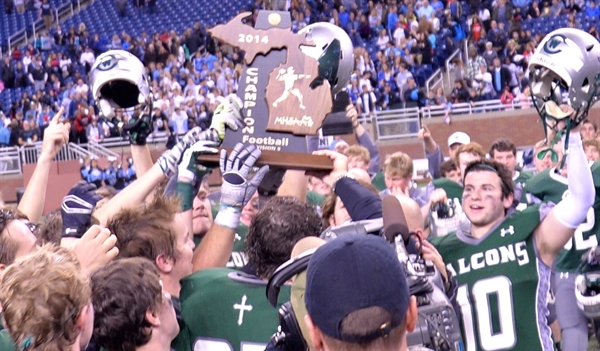
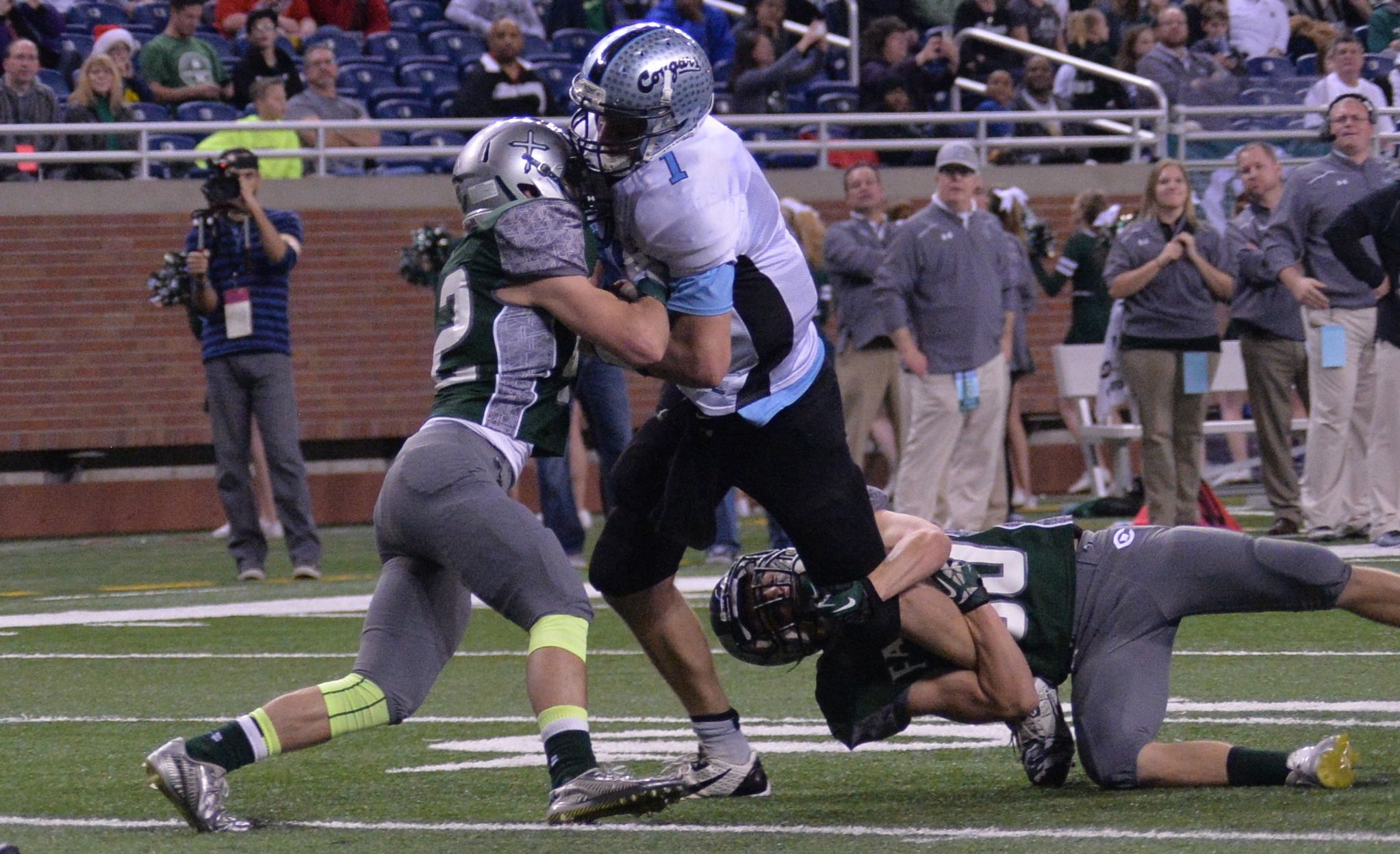
PHOTOS: (Top) Grand Rapids West Catholic celebrates its second straight MHSAA Division 5 championship Saturday at Ford Field. (Middle) West Catholic’s Brett Wildman (2) works with a teammate to bring down Lansing Catholic’s Tony Poljan. (Click for action photos and team photos from Hockey Weekly Action Photos.)
VIDEO HIGHLIGHTS:
FALCONS FIRST TD - Grand Rapids West Catholic led 10-0 after the first quarter, its touchdown coming on an 87-yard pitch and catch from Travis Russell to Charlie O'Connor.
COUGARS BACK IN THE GAME - Late in the third quarter, Lansing Catholic tightened things up with a 96-yard drive, capped by a 41-yard pass from Tony Poljan to Zac Baker.
Watch the game in its entirety and order DVDs by Clicking Here, and watch the postgame press conference by Clicking Here.

All Eyes on Ithaca's Winning Streak
November 1, 2012
By Geoff Kimmerly
Second Half editor
Terry Hessbrook has sensed this level of buzz around Ithaca's football program once before.
He was a senior running back during the 1984 "dream season" when the team finished the regular season 9-0 and made the playoffs for the first time. The Yellowjackets' postseason run lasted only a week – Ithaca fell to Grand Rapids South Christian 20-0 in the first round, which in those days of shorter playoffs was the Regional Final – but the excitement was reminiscent of the attention his program is getting heading into Friday's Division 6 District Final against Hemlock.
Except this hype extends far outside the city limits of his 2,900-resident hometown. Ithaca has won 38 straight games, the fifth-longest streak in MHSAA football history, and is only three more wins from a third straight trip to the Finals at Ford Field.
“It’s been really neat to have people take a look at what we’re doing in Ithaca,” Hessbrook said. “We’re not doing anything different. We’re not reinventing the wheel. We’re not a bunch of geniuses or anything like that. We just have a coaching staff that works really hard and supports each other, and we don’t care who gets the credit. And the players don’t care who gets the credit.”
How much the ninth-year coach is beaming comes through the phone as he talks of his players' handling of the growing expectations or how fortunate he is to be surrounded by assistants he's been close with, in at least a few cases, for decades.
And winning makes everything more fun. The Yellowjackets get a Second Half High 5 this week as they work toward becoming just the fifth school to win three straight MHSAA titles since the first playoffs were held in 1975. The winning streak is the third-longest among those that included at least one season since the postseason was added.
Ahead of Ithaca on that consecutive wins list are Hudson (72), Morenci (44), Cheboygan (43) and New Lothrop (39). But only Cheboygan accomplished its streak completely within the playoff era, with Hudson’s coming to an end in the first MHSAA Class C Final.
Making this run more special is that half the team has been together for nearly all of it.
Hessbrook brought his players into a huddle at the start of practice this August, and as he started looking at their faces, a thought crossed his mind.
“Wow, you guys have been around for a long time,” he told them.
Ithaca’s football players haven’t been around any longer than those on any other team in Michigan. But it sure feels that way. The Yellowjackets have played in 12 playoff games over the last three years, and five seniors who moved to varsity at the start of 2010 – receiver Markes Gadlen, linebackers Tyler Gibson and Jacob Barnes and linemen Bradley Martyn and Josh Capen – have played in 38 varsity games. That’s the equivalent of more than four regular seasons. And the team's other 12 seniors all came up for the playoffs in 2010, giving them more postseason experience than perhaps any group currently playing in this state.
During that 2010 run, they felt like they were along for the ride. Last season’s championship was about seniors like Garrett Miniard and David Brown showing they could win one too after following all-state quarterback Alex Niznak’s lead the year before. Now, these seniors similarly want to be the leaders of another title run.
But Hessbrook is sure to credit one more group – the 2009 team that played in the team's first MHSAA Semifinal.
“In 2009, that group of players raised the bar, and they made it possible, although they didn’t win,” Hessbrook said. “They didn’t get to the big game. But in 2009, for one quarter (in the Semifinal), we played with Montague (which went on to finish 14-0).
“The bar has been raised. I don’t know that the goal now is to (just) get into the playoffs. I think the kids are hungry enough that they don’t want to just get in. They want to get in and make noise.”
The name statewide observers are coming to know is that of junior quarterback Travis Smith. He took over in the 2011 opener and quarterbacked the team through the 42-14 championship game win over Constantine, throwing for 299 yards – fifth-best all-time for an MHSAA championship game.
His numbers this fall say plenty – 107 completions in 175 attempts for 1,696 yards and 30 touchdowns, with only four interceptions. Smith also leads the team with 610 rushing yards and 12 touchdowns on the ground. He’s 6-foot-2 and 200 pounds and already getting the college looks that came to Niznak during his senior season after he’d already committed to Central Michigan.
Total, the team is outscoring opponents on average 53-6. The defense is a little smaller but faster this fall, and is averaging exactly three turnovers per game.
Another stat helps it all make more sense. Teams submit the grade-point average for their top 11 players for academic all-state – and Ithaca’s group comes in at 3.85.
And visitors to Ithaca don’t get the feel they’re in a small town once they enter the stadium. Recent renovations included the addition of viewing platforms 15 feet above the track that put fans closer to the field than the first row of bleachers. There are new bathrooms and a larger concessions area, but the biggest blast comes from the 13 by 24-foot Jumbotron scoreboard that’s made the stadium feel more like the home of a Division II college team.
Hessbrook estimates at least 2,000 fans are showing up for home games, and similarly large crowds have followed his team on the road.
To Ithaca’s credit, the team is taking all of this in stride. It’s not that the streak isn’t a big deal – “It is what it is,” Hessbrook said – but the players just don’t talk about it too much.
“They’re really a mature group of seniors, really grounded, from great families with great parents who are very supportive of what we’re doing and just keep their kids grounded. The coaching staff does a good job keeping the kids grounded," Hessbrook said. "You’re only as good as your last game. Nobody’s going to care what you did last week or last month. And I think the players believe that.”
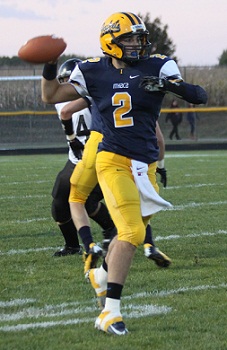
PHOTOS: (Top) Ithaca's Caden Kipp and Zach Allen (12) celebrate after a touchdown during last week's win over Grandville Calvin Christian. (Middle) Quarterback Travis Smith already is in the MHSAA record book for his performance during last season's Division 6 Final. (Click to see more from HighSchoolSportsScene.com).