

Saints Remember, Rally During Semifinal Run
November 20, 2015
By Dennis Grall
Special for Second Half
ST. IGNACE – Tradition and excellence are distinctive parts of the athletic program at LaSalle High School at this eastern tip of the Upper Peninsula.
 Located at the north end of the Mackinac Bridge, St. Ignace has won five MHSAA girls basketball championships since 1999, and the school's football team won the 1983 Class C title. The football team also is currently preparing for its third MHSAA Semifinal appearance since 2011.
When the Saints face two-time defending Division 8 champion Muskegon Catholic Central on Saturday at Thirlby Field in Traverse City, they will have an extra player in their huddle.
Mitchell Snyder, a three-year starter at center, was killed in a car accident following the school's homecoming in October when he was struck by an alleged drunk driver.
"Since his death, the team has really come together as a unit," said veteran St. Ignace News sportswriter Dave Latva.
Head coach Marty Spencer, in his 19th season at the helm, agreed. "This has been a rallying point for us," said Spencer, noting the Snyder family has become an integral part of every football game.
 "This has brought us closer; it has brought his family closer to us. We have rallied around him. He is with us. He is on our shoulders. He is in our huddle."
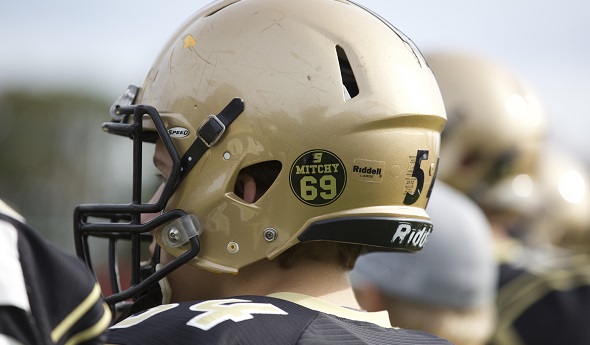
Snyder's father, Brent, wears his son's No. 69 jersey to every game, and the players reach out and touch the jersey as they leave the locker room for the field. His number also appears on the back of each player's helmet.
In the first game after the accident, against Ironwood and played in Gladstone, Brent Snyder asked the Saints what they thought Mitchell would want them to do. Snyder told them Mitchell loved to play football, and they should continue to play the game.
The Saints ran their opening two plays against Ironwood with just 10 players, in memory of their deceased teammate. "Mitchell was there blocking for us," said Spencer.
Spencer said the coaching staff and players talked extensively about the tragic accident. "It was tough that first week. We struggled," said Spencer. "We talked a lot trying to find answers, and you never can answer those questions.
"We had to do that for our well-being, for us to survive. As he helps us through each game, it gets better and better for us. Not just for us, for the whole community."
 Spencer has guided St. Ignace to an 11-1 record. Its only loss was 20-14 to unbeaten Ishpeming, which is in the Division 7 Semifinals for the fourth straight year. Last week the Saints beat perennial Division 8 power Crystal Falls Forest Park 22-8.
"Our kids are pretty resilient," said Spencer. "He (Mitchell Snyder) has been our backbone for this run. It could have destroyed us all. Mitchell's dad said there should be no more crying. Mitchell is not crying. He wants you to play football."
Because the Saints have played such powerful foes as Ishpeming and Forest Park, they will not be intimidated going up against a team the stature of Muskegon Catholic Central. "They are bigger than us, they have size and speed," said Spencer. "Our kids are confident. We have played some good teams (including also Fowler and Johannesburg-Lewiston). We are ready."
Leading the Saints is senior Gage Kreski, an all-state prospect in football and basketball and highly-sought college recruit in both sports. Kreski is the team's quarterback and was the Upper Peninsula's defensive player of the year (small school division, as voted by media) as a back. He also does the punting and returns punts.
"He does so much," said Spencer, noting Kreski had 11 interceptions as a sophomore and this year has scored off two of his three interceptions as offenses steer away from him. "He is a constant athlete who keeps working. He can play anywhere. He could be one heckuva wide receiver," said Spencer.
Kreski has rushed for 851 yards and added another 1,235 yards passing. He has solid backfield support from Mitchell Peterson, Andrew Goldthorpe and Dave LaVake, with linemen Cole Garen and Jared Helms setting the interior tempo for the two-time Ski Valley Conference champions.
 Spencer said the heavily balanced Saints have emphasized defense this year with a 52 alignment (five linemen, two linebackers). "Against the run, this is the best it has ever been," he said.
The narrow loss to Ishpeming provided a confidence boost for the Saints, who have a fully home-grown coaching staff under Spencer, a downstate native. Spencer coached nearly every assistant coach when they played and said having St. Ignace grads on the staff "helps continue the legacy that has been built."
Two of the aides are volunteers who moved back home this fall, Chase and Zach Pierson, the sons of legendary St. Ignace football standout and coach Barry Pierson.
"It is nice having people who know the tradition here, the ins and outs of what the program means to people," said Spencer.
 Denny Grall retired in 2012 after 39 years at the Escanaba Daily Press and four at the Green Bay Press-Gazette, plus 15 months for WLST radio in Escanaba; he served as the Daily Press sports editor from 1970-80 and again from 1984-2012. Grall was inducted into the Upper Peninsula Sports Hall of Fame in 2002 and serves as its executive secretary. E-mail him at [email protected] with story ideas for the Upper Peninsula.
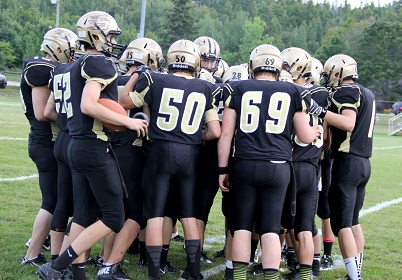
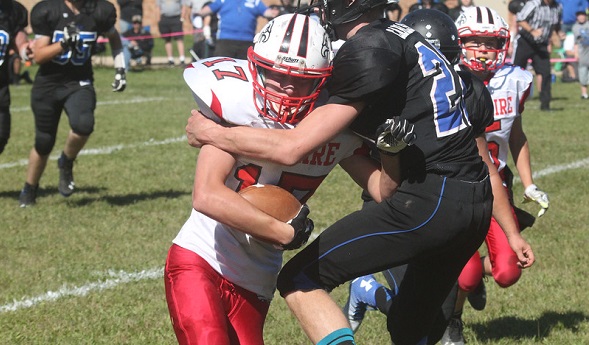
PHOTOS: (Top) St. Ignace players all wear a decal on their helmets in memory of late teammate Mitchell Snyder. (Middle) A Saints defender stacks up an Indian River Inland Lakes ball-carrier earlier this season. (Below) St. Ignace huddles during a break in play. (Photos courtesy of Kristi Gustafson.)
A Game for Every Fan: Week 7
October 9, 2014
By Geoff Kimmerly
Second Half editor
League champions will celebrate this weekend. And 88 teams have the opportunity to clinch playoff berths, joining 54 that already have qualified.
But a similar pressure rests on the 117 teams that enter this weekend 3-3 – and needing to win out to earn automatic tickets to the postseason.
It’s a group that includes Detroit Catholic Central, Lake Orion, Grand Rapids Catholic Central and Saginaw Nouvel – teams which advanced to Ford Field championship games over the last five years.
Keep that in mind when checking out the games to watch in the three weeks to come, including those listed below. As those coaches will tell you, for many the playoff begin now.
Mid-Michigan
Williamston (6-0) at Lansing Catholic (6-0)
Most would bill this as a game between a pair of talented quarterbacks – Lansing Catholic’s 6-foot-6 Tony Poljan vs. Williamston’s speedy pass/run threat Chaz Moore. But the Capital Area Activities Conference White championship could be decided tonight as well by a Cougars defense giving up only 11 points per game or a Williamston defense a smidge better on paper at 9.8 ppg.
Others that caught my eye: Grand Blanc (5-1) at Hartland (5-1), Grand Ledge (4-2) at Lansing Everett (4-2), Laingsburg (4-2) at Pewamo-Westphalia (5-1), Reed City (5-1) at Stanton Central Montcalm (4-2).
West Michigan
Whitehall (6-0) at Muskegon Oakridge (5-1)
After back-to-back losing seasons – including a 1-8 finish in 2013 – there are probably a few people surprised to be talking about Whitehall football this fall. But the Vikings can clinch their best record since 2006 and a share of the West Michigan Conference title with a win tonight. That would be an improvement on 2006, actually – Whitehall finished 9-2 that fall, but lost to Oakridge 14-6 to finish league runner-up.
Others that caught my eye: Cedar Springs (5-1) at Grand Rapids Forest Hills Northern (6-0), Hudsonville (4-2) at East Kentwood (5-1), Muskegon Catholic Central (6-0) at Muskegon Orchard View (4-2), Caledonia (4-2) at East Grand Rapids (4-2).
Greater Detroit
Walled Lake Western (5-1) at Walled Lake Central (5-1)
These two have played each other annually – and a few seasons twice – dating to 1969. But this should be the next in a latest series of high-impact matchups. Walled Lake Central can claim the Kensington Lakes Activities Association North title outright, or share with Western and potentially Waterford Mott if the Warriors win. Western was victorious in 2011, beating Central 18-11 in the league finale to win the North title after Central did the same to Western in 2010.
Others that caught my eye: Plymouth (5-1) at Canton (5-1), Wyandotte Roosevelt (5-1) at Brownstown Woodhaven (6-0), Ida (6-0) at Hudson (5-1), Grosse Pointe Woods University Liggett (5-1) at Lutheran Westland (5-1) on Saturday.
Upper Peninsula
Ishpeming (6-0) at Negaunee (4-2)
These two dominated the Mid-Peninsula Athletic Conference the last two seasons – Negaunee winning the league title in 2012 and Ishpeming last fall – but the Miners are already trailing the Hematites by a win thanks to the re-emergence this fall of Iron Mountain (the Mountaineers beat Negaunee 20-17 in Week 4). Negaunee will have to break Ishpeming’s 27-game winning streak tonight to create a possible three-team shared title.
Others that caught my eye: Munising (5-1) at Bark River-Harris (5-1), Constantine (6-0) at Marquette (5-1) on Saturday, L'Anse (4-2) at Calumet (3-3), Ishpeming Westwood (4-2) at Norway (3-3).
Southwest and Border
Three Rivers (4-2) at Plainwell (5-1)
All three remaining games for Wolverine B Conference teams are league games, and the East race is down to three teams – this pair and Sturgis, with all three opening the league schedule 2-0. Three Rivers and Plainwell didn’t play in the same division of the league the last two seasons, but kept a long-standing rivalry alive with a couple of nonleague tilts won by the Trojans by eight and seven points. Plainwell’s only loss this fall is a two-pointer to Edwardsburg – which also beat Three Rivers by two on opening night.
Others that caught my eye: Saugatuck (4-2) at Fennville (4-2), Edwardsburg (5-1) at Dowagiac (3-3), Battle Creek Harper Creek (4-2) at Coldwater (5-1), Portage Central (4-1) at Portage Northern (4-2).
Lower Up North
Petoskey (5-1) at Gaylord (4-2)
The good news is Petoskey already has Big North Conference leader Cadillac out of the way – the Northmen fell in their Week 3 game, 27-7. The bad news is Petoskey now has to wait and hope either Traverse City West this week or Traverse City Central in Week 9 beats Cadillac so Petoskey can earn a share of the league title. But Petoskey also must be careful – Gaylord lost to Cadillac and Central the last two weeks by a combined 19 points and is seeking its first playoff berth since 2005.
Others that caught my eye: Kingsley (4-2) at Suttons Bay (5-1), Cadillac (6-0) at Traverse City West (3-3), Grayling (3-3) at Elk Rapids (3-3), Indian River Inland Lakes (5-1) at Central Lake (4-2).
Bay and Thumb
Harrison (6-0) at Beaverton (4-2)
Harrison already will post its best finish since 1999 and first winning record since 2000 – and is in best position to end Clare’s seven-season run atop the Jack Pine Conference. But the Hornets must be careful to not look ahead to that Week 8 matchup; Beaverton is one of three teams tied for third place and needs just one more victory to guarantee its first winning season since 2000 as well.
Others that caught my eye: Midland (3-3) at Lapeer (6-0), Romeo (3-3) at Port Huron (5-1), Carrollton (3-3) at Saginaw Michigan Lutheran Seminary (5-1), Flint Powers Catholic (4-2) at Flint Southwestern Academy (3-3).
8-Player
Battle Creek St. Philip (6-0) at Waldron (5-1)
The Southern Central 8-Man Football League championship is on the line. St. Philip outscored Waldron by a combined 110-6 in two games last season and has scored, 55, 56, 89 and 72 points over the last four weeks, respectively. But this is a much better Waldron team than in 2013 – its lone loss is to undefeated Portland St. Patrick, and the Spartans look good to win seven games for the first time since 2007.
Others that caught my eye: Engadine (3-3) at Bellaire (6-0), Owendale-Gagetown (6-0) at Kingston (3-3).
PHOTO: Bellaire, running against Eben Junction Superior Central last week, is one of seven undefeated teams in 8-player football. Superior Central is in a tight race for the final playoff spot and must climb six to make the field of 16. (Photo courtesy of Paul Gerard.)