


Scheduling Controversy
November 14, 2017
A dozen years ago, I asked our counterpart organizations in other states if they scheduled their schools’ regular-season varsity football games. Very few did so.
More recently, I’ve realized that I didn’t ask enough questions. It turns out that few statewide high school associations tell schools who they play each week of the regular season. However, many more give schools the group of opponents they may schedule. They place schools in leagues and/or districts and/or regions and instruct schools to schedule from among those schools only or predominantly.
I have been waiting for the tipping point where a sufficient number of high schools in Michigan are sufficiently stressed over scheduling football games that they would turn to the MHSAA to solve the problem.
I’m anticipating this might occur first among schools playing 8-player football, and that success there will lead to our assistance for 11-player schools.
One approach – the simpler solution – would work like this:
-
All 8-player schools within the enrollment limit for the 8-player tournament would be placed in two divisions on the basis of enrollment in early March. About 32 schools in each, based on current participation.
-
At the same time, each division would be divided into four regions of about eight schools.
-
In April, the schools of each region would convene to schedule seven regular season games for each school.
-
Based on current numbers, schools would still have two open weeks to fill, if they wish, for games with schools in other regions or of the other division or in neighboring states.
A second option – the date-specific solution – would provide every school its weekly schedule for all nine dates, or weeks 1 through 8, or weeks 2 through 8, depending on local preferences. This would not be difficult in concept once there is agreement on what criteria would be used and what value each criterion would have.
For example, one important criterion would be similarity of enrollment; another of great value would be proximity. Perhaps league affiliation would be a factor with some value. Perhaps historic rivalries would be another factor with a value. Then the computer spits out schedules for each school for every week for two years, home and away.
I don’t campaign for this task because, frankly, it will produce complaints and controversy. But if this organization exists to serve, then this is a service that today’s chronic complaints tell us we should begin to provide soon.
I suggest we do this for 8-player football for the 2019 and 2020 seasons (with a paper trial run for 2018). If it proves successful, we could expand the service to 11-player schools as soon after as they are satisfied with our efforts for 8-player schools.
Drive for Detroit: Week 7 Preview
October 6, 2016
By Geoff Kimmerly
Second Half editor
Tonight could end with at least a few Michigan communities celebrating the best night in their local high school's football history.
 Breckenridge is seeking its first league title since its players' grandparents were newborns. Engadine, Corunna and many more could have momentous evenings as well as league titles stand to be decided all over the state.
All nine highlighted games of this week's Drive for Detroit preview powered by MI Student Aid could decide league races, whether tonight or in the near future. Check out the MHSAA Score Center for a schedule of this weekend's games and to see scores as they're reported. All games listed below are today unless noted.
Bay & Thumb
Corunna (6-0) at Lake Fenton (6-0)
This Genesee Area Conference Red finale matches the league’s co-leaders. Corunna’s transformation the last two seasons truly deserves note; the Cavaliers didn’t have a winning season from 2006-12 and then fell back to 2-7 in 2014 after a 6-4 finish the year before. But they’re in position to repeat as Red champs after sharing the title last season with Goodrich. Lake Fenton has been much more of a regular contender but still will be playing for its first league title since sharing the Red with Montrose in 2007.
Others that caught my eye: Alma (5-1) at Carrollton (4-2), Saginaw Swan Valley (4-2) at Freeland (6-0), Davison (6-0) at Lapeer (5-1), Saginaw Heritage (3-3) at Flint Carman-Ainsworth (4-2).
Greater Detroit
Rochester Adams (5-1) at Birmingham Groves (6-0)
It’s a little complicated, but the Oakland Activities Association White winner also can be partially determined tonight. Thanks to a one-point loss to Oak Park in Week 4, Adams trails Groves just slightly in the standings with the opportunity to secure a share of the league title with a win tonight in what will be its final league game of the fall. Groves also can clinch a share tonight with a win but still has one more league game to play next week and must win that as well to clinch the title outright – unless Oak Park, already with a league defeat to Groves, also loses one of its final two OAA White games. An Adams win tonight could lead to a three-way title share.
Others that caught my eye: Romeo (4-2) at Warren Mott (6-0), Detroit Western International (4-2) at Detroit Mumford (5-1), Detroit Catholic Central (6-0) at Orchard Lake St. Mary’s (4-2), Detroit East English (4-2) at Detroit Martin Luther King (5-1) on Saturday.
Mid-Michigan
Merrill (5-1) at Breckenridge (6-0)
Already celebrating its first playoff berth since 1993 – and after going 0-9 (!) last season – Breckenridge can secure a share of its first league title tonight in 70 years, according to a Midland Daily News report. But Merrill – which like Breckenridge joined the Mid-State Activities Conference this season after leaving the Tri-Valley Conference West – can set up a possibility to share the championship as it enters with only an MSAC loss to Mount Pleasant Sacred Heart. Merrill downed Breckenridge 48-6 a year ago after the Huskies took their 2014 meeting.
Others that caught my eye: Fowler (4-2) at Dansville (4-2), Lansing Sexton (4-2) at East Lansing (4-2), Stockbridge (3-3) at Olivet (4-2), DeWitt (5-1) at St. Johns (3-3).
Northern Lower Peninsula
Clare (5-1) at Roscommon (6-0)
These two are tied for first in the Jack Pine Conference with three games to play – meaning that a loss tonight won’t entirely derail either’s hopes. But the winner should be set up well to at least share the title, although Roscommon still must play Harrison (4-2) and Claire finishes with playoff hopefuls Beaverton (4-2) and Houghton Lake (3-3). The Pioneers are used to this scenario – before falling twice last season, they had won 34 straight Jack Pine games and have dominated the league most of the last two decades. Roscommon, meanwhile, has its most wins already since 2006, when it finished 10-2 and won the conference.
Others that caught my eye: Gaylord St. Mary (5-1) at Johannesburg-Lewiston (3-3), Muskegon Catholic Central (6-0) at Manistee (4-2), Charlevoix (5-1) at Onekama (5-1), Saginaw Nouvel (4-2) at Tawas (4-1).
Southeast & Border
Ida (6-0) at Hudson (5-1)
Ida has won all but one of its Lenawee County Athletic Association games over the last two seasons by at least 24 points. The team to come closer, Hillsdale (falling 20-17), is next week’s opponent – but Ida won’t look past rejuvenated Hudson. The Tigers have bounced back from finishing 4-5 last year and still have LCAA title hopes despite falling to Hillsdale 14-6 last week. Hillsdale already has a league loss as well, so an Ida win tonight puts the Bluestreaks in strong position to at least share the championship after winning it outright in 2015.
Others that caught my eye: Petersburg-Summerfield (4-2) at Clinton (4-2), Quincy (5-1) at Concord (5-1), Milan (6-0) at Monroe St. Mary Catholic Central (3-3), Morenci (4-2) at Ottawa Lake Whiteford (6-0).
Southwest Corridor
Battle Creek Harper Creek (6-0) at Coldwater (4-2)
Harper Creek is having an all-around great fall; the volleyball team is ranked No. 6 in Class B, the boys cross country team was tied for No. 9 in Lower Peninsula Division 2 entering this week, and the football team has doubled its wins from a season ago with an opportunity tonight to clinch a share of the Interstate 8 Athletic Conference championship against last year’s champion. Coldwater has won two straight over the Beavers and won’t go quietly, but Harper Creek has yet to allow a team to get closer than 10 points.
Others that caught my eye: St. Joseph Lake Michigan Catholic (5-1) at Bridgman (4-2), Schoolcraft (6-0) at Gobles (5-1), Portage Central (5-1) at Portage Northern (4-2), Delton Kellogg (4-2) at Watervliet (4-2).
Upper Peninsula
Ishpeming (3-2) at Negaunee (6-0)
A couple of pretty strong Negaunee teams have had their Mid-Peninsula Athletic Conference hopes dashed by MHSAA title-contending Ishpeming teams over the last few years. The Hematites have beaten the Miners in three straight, and the 2013 and 2015 victories decided league titles. But Negaunee enters as the favorite this time with wins over five teams still up for playoff berths, and Ishpeming has a little additional pressure; it must win two of its last three games against Negaunee, St. Ignace and Gwinn to guarantee adding to a 14-season playoff streak.
Others that caught my eye: Kingsford (4-2) at Iron Mountain (5-1), Escanaba (5-1) at Gladstone (3-3), Lake Linden-Hubbell (6-0) at Houghton (3-3), Hancock (4-2) at Gwinn (4-2).
West Michigan
Zeeland East (5-1) at Hudsonville Unity Christian (6-0)
Four teams in the Ottawa-Kent Conference Green are at least 5-1 and a fifth is 4-2, making this arguably the strongest league in the state top to bottom this fall. Two of this week’s matchups are highlighted in this space this week, and Unity Christian enters tied with Byron Center for first place but with Hamilton and Zeeland East holding only one league loss. East is a newcomer after playing previously in the O-K Black, but could have the greatest influence on the final finish with Unity on the schedule this week, Byron Center next week and rival Zeeland West in Week 9
Others that caught my eye: Whitehall (4-2) at Ravenna (4-2), Big Rapids (3-3) at Reed City (6-0), Grand Rapids South Christian (3-3) at Wyoming (4-2), Hamilton (5-1) at Zeeland West (4-2).
8-Player
Cedarville (6-0) at Engadine (6-0)
Engadine is in the midst of a string of successful seasons it hasn’t enjoyed since the mid-1980s, but winning tonight could make this fall the best of the bunch. The Eagles can clinch a share of the Bridge-Alliance League title after returning this fall after a year playing in the Western Eight Conference. Cedarville, of course, is a regular favorite and has only four league losses in five seasons of 8-player football. The Trojans’ closest games this fall have been a pair of 20-point wins, and Engadine hasn’t let anyone get closer than 10.
Others that caught my eye: Wyoming Tri-unity Christian (6-0) at Lawrence (6-0), Webberville (5-1) at Portland St. Patrick (6-0), Rapid River (5-1) at Stephenson (5-1).
Second Half’s weekly “Drive for Detroit” previews are powered by MI Student Aid, a part of the Student Financial Services Bureau located within the Michigan Department of Treasury. MI Student Aid encourages students to pursue postsecondary education by providing access to student financial resources and information, including various student financial assistance programs to help make college more affordable for Michigan students. MI Student Aid administers the state’s 529 savings programs (MET/MESP) and eight additional aid programs within its Student Scholarships and Grants division. Click for more information and connect with MI Student Aid on Facebook and Twitter @mistudentaid.
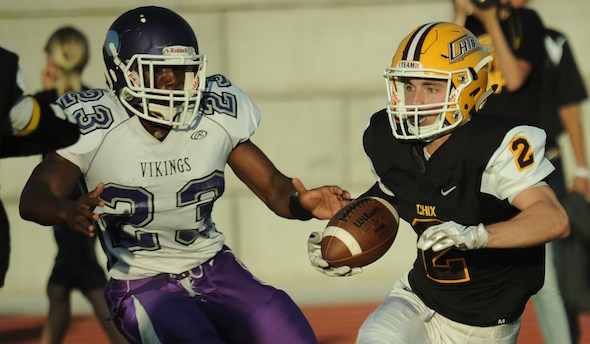
PHOTO: Saginaw Swan Valley (left) and Zeeland East faced off earlier this season; both will attempt to beat league leaders this weekend. (Click to see more from HighSchoolSportsScene.com.)