


Scheduling Controversy
November 14, 2017
A dozen years ago, I asked our counterpart organizations in other states if they scheduled their schools’ regular-season varsity football games. Very few did so.
More recently, I’ve realized that I didn’t ask enough questions. It turns out that few statewide high school associations tell schools who they play each week of the regular season. However, many more give schools the group of opponents they may schedule. They place schools in leagues and/or districts and/or regions and instruct schools to schedule from among those schools only or predominantly.
I have been waiting for the tipping point where a sufficient number of high schools in Michigan are sufficiently stressed over scheduling football games that they would turn to the MHSAA to solve the problem.
I’m anticipating this might occur first among schools playing 8-player football, and that success there will lead to our assistance for 11-player schools.
One approach – the simpler solution – would work like this:
-
All 8-player schools within the enrollment limit for the 8-player tournament would be placed in two divisions on the basis of enrollment in early March. About 32 schools in each, based on current participation.
-
At the same time, each division would be divided into four regions of about eight schools.
-
In April, the schools of each region would convene to schedule seven regular season games for each school.
-
Based on current numbers, schools would still have two open weeks to fill, if they wish, for games with schools in other regions or of the other division or in neighboring states.
A second option – the date-specific solution – would provide every school its weekly schedule for all nine dates, or weeks 1 through 8, or weeks 2 through 8, depending on local preferences. This would not be difficult in concept once there is agreement on what criteria would be used and what value each criterion would have.
For example, one important criterion would be similarity of enrollment; another of great value would be proximity. Perhaps league affiliation would be a factor with some value. Perhaps historic rivalries would be another factor with a value. Then the computer spits out schedules for each school for every week for two years, home and away.
I don’t campaign for this task because, frankly, it will produce complaints and controversy. But if this organization exists to serve, then this is a service that today’s chronic complaints tell us we should begin to provide soon.
I suggest we do this for 8-player football for the 2019 and 2020 seasons (with a paper trial run for 2018). If it proves successful, we could expand the service to 11-player schools as soon after as they are satisfied with our efforts for 8-player schools.
Drive for Detroit: Week 4 in Review
September 24, 2013
By Geoff Kimmerly
Second Half editor
Just when we thought we'd figured out a few things about how this MHSAA football season might unfold ... we found out we don't know that much yet.
Upsets ruled Week 4. Of course, the teams that won probably don't see their victories that way. And in two months, some of what we consider surprises now might not be considered stunners any longer.
But check out how the unexpected played a major role as we began the second third of this fall's slate.
West Michigan
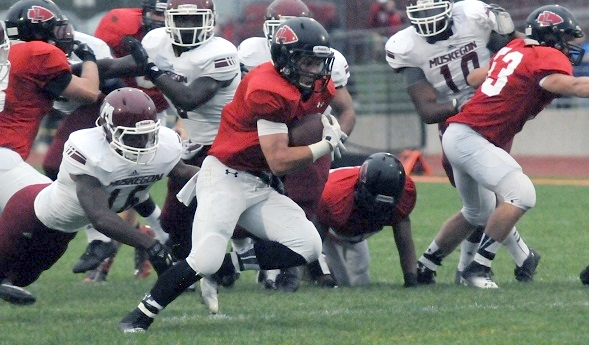
Lowell 31, Muskegon 20
Many were so caught up in Muskegon’s 45-0 win over Rockford two weeks ago that they likely didn’t give Lowell (4-0) a shot at catching the Big Reds (3-1). But Kyler Shurlow is fast becoming the next Red Arrows quarterback star, and he came up big in his team’s biggest game of the regular season. Click to read more from the Grand Rapids Press.
Also noted:
Comstock Park 27, Allendale 25: The Falcons (3-1) have pushed Comstock Park to the brink the last two seasons, but the Panthers (4-0) survived again after a five-point win in their 2012 matchup.
Muskegon Reeths-Puffer 14, East Kentwood 7: Reeths-Puffer (3-1) hasn’t made the playoffs since 2007, but is ascending after avenging last season’s 35-points loss to East Kentwood (2-2) to also equal its number of wins for the entire season.
Zeeland East 27, Grand Rapids Forest Hills Central 25: The undefeated Chix (4-0) had to survive a second straight game against Forest Hills Central (2-2) decided by four points or fewer.
Reed City 22, Newaygo 14: Make that 24 straight regular-season wins for the Coyotes (4-0), who by beating solid Newaygo (3-1) look even better to push it to 29.
Upper Peninsula
Escanaba 35, Marquette 14
This one was not just significant but probably shocking to fans who pay close attention to Upper Peninsula’s biggest schools. Escanaba entered 0-3 and Marquette 3-0, but the Eskymos made it three straight over the Redmen. Click to read more from the Escanaba Daily Press.
Also noted:
L'Anse 21, Hancock 20: The Purple Hornets (3-1) have one of the highest playoff point averages of any team expected to make the Division 8 playoffs, but Hancock (1-3) must win out to gain an automatic bid.
Negaunee 36, Iron Mountain 8: The Miners are 4-0 for the second straight season, but the Mountaineers (1-3) face their toughest start since 1990.
Norway 36, Manistique 34: Norway (2-2) is a win from equaling last season’s total after beating a 2012 playoff qualifier in Manistique (0-4).
Lake Linden-Hubbell 22, Bessemer 20: The Lakes (2-2) earned a shot at staying in the Great Western Conference title hunt, while dealing a blow to repeat hopes of Bessemer (3-1).
Mid-Michigan
Holt 31, Lansing Everett 21
Just when it looked like Holt (2-2) wouldn’t factor in the Capital Area Activities Conference Blue race this season, the Rams beat the reigning champion and presumed favorite by scoring more points in one game than Everett (3-1) had given up in its other three games combined. Click to read more from the Lansing State Journal.
Also noted:
Fowler 42, Bath 22: The Eagles (3-1) have outscored three opponents by a combined 106-50 since falling 40-0 to Mendon on opening night; Fowler also has beaten the Bees (2-2) in 24 straight.
Pinckney 20, Howell 10: Seeking their first winning record and playoff berth since 2001, the Pirates (3-1) are halfway there and off to their best start since that season; Howell remains in good shape at 3-1 as well.
Eaton Rapids 17, Jackson Northwest 7: The Greyhounds (3-1) have tied their most wins for a season since 1997, although Northwest (2-2) can’t be too frustrated with its most victories for a season since 2009.
Springport 18, Reading 13: The Spartans (3-1) lent Big 8 Conference leaders Jonesville and Homer a hand by downing last season’s champ, Reading (2-2).
Lower Up North
Standish-Sterling 27, Whittemore-Prescott 20
Standish-Sterling (4-0) continued its best start since 2008 with a late stand as Whittemore-Prescott (3-1) also played to remain perfect on the season. The Cardinals had won both games since the series was restarted after previously coming to close after the 1985 season. Click to read more from the Bay City Times.
Also noted:
Kinglsey 31, Frankfort 20: The Stags (3-1) set up next week’s rematch with reigning Northwest Conference champion Maple City Glen Lake by edging Frankfort (2-2) for the third time in four seasons.
Cheboygan 42, Ludington 14: The Chiefs moved to 3-1 for the second straight season by dealing a first loss this fall to Ludington (3-1), which remains off to its best start since 2004.
Mancelona 22, Central Lake 18: These teams combined to go 17-5 in 2012, and Mancelona (2-2) got back on the right foot by also pushing Central Lake to 2-2 and claiming the M-88 Trophy.
Traverse City St. Francis 34, Grayling 14: The Gladiators (3-1) ended Grayling’s 12-game regular-season winning streak and made it 10 of 11 over the Vikings (3-1).
Southwest and Border
Parchment 44, Constantine 26
Parchment has had only one playoff season over the last decade and not a lot of wins to be this excited about. The Panthers (2-2) hadn’t beaten Constantine (2-2) since the latter joined the Kalamazoo Valley Association in 2008, but Clay Wilkey averaged more than 20 yards per carry in leading Parchment to the big upset. Read more from the Kalamazoo Gazette.
Also noted:
Portage Central 38, Stevensville Lakeshore 28: This makes Portage Central (4-0) one the favorites in the Southwestern Michigan Activities Conference West, while leaving Lakeshore (2-2) to battle back from its worst start since 2004.
St. Joseph 17, Portage Northern 10: St. Joseph (4-0) is that other favorite in the SMAC West, thanks to a defense that is giving up 12 points per game and held the Huskies (3-1) to a season low.
Niles Brandywine 26, Bridgman 18: The Bobcats (4-0) made the playoffs last season for the first time since 2002 and haven’t slowed down, although Bridgman (2-2) gave them their toughest game to date.
Plainwell 44, Otsego 17: The Trojans (4-0) just keep rolling despite playing three 2012 playoff teams over their first four games; Otsego has little room for error at 2-2 and with tough opponents waiting in Weeks 8 and 9.
Greater Detroit and Southeast
Southfield 20, Oak Park 12
The Bluejays have arrived among the elite in the Detroit area. That seemed a pretty good bet after a four-point loss to Detroit Cass Tech during Week 1, but Southfield (3-1) took another big step by handing Oak Park (3-1) its first loss and shutting down a Knights offense averaging nearly 32 points per game entering the weekend. Click to read more from the Detroit Free Press.
Also noted:
Rochester Hills Stoney Creek 36, Lake Orion 7: Last season was the only other time during its 12-year history that Stoney Creek (4-0) had played powerful Lake Orion (3-1), and this one looked a lot different than that 35-point loss.
Birmingham Brother Rice 26, Warren DeLaSalle 24: Of a number of key Catholic League games, this one is the most telling; Brother Rice (4-0) might be the favorite again, but DeLaSalle (2-2) should push the other contenders as well.
Pontiac Notre Dame Prep 28, Flint Powers Catholic 2: Few statewide are surging early like the Fighting Irish (4-0), who have outscored opponents by a combined 172-10. Powers (2-2) hadn’t scored fewer than 14 points before this game.
Saline 35, Ann Arbor Pioneer 3: Saline tied for the Southeastern Conference Red title last season and missed winning outright by a one-point loss to Pioneer (2-2); this time, the Hornets (4-0) might not be slowed.
Bay and Thumb
Midland 51, Saginaw Arthur Hill 21
Much has been discussed, and rightly so, about Arthur Hill’s resurgence this season. But it appears the Saginaw Valley Association North still belongs to Midland (4-0), which showed it in a big way. The reigning league champ put up its season high points total against a Lumberjacks team that had started 3-0 and not given up more than 18 points in a game. Click to read more from the Saginaw News.
Also noted:
Mount Pleasant 35, Midland Dow 28: The Oilers’ two-win season of 2012 is fast becoming a distant memory, with this win over Dow (3-1) putting Mount Pleasant (3-1) in a tie for first in the SVA North.
Elkton-Pigeon-Bay Port 27, Unionville-Sebewaing 0: Hard to believe the Lakers (4-0) haven’t made the playoffs since 2009, but they’ve now won as many games as in all of 2012. Beating USA (3-1) also sets Laker up for a Greater Thumb Conference West showdown with Reese that could decide the title.
Peck 61, Lawrence 38: These are two of the top 8-player teams in the state, with Peck (4-0) now owning the highest playoff point average and Lawrence (2-1) looking like a playoff lock as well in its first season after making the move.
Richmond 42, Almont 35 (2 OT): Make Richmond (3-1) the favorite now in the Blue Water Area Conference after beating both Almont (3-1) and Croswell-Lexington.
Trophy Games
Each week the MHSAA highlights trophy games around the state. Here are a few in addition to the one mentioned above:
Little Brown Jug: Union City vs. Athens. These two play for a trophy that originated in 1947. Final: Union City 33, Athens 14.
Little Brown Jug: Homer vs. Concord. Like their Big Eight Conference colleagues mentioned just above, these two play for a similar prize. Final: Homer 44, Concord 6.
The Axe: Munising vs. Newberry. This newer traveling award originated in 2004. Final: Munising 28, Newberry 27.
Rocket-Rebel Trophy: Wyoming Kelloggsville vs. Wyoming Lee. These crosstown rivals both also play in the O-K Silver. Final: Kelloggsville 47, Lee 6.
Battle for Butch: Beaverton vs. Gladwin. These Jack Pine Conference rivals play for a stuffed dog stitched together in 1937. Final: Gladwin 48, Beaverton 14.
Holton-Hesperia Trophy: Holton vs. Hesperia. These two have been foes in various leagues going back half a century. Final: Hesperia 40, Holton 19.
PHOTO: Lowell ran past Muskegon 31-20 in a face-off of two of the most highly-regarded teams in the state. (Click to see more from High School Sports Scene.)